
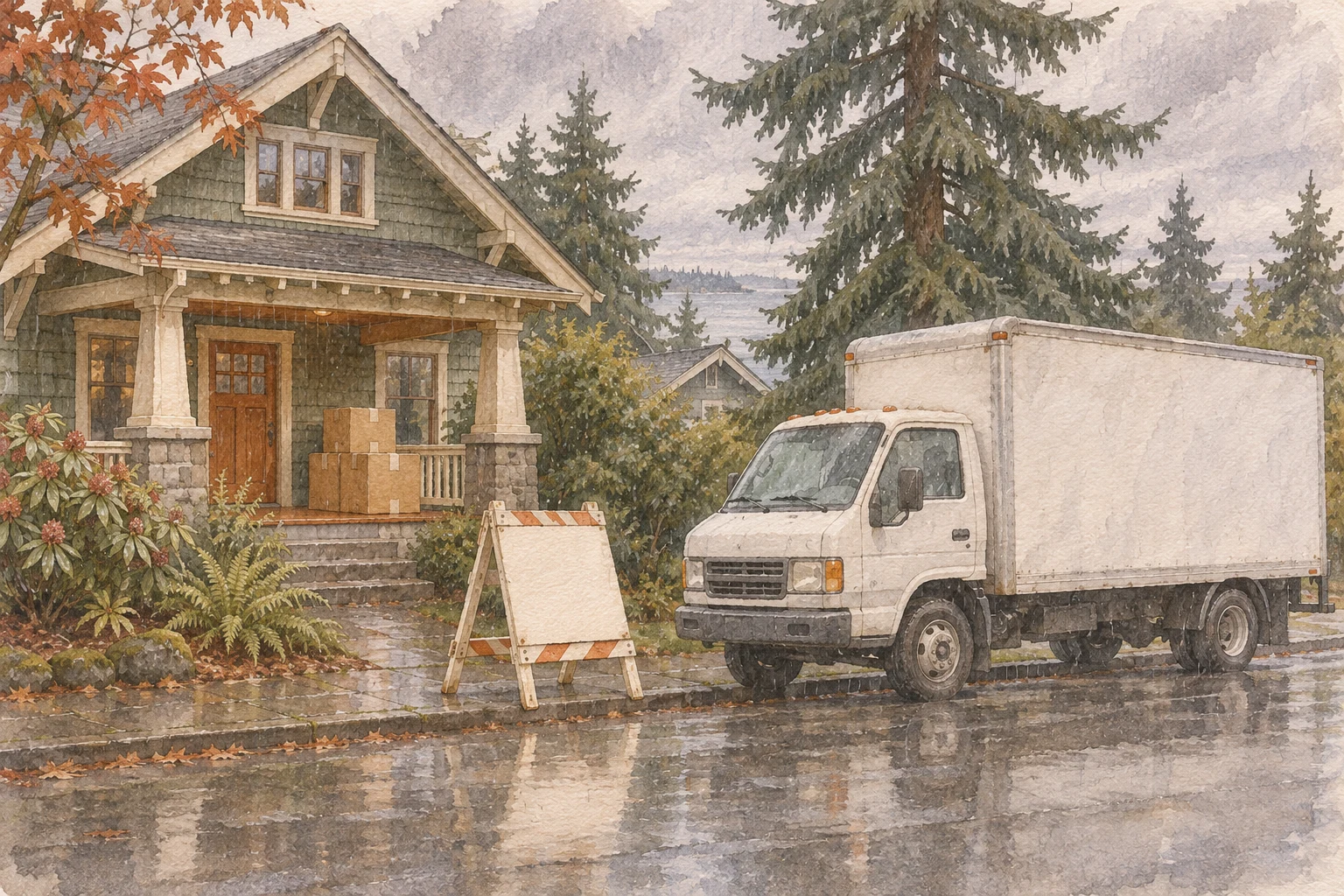
A moving truck does not need a Street Use permit in Seattle, according to SDOT’s moving-truck guidance and CAM 2118. Reserving its curb space is a separate task: establish a Temporary No Parking Zone and obtain a Restricted Area Parking (RAP) permit for the eligible truck occupying it. On an unpaid street, arrange easels, complete their dates and times, apply, then attach the issued public notices. Aim to have the complete signs and notices posted 72 hours ahead; an application alone does not make the zone enforceable.
Which step fits your street
| Your situation | What to do | City guidance |
|---|---|---|
| Ordinary legal parking space | The moving truck itself does not need a Street Use permit. Follow the space’s existing restrictions. | Storage-container and moving-truck guidance |
| Restricted parking area | SDOT says a Temporary No Parking Zone and/or Hooded Meter Truck Permit may be needed. Ask the Traffic Permit Counter which arrangement applies. | CAM 2118 |
| Reserve unpaid curb space | Arrange private-company easels, complete the signs, apply for the non-paid zone and post its issued notices. Obtain a RAP for the truck. | Zone instructions; non-paid application |
| Reserve paid curb space | Use the paid-area application with curbspace identifiers. SDOT generally arranges standard paid-area signs; the custom-hours Barricade option requires a private company. | Paid-area application |
| Friend’s passenger car or a rental van | Passenger and non-truck vehicles are not eligible for RAPs. Trucks and service vans must have truck or commercial plates; confirm the actual rental vehicle’s plates. | RAP eligibility |
SDOT expressly lists moving vans as a purpose of these zones. Its conditions of use still require you to observe posted peak-hour restrictions regardless of reservation type. A reservation does not let the truck remain through a posted rush-hour no-parking period. When using paid parking spaces, notify adjacent properties and retail establishments.
Make the unpaid-area signs enforceable
- Arrange the easels early. Contact a barricade company and allow time for installation, application review and printing. Its charge and lead time are separate from City fees.
- Complete each sign. Write legible start and end dates and times in the easel’s from/to fields, using a non-permanent marker or grease pencil. Check the responsible-party contact name and telephone number. CAM 2114 (2017) requires these details; the preprinted City Towing number is not the responsible-party contact.
- Apply after the easels are in place. Follow the non-paid-area instructions, including the correct sign/public-notice installation date and time and onsite contact information. You can include the truck’s RAP request during this application.
- Print the issued notice and attach it. Have printer access ready. The printing guide directs you to the issued License record’s Attachments tab and Permit.pdf. The notice is available upon permit issuance, and can be accessed again later; submission may require review rather than immediate issuance. Attach printed public notices to at least two signs per block, protected from weather without obscuring the sign face.
The zone page recommends placing the easels including the printed public notices 72 hours ahead. It describes a 24-hour notice minimum for enforcement, which does not replace the completed-sign requirements. Blank dates or missing notices can leave the zone unenforceable. A completed application is not a guarantee of approval or towing.
The City’s clocks on one card
| Clock | What it covers | Source |
|---|---|---|
| 72 hours: recommended posting | Have complete easels and printed public notices posted; allow enough time beforehand for the application and printing. | Zone instructions |
| 24 hours: enforcement notice | The zone page describes this minimum notice for enforcement. Dates/times and required public notices still matter. | Zone instructions |
| 24 hours: applications | Apply at least 24 hours before the space is needed, including extensions. This is not a promised processing time. | RAP conditions |
| 30 days: non-paid application | The non-paid help limits the requested end date to no more than 30 days from the start and calls for a new application per 30-day period. Do not assume this is a universal paid-area limit. | Non-paid application |
| Weekends and holidays | The conditions say no sign installations or removals occur on these days. Confirm the arrangement for your sign type and installer. | TNP conditions |
Paid reservations have their own application and extension instructions. The weekday restriction is written as a general condition, not an express exemption for private easels on unpaid streets. Ask the Counter how it applies to your arrangement.
A Saturday and a Tuesday, counted
For an illustrative 8 am start, the countbacks are below. Start earlier to allow for approval, printing and installation, and check the actual calendar for holidays.
| Zone starts | Posting target, 72 hours earlier | Application countback, 24 hours earlier | Planning check |
|---|---|---|---|
| Saturday, 8 am | Wednesday, 8 am | Friday, 8 am | These are weekdays, but check holidays and arrange the complete posting before the target. |
| Tuesday, 8 am | Saturday, 8 am | Monday, 8 am | For a City-installed arrangement with no weekend installation, aim for Friday or earlier and confirm with the Counter. |
The Friday target is a planning inference from the posting recommendation and weekend condition, not a City-published Friday deadline or an installation guarantee. Confirm private-company arrangements too; a paid or unpaid location alone does not settle the weekend rule.
Paid spaces: who installs the signs
CAM 2114 says SDOT generally restricts parking in paid areas, and the current zone page charges for sign installation and removal there. Those descriptions fit together. The current paid-area help identifies the exception: choose Barricade for customized hours, arrange a local barricade company because SDOT does not install that sign type, and expect paid-area reservation fees to remain applicable. Follow the notice instructions for the selected sign type.
What the City charges
The published City fee schedule lists these amounts:
| Fee | Published amount |
|---|---|
| RAP | $16.00 per truck permit for up to two days; $8.00 for the third and each additional day per permit. |
| Paid-space sign installation/removal | $18.50 labor charge for metered-space signs. |
| Yellow: per metered space per day | $22.00 Downtown; $17.00 outside Downtown. No parking 7 AM–6 PM, Monday–Saturday. |
| Red: per metered space per day | $27.00 Downtown; $20.00 outside Downtown. A 24-hour tow-away zone. |
| Barricade company | A separate company fee; the zone page supplies no fixed amount. |
For one eligible truck, a one-day RAP is $16.00; a three-day RAP is $16.00 + $8.00 = $24.00. These are truck-permit amounts before barricade-company costs and any applicable paid-space charges.
What cannot be reserved, and who to contact
Do not reserve existing restricted zones such as Carshare, Carpool, Van Pool, Food Vending, Truck Only, Passenger Load or other Load/Unload Only zones through the ordinary process. For special cases, ask the Counter about relocating the affected zone; additional fees and adjacent-property or business sign-off may be required.
- Traffic Permit Counter: trafficpermitsinfo@seattle.gov or (206) 684-5086.
- In person: Seattle Municipal Tower, 700 5th Avenue, 4th-floor service kiosk, Monday–Friday, 10:30 AM–3:00 PM, except holidays, according to the current zone page.
- Posted easel questions: check the company name and number at the bottom of the sign; SDOT says a sign without that identification is invalid.
- A vehicle already towed: City Towing, (206) 684-5444.
After the truck leaves
If a clean follows the move, plan for the truck and heavy belongings to be out first, and confirm lifting and access arrangements with your cleaning provider. Our Seattle move-out cleaning guide and summer move-in and move-out guide cover the calendar side. For wet entryways, see the Seattle rainy-season routine; for bottles left behind, see the Seattle drop-off plan for leftover cleaning products.
Where Hometress fits
Hometress is a cleaning marketplace that connects independent cleaning professionals with customers. Hometress takes online bookings only in Philadelphia today. This article does not promise a Seattle visit; you can join the Seattle waitlist. For Hometress bookings, the Terms of Service say cleaners cannot move items weighing more than 30 pounds.
Common questions
Does a moving truck need a permit in Seattle?
The truck does not need a Street Use permit just for being a moving truck. A truck occupying a reserved Temporary No Parking Zone needs a RAP, and SDOT names additional arrangements for restricted parking areas. Existing parking and peak-hour restrictions still apply.
Can a friend’s car use the reserved space?
No personal-vehicle parking: passenger and non-truck vehicles are not eligible for a RAP. Confirm truck/commercial plates for a rental van rather than assuming the rental label is enough.
How far ahead should I start?
Work back from a complete 72-hour posting target and the 24-hour application minimum, allowing extra time for review, issuance, printing and installation. Confirm weekend and holiday arrangements. Those minimums do not promise a turnaround time.
What if my block has pay stations?
Use the paid-area application, check the sign type and installer, notify adjacent properties and businesses, and observe posted peak-hour restrictions. Custom-hour Barricade signs require a private company and still incur paid-area reservation fees. Confirm scheduling with the Counter.
Sources checked and article updated November 11, 2026. This guide uses SDOT’s current pages and portal help alongside the dated CAMs. Confirm your specific curb, sign type and schedule with SDOT before relying on a reservation.