
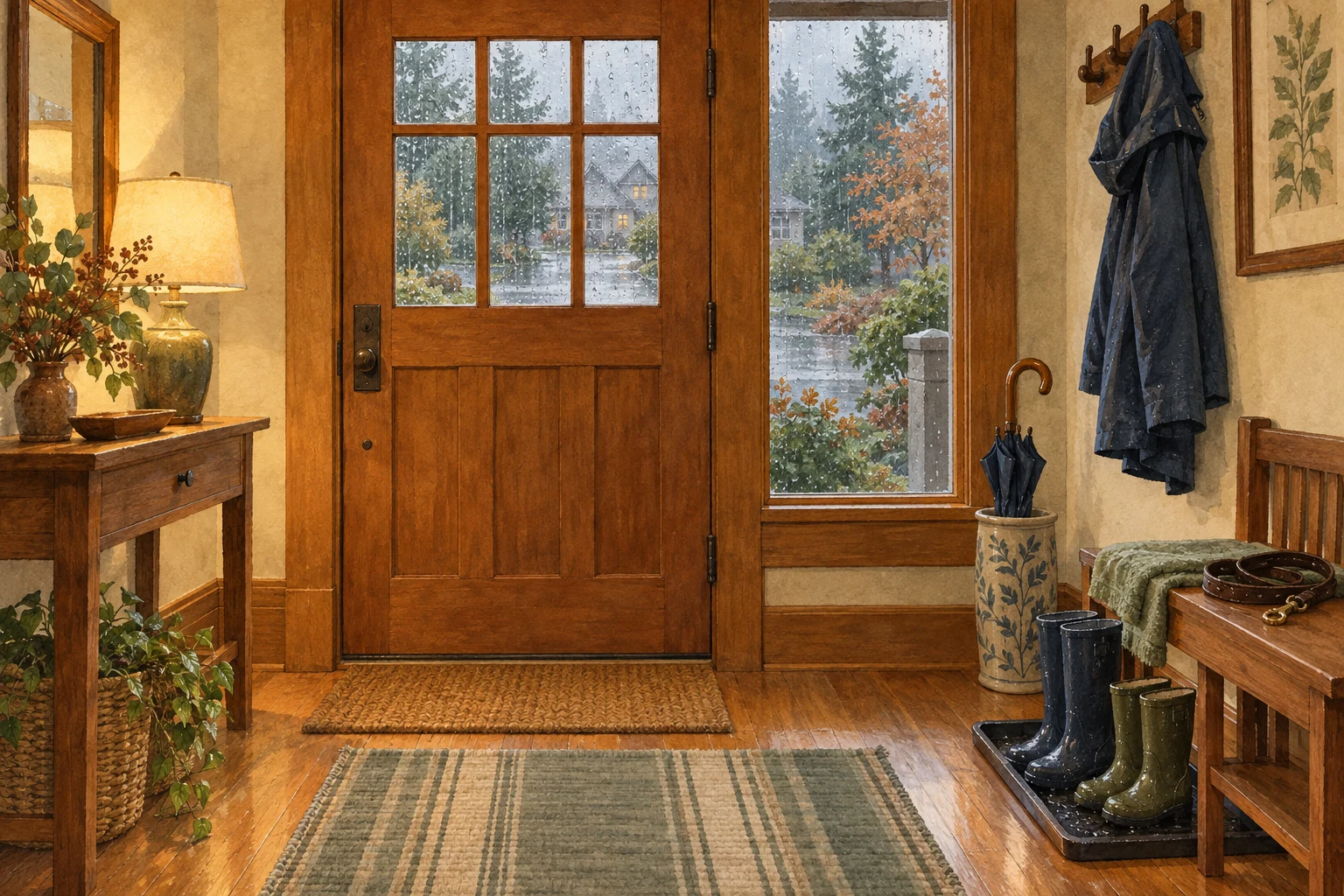
Seattle’s wet season is less a run of storms than months of damp days. NOAA’s 1991–2020 climate normals for the Seattle-Tacoma International Airport station count about 118 days with measurable precipitation from October through April, and only about 20 of them bring half an inch or more. The mess that follows is small and constant: grit on the floor by the door, a wet dog, a fogged window every morning, a bathroom that never quite dries. So the routine that works is mostly small daily habits, backed by a short weekly, monthly and once-a-season list.
One thing up front: Hometress does not take online bookings in Seattle yet. Seattle has a waitlist, so nothing here is a Hometress Seattle price or a promise of service. This is home care you can do yourself. If your house is an older one, with radiators, original woodwork or a damp basement, our guide to cleaning Seattle’s older homes covers those details, and this guide does not repeat them.
What the wet months look like
These are the Sea-Tac station’s numbers from the National Centers for Environmental Information’s 1991–2020 U.S. Climate Normals, which we read on October 29, 2026. A day with measurable precipitation is NOAA’s count of days with 0.01 inch or more.
| Month | Days with measurable precipitation | Days with 0.50 inch or more | Normal daily low |
|---|---|---|---|
| October | 14.3 | 2.6 | 47.0°F |
| November | 18.4 | 3.9 | 40.9°F |
| December | 18.4 | 3.6 | 37.1°F |
| January | 18.7 | 3.9 | 37.7°F |
| February | 15.9 | 2.4 | 37.7°F |
| March | 17.1 | 2.1 | 39.9°F |
| April | 15.0 | 1.5 | 43.3°F |
| July, for contrast | 4.7 | 0.3 | 56.8°F |
Three things in that table shape the routine. The reading is ours, not NOAA’s. First, from November through January about three days in five are wet, so the entry is never finished for the season. Second, most wet days are modest: only about 20 of the 118 reach half an inch, and about 43 bring less than a tenth of an inch. Those light days are the ones nobody calls rainy, but shoes, coats and the dog still come in damp. Third, normal lows sit near 37°F from December through February, so window glass runs cold overnight, and that is where the moisture inside a home shows up first.
The light changes as much as the weather. The U.S. Naval Observatory’s sun and moon data for downtown Seattle put sunrise at 7:55 a.m. and sunset at 4:20 p.m. on December 21, 2026: 8 hours and 25 minutes of daylight, against 15 hours and 59 minutes on June 21. When the clocks change on November 1, sunset moves from 5:53 p.m. the evening before to 4:51 p.m. For most households that means weekday cleaning happens under lamps, and dust and streaks wait for a clear weekend morning to show themselves.
The entry: where the season comes in
Set up the door once, early in the season, so the mess stops there:
- Two mats. A coarse one outside scrapes grit off soles, and an absorbent one inside takes the water. The National Wood Flooring Association (NWFA) puts it plainly: “Use throw rugs at doorways to help prevent debris from being tracked in and scratching the floor.”
- A boot tray big enough for everyone’s shoes, so wet soles stand on rubber, not on wood.
- Hooks over the tray or over tile, so coats drip where it does not matter.
- An umbrella stand, or a habit of opening wet umbrellas in the tub to dry before closing them.
Wet gear goes into a closet only once it is dry. Washington’s Department of Health (DOH) notes that mold can grow along walls “where warm moist air condenses on cooler wall surfaces, such as inside cold exterior walls, behind dressers, headboards, and in closets where articles are stored against walls.” A damp coat pressed against the back of a closet on an outside wall is exactly that.
For hardwood, the order matters more than the product: dry first, then damp. The NWFA page above says it “recommends sweeping or using a soft microfiber (or similar) dust mop on wood floors on a daily basis, and then using a vacuum on the bare floor setting once a week or as necessary,” and “Every month, use a cleaning product made specifically for the finish on the floor.” It also warns: “Steer clear of using wet mops or steam mops, which will damage the finish and the wood over long periods of time.” An August 2025 NWFA homeowner article explains the gray film that shows up by the door every winter. Skip the dry step and the grit gets trapped under the mop, and “Mixing water with dirt creates mud, making floors look dull and streaky.” Its rule for the damp pass is short: “Never leave your wood floors wet.”
Windows and the bathroom: a drying habit
In these months condensation is a daily chore, and it takes about a minute. DOH’s advice is direct: “Check around your windows for signs of condensation and water droplets. Wipe them up right away so mold can't start to grow.” The habit that makes it stick: keep a microfiber cloth on the sill of the worst window, wipe the glass and the sill when you open the blinds in the morning, and hang the cloth to dry.
The bathroom works the same way: get the water out of the room before it settles.
- Run the fan from the moment the water goes on until the mirror clears. DOH: “Install and use exhaust fans in bathrooms, kitchens, and laundry rooms.”
- Leave the door open afterward, and spread towels out rather than doubling them over one hook.
- Squeegee or wipe the shower glass and the tile ledges where water sits.
- Count the kitchen too. The EPA’s guide to mold and moisture says “Use exhaust fans or open windows whenever cooking, running the dishwasher or dishwashing, etc.”
If you want a number to watch, the same EPA guide says to keep indoor humidity “below 60 percent (ideally between 30 and 50 percent)” and that it “can be measured with a moisture or humidity meter, a small, inexpensive ($10-$50) instrument available at many hardware stores.” A meter in the bedroom tells you whether the morning wipe is keeping up. A spot that keeps coming back on the same sill or ceiling corner after a few weeks of this is a moisture question rather than a cleaning one, and worth looking into.
The dog walk
A dog in a Seattle winter brings in more water than any umbrella. What helps is a station by the door and the same order after every walk:
- Two towels in rotation, one by the door and one in the wash. Wipe paws first, then legs and belly, before the dog crosses the runner.
- Hang the leash and harness on a hook to dry, not in a pile on the bench.
- Know the shake zone. If your dog shakes as soon as it is inside, the lower door, the nearby walls and the baseboards collect a fine spray of muddy water. Wipe that strip every week.
- Let wet fur dry before you vacuum it. Damp hair clumps and smears; dry hair lifts.
- Wash the dog bed cover more often than you do in summer, since a damp dog sleeps on it.
Short days: clean for the light you have
Lamplight is forgiving, and low sun is not. When the winter sun does come out, it comes in at a low angle and rakes across glass, shelves and floors, showing every streak and dust line the lamps hid all week. Two habits use that:
- A daylight pass on the weekend. Pick a clear morning, walk the main rooms with a dry microfiber cloth, and catch what the light shows: shelf edges, screens, glass tabletops and the inside of the windows.
- Wash glass out of direct sun, on a gray day or on the side of the house the sun is not on. Glass cleaner that dries before you wipe it off leaves streaks.
Dust before you vacuum in the same pass, so whatever falls ends up on the floor you are about to clean.
The routine
Every day, about five minutes
- Dust-mop or sweep the entry and the path from the door.
- Wipe condensation from window glass and sills in the morning.
- Run the bathroom fan through the shower and until the mirror clears.
- Towel the dog at the door, and hang wet coats over the tray.
Every week
- Vacuum the floors on the bare-floor setting, entry first.
- Shake out or vacuum both entry mats, and empty and rinse the boot tray.
- Wash the dog towels and the bath mat.
- Wipe the shake zone: the lower door, the nearby walls and the baseboards.
- Wipe the shower glass, the tile ledges and the area around the sink.
- Do the weekend daylight pass.
Every month
- Clean hardwood with a product made for its finish, on a damp mop, not a wet one.
- Wash the inside runner and the dog bed cover.
- Clean the window tracks and sills where condensation collects, and dust the blinds.
- Vacuum the bathroom fan grille so it keeps pulling air.
- Look behind furniture on outside walls and at the back of closets on outside walls.
Once a season
October, set-up. Put out both mats, the boot tray and the hooks. Move large furniture off the outside walls; DOH says “Move large objects a few inches away from the inside of exterior walls to increase air circulation.” Hold a square of tissue to the bathroom fan grille while it runs, and if it does not pull the tissue in, the fan is worth a closer look. Clean the window tracks before condensation season starts, and dust the heat registers or baseboard heaters before the heat runs for the season. If you are reading this in late October, do the set-up this weekend.
January, mid-season. Give the entry floor and its baseboards a full clean. Launder curtains that hang against windows that sweat. Replace a mat that has stopped soaking up water, and check the closets on outside walls again.
April into May, close-out. The normals drop from 15.0 wet days in April to 11.3 in May, so this is when the entry can stand down. Wash the windows, then wash and fully dry the winter mats, boots and the dog bed before you store anything. If you would rather hand the end-of-season reset to someone, our guide to deep cleaning versus regular cleaning in Seattle covers what each one includes.
Questions
When does Seattle’s rainy season start and end?
NOAA’s normals for Sea-Tac show the count of wet days climbing from 8.3 in September to 14.3 in October, staying at 15 or more from November through April, and falling to 11.3 in May. Set the entry up in early October and pack it away in May.
How do I get the gray film off the hardwood by the door?
Dry first, then damp. Dust-mop or vacuum to lift the grit, then use a cleaner made for your floor’s finish on a mop that is damp, not wet. NWFA says not to use vinyl or tile products on wood, and that “Polishes, waxes, and restorers can cause wood to become slippery and appear dull quickly,” so a film that survives the dry-then-damp pass may be product rather than dirt.
Do I need a dehumidifier?
Start with the meter. The EPA guide lists “Use air conditioners and/or de-humidifiers when needed.” If the morning wipe and the fans keep the reading inside EPA’s range, you may not need one. We do not recommend any product.
How often should a cleaner come in the wet months?
That is its own question. Our guide to how often to schedule cleaning in Seattle homes walks through weekly, every other week and monthly visits, including why some households add visits in the wettest months.
Where Hometress fits
Hometress takes online bookings only in Philadelphia today. If you live in Seattle, the Seattle page has a waitlist: leave your email and ZIP code, and we will email you when online booking opens there. In a small apartment, the nightly ten-minute reset in our Seattle apartment cleaning checklist pairs well with the daily list above. Join the Seattle waitlist.