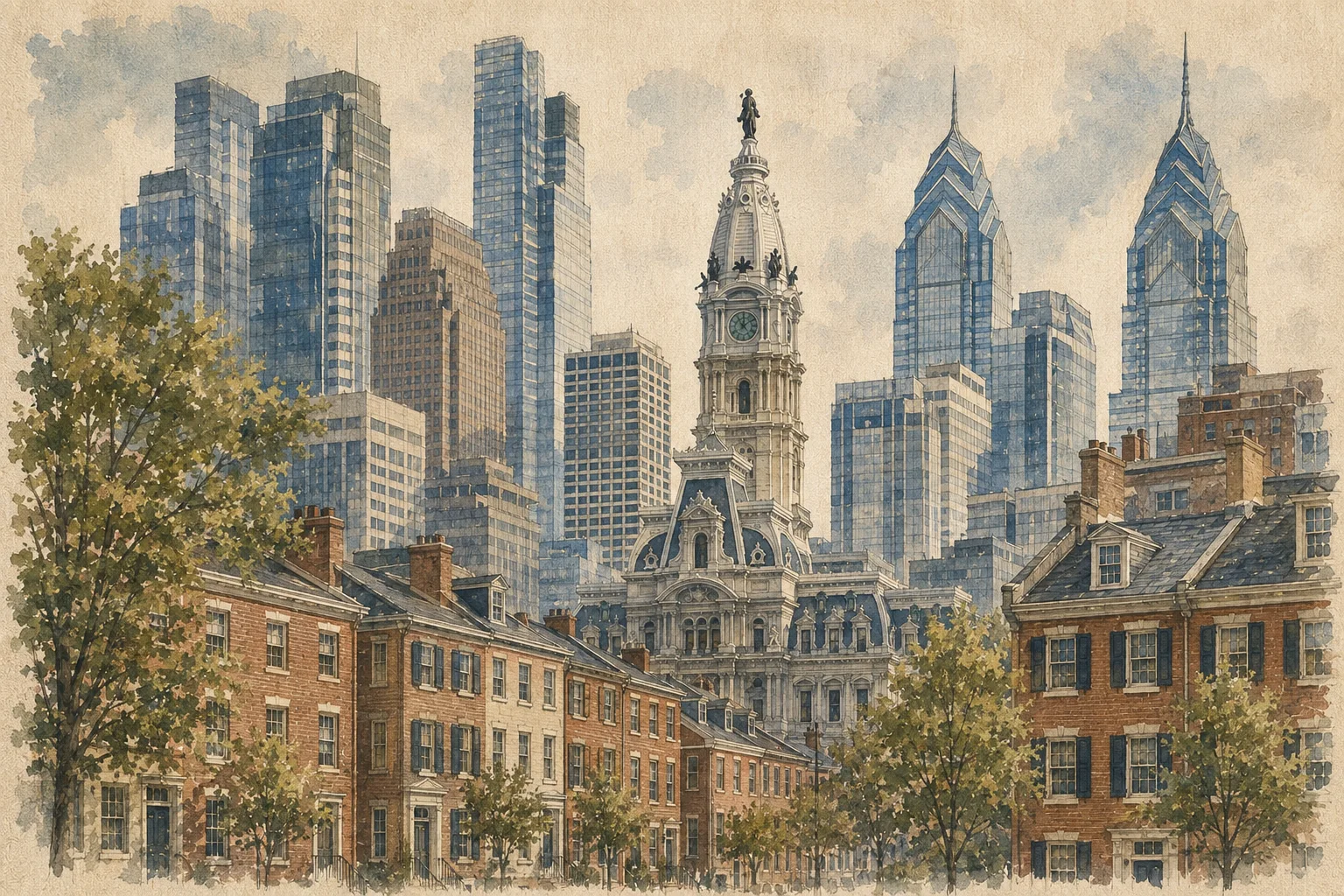
A little orientation
Ask clearer questions about safety in Philadelphia
Read the data's limits
Check dates, categories, and location precision before comparing incident counts.
Avoid a personal risk score
Reported incidents do not turn a neighborhood, hour, or route into a guarantee of safety.
Match the contact to the issue
Use the relevant official channel for the specific concern; Philly311 is for non-emergency City services.
A closer look
What are you trying to understand?
Choose a data question, a journey, or a service concern without reducing a neighborhood to a label.
Check what the numbers describe
Open the City's incident-data page and read its notes before comparing places or periods. Record the dates, incident categories, and geographic area you are using, and keep the data's preliminary status and location limits visible rather than turning counts into a personal risk forecast.
A useful questionAre these figures describing the same period, category, and area?
Source & next step ↗Make the journey easier to manage
Use SEPTA's planner for your actual starting point, destination, and intended travel time. Save the boarding location and a return option, then check current service information; this is practical journey planning, not a claim that a named route or hour is safer.
A useful questionWhat alternative would help if my travel plan changes?
Source & next step ↗Find the appropriate non-emergency path
Read Philly311's guidance for a non-emergency City service issue, such as a condition you want the responsible department to address. Prepare the precise location and an observable description, then keep the request details so follow-up does not depend on an anecdote about response times.
A useful questionWhat location and observable condition should I include in the request?
Source & next step ↗This guide is a field manual written in plain English for people who live here, or are about to. The rule you’ll hear repeated most is simple: no neighborhood in Philadelphia is 100 percent safe. Every block has its own pulse, and that pulse changes by the hour. Safety here depends less on ZIP codes and more on timing and corners.
Think of the city in block-and-clock terms. “Block” means the exact side of the street you stand on, where the lighting, cameras, and eyes on the street are different from the opposite curb. “Clock” means the hour you choose to be there, because a route that feels fine at 3 p.m. can feel empty and tense at 11 p.m. When locals talk about safety, they describe when something happens as much as where. A few hours’ difference can separate a calm walk from a police report.
When we say hyper-local, we mean what residents actually see and do: which bodega stays open late enough to be a safe stop, which SEPTA exit keeps you under a streetlight, and which day of the week the crowd turns rough near a bar. These are the small adjustments people make automatically after living here for a while.
Neighborhood Deep Profiles
Each of the following eleven neighborhoods is described not as a single “safe” or “unsafe” zone but as a pattern that changes over time and by corner. Local slang appears as it’s used: “trap block” for a drug-heavy stretch, “The El” for the elevated subway, “the bubble” for a campus-protected zone. Every profile closes with a short “If you’re new here → do this instead” call-out, practical, no-nonsense advice.
Kensington. A raw part of North Philly once known for tight family blocks, now infamous for open-air drug trade. Long-timers remember when small stores kept the corners busy; today, most errands are daylight-only. The area around Allegheny & K Street is what locals call a trap block. Nights after nine bring heavy avoidance. If you’re new here → stick to daylight, avoid those intersections entirely, and rideshare home after dark.
Fishtown. Gentrified energy layered over old industrial bones. Residents range from long-term families to new-build renters. Used to be quiet except for bar nights; now weekend noise runs until three a.m. Frankford & Girard is the local heartbeat, safe by day, chaotic after bars close. If you’re new here → cross to the lit side of Girard at night or schedule departures before last call.
Old City. Once the historic tourist corridor, now a nightlife strip that swings from safe daylight tours to 2 a.m. chaos. Locals avoid narrow alleys near 2nd & Market after midnight. Used to be the quiet side of Center City; now it mirrors Fishtown’s weekend volatility. If you’re new here → walk main drags only, and rideshare between venues after ten.
Rittenhouse. Polished, busy, and social by day; quieter and more cautious at night. Residents skew professional; students and nightlife crowd fill the edges. The blocks west of 18th & Walnut were “automatic safe zones” a decade ago; now locals watch lighting and bar spillovers. If you’re new here → use the storefront-lit side after dark and avoid looping the park perimeter late.
University City. The “bubble” around Penn and Drexel. Security cameras, blue-light poles, and the Penn Guardian app make night walks manageable within patrol sightlines. Past 40th Street the density drops and locals switch to rideshare. If you’re new here → stay inside the lighted grid at night and use the escort feature when leaving campus after ten.
Chestnut Hill. Green, residential, and slow-paced. Historically safe and still feels like a small town. Locals note lower siren counts and consistent lighting. If you’re new here → skip park shortcuts after dark and favor Germantown Ave’s storefront side for late errands.
Fitler Square. Quiet pocket wedged between the river and Center City. Daytime dog-walkers and joggers set the tone. Trails near the Schuylkill were once considered fine at dusk but now locals avoid them after ten. If you’re new here → choose the 24th Street route instead of river paths at night.
South Philly (Bella Vista, Queen Village). Tight-knit rowhouse grid with active block chats and watch groups. Two decades ago certain corners were rough; now community surveillance keeps it steady. If you’re new here → learn your block chat, keep porch lights on, and avoid walking behind bars after midnight.
Art Museum District. Tourist volume provides daylight security; after hours, park edges thin out fast. Residents have learned to treat the Parkway like a line, inside is calm, outside turns empty. If you’re new here → rideshare across the park gap and re-enter on a lit arterial like Spring Garden.
Northwest Philly. Leafy, slower, with stable long-term homeowners. Safety tied to lighting, not demographics. Locals still avoid forested connectors and the train stops bordering parkland late at night. If you’re new here → use main streets like Germantown Ave and call rideshare for last-mile stretches after ten.
Northeast Philly. Once marketed as suburban-quiet, now seeing upticks in car theft and break-ins. Families still fill the blocks, but timing matters: errands by day, vigilance by night. If you’re new here → avoid long waits at quiet bus stops and secure packages promptly; doorbell cameras are the neighborhood norm.
Temporal Playbook: By Hour, By Day
Mornings (6 a.m.-10 a.m.)
Calmest stretch citywide. Delivery trucks, commuters, and daylight create natural coverage. Most locals walk freely, headphones off but relaxed.
Mid-day (10 a.m.-4 p.m.)
Errand window. Crime risk low across nearly all neighborhoods; even places like Kensington or North Philly see active foot traffic then. Tuesday afternoons are locally called “dead safe”, stores open, streets calm, little nightlife overlap.
Evening (4 p.m.-9 p.m.)
Transition zone. Lighting quality now matters as much as geography. Locals shift to main drags, keep an eye on shadows, and check block chats for incidents. Transit use still normal; platforms feel populated.
Night (9 p.m.–midnight)
Among 3,682 shooting-victim records with a recorded incident time in the City dataset for 2023–2025, 913 occurred from 9 p.m. up to midnight. The three highest hourly counts were at 10 p.m., 9 p.m., and 11 p.m.
Late Night / Early Morning (midnight–3 a.m.)
The same dataset records 587 incidents from midnight up to 3 a.m. These figures describe recorded shooting victims by incident time. They do not measure a person’s overall risk, account for how many people were outside, or establish which neighborhood or travel choice is safer.
Source: City of Philadelphia shooting-victims open data, 2023–2025; 3,682 records with a recorded time. Retrieved September 7, 2026.
Weekends vs Weekdays
Friday-Saturday nights drive most nightlife-related incidents; Tuesday remains the lowest-stress day. Sundays are mixed, quieter streets but also fewer people outside if trouble starts. Locals align chores and grocery runs with weekday daylight, reserving weekends for social plans wrapped before midnight.
Seasonal pattern
Summer brings more street activity and extended risk window; winter darkness pushes the caution clock earlier, around 7 p.m.
The clock, as the guide draws it
Safety here depends less on ZIP codes and more on timing and corners.
Crime-Type Landscape
When locals talk about safety, they don’t just mean “crime” in general. They break it down by type, time, and fixability. The lived reality is that danger wears different faces depending on where you stand and what hour it is.
Gun Violence Zones
The highest concentration of shootings sits in Kensington and broad stretches of North Philly, where residents describe “bullets flying” as background noise rather than headlines. In those areas, the risk isn’t constant chaos. It’s unpredictability. Calm afternoons flip in seconds, and most locals cope by adjusting when they’re outside, not just where. The rule: keep errands in daylight, stay clear of “trap blocks” (corners openly dealing drugs), and trust your ears. If a street goes unnaturally quiet, that’s your cue to leave. For most residents outside the hot zones, gun violence is a distant-but-felt fear, the reason they install doorbell cameras or avoid long waits at bus stops after dark.
Theft Zones
Citywide, package theft and car break-ins are the background noise everyone lives with. They cluster less by neighborhood and more by lighting and visibility. Residents combat theft through a citywide “tech stack”: Ring or Arlo cameras, automatic car locks synced to phones, and neighbors who text each other the moment a suspicious person is caught on video. It’s not rare to see group threads where a blurry hoodie photo travels block to block in under a minute. Theft here is viewed as a nuisance tax, annoying but manageable with vigilance and gadgets.
Random Assault Zones
The phrase locals use is “sketched out,” and it describes the sense that violence feels random. Assaults flare in mixed-use corridors where nightlife and residential streets overlap, Fishtown, Old City, and near bar edges of Rittenhouse. They’re rarely targeted crimes; they’re chaotic collisions of alcohol, strangers, and thin police coverage. Mitigation here is social: walk with friends, stay on main drags, time your exit before closing hours. In these zones, a crowd can flip from safety to risk depending on mood and music.
How Residents Mitigate Each Type
Gun violence pushes people toward time discipline, daylight-only errands and fast retreats indoors after nine.
Theft spawns hardware defenses, doorbell cameras, floodlights, and automated car locks.
Random assaults breed social strategies, buddy systems, shared routes, and WhatsApp pings before late-night departures.
No one relies on police alone; locals build their own layered defense of light, tech, and timing.
Community and Response Infrastructure
Philadelphia’s safety net isn’t institutional. It’s crowdsourced. The backbone is a web of block-chat networks that run on group texts, WhatsApp, or private Facebook groups. In South Philly’s Bella Vista and Queen Village, these chats operate like hyper-local 911s: one post about a suspicious car triggers ten porch lights and three cameras. In Fitler Square or Chestnut Hill, they function as quieter early-warning systems for package thefts or unfamiliar faces.
The hardware layer is equally visible. Ring and Arlo cameras now hang over nearly every porch, and doorbell chimes are a nightly soundtrack. In some blocks, residents even coordinate camera angles to cover entire intersections, creating de facto surveillance grids. People don’t wait for official police patrols; they film their own evidence.
Police perception splits sharply. Older residents and homeowners often argue that visible patrols deter violence; younger and minority locals describe over-policing and racial profiling. The shared frustration is inconsistency, stories of calling during a break-in and no one showing up sit next to praise for specific officers who go the extra mile. The consensus: rely on PPD when you can, but have your own system ready.
Volunteer patrols still exist quietly, especially in South Philly. In Bella Vista, neighborhood-watch captains coordinate after-dark loops; in Queen Village, parents walk school routes together to increase visibility. These aren’t vigilante squads. They’re informal eyes keeping order through presence.
As for 911 and PPD responsiveness, anecdotes swing from “cops here in five minutes” to “no one came at all.” Many residents don’t gamble; they document incidents on video, post to block chats, and only then follow up officially. The trusted chain of safety is neighbor first, camera second, police last.
Language of Safety: How Locals Talk About Risk
You can’t understand Philly safety without understanding Philly talk. The slang tells you what people really feel when they step outside.
“Trap blocks.” A blunt label for corners where open-air drug trade happens. Nobody says “high-crime area”; they say, “that’s a trap block.” The term doubles as navigation advice. Locals drop it mid-conversation to warn you off a route without needing to sound alarmist.
“Jawn.” The universal noun. It can mean a person, a place, a route, even an uneasy vibe: “That jawn gets weird after dark.” In safety talk, it fills gaps where formal language fails, because risk is felt more than measured.
“Bul***it.” The local shorthand for systems that don’t work, delayed police responses, broken lighting, stolen packages. It’s frustration with infrastructure more than crime itself.
“Tight-knit.” Used with pride, it means the block has each other’s backs. It’s both social glue and self-defense: “We’re tight-knit, so nothing goes down without someone seeing it.”
“Survivor mentality.” Said half-jokingly, half-seriously on Reddit threads describing the city’s daily caution. It’s not self-pity; it’s a badge. To “survive Philly” means you’ve learned the rhythms, memorized the safe corners, and accepted vigilance as normal life.
Taken together, this slang builds a psychology of adaptation. People aren’t naive or paranoid. They’re practical. They expect rough edges, they share intel, and they talk about danger like weather: inevitable, unpredictable, and something you learn to read.
The language doesn’t just describe safety; it creates it, teaching newcomers how to sense the city’s moods long before a siren ever sounds.
How Safety Shifted by Decade
| Era | Citywide Pattern | South Philly Trajectory | Northeast Trend | Gentrification Corridors (Northern Liberties / Fishtown / Point Breeze) | Street-Level Takeaway |
|---|---|---|---|---|---|
| 2000 – 2010 | Post-industrial slump; high gun violence concentrated in North and South Philly. Nightlife minimal outside Center City. | Rough reputation, auto theft & corner fights common. Locals recall “lock-your-door-twice” nights. | Stable working-class zone with suburban calm; few cameras or patrols. | Mostly vacant lots; artists and warehouses starting to appear but no police presence after dark. | “Stay on main avenues and be home by 9 p.m.” was standard. |
| 2010 – 2020 | Crime overall down, but pockets remained unpredictable. Gentrification began pushing boundaries north and south. | Rapid cleanup: block watches, younger homeowners, more lighting. Violence dropped but theft rose. | Early signs of property crime uptick as policing resources shifted elsewhere. | Northern Liberties & Fishtown saw influx of bars, boutiques, and cameras. Point Breeze early redevelopment sparked friction. | Daylight walks normalized; nightlife began spilling outside Center City. |
| 2020 – 2025 | Gun violence spikes unevenly; economic strain + pandemic years reshuffled risk. City now judged block-by-block. | Now viewed as “tight-knit” success story, neighbors coordinate by text, porch cameras ubiquitous. | Reports of rising car break-ins and gun incidents; perceived slide from “quiet” to “watchful.” | Mature gentrified zones: safer lighting and patrols but nightlife disorder and displacement tensions. | Modern rule: watch the clock not the ZIP code; timing trumps address. |
Transit After Dark Matrix
| Neighborhood | Safer Hours | Higher-Risk Hours | Best Transfer Node / Route | When Locals Switch to Rideshare |
|---|---|---|---|---|
| Kensington | 6 a – 8 p (daylight only) | After 9 p (high gun & drug activity) | Avoid local stations; ride through or transfer at Girard Ave. | Any trip requiring a stop here after 9 p. |
| Fishtown | 6 a – 9 p (main avenues busy) | 9 p – 3 a (bar fights, crowds) | Girard Station or Frankford Ave corridor | After last call (≈2 a m) or if streets empty. |
| Old City | 7 a – 10 p | 10 p – 3 a (nightlife surge) | 2nd & Market El stop (well-lit) | After midnight or post-event transfers. |
| Rittenhouse | 7 a – 9 p | 9 p – 2 a (bar edges thin) | Walnut/Chestnut corridors (busier routes) | When returning via quiet residential blocks after 10 p. |
| University City | 6 a – 10 p | 10 p – 2 a | Within Penn/Drexel patrol grid (30th–40th St) | When leaving the security bubble after 10 p. |
| Chestnut Hill | 6 a – 9 p | After 9 p (low foot traffic) | Regional Rail station or Germantown Ave bus corridor | If arrival requires long dark walk from stop. |
| Fitler Square | 7 a – 10 p | 10 p – 2 a (park edges) | Bus routes along 24th–25th St | Any route that uses river trail after dark. |
| South Philly (Bella Vista / Queen Village) | 7 a – 10 p | 10 p – 3 a (bar closings) | Broad St Line (main artery) | After midnight or if last leg is quiet residential stretch. |
| Art Museum District | 7 a – 9 p | 9 p – 2 a (park perimeter) | Spring Garden transfer points | Any cross-park segment after dark. |
| Northwest Philly | 6 a – 9 p | After 9 p (isolated stops) | Germantown Ave corridor | If transfer requires waiting alone at forested stop. |
| Northeast Philly | 6 a – 8 p | After 8 p (sparse lighting) | Bustleton Ave bus route | When bus intervals exceed 15 min after dark. |
Unwritten Rules & Street Etiquette
Philadelphia safety isn’t just about police or cameras. It’s about reading the street like a language. Locals follow habits so ingrained they rarely mention them aloud.
Which side of the street.
Walk on the storefront-lit side at night, the one with windows, open signs, or porch lights. Avoid the tree-shadowed or stoop-recessed edge where visibility drops. When in doubt, choose the side facing traffic so you see approaching cars.
Eye contact and distance.
A nod is fine; a stare is provocation. In most neighborhoods, acknowledging people without lingering eye contact signals awareness, not challenge. Keep a few feet of buffer when passing groups; locals naturally drift to the curb side to maintain space.
Using bodegas as safe havens.
Corner stores double as mini-refuges. If you feel uneasy or notice you’re being followed, step inside, buy a drink, and let the clerk know you’re waiting for a ride. Owners are used to it and often watch the door for regulars. In some North and South Philly blocks, that friendly bodega light is the unofficial “safe zone.”
Sound discipline.
No headphones or phone scrolling on empty streets. Locals keep one ear open for footsteps, engines, or sudden silence, the “quiet snap” that signals trouble brewing.
The “keys between fingers” move.
A default stance after dark, especially for women walking alone. Not aggression, just preparedness. Keys visible, phone half-ready, eyes forward. Most residents don’t advertise fear; they project alert calm.
Conversation boundaries.
When approached by strangers with unclear intent, requests for money, vague directions, locals answer briefly and keep walking. Polite distance replaces confrontation. The unspoken rule: engage just enough to stay human, not enough to get cornered.
These micro-behaviors are the city’s true safety system: small, practiced gestures that keep you part of the flow without drawing attention. Master them, and you stop moving like a visitor. You start moving like a Philadelphian.
Reading the street like a language
The habits the guide says locals follow so automatically they rarely mention them aloud. None of them is about a particular neighborhood.
- Walk the storefront-lit side at night, the one with windows, open signs or porch lights.
- When in doubt, choose the side facing traffic so you see approaching cars.
- A nod is fine. Acknowledge people without lingering eye contact, and keep a few feet of buffer passing groups.
- Treat a corner store as a refuge: step inside, buy a drink, tell the clerk you are waiting for a ride.
- Keep one ear open for footsteps, engines, or sudden silence.
- The tree-shadowed or stoop-recessed edge, where visibility drops.
- Headphones or phone scrolling on empty streets.
- A stare, which reads as provocation rather than awareness.
- Getting drawn in by a stranger with unclear intent. Answer briefly and keep walking.
Local Metrics and Safety Signals
You can gauge a block’s safety the way locals do, using a mix of sound, light, and presence. Use this as a mental checklist whenever you’re scouting an address or walking home.
| Signal | Ideal Range | What It Means | Quick Fix if It’s Off |
|---|---|---|---|
| Sirens per night | 0–2 | Normal city background. More than three a night suggests nearby incidents or hospital proximity. | Check police district logs; if frequent, schedule errands earlier. |
| Lighting continuity | Unbroken every 50–60 ft | Even light discourages loitering and theft. Dark gaps between poles mark watch zones. | Add motion lights, keep porch lamps on dusk-to-dawn. |
| Camera density | At least 1 visible doorbell or storefront cam per 3 houses | Acts as a deterrent and community proof. | Coordinate with neighbors to cover blind corners. |
| Foot traffic after dark | Light to moderate (steady walkers, not groups) | Indicates eyes on the street. Deserted or chaotic blocks feel risky. | Time your return to overlap with commuter flow. |
| Noise profile | Low conversational hum, not shouting | Healthy nightlife sounds mean activity, not chaos. | If you hear repeated shouting/fights, shift route or timing. |
| Cleanliness & maintenance | Trash picked up, cars intact | Cared-for blocks correlate with neighbor engagement. | Join clean-ups or report abandoned vehicles. |
| Visible signage / open stores | Bodega or café open past 9 p m | Indicates micro-safety anchor. | Note which shops stay open; plan routes around them. |
| Neighbor responsiveness | Replies in block chat within minutes | Fast info exchange prevents escalation. | Offer to join existing group or start one. |
If you can tick off at least five of these eight indicators, you’re in what locals call a “watchful but stable” block. Anything below that merits extra caution after 9 p m.
The signals locals read on a block
The guide's own checklist for scouting an address, in its words. Ranges it calls ideal, not measurements of any particular street.
Research Your Address Toolkit
Before signing a lease or planning regular routes, locals cross-reference a few data sources:
-
Philadelphia Police Department Crime Map → https://www.phillypolice.com/crime-maps-stats/
Filter by district and time window; note clusters within a two-block radius. -
PPD CompStat Dashboard → https://phlpd.maps.arcgis.com
Weekly updates showing trends in violent crime, theft, and property offenses. -
OpenDataPhilly.org Safety Datasets
Layer shootings, 311 lighting complaints, and vacant-lot reports. -
Ring Neighbors App
Treat it as ambient radar. Repeated posts about “car window smashed” within a square mile signal pattern, not coincidence. Cross-check dates if alerts happen in the same time band (e.g., 2–4 a m.), you’ve identified a routine hotspot.
Questions to ask landlords or neighbors
- How often do you hear sirens at night? (Reveals emergency activity, not hearsay.)
- Do porch lights stay on after midnight? (Shows collective vigilance.)
- Is there an active block chat or watch group?
- How reliable is police response here? (Locals will be honest.)
- Where’s the nearest 24-hour store or bodega? (Your fallback safe point.)
Locals never rely on one metric. They triangulate stories, data, and daily rhythm before deciding how a street “feels.”
Emotional Reality and Community Pride
Beneath the frustration, most Philadelphians talk about safety with stubborn affection. “We watch out for each other,” one South Philly resident wrote, describing how a block text thread helped recover a neighbor’s stolen car in under an hour. A woman in Fitler Square mentioned, “It’s quiet enough to hear your own footsteps. But if you scream, five windows fly open.” That’s the city’s hidden infrastructure: ordinary people paying attention.
Locals stay because they love the texture. The history layered over grit, the block parties where kids play under string lights, the unspoken understanding that everyone belongs as long as they look out for the next person. Community events like summer clean-ups, Halloween stoop contests, and porch concerts do more for safety than any statistic. They keep neighbors visible to one another, and visibility is the first line of defense.
In every neighborhood, from Kensington to Chestnut Hill, the emotion under the sarcasm is pride. People complain loudly because they care fiercely. That’s the paradox that keeps Philly alive.
How to Stay Alive and Still Love Philly
To live safely here is to live aware, not afraid. You learn the rhythm: daylight for errands, main-drag corners after dark, rideshare when the crowd thins. You check lighting, listen for sirens, and keep keys ready without clutching them in panic. It’s all second nature after a few months, the same intuition locals call “reading the block.”
The method is the same one this guide has repeated: block-and-clock. Know which side of the street you’re on and when you’re there. The rest is attitude. Neither naive nor paranoid, just tuned in.
Philadelphia remains what it’s always been: gritty, vocal, layered with history, full of people who will curse the city one minute and defend it the next. Stay alert, stay kind, keep your lights on, and you’ll find what every resident eventually does. That underneath the rough edges is a city that fights for itself, one lit porch and one watchful neighbor at a time.
Make it yours
Keep a careful safety-planning note
A short list to turn what you read into your own next steps.
Saved checks stay on this device when browser storage is available. This is a personal planning list, not a property inspection or professional assessment.
Sources & next steps
Useful advice should
show its working.
These resources support the reader tools above and help you check details for your own address, date, or plans.
- City crime incident data
Preliminary incident data include classification and location limitations; counts are not a personal safety forecast.
- SEPTA trip planner
Compare transit journeys using your actual stops, date, and departure time.
- Philly311
City information explains how to ask a service question or submit a non-emergency request.
The tool does not identify safer neighborhoods, blocks, or hours. City incident data are preliminary and not a personal forecast; the service section concerns non-emergency requests only.
Keep exploring