A little orientation
A practical guide to Center City
Choose a starting point.
City Hall, Market Street and Sansom Street are guide anchors; compare actual addresses before treating downtown as one place.
Count the whole journey.
Include the walk to the station, any transfer and the final building entrance when comparing your daily trip.
Ask about the building.
Confirm deliveries, visitor access and move-in arrangements with management before assuming a downtown apartment handles these details for you.
A closer look
Three parts of a downtown day
Use these checks to connect the city outside with the home upstairs.
Start at your front door.
Choose a candidate address near Market or Sansom, then plan a journey to the place you actually need to reach. Compare the return trip too, including station access and the walk from the exit.
A useful questionWhich entrance and return journey would you use on an ordinary weekday?
Source & next step ↗Look beyond the view.
Use the address in Atlas to review available property records, then bring questions to the viewing. Ask separately about building access, elevator arrangements and who handles maintenance; a record search cannot answer every building question.
A useful questionWhat would you need from the building before moving your belongings in?
Source & next step ↗Price the arrangement you need.
If a car is part of your plan, compare official parking information with the building’s written offer. Treat daily visits, overnight parking and moving-day loading as separate arrangements, each with its own terms to confirm.
A useful questionIs your quoted parking arrangement suitable for overnight stays and visitor access?
Source & next step ↗The heart of the city, not a neighborhood
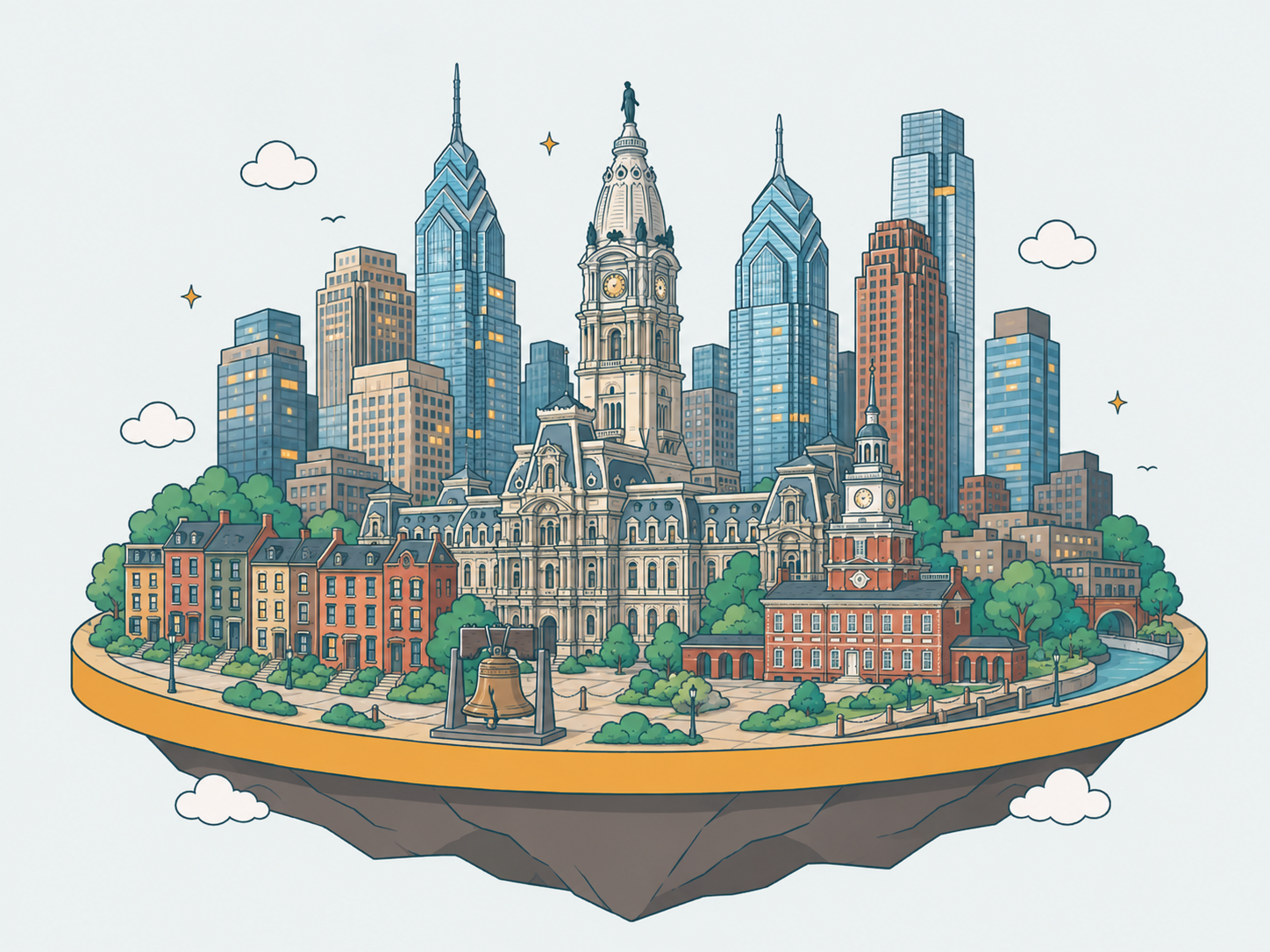
Center City housing is converted lofts in old office buildings and luxury high-rises with doormen who know your coffee order. Here's the thing nobody says out loud: Center City isn't a neighborhood in the traditional Philly sense. It's downtown. Living here means sharing your sidewalk with commuters, conference attendees, and tourists hunting the Liberty Bell — and it's either exactly what you want or precisely what you're trying to escape.
What makes Center City different
This isn't Rittenhouse Square or Washington Square West, even though both technically sit inside the broader Center City boundaries. When locals say “Center City,” they mean the dense commercial core — roughly Market to Walnut, Broad to 18th, with City Hall at its gravitational center.
It's Philadelphia's original downtown, the grid William Penn laid out in 1682. The boundaries have always been fuzzy; the core is unmistakable. Office towers, hotels, the Fashion District, Reading Terminal Market, City Hall, and the dense restaurant corridor along Sansom and Walnut.
The physical character is vertical. High-rises, not rowhomes. Street level is restaurants, banks, Wawa, CVS, phone repair shops, and the occasional struggling retail space; above that, offices, hotels, and residential floors where people actually live — though you'd never guess it from the sidewalk.
Why everyone ends up here: SEPTA's nerve center is Center City. The Market-Frankford Line, the Broad Street Line, and every Regional Rail line converge at three stations within blocks of each other. You can get anywhere in the city from here — which is exactly why it's crowded. It's the convergence point where North, South, and West Philly all meet: neutral territory in a city of fierce neighborhood loyalty, which gives it a more transient, less personal feel than an actual residential neighborhood.
The lay of the land
Downtown reads as one block of towers from the outside. Inside, a handful of corridors behave completely differently — and locals treat them that way.
The City Hall core
Market to Walnut · Broad to 18thThe gravitational center. City Hall itself is Second Empire, finished in 1901 after thirty years of construction, and the observation deck reopened post-pandemic. This is where the grid, the transit, and the office economy all meet.
Market Street
The wide, loud arterySEPTA stations, the Fashion District, tour groups, office workers at lunch, and a lot of people just trying to get somewhere else. It isn't charming; it's functional. The blocks between 8th and 15th can feel unsettled depending on the hour — not dangerous, just a lot of empty storefronts. That's slowly changing.
Sansom Street
15th–20th · the dining corridorWhere Center City shows off. Parc, Sampan, El Vez, and more bars and restaurants than you can count. Sidewalks get packed in warm weather when outdoor seating takes over. Parking here is essentially decorative.
Midtown Village
Overlaps the GayborhoodThe Gayborhood (12th–13th, Walnut to Pine) plus the surrounding blocks — restaurant density, bars, and the closest thing downtown has to a village feeling. It's the epicenter of LGBTQ+ nightlife year-round.
The Fashion District
8th–11th & MarketThe old Gallery, rebuilt. Retail struggled here even before the pandemic and the shift to remote work gutted the foot traffic. The dead zones on this stretch and the eastern edge toward Old City are real — this is the part of downtown still looking for its second act.
What downtown actually gives you
- Three rail hubs within blocks — the El, the Broad Street Line, and every Regional Rail line.
- Restaurant density so absurd you could eat out nightly for a year without repeating.
- Reading Terminal Market, thriving while the malls around it struggled.
- 24-hour city energy — something is always open, always happening.
- The Schuylkill River Trail close enough to run before work.
- Regional Rail out to New York, DC, and the shore for day trips.
- A residential community — you live among tourists and office workers.
- Real green space in the core; the actual squares border it, they aren't in it.
- Parking that isn't metered or $300–500/month in a garage.
- Family infrastructure — schools are limited and playgrounds are sparse.
- Block parties. Events here are citywide, not hyper-local.
- Quiet. Traffic, sirens, weekend bar crowds, and construction are constant.
Where to actually eat
The food scene here isn't hype — it's Philly's real strength, and locals are proud of it. What they actually order, and what it actually costs.
Reading Terminal Market
$$$$The tourist magnet that locals genuinely love. Go on a weekday morning when it's office workers grabbing breakfast, not tour groups. DiNic's roast pork (locals will tell you it beats a cheesesteak), Beiler's donuts, the Amish counters. Overwhelmingly crowded on weekends and the bathrooms are terrible. Still worth it.
Best for · a weekday-morning lunch run
Parc
$$$$The brasserie on Rittenhouse Square. See-and-be-seen sidewalk seating, and the people-watching is unmatched. Order a coffee, sit for two hours, nobody rushes you. This is where locals take visiting parents.
Best for · visiting parents
Vernick Food & Drink
$$$$James Beard-winning and consistently on national best-of lists. The wood-fired cooking actually lives up to the write-ups. Expensive, but the kind of expensive that earns it. Reservations essential.
Best for · the special occasion
McGillin's Olde Ale House
$$$$Philadelphia's oldest continuously operating tavern. Burgers, beer, low ceilings, and an Irish-pub atmosphere that isn't trying too hard. Tourists love it, locals love it, everyone's here.
Best for · a beer with no agenda
Sampan
$$$$Midtown Village, solid happy hour, gets loud. The duck tacos are the move.
Best for · happy hour with a group
Reality check: the food is excellent and you'll pay Center City prices for it — $15–20 at lunch, $40–60+ per person at dinner. The complaint you'll actually hear is service slowing down when places are slammed, which is often. And a lot of restaurants close Sunday and Monday, which catches newcomers off guard every time.
The civic stuff worth your time
Downtown's public rooms — the ones locals use, and the one they should.
City Hall observation deck
$10Reopened post-pandemic, and it's the best view of Philadelphia for ten dollars. The building itself is stunning — Second Empire, finished 1901, thirty years in the making. A tourist thing locals rarely do and should.
Best for · the best view in the city
Free Library, Parkway Central
FreeMagnificent — marble, real reading rooms, free WiFi, and bathrooms. Locals treat it as a workspace and meeting spot, which is exactly what it's good for.
Best for · a free place to work
Dilworth Park
Renovated in 2014: a fountain in summer, an ice rink in winter, a café year-round. Where Center City workers eat lunch — and also where you'll encounter the visible homelessness the city is grappling with.
Best for · lunch outside, winter skating
Love Park (JFK Plaza)
The fountain with the LOVE sculpture. A photo op and skateboarders. Not much else — and that's fine.
Best for · the photo
Living here: the real costs
Center City homes run from studios in converted office buildings up through luxury units with floor-to-ceiling windows. The honest numbers:
The good & the trade-offs
- You walk to everything: restaurants, bars, theaters, museums, transit, work.
- SEPTA access is unmatched — Regional Rail, the El, and the subway all converge.
- You're at the center of everything happening in Philadelphia.
- A world-class food scene, and you're at the epicenter of it.
- No car needed — honestly, better without one.
- The Schuylkill River Trail is close enough for a real run.
- Expensive — $2,200+ for a studio, $3,000–4,500+ for a decent 1-bed.
- Noise is constant: traffic, sirens, weekend bar crowds, construction.
- Visible homelessness and street harassment affect daily quality of life.
- Office-heavy blocks empty out and feel deserted after 7pm.
- Retail is still recovering — fewer shops and services than pre-pandemic.
- Many buildings are older with dated amenities despite high rents.
Is Center City for you?
Downtown is a genuine lifestyle, not a default. It suits some people completely and nobody else at all.
- You're a young professional who'd trade square footage for walkability.
- You work remotely and want to be central without a commute.
- You genuinely prefer dense urban living to neighborhood character.
- You can afford $2,500+ rent without stretching.
- You're single or a couple without kids, and you want maximum restaurant access.
- You thrive on energy and don't need quiet.
- You value knowing your neighbors and having a real community.
- You're sensitive to noise, crowds, or street chaos.
- You need outdoor space beyond a small park.
- You have kids — schools are limited and playgrounds are sparse.
- You want authentic Philly neighborhood culture. This isn't it.
- You need a car for work; parking costs make it prohibitive.
Getting around
Walking is the whole point. The grid makes navigation idiot-proof, and you can walk to work, lunch, dinner, drinks, SEPTA, the river trail, and the museums. Old City is half a mile east, Rittenhouse Square three-tenths west, Washington Square West four-tenths south, Logan Square six-tenths northwest, Chinatown four-tenths north.
SEPTA
- Market-Frankford Line (the El) — 11th, 13th, and 15th Street stations.
- Broad Street Line — City Hall station.
- Regional Rail — Jefferson Station (Market East), Suburban Station (16th & JFK), and 30th Street Station on the University City edge.
- Buses — every major line runs through here.
You don't need transit to get around Center City itself. You need it to get everywhere else in the region.
Driving (don't)
- Street parking is metered ($2–4/hour) and aggressively enforced. The PPA is universally hated, and locals will warn you: you will learn the hard way.
- Garage parking runs $300–500/month for a reserved spot, $25–40/day hourly.
- Residential permit zones don't exist in the core — it's all metered or garage.
Biking: protected lanes went in on Chestnut and Spruce in 2024, and the Schuylkill River Trail is accessible via 22nd Street. Bike culture is growing but drivers are aggressive — use lights, be visible, and assume every car will door you.
Events worth planning around
Dilworth Park ice skating
Right at City Hall. Touristy, and locals do it anyway when family visits. Free to watch, $5 to skate.
Made in America
Jay-Z's festival on the Parkway. If you live here, your neighborhood gets invaded — either leave town or embrace it. There's no third option.
Philly Pride Parade & Festival
Starts at 13th & Locust with a huge turnout. The Gayborhood — 12th to 13th, Walnut to Pine — is the epicenter of LGBTQ+ nightlife the rest of the year too.
Outfest
A Gayborhood street festival drawing 50,000+ people. Block-party energy, vendors, stages.
The post-pandemic reality
Center City is in productive tension between its past as an office-worker downtown and its future as something else. Both sides of that argument are true at once, and you'll hear both.
Officials point to foot traffic recovering toward pre-pandemic levels, falling reported crime, a run of new supermarkets across Greater Center City, and nightlife that's genuinely thriving.
The cracks are just as visible: a lot of empty office space, office attendance still well short of where it was, and a run of major retail closures. Plenty of people say they do not feel safe downtown even as the crime figures improve, and rising unsheltered homelessness has made the visibility issue impossible to ignore. Perception affects foot traffic, and foot traffic affects business.
The part that surprised everyone: young professionals didn't flee. Remote workers are choosing to live downtown because they're city people — not despite it.
Honest safety assessment
The gap between the reported crime figures and the way downtown feels is the whole story here. Officials point to reported crime falling since 2019; plenty of people still say they do not feel safe downtown, suburban respondents least of all and Center City's own residents most. That gap is real and consequential, and it is worth knowing which of the two you are reacting to.
Generally safer
- The Rittenhouse Square area (18th–20th, Walnut to Locust).
- Washington Square West (6th–9th, Walnut to Pine).
- The restaurant corridor along Sansom, 15th to 20th.
- Daytime — basically everywhere there's foot traffic.
Use caution
- Around SEPTA stations late at night — not dangerous, just unsettled.
- Empty office blocks after 7pm, when nobody's around.
The honest version: daytime downtown is busy — the sidewalks are full. Nighttime varies block by block; restaurant areas stay lively until midnight while office blocks empty out by 7pm. The issue residents raise is not violent crime. It's quality of life: aggressive panhandling, visible drug use, street harassment. Your walk home involves navigating people in crisis, and that wears on you.
A Center City home, season by season
What each season does to a downtown high-rise — and the move that answers it.
Construction dust from the blocks that are always under construction settles on every horizontal surface, and Parkway pollen rides in through the first open windows.
The move · A full window-and-sill pass plus a top-down dusting sweep, timed for when the light starts mattering again.
Floor-to-ceiling glass shows every fingerprint and streak, and the humidity plus street exhaust means whatever comes in through the window stays on the surface.
The move · Streak-free glass on the big windows and a light, frequent surface pass so nothing has time to bake on.
Building HVAC kicks over and pushes months of duct dust through the whole unit, right as entertaining season starts.
The move · We hit the vents and every horizontal surface in the first weeks the heat runs, before the duct dust has time to settle into the whole unit.
Sidewalk salt rides up the elevator on every shoe, and dry building heat bakes dust onto every hard surface.
The move · The entry carries the visit — salt comes off shoes at the door, not in the hallway — and hard surfaces get dusted often enough that building heat never bakes anything on.
Keeping a Center City home effortless
Downtown homes are mostly vertical: high-rise units, converted lofts, and a lot of glass. The maintenance profile is different from a rowhome, and a standard reset here is about consistency more than heroics.
What these homes need
- Glass, done properly — the view is what you're paying for, so streaks are the enemy.
- The entry — city grit rides in from the sidewalk on every trip; a mat-and-floor reset every visit.
- Air-handling dust — building HVAC moves dust everywhere; vents and horizontal surfaces need a regular pass.
- Building access, handled — elevators, front desks, loading docks, and certificates of insurance. We work around all of it.
Why trust this guide? Nobody paid for a mention here. It is written from the practical side of downtown living — front desks, service elevators, loading docks that close at five — rather than from a visit.
Make it yours
Before choosing a downtown home
A short list to turn what you read into your own next steps.
Saved checks stay on this device when browser storage is available. This is a personal planning list, not a property inspection or professional assessment.
A few good questions
Before you make a plan.
How much does house cleaning cost in Center City?
Do you clean high-rise and doorman buildings downtown?
Do cleaners bring their own supplies?
Can I get the same cleaner each visit?
Can you clean while I'm at work?
Sources & next steps
Useful advice should
show its working.
These resources support the reader tools above and help you check details for your own address, date, or plans.
- SEPTA trip planner
Plan your date, direction and return journey; check service and accessibility details.
- Philadelphia Atlas
Look up an address and review available City property records.
- Philadelphia Parking Authority
Check official parking information; read the restrictions at the actual space.
These tools help you assess a particular address. They do not establish neighborhood safety, current market rents or every building’s policies.
Keep exploring