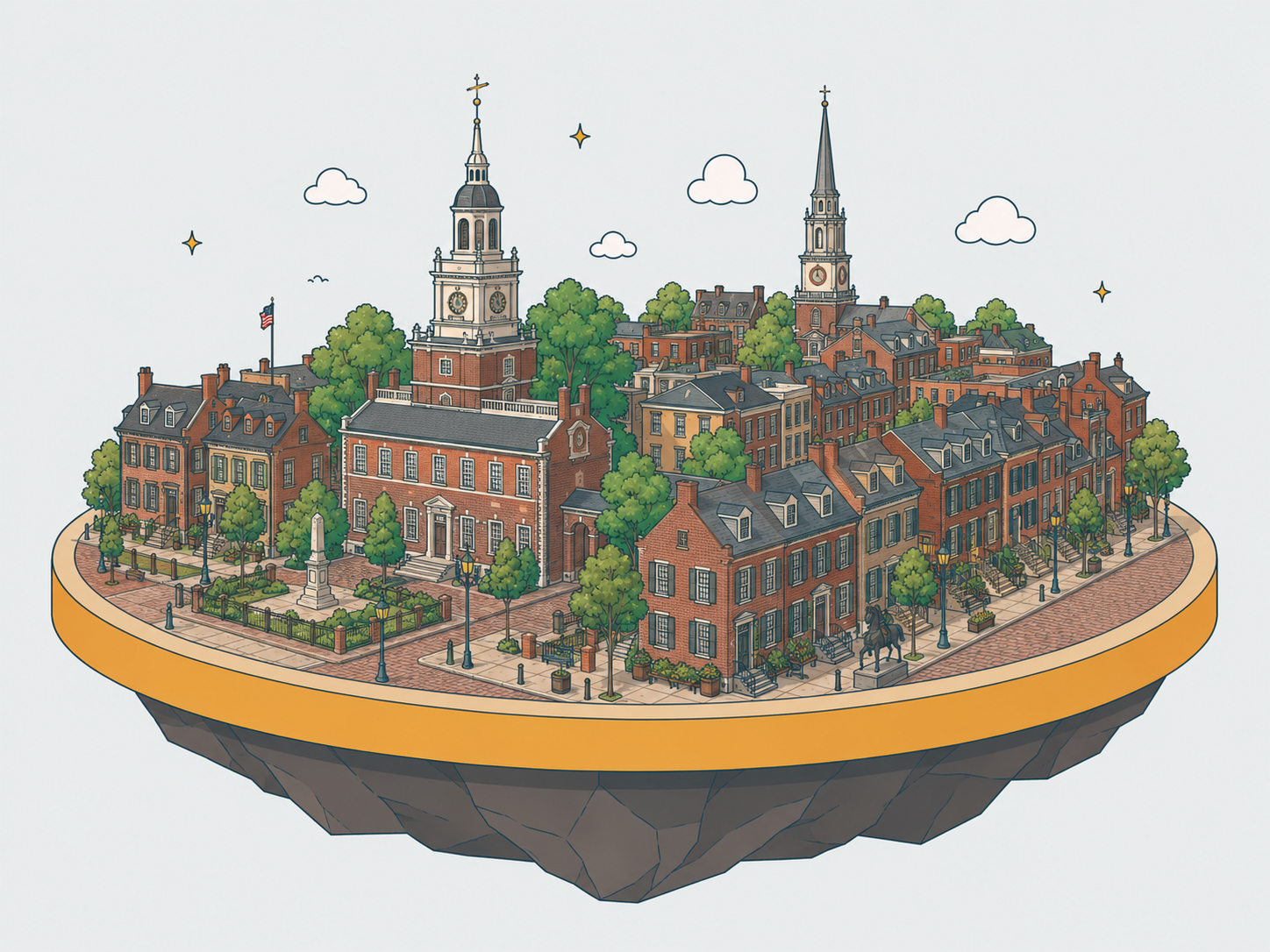
A little orientation
Make an Old City visit you can actually follow
Check current entry rules
Use the National Park Service's guidance for the particular Independence Hall visit you want.
Name the waterfront stop
Choose a specific pier or park and check the operator's directions and current information.
Plan the approach
Consider the actual entrance and walking surfaces when arranging the day for your group.
A closer look
Choose your Old City anchor
Start with one destination and make the next step practical.
Confirm the entry you need
Read the National Park Service's current Independence Hall guidance before choosing a visit. Check ticketing, screening, and the entrance suited to your group, then arrange nearby food or other stops around that confirmed plan rather than a general promise of free entry.
A useful questionWhat entry arrangements apply to the visit I am choosing?
Source & next step ↗Pick the pier before the route
Use the Delaware River Waterfront operator's site to choose a specific destination such as Race Street Pier. Check directions, current conditions, and any facilities essential to your group before planning the walk from Old City or counting on a particular amenity.
A useful questionWhich facilities and approach should I confirm for this pier?
Source & next step ↗Leave room for the walking
Enter your actual Old City destination into SEPTA's planner and check the suggested boarding point. Confirm the venue entrance separately, then compare the return trip and walking sections so a short map distance does not become a rushed itinerary.
A useful questionHow much walking does this plan ask of our group?
Source & next step ↗Three neighborhoods wearing the same cobblestones
Old City housing is rowhouses and converted lofts — from the cobblestone side streets near Elfreth's Alley to the modern condos overlooking the Delaware. Here's something most guides won't tell you: Old City is three completely different places depending on when you show up. A daytime museum district. A residential neighborhood where people have quietly lived for decades. And, Thursday through Saturday night, a full-blown bar scene that turns those same historic streets into something closer to a bachelorette-party convention.
What makes Old City different
This is Philadelphia's birthplace, literally. The boundaries run roughly Walnut Street to Vine, Front Street to 6th — the blocks where American independence was debated, declared, and nearly derailed a few times. ZIP codes 19106 and 19107 cover most of it.
Here's what the tourism bureau won't emphasize: Old City's central tension is between the people who come to see where history happened and the people who actually live among it. You've got 18th-century architecture, James Beard-winning restaurants, and also a bar scene where the bachelorette-party-to-square-foot ratio peaks around 11pm on Saturdays.
The main commercial corridor runs along 2nd and 3rd Streets between Market and South, packed with restaurants from $15 BYOBs to $100+ tasting menus. First Friday — the monthly arts walk that started in 1991 — still happens, though locals will tell you it isn't what it used to be. On the eastern edge, the Delaware River waterfront gives you real green space and sunset views without the tourist crush.
Getting here: SEPTA's Market-Frankford Line runs underneath Market Street with stations at 2nd and 5th. The neighborhood is supremely walkable — you can hit Independence Hall, the Liberty Bell, and three excellent restaurants inside a 10-minute radius.
The lay of the land
Market Street essentially splits Old City's personality in half. Knowing which side you're on tells you most of what you need.
North of Market
Market to VineThe more residential, arts-focused half — gallery spaces and the occasional dive bar. Quieter, and where the neighborhood feels most like a neighborhood.
South of Market
Market to WalnutWhere history, dining, and nightlife collide. Chestnut Street in particular transforms completely after dark.
2nd Street · restaurant row
Market to WalnutThe best blocks for wandering. Restaurant density is highest here, and the side streets between 2nd and 3rd hold the cobblestones everyone photographs.
Elfreth's Alley
Between 2nd & Front, near ArchThe nation's oldest continuously inhabited residential street, occupied since 1703. One block long, genuinely beautiful, and packed with tourists taking the same photo. Come before 10am or after 5pm.
The waterfront
East edge · Columbus BlvdRace Street Pier and Penn's Landing on the Delaware — the surprise green space, and the sunset views that make the rest of the crowding worth it.
What Old City actually gives you
- 15+ historic sites inside a walkable radius.
- One of the highest concentrations of notable restaurants in the city.
- Real cobblestone streets and 18th-century architecture you live in, not tour.
- Delaware River waterfront access for running, biking, and sunsets.
- Market-Frankford Line stations at 2nd and 5th Street.
- Quiet residential pockets on the side blocks, two minutes off the main drag.
- Parking. Functionally impossible after 7pm Thursday through Saturday.
- Quiet on a weekend night if your unit faces Chestnut or 2nd.
- An off-season — tourist crowds run year-round, heaviest spring through fall.
- Much green space beyond the piers and the waterfront.
- Level footing — the cobblestones are charming and genuinely uneven.
Where to actually eat
Old City has one of Philadelphia's densest restaurant corridors — which doesn't mean everything is worth the hype or the price tag. Honest takes:
Zahav
$$$$The nationally acclaimed one everybody tells you to try. The hummus and laffa are genuinely exceptional and the lamb shoulder lives up to it. The honest part: the side room diminishes the atmosphere considerably versus the main dining room, and last we checked it ran $165+ prix fixe plus a 20% service charge that is NOT gratuity — tips are still expected — so a couple can clear $330. Reservations open weeks ahead and vanish in minutes; the bar takes walk-ins. Check current pricing before you plan the night around it.
Best for · the once-a-year occasion
Fork
$$$$Ellen Yin's restaurant has been a consistent performer for decades and still is. The dry-aged burger gets named in practically every review as one of Philly's best, and the seasonal menu keeps it moving. Service is professional without being stuffy. $50–100 per person at dinner, and the portions and execution match. Lunch is the easier reservation.
Best for · the burger, honestly
Amada
$$$Jose Garces's tapas room — patatas bravas and gambas al ajillo are the consistent favorites. It gets loud when busy and service can slow at peak weekend hours. Come for the variety: six small plates instead of committing to one entrée. Reservations strongly recommended.
Best for · a group that can't agree
Han Dynasty
$$Szechuan in a former bank building with dramatic high ceilings — the architecture almost outshines the food. Dan Dan noodles are the move, authentically spicy with the levels clearly marked, generous portions. Service is hit-or-miss during rushes. Better for a casual dinner than a special occasion.
Best for · a casual weeknight
Reality check: the restaurants here are genuinely excellent, and you're paying a premium for the address. Weekend reservations at the top spots need advance planning. And some places are coasting on reputation — if a restaurant has been “opening soon” since 2023 or the facade is permanently dusty, skip it.
Historic sites worth your time
You're going to see some of these regardless. Here's how locals rank them, and when to actually go.
Museum of the American Revolution
$21The underrated one locals wish visitors would prioritize over another Liberty Bell selfie. Opened in 2017, and it houses Washington's actual war tent plus immersive exhibits far more engaging than queueing to see a cracked bell through glass. Budget 2–3 hours; timed entry recommended; parking garage on site.
Best for · the visitor who wants substance
Independence Hall & Liberty Bell
FreeYou're probably going anyway. Hall tours are free but need timed tickets — reserve online or grab them early at the visitor center. The bell is exactly what it looks like in photos. Both get mobbed 10am–3pm. The move is 8:30am at park opening, or after 4pm when the tour groups clear out.
Best for · 8:30am or 4pm, never noon
Second Bank of the United States
FreeA free portrait gallery inside a stunning Greek Revival building — air-conditioned, rarely crowded, and a genuinely interesting collection of early American political figures. This is what you do when you need a break from the crowds.
Best for · escaping the crowds
Elfreth's Alley
FreeThe nation's oldest continuously inhabited street, since 1703. One block. Beautiful. Also packed with people taking the identical photo. Early morning or evening, or just walk past without stopping — you'll get the idea.
Best for · an early-morning walk
How walkable is it, really?
Everything you need is inside ten minutes on foot. Walk Score and Transit Score below were last checked in July 2026 — both are third-party scores, not ours.
Living here: the real costs
We service converted lofts, historic rowhouses, and modern condos across Old City. The figures below were last checked in July 2026 — check current listings before you plan around them.
The good & the trade-offs
- Supreme walkability — groceries, restaurants, entertainment, parks all inside 10 minutes.
- Excellent SEPTA access via the Market-Frankford Line and bus routes.
- You live inside legitimately historic architecture, not next to it.
- Delaware River waterfront for running, biking, and sunsets.
- A strong restaurant and cultural scene at your doorstep.
- Noise is the number-one complaint — Thursday to Saturday brings bar crowds and general loudness.
- Parking is a nightmare; residential permits don't guarantee a spot.
- Tourist saturation means crowds year-round, heaviest spring through fall.
- Prices are high and have climbed steadily for a decade.
- Weekend trash and noise from the nightlife scene grate on residents.
- Some blocks read as a bar district rather than a neighborhood on weekends.
Is Old City for you?
The trade is straightforward: extraordinary architecture and walkability, paid for in noise and crowds.
- You want to live in Philadelphia's founding neighborhood, history and all.
- You can walk to Center City for work, or you work remotely.
- You thrive on urban energy and don't need quiet residential streets.
- You value walkability and low car dependency.
- You enjoy the bar scene — or genuinely don't mind it.
- You're an empty-nester who wants city living with cultural access.
- You need quiet after 10pm Thursday through Saturday.
- You have young children — noise, limited green space, constant crowds.
- You're on a tight budget. This is expensive Philadelphia.
- You need convenient parking or regular car access.
- You're sensitive to tourist crowds and constant foot traffic.
- You work remotely and need absolute quiet during the day.
Getting around
Walking handles daily life here. Everything you need is inside ten minutes, sidewalks are wide on the main streets, and the neighborhood is extremely pedestrian-friendly. The cobblestones are charming and genuinely uneven — watch your step in heels or with wheeled luggage.
SEPTA
- Market-Frankford Line — 2nd Street and 5th Street stations serve the neighborhood.
- Buses run along Market Street and Columbus Boulevard.
You genuinely don't need a car for daily life here.
Driving (don't)
- Unless your building includes a garage space or off-street parking, car ownership in Old City is an exercise in frustration.
- Residential permit zones exist but don't guarantee a spot.
- Street parking is metered until 8pm on most blocks, highly competitive after 7pm any day, and nearly impossible Thursday through Saturday night.
- Expect to pay for a garage, or 30 minutes circling and hoping. Check the current posted rate — garage pricing here moves.
Biking: protected lanes run on nearby Spruce and Pine, and the Delaware River Trail follows the waterfront. Bike-friendly overall, though the cobblestones are bumpy. Most apartment buildings have bike storage.
Events worth planning around
First Friday
The monthly arts walk, with galleries clustered on 2nd and 3rd Streets. Free, some spots pour wine, and it's legitimately interesting in the right month. It has lost much of its luster since the 2000s–2010s per a 2024 Inquirer piece, though younger, more diverse galleries are driving some revival. Check which galleries are participating first.
Independence Day
You're literally at Independence Hall. Incredibly crowded, intensely patriotic, traffic and parking impossible. If you live here, leave town. If you're visiting for it, book a hotel a year ahead.
Welcome America Festival
A multi-day run of concerts and events, and absolute chaos. Same advice: avoid it if you live here, plan extensively if you're visiting.
Philly Free Streets
The city closes streets to cars for walking and biking. When the route includes Old City, exploring it without vehicular traffic is genuinely pleasant. Check the city calendar for dates.
The tourist-versus-local reality
Old City lives in a constant state of identity tension. Independence Hall, the Liberty Bell, and the Betsy Ross House drive enormous foot traffic year-round. But people also live here — in converted lofts and historic rowhouses, raising families and building lives among the tour groups.
For residents that means accepting that your neighborhood is also a major destination. You'll navigate sidewalk crowds. You'll give directions to confused visitors. You'll watch the same Liberty Bell photo get taken ten thousand times a day.
The trade: you live inside legitimately historic architecture, with world-class restaurants within walking distance and Independence Hall out the window. Whether that's worth the noise and crowds depends entirely on your priorities — and it's worth being honest with yourself about that before you sign a lease.
One more honest note on nightlife: Chestnut Street between Front and 3rd becomes bachelorette-party central Thursday through Saturday. The bars draw a 20s–30s crowd heavy on out-of-towners. If you want that energy, it's right there. If you want a quiet drink and conversation after dinner, head to Northern Liberties or Rittenhouse instead.
Honest safety assessment
The issue residents raise most is crowds and congestion. Tourism is what fills the streets here, and it creates its own quality-of-life trade-offs.
By time of day
- 6am–7pm — heavy foot traffic, a standing police presence around the federal buildings and tourist sites, well-lit streets.
- 7pm–midnight — the main corridors (Market, Chestnut, 2nd) stay busy on restaurant and bar traffic. Side streets are quieter.
- Midnight–6am — activity concentrates on the main streets where the bar crowds are. Some residents report property crime: car break-ins and the occasional home break-in.
Where to pay attention
- Quiet residential side streets very late at night.
- Parking garages after dark — use the well-lit options.
- Standard city habits apply: nothing visible in the car, lock the door, stay aware.
An Old City home, season by season
What each season does to a historic rowhouse or converted loft — and the move that answers it.
Tourist season ramps up and the sidewalk grit comes in with it, right as pollen finds every original window sash.
The move · A full window-and-sill pass plus a deeper entryway reset, timed before the spring crowds peak.
Waterfront humidity settles into old plaster and brick, and open windows pull street noise and dust straight in off 2nd Street.
The move · Frequent dusting on horizontal detail, and a light, dry pass that won't drive moisture into centuries-old surfaces.
First heating cycles push dust through the whole house, and the leaf litter on the cobblestones tracks in on every shoe.
The move · Vents and baseboards get the deep pass, and the entry moves to every-visit while the cobblestones are still shedding leaves.
Salt and slush come in at the stoop and attack original hardwood finish; the cobblestones hold both longer than pavement does.
The move · Because cobblestones hold slush longer than pavement, the stoop and the first ten feet of floor get worked every single visit — pH-neutral, never wet, on floors this old.
Keeping an Old City home effortless
The housing stock here is mostly historic — colonial rowhouses, converted warehouse lofts, and condos inside old commercial buildings. Most have been renovated inside, so you get modern kitchens and baths wrapped in 18th- and 19th-century structure. That combination has its own maintenance profile.
What these homes need
- Original hardwood, handled gently — pH-neutral care with no standing water on centuries-old floors.
- The entryway — the cobblestones hold grit, and it all comes in at the stoop. A mat-and-floor reset every visit.
- Plaster, brick, and exposed beams — loft conversions hold dust in every seam; a soft, dry pass keeps them crisp.
- Narrow stairs and tight landings — rowhouse geometry our teams plan around, so nothing gets skipped.
Why trust this guide? No one bought a spot on this page. It is written from the practical side of these buildings — cobblestones, the narrow stairs of colonial rowhouses, lofts carved out of old warehouses — where you learn which doorways are a problem.
Make it yours
Before your Old City day
A short list to turn what you read into your own next steps.
Saved checks stay on this device when browser storage is available. This is a personal planning list, not a property inspection or professional assessment.
A few good questions
Before you make a plan.
How much does house cleaning cost in Old City?
Do you clean historic rowhouses and converted lofts?
How do you handle original hardwood and plaster?
Do cleaners bring their own supplies?
Parking is impossible here. Is that a problem for a booking?
Sources & next steps
Useful advice should
show its working.
These resources support the reader tools above and help you check details for your own address, date, or plans.
- Visit Independence Hall
National Park Service guidance covers entry, tickets, screening, and accessibility.
- Delaware River Waterfront
The waterfront operator links current park information, events, directions, and construction updates.
- SEPTA trip planner
Compare transit journeys using your actual stops, date, and departure time.
Current NPS entry guidance takes precedence over a broad ticket summary. Waterfront amenities, construction access, and venue schedules need destination-specific checks.
Keep exploring