A little orientation
Explore the Gayborhood with care
Begin with a community source.
Look at William Way’s own programs and updates before assuming the neighborhood experience begins and ends with its nightlife.
Ask about the actual event.
Confirm admission, access and participation details with the organizer rather than treating every venue or gathering as interchangeable.
Make a shared journey plan.
Agree on the meeting point and return options with your group, using current information rather than a promised safest corner.
A closer look
Find the visit that suits you
The guide’s 13th and Locust, Camac Street and community references are starting points for your own plan.
Start with William Way.
Read William Way LGBT Community Center’s current updates and choose a program or resource you want to learn about. Confirm the venue and participation details directly, rather than assuming a listed address or familiar event name settles the plan.
A useful questionWhich program interests you, and what does the Center ask visitors to know?
Source & next step ↗Choose a venue, then a route.
If you are researching a night out near 13th and Locust or Camac Street, confirm the event with its organizer first. Plan the journey to that address and a return that works for everyone in your group.
A useful questionWhere will your group meet, and how will each person get home?
Source & next step ↗Follow a question into the sources.
Use the guide’s LGBTQ+ history as an invitation to learn more through community-led resources. Start with William Way’s own material and ask where to find the relevant records; avoid treating a neighborhood anecdote as everyone’s shared experience.
A useful questionWhose account are you reading, and what sources help place it in context?
Source & next step ↗Inside Philadelphia’s Gayborhood: The Real, Raw, and Relentlessly Local Guide
Washington Square West and the Gayborhood run from walk-ups near 13th & Locust to condo towers edging Market. The neighborhood changes by the hour: calm weekday mornings when the only sound is a shop gate sliding up, happy-hour chatter spilling from bar patios, and the 2 a.m. scramble when everyone’s calling rides at once. This guide is about what’s joyful, what’s complicated, and how to move smart so you actually enjoy the place you came here to love.
Orientation: The Block That Started It All
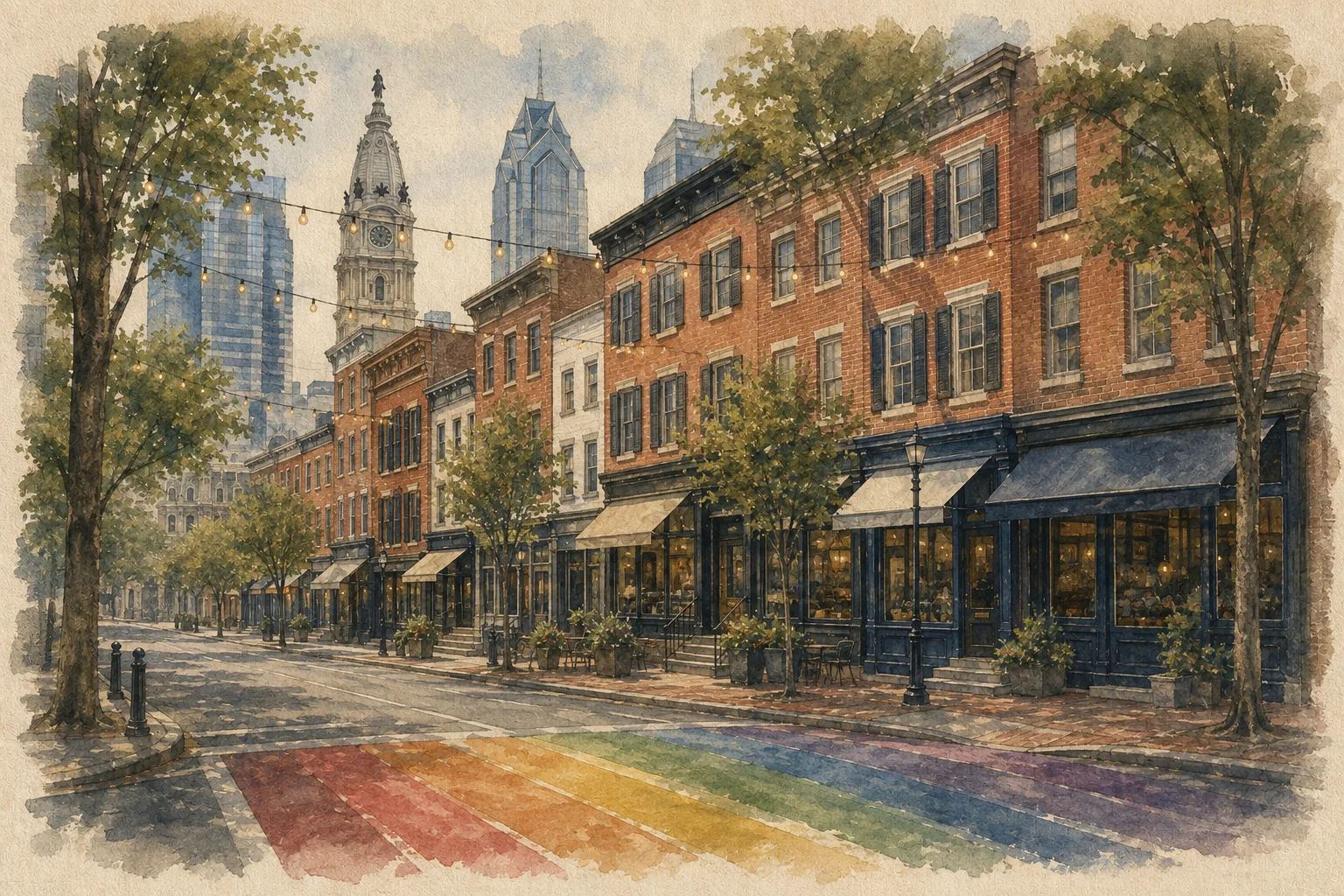
If someone says “meet me on the Block,” they mean 13th Street around Locust, rainbow crosswalk country. Stand on the southwest corner of 13th & Locust if you’re people-watching; the northeast corner is better for clean photos (fewer cars in frame). Two truths set your compass here: locals call it the Gayborhood (not “Midtown Village”), and the crosswalks aren’t just paint. They’re a memory wall for decades of organizing, drag, and chosen-family milestones.
You’ll notice the paradox within five minutes: safer and shinier than it used to be, still queer as hell, and also pricier than most first-timers expect. Elders will tell you about the nights when walking these blocks required a buddy and a plan; newer residents will point to packed patios, pronoun pins, and a sense that you can breathe openly in daylight. Both are right. Think of the Gayborhood as a living archive: part museum, part dance floor, part living room that the whole city borrows on weekends.
Micro-moves that matter:
- For a first pass, walk Locust → 13th → Spruce in a short loop. You’ll catch the bookstore, the crosswalks, and a read on where lines start forming.
- If you’re allergic to crowds, note how quickly the volume drops once you step east onto Camac or west toward 12th. Ten doors can change your night.
Locals call it the Gayborhood, not Midtown Village.
- 13th & Locust
- Camac Street
- Giovanni's Room
- William Way LGBT Community Center
Schematic · not to scale
Micro-Map of the Gayborhood
13th Street Core (“The Block”).
This is gravity: lines at Voyeur, friends stacking outside Tabu, couples angling for crosswalk pics. Sidewalks pinch at peak hours; keep the ropes clear (it’s an unwritten rule). If you need a quick reset, duck mid-block alleys; they’re the neighborhood’s pressure valves.
Camac Street Pocket.
A half-beat slower and a shade more conversational. Smaller rooms, mixed crowds, better for catching up without yelling. If 13th feels like a parade, Camac is the porch.
Locust-Spruce Corridor.
Daytime sweet spot: coffee, stoops, and Giovanni’s Room, which functions as the neighborhood’s heartbeat. If you’re here in June, you might stumble onto the community repaint of the rainbow crosswalks, rollers, selfies, and a lot of “I remember when” stories.
Market Street Edges.
Less neon, more apartments. After closing time, this is where locals order rides to avoid the 13th-Street surge and the photo-op clusters. If you need quiet, walk two blocks north before you tap “Request.”
Wayfinding vernacular.
You’ll hear: “The Block” (13th core), “PPA’d” (ticketed), “The El” (SEPTA line), and “jawn” (anything). Learn them; they compress directions and defuse confusion fast.
Micro-map of the Gayborhood
Ten doors can change your night.
13th Street Core
"The Block"This is gravity — lines, friends stacking on the sidewalk, couples angling for crosswalk pics. Sidewalks pinch at peak hours.
Camac Street Pocket
East of 13thA half-beat slower and a shade more conversational. Smaller rooms, mixed crowds, better for catching up without yelling.
Locust-Spruce Corridor
The daytime sweet spotCoffee, stoops, and Giovanni's Room, which functions as the neighborhood's heartbeat.
Market Street Edges
NorthLess neon, more apartments. Where locals order rides after closing to avoid the 13th Street surge.
The Feel by the Clock
Morning (7-11 a.m.).
Shop gates roll up, bar staff hose down last night, and the streets belong to residents and dog-walkers. This is when you actually see the architecture and can browse Giovanni’s Room in peace. If you need errands or photos without crowds, this is your window.
Happy Hour (4-7 p.m.).
The locals’ price hack. Sip at Double Knot or Sampan, then migrate toward 13th as the sun goes down. Conversations carry; DJs haven’t cranked yet; staff have time to chat. If you care about value, stack HH and a split plate and you’ve just bought yourself a cover charge later.
Prime Time (9 p.m.-1 a.m.).
The Block becomes the city’s commons. Expect packed thresholds and the “who’s-where” text chain to ping nonstop. If lines give you hives, arrive before 10. Music repetition (“we’ve heard that Dua Lipa track three times”) is a real gripe. If variety matters, ask the door who’s spinning before you pay the cover.
After 2 a.m. (close → ride).
Unwritten rule: move with a crew. Order your ride from Walnut or Spruce instead of 13th; the pickup is cleaner and calmer. Keep your phone off the back pocket, and don’t linger under apartment windows. People live upstairs, and they’re not in the mood for post-club decibels.
Eating Your Way Through the Rainbow
For a neighborhood built on nightlife, the Gayborhood eats better than it parties. The mix of queer-owned kitchens, sleek date-night staples, and weekday “HH jawns” (happy-hour finds) gives locals a rhythm that outsiders miss entirely.
Bud & Marilyn’s anchors the dinner scene, retro lighting, strong cocktails, and a wedge salad that’s practically folklore. It is not a cheap dinner, but you’re paying for familiarity as much as flavor; regulars sit at the bar because that’s where the real conversation happens. Two doors down, Barbuzzo offers the wood-fired smell that cuts through Locust Street at dusk. Solo diners slide onto the bar stool, order the pizza and a glass of rosé, and end up talking to someone before the plate lands.
For those running on queer time (a.k.a. “we’ll eat when we remember”), Double Knot’s happy hour is the precision move, 4 to 7 p.m., with discounted sushi and cocktails. Finish there, walk ten steps to 13th Street, and you’re perfectly positioned for the crowd swell. If you’d rather keep things airy, The Little Gay Pub, half lounge, half rooftop, carries the summer evening energy without the Voyeur sweat. Its rooftop is the unofficial “best-kept secret” for locals who want conversation with skyline views and none of the line drama.
Micro-rule: Restaurants here fill at 7 sharp on Fridays, but Mondays and Tuesdays are wide open. Locals plan date nights early-week to avoid the 13th Street gridlock and the parking roulette that comes with it.
Where the day actually goes
For a neighborhood built on nightlife, the Gayborhood eats better than it parties.
Giovanni's Room
The shop calls itself the country's oldest running queer and feminist bookstore. Locals treat it as both confession booth and community center.
William Way LGBT Community Center
Quieter than the bars and arguably more vital. Drag bingo fundraisers to grief groups for queer elders.
Bud & Marilyn's
Anchors the dinner scene — retro lighting, strong cocktails, and a wedge salad that is practically folklore.
Barbuzzo
The wood-fired smell that cuts through Locust Street at dusk. Solo diners slide onto the bar stool.
Double Knot
The precision move, 4 to 7 p.m., with discounted sushi and cocktails, ten steps from 13th Street.
The Little Gay Pub
Half lounge, half rooftop. Conversation with skyline views and none of the line drama.
Tabu
Where the evening starts right. Thursday drag shows are free and still mostly local.
Nightlife DNA: Bars, Queues, and Unwritten Codes
Every Philadelphian who’s ever danced under colored lights has a Voyeur story. It’s the neighborhood’s pressure valve, three floors of pulse, fog, and vodka sodas that taste like absolution after a long week. Inside, it’s chaos and camaraderie. Sweaty, flirtatious, occasionally overwhelming.
Just before things go feral, most people warm up at Tabu, the heart that keeps the scene humane. Thursday drag shows are free, the bartenders actually smile, and you’ll overhear the night’s logistics forming in real time: “Voyeur after this?” “Skip Woody’s tonight.” The same crowd that preaches self-care on Twitter will still end up at Voyeur by 1:30, but Tabu is where their evening starts right.
Woody’s remains the granddaddy, packed, legendary, and polarizing. It’s either the comfort of routine or the same Dua Lipa track for the third time. The younger crowd swears by Bike Stop for something different; what was once a leatherman’s den now welcomes a trans-inclusive mix, proof that the neighborhood still evolves when the right hands steward it.
Door behavior is everything here. If security greets you like family, you’ll tell everyone. If they side-eye your crew or misgender someone, word spreads even faster.
Unwritten nightlife code: Tip heavy early, move in pairs after 2 a.m., and never clog the rope line for selfies. People behind you are paying to breathe.
What It Costs to Belong
There’s the cover charge, and then there’s the real cost. The slow bleed of cocktails, parking, and rent that makes “the gay tax” feel literal. The math rarely lies: drinks, covers on surge nights like Pride and OutFest, and dinner out all add up faster than most people budget for. Check current prices before you plan a night around them.
Locals adapt through strategy. They stack happy hours. Sampan → Double Knot → Tabu. And slide through the door before the cover hits. East-to-west bar drift saves time and sanity: start at Camac or 12th for conversation, reach 13th around 10 when energy peaks.
Parking is its own blood sport. “Getting PPA’d” is a rite of passage: step out for one extra smoke and find a bright envelope under your wiper. Veterans don’t risk it anymore. They budget the garage fee and call it peace of mind.
And yet, the money somehow feels worth it. The Gayborhood’s economy runs on visibility; every overpriced martini helps keep a queer door open. Locals judge venues by three silent metrics:
- Value ratio (HH quality vs. drink price)
- Door behavior (how staff treat every identity)
- Music variety (too many repeats = exile next weekend)
Price may be the loudest complaint, but belonging. Being able to dance, kiss, argue, or cry without scanning the room first remains the unspoken return on investment.
The Emotional Weather
Ask ten locals to describe the Gayborhood, you’ll get ten emotional forecasts. Pride, frustration, nostalgia, and joy often overlap within the same hour. The mood here isn’t seasonal. It’s cyclical.
Bittersweet pride is the dominant note. Locals can critique the corporatization of Pride while still showing up in glitter to repaint the crosswalks. That duality, complaining but still caring, is a love language.
Then there’s the anger underneath. Conversations about racism and exclusion surface every Pride season, often reigniting over bar incidents or viral videos. It’s the neighborhood’s open wound: an inclusive reputation that doesn’t always hold at the door. Social feeds fill with calls for better representation and reminders that “visibility isn’t equity.”
But for every argument, there’s a balancing joy. In drag brunches that double as family reunions, in locals organizing mutual-aid coffee runs for houseless neighbors, in nights when the music hits right and everyone sings the same hook. Pride here is both protest and therapy. The emotional weather never stabilizes. But that volatility is also what keeps the Gayborhood alive.
Legacy & Lineage
Long before rainbow crosswalks and rooftop bars, the Gayborhood was a patchwork of safe rooms stitched together by necessity. The roots run through Giovanni’s Room, which calls itself the country’s oldest running queer and feminist bookstore. Step inside and the city’s queer timeline is tangible, handwritten flyers for 80s rallies, staff picks on trans history, photos of the marches that predated hashtags. Locals still treat the shop as both confession booth and community center. Buy a book, and you’ll probably get directions to your next favorite bar too.
Two blocks away, the William Way LGBT Community Center carries the institutional memory. Its bulletin boards advertise everything from drag bingo fundraisers to grief groups for queer elders. It’s quieter than the bars but arguably more vital; this is where the infrastructure of survival still lives.
For newcomers who want context, Beyond the Bell’s LGBTQ History Tour is the real education. In ninety minutes, it threads Barbara Gittings, Kiyoshi Kuromiya, and the activists who turned these corners into symbols. You’ll stop at 13th & Locust, the intersection later christened Jeff Guaracino Way, and realize those rainbow stripes under your feet aren’t decoration; they’re an archive.
Every June, volunteers repaint them. The smell of fresh paint mixes with street food and pop music. That’s the Gayborhood’s version of church. The ritual honors those who risked their jobs and safety just to exist here, ensuring that every selfie taken on the crosswalk includes a layer of history under the gloss.
The Tensions That Never Die
Underneath the lights and laughter, there’s a constant low hum of contradiction. The Gayborhood is loved and criticized in equal measure, sometimes by the same people in the same night.
Gentrification sits at the top of every thread: “rainbow condos replacing queer history.” Locals grieve the closure of bars like Cockatoo and Level Up, which offered space for Black and brown queer communities before rent spikes wiped them out. Yet others argue that development brought safety, cleaner streets, and public visibility. It’s not a single fight; it’s two conflicting forms of progress colliding.
Inclusivity is the second fault line. Many residents will defend the area as “the safest place to be yourself in the city,” while others say it’s safe for some more than others. Each new Pride season tests whether lessons have stuck or just been rebranded.
Then there’s the ongoing debate between authenticity and performance. Is the Gayborhood still a grassroots community, or has it become a stage for corporate allyship and influencer aesthetics? The truth is both. Thursday’s drag show at Tabu might raise funds for a trans shelter, while Friday’s block party might be sponsored by a vodka brand. The friction isn’t hypocrisy. It’s evolution.
And every few months, someone resurrects the name war. Realtors and developers still push “Midtown Village” as a neutral brand; locals reject it as erasure. You can spot who’s from here by the way they say it, with pride and a touch of defiance: It’s the Gayborhood. Say it with your chest.
Safety 101, The Real Rules
Ask five locals if the Gayborhood is safe and they’ll all nod, with caveats. Daytime? Totally fine. Nighttime? Depends where and when. The phrase “rowdy after midnight but generally safe” comes up so often it’s practically the Yelp summary. But there are micro-rules only insiders know.
The first: after 2 a.m., always move in a crew. Even if you’re two streets from home, group up before stepping out. People joke that “13th Street turns into the Hunger Games” after closing; it’s half-joke, half-truth. The safest rideshare pick-ups are from Walnut or Spruce, not directly on 13th Street where the surge prices and selfie mobs collide.
The second: keep your phone somewhere secure. Locals stash phones in zipped inner pockets; back-pocket flexing is rookie behavior.
The third: watch your parking. The PPA (Parking Authority) is the neighborhood’s shared nemesis; they ticket faster than you can finish a cocktail. “Getting PPA’d” is so common it’s become a verb. Veterans don’t gamble. They head straight to the 12th & Sansom garage or pre-pay on the ParkWhiz app.
Finally, understand that “safe” here doesn’t mean “perfect.” It means there’s always a network watching. If something happens, a thread spins up on Queer Exchange PHILLY, someone DMs a friend of a friend, and within minutes the community has each other’s backs. That protective web is why locals still call this block home.
Language & Identity
Every neighborhood has an accent; the Gayborhood speaks in Philly Queer Dialect, equal parts sarcasm, survival, and slang.
You’ll hear “The Block” for 13th Street’s nightlife core, “The El” for the elevated SEPTA line, and the all-purpose noun “jawn.” (“That brunch jawn was packed,” or “Where’s the drag jawn tonight?”) Outsiders laugh; locals just know it’s the verbal badge of membership.
Another term that surfaces nightly: “PPA’d.” It’s both complaint and confession, as in “Girl, I got PPA’d again outside Tabu.” The phrase “gay tax” circulates in the same breath, shorthand for the cocktail surcharge everyone grumbles about but keeps paying.
Social media adds its own layer of identity maintenance. Twitter/X humor threads caption weekend chaos, “13th St Hunger Games”, while Instagram reels turn drag queens and rainbow crosswalks into a living postcard. Locals use humor as armor: joking about sweaty lines and same-song DJs, but also acknowledging racial tension and commercialization fatigue underneath.
Speech here performs solidarity. Correct someone misgendering a bartender and you’re instantly family. Call the area “Midtown Village,” though, and you’ll out yourself as a stranger faster than any accent could.
The Digital Pulse
If the streets are the Gayborhood’s stage, the internet is its group chat. Across Reddit, Facebook, Instagram, and Twitter/X, the same threads braid pride, gossip, and accountability.
On Reddit, r/queerphilly runs on advice and argument. Locals post safety check-ins (“is 13th still packed Sundays?”), debate bar inclusion, and drop itinerary blueprints: “Start at Tabu, skip Woody’s, end with South Philly drag.”
Facebook groups like Queer Exchange PHILLY act as mutual-aid command centers, housing leads, lost-phone recoveries, warning posts after festival weekends. During OURfest or OutFest, Philly Pride 365 floods timelines with volunteer calls and parade maps, while DiscoverPHL pushes polished tourism reels. Locals interact with both, knowing one’s glossy PR and the other’s heartbeat.
On Twitter/X, satire accounts such as @GayborhoodFame narrate the nightlife minute-by-minute. “Voyeur needs AC and Jesus”, echoing frustrations you can smell. Official outlets like @PhillyGayNews counterbalance with coverage of new civic dedications like Jeff Guaracino Way.
Instagram ties it all together visually. Scroll the location tag #GayborhoodPhilly: drag brunch jawns, rooftop sunsets from The Little Gay Pub, freshly repainted crosswalks at 13th & Locust. Posts reveal the real tempo of the neighborhood, the quick fade from euphoria to exhaustion to pride again.
Together, these channels form a live nervous system. News spreads in minutes, callouts keep venues accountable, and memes remind everyone that surviving and laughing through the chaos is part of the tradition.
Living the Routine (If You Moved Here)
Spend six months living around 13th and Locust and the rhythm seeps into your bones. Mornings start slow: barbacks rinsing sidewalks, the smell of espresso from Greenstreet Coffee, and the hum of SEPTA buses shaking off the night. Regulars duck into Giovanni’s Room before work, browsing the front tables while waiting for their online order to load, and sometimes leaving with a book they didn’t plan to buy. Because that’s how this place works: you come for one thing, and it gives you something else.
By weekday afternoons, the Gayborhood looks almost unrecognizable. Professionals weave through in business attire, the drag queens are asleep, and locals grab quick lunches at Middle Child Clubhouse or Barbuzzo’s bar counter. That calm is short-lived; around four o’clock, bartenders start restocking the wells and the week shifts toward happy-hour gear. This is when insiders stack their moves, Double Knot for sushi deals, then a quick detour to Tabu’s HH specials, all before the crowd rolls in.
Living here also means understanding noise and balance. Weeknights, the neighborhood feels intimate, like the city’s exhale. By Friday, it’s a street party. Renters who live above bars keep white noise machines running and know which windows rattle worst when Voyeur’s bass kicks in. But ask any longtime resident, and they’ll say the same: “The chaos is worth the convenience.” Grocery store, subway, dry cleaning, and nightlife are all within three blocks. It’s walkable, unpredictable, and deeply human, messy in ways only Philly can be.
“Used to Be” vs. “Still Is”
To understand the Gayborhood, you have to hold two versions in your head: the one that was and the one that is.
The older crowd remembers the underground 1990s, basement drag balls, whispered addresses, and real fear. The younger set grew up in an era of rainbow crosswalks and city-backed Pride parades. The tension between the two eras shows up in language: older voices speak of survival; newer ones speak of celebration. Neither cancels the other.
Bar closures have become symbols of that change. When Cockatoo and Level Up shut down, the loss hit especially hard for queer people of color who saw those spaces as proof that they belonged in a nightlife that sometimes forgot them. In their place rose glossy new lounges with sponsorship banners and better lighting, but fewer roots. Reddit threads still mourn them, and photos from their openings circulate like yearbook pages of an old life.
And yet, so much still is. The rainbow crosswalks still get repainted by hand every year. The Giovanni’s Room front window still changes with each new queer author release. Tabu still throws drag nights where performers double as bartenders, and the Bike Stop still evolves, quietly and consistently, toward more inclusion. The city might change the skyline, but every June, the flags go back up, and the same laughter echoes down Locust. That’s permanence by another name.
The Queer Calendar
The Gayborhood doesn’t measure time by seasons. It measures it by events.
January-March: the hibernation quarter. Locals joke it’s “drag brunch and tax season.” Bars thin out; community centers fill up with workshops and winter drives. You’ll find warmth in smaller events like William Way’s art openings or Beyond the Bell’s history walks, which run year-round, snow or shine.
April-June: the bloom. Rooftops reopen at The Little Gay Pub, Pride planning kicks into overdrive, and every block hums with rehearsal energy. Volunteers repaint the rainbow crosswalks just before OURfest, an annual sign that summer has officially arrived.
July-August: high heat, high drama. Voyeur’s AC memes flood Twitter again (“needs AC and Jesus”), and drink prices climb with the humidity. Locals escape to beach weekends in Rehoboth or Asbury Park, but the true diehards stay for OutFest planning meetings and mid-summer drag fundraisers.
September-October: homecoming season. OutFest and OURfest 2.0 dominate social feeds, street closures, market booths, and confetti that somehow lasts until Christmas. This is peak Gayborhood, where everyone from the suburbs returns, and the neighborhood feels its fullest and most itself.
November-December: cozy phase. Crowds thin, lights go up early, and bars host “Chosen Family Dinners” before Thanksgiving. The air smells like cinnamon, fryer oil, and leftover glitter. Locals joke that if you’ve survived a year of Gayborhood nightlife, you’ve earned honorary citizenship.
The calendar never really resets; it just loops. Each year adds another layer to the archive, another reason people still say, sometimes proudly, sometimes wearily, “See you on 13th.”
The queer calendar
The Gayborhood measures time by events, not seasons.
The Economics of Belonging
In the Gayborhood, price and identity constantly intersect. Locals call it “the gay tax”, a shorthand for the cost of visibility. It’s not just the drink and brunch prices; it’s the unspoken price of entry to feel safe, seen, and stylish in a city that hasn’t always offered that freely. Yelp reviews joke about it, but the subtext is deeper: belonging here costs money, and the economic divide mirrors the racial and class divides threading through Philly itself.
Older residents remember when you could nurse a cheap beer at Woody’s and still pay rent nearby. The phrase “rainbow condos replacing queer history” captures the heartbreak of seeing symbolic progress swallow its own community. The people who built the culture can’t always afford to stay in it.
Still, locals hustle the system. Happy-hour regulars know where to go for value, Double Knot’s sushi deals, Sampan’s weekday HH, Tabu’s drink specials, or Little Gay Pub’s early-night pours before surge pricing hits. Beyond the surface, there’s an unspoken economy of reciprocity: friends tip bartenders a little extra, barbacks save seats for regulars, drag queens plug each other’s shows, and community events raise rent money for neighbors. It’s capitalism softened by care, a queer micro-economy balancing joy and survival.
The Architecture of Space
Few Philly neighborhoods wear their history as visibly as the Gayborhood. Its 13th and Locust intersection is both geographic and symbolic center, anchored by the rainbow crosswalks, Jeff Guaracino Way signage, and a dense cluster of bars that make the block feel like its own small town.
But the architecture tells deeper stories if you look closely. The brick façades and narrow rowhouses that now host cocktail bars once hid secret meeting rooms during the 1970s and 80s AIDS activism waves. The William Way Center occupies a repurposed social hall, its wooden staircase creaking under the weight of decades of flyers, protests, and reunions. Even the Giovanni’s Room storefront carries preserved glass lettering from its original 1970s lease, unchanged, deliberate, defiant.
In recent years, architectural change has become shorthand for cultural change. Sleek condos rise where old clubs stood; new signage brands parts of the neighborhood “Midtown Village,” sparking fierce resistance. Locals see it as an attempt to sand down the queer identity embedded in the walls. As one Redditor put it: “You can’t paint over a history that bleeds glitter.”
Every renovation becomes a referendum. When a new bar opens, the first questions asked online aren’t just “what’s the drink list?” but “who owns it?” and “are they queer?”, proof that physical space here isn’t neutral. It’s emotional real estate, built on visibility and memory.
The Rhythm After Dark
The Gayborhood’s pulse is measured in beats per minute, not heartbeats. Every night, especially Thursday through Sunday, it hums with a rhythm that locals can trace like clockwork. 9 p.m. is warm-up, small talk at Tabu, casual drinks at Bud & Marilyn’s. 11 p.m. is threshold hour: lines form outside Voyeur, drag queens sprint between sets, and the sidewalks fill with cigarette smoke and perfume. By 1 a.m., chaos reigns, music leaking from every doorway, street vendors selling bottled water, Uber queues snaking into the intersections.
Locals know the unwritten choreography. If you want less intensity, Bike Stop’s basement offers darker, more relaxed vibes, while upstairs stays mixed and friendly. Tabu’s Thursday drag shows remain the insider favorite. Free, lively, and still mostly local.
The rhythm shifts by night of week. Mondays and Tuesdays are ghost-town calm. Bartenders swapping stories more than serving drinks. Fridays bring the tourists and suburban visitors; Saturdays are for the regulars reclaiming their block. Sunday drag brunches act as soft-landing therapy: mimosas, laughter, gossip, recovery.
And when the music stops around 2 a.m., the Gayborhood doesn’t exactly sleep. It exhales. Locals spill into Wawa for hoagies, argue about which DJ recycled the same Dua Lipa track, or just walk home under the flickering rainbow crosswalks. The city quiets, but the air still carries bass echoes and the faint smell of glitter and fryer oil, a reminder that, for better or worse, this neighborhood never really powers down.
Earning Your Glitter: The Six-Month Curve of Belonging
Moving into the Gayborhood isn’t just about changing your address. It’s like being handed a map that only unfolds after you’ve earned it. Every newcomer goes through the same unspoken six-month initiation curve.
Month One: Orientation. You’ll overspend on cocktails, underestimate parking, and underestimate just how loud Saturday nights get. You’ll wake up to glitter on your windowsill and wonder where it came from. Don’t fight it. This is your baptism.
Month Two: Integration. You’ll start recognizing faces. The drag host at Tabu, the barista at Greenstreet, the cashier at the Wawa on 12th. You’ll finally learn which corners to avoid after 2 a.m. and that PPA’d means “welcome to Philly, babe.”
Month Three: Belonging. You’ll stop calling it Midtown Village (you’ll be corrected once, never again). You’ll know which bartenders pour heavy and which nights Voyeur’s back door trick still works. Somewhere between a drag brunch and a rent reminder, the Gayborhood will start feeling less like a destination and more like a dialect.
Month Four: Frustration. You’ll start ranting about gentrification, the noise, and the rent. But you’ll defend it instantly if an outsider insults it. You’ll find yourself explaining to friends that yes, it’s chaotic, but it’s our chaos.
Month Five: Connection. You’ll start volunteering, tipping more generously, and finding your “regular” table. You’ll notice that the same drag queens who joked with you three months ago now nod in recognition.
Month Six: Ownership. You’ve earned your stripes, or at least your hangover badge. You’ll navigate 13th Street traffic without flinching and instinctively choose the right side of the sidewalk to dodge a parade float. The Gayborhood will still surprise you, but by now, you’ll have joined its rhythm rather than fighting it.
Where the Compass Points Home
Stand at 13th & Locust at any hour and you’ll understand why locals call it the city’s emotional center. It’s not the highest-rent block, not the busiest, and not the prettiest. But it’s the most alive. Every stripe on the rainbow crosswalk tells a piece of Philadelphia’s story: protest, pride, and persistence in the same 20 feet of pavement.
Tourists head for Rittenhouse or Old City; locals orbit here because it’s where contradictions coexist. Drag queens and office clerks share crosswalks. Lawyers spill out of happy hours next to queer teens livestreaming dance battles. The William Way Center might be holding an HIV-testing drive while, two doors down, someone orders a $25 cocktail under neon angel wings. That coexistence, earnest and messy, is what makes it the real heartbeat of Center City.
Urban planners can redraw maps all they want; residents already know this is the city’s gravitational midpoint. From here, you can walk to almost anywhere in ten minutes: City Hall to the west, Washington Square to the east, Rittenhouse north, South Street south. The subway hums beneath, SEPTA buses roar above, but the pulse is human, not mechanical. Even when the lights flicker, this corner never goes dark.
The Block That Outshines Time
Every neighborhood changes, but few fight to stay visible as fiercely as the Gayborhood. Each repainting of the rainbow crosswalks, each drag show, each bookstore window display is an act of defiance. A way of saying, We’re still here, still loud, still loving each other in public.
Yes, the rent keeps climbing. Yes, bars close and condos rise. But so does the community, again and again. When a venue shutters, another opens in its memory. When a Pride parade ends, someone sweeps up the glitter and starts planning next year’s. The Gayborhood’s strength isn’t in its buildings; it’s in the people who repaint, rebuild, and remember.
Locals call it “the block that refuses to fade” because no matter how many times it’s rebranded or commodified, the essence remains: queer joy, stubborn pride, and the understanding that safety is something you build together.
So if you stand there long enough beneath the neon lights, beside the rainbow paint still drying, you’ll feel it too: not nostalgia, not novelty, but continuity. The kind that hums through the city’s veins, whispering what every Philadelphian already knows, this block, loud and flawed and fearless, isn’t going anywhere.
Make it yours
Before you head out
A short list to turn what you read into your own next steps.
Saved checks stay on this device when browser storage is available. This is a personal planning list, not a property inspection or professional assessment.
Sources & next steps
Useful advice should
show its working.
These resources support the reader tools above and help you check details for your own address, date, or plans.
- William Way LGBT Community Center
Check the Center’s own program and visitor updates.
- SEPTA trip planner
Plan your date, direction and return journey; check service and accessibility details.
Community resources speak for their own work. These prompts do not assign one identity, viewpoint or safety experience to everyone in the neighborhood.
Keep exploring