A little orientation
Make a Midtown Village day your own
Give the visit an anchor.
Choose one restaurant or other destination to research near 13th Street, then build the rest of your plan around it.
Check the room you would occupy.
For a home search, ask about the particular apartment’s layout, windows and maintenance rather than relying on a neighborhood mood.
Separate community from branding.
Read community organizations’ own accounts alongside district labels, leaving room for different people to describe the same streets differently.
A closer look
An outing, a home, a community
These are different ways to use the guide; choose the one that fits your reason for being here.
Connect two confirmed stops.
Use the guide’s DanDan, Green Eggs Café or coffee-shop references as leads to check directly. Choose two confirmed destinations and plan the journey between them, including any access needs and a return option for your group.
A useful questionWhich two confirmed stops would make a comfortable outing for your group?
Source & next step ↗Ask about the actual room.
Look up the address before viewing a home near the streets described in the guide. During the appointment, ask which windows face shared spaces or businesses and how maintenance requests are handled; record questions that still need answers.
A useful questionWhat have you learned about this apartment beyond the neighborhood description?
Source & next step ↗Make space for another perspective.
If the Midtown Village and Gayborhood names raise questions, start with a community source such as William Way. Explore its current resources and historical material without assuming one organization or one article represents everyone who uses these streets.
A useful questionWhich community-led resource could help you understand a different part of the neighborhood?
Source & next step ↗Midtown Village, still affectionately called the Gayborhood by nearly everyone who actually lives here, is one of Philadelphia’s most distinct micro-neighborhoods. It’s the heartbeat of Center City nightlife and LGBTQ+ culture, packed with independent restaurants, bars, and shops that feel personal, not corporate. Yet behind the rainbow street signs and brunch crowds lies a neighborhood constantly negotiating between pride and pressure: noise vs. charm, festivals vs. fees, and a “Midtown Village” name few locals asked for.
If you draw a small square around 11th to 13th, Walnut to Spruce, you’ve got the heartbeat of Philadelphia. Everyone else calls it Midtown Village, but locals roll their eyes at that. Realtors might use that name to sell condos, but to anyone who’s lived here longer than a weekend, it’s the Gayborhood. The rainbow street signs, the mix of old rowhomes and glass storefronts, the clatter of heels outside Voyeur at 1:30 a.m., it’s all unmistakable. It’s loud, proud, walkable, and a little chaotic, but it’s also one of the few places in the city that still feels genuinely human.
Welcome to the Village That Refuses to Be Rebranded
If you hop off the Broad Street Line at Walnut-Locust and start walking east, you’ll feel it shift around 13th Street. The sidewalks get tighter, the air smells faintly like espresso and fried scallion pancakes, and suddenly you’re in the Village. Everyone has their own shorthand. Some say “Gayborhood,” some “the Village,” and the rare few, usually out-of-towners or realtors, try “Midtown Village.” You can tell who’s who by which word they pick.
The real locals still wince when they see “Midtown Village” on Google Maps. The name popped up in the early 2000s when real estate groups tried to cleanly rebrand the area, but that’s like calling South Street “Retail Corridor South.” It never stuck emotionally. The Gayborhood isn’t just geography. It’s history. It’s where Philly’s LGBTQ+ life grew, block by block, through activism and nightlife that refused to disappear.
If you stand at 13th and Sansom around sunset, that’s the intersection that actually hums. To your left, Green Eggs Café still has brunch stragglers finishing their last mimosas. To your right, Time is warming up its stage lights for the first jazz set. Around you, drag performers in wigs and businessmen in suits weave through each other without missing a beat. The neighborhood has learned to live with contradictions and to own them.
- Walnut-Locust
- 13th Street
- 13th and Locust
- Walnut and Sansom
Schematic · not to scale
The Pulse of Philly Nights (and the Price of Sleep)
The Gayborhood doesn’t wind down; it just changes color. By 9 p.m., the sidewalk at 13th and Locust is lined with a rotation of people heading to Time, Voyeur, U Bar, or the narrow alley leading to Graffiti Bar. Each spot has its own soundtrack, horn solos, thudding bass, laughter echoing off old brick. It’s Philly nightlife at its purest: a little gritty, a lot inclusive, and impossible to fully predict.
But if you live here, you know the unspoken schedule. Thursday is the “soft open” of the weekend. Noise starts but stays polite. Friday builds like a crescendo: by 11 p.m., the sidewalks are impossible to navigate without bumping shoulders. Saturday hits peak chaos around 12:30 a.m., when bars close and the shouting begins. It’s not just drunk talk; it’s engines revving, sirens blipping, and the faint smash of a bottle on 12th. Sunday mornings? You’ll see the aftermath, bottles in planters, trash piled next to recycling bins, and the faint hum of street cleaners who are perpetually one night behind.
Locals talk about “the Walnut-to-Chestnut divide.” Closer to Walnut and Sansom, the streetlights are bright, the patios tidy, and people walk dogs after dinner without flinching. Cross to 12th and Chestnut, and the tone changes, dimmer, louder, sometimes chaotic. People who’ve lived here long enough know which side of the block to stand on while waiting for a ride. It’s not fear. It’s rhythm awareness.
And if you live near 13th and Locust, you’ll also know the practical truth: invest in double-pane windows or a white-noise machine. Everyone loves the sound of life, until you’re trying to sleep through it.
Brunch Republic: Where Mornings Start at Noon
If Center City has a religion, brunch is its Sunday service, and Green Eggs Café is its cathedral. The “Kitchen Sink” skillet isn’t just food; it’s a rite of passage. Locals joke that it’s the one dish that can make a hungover Saturday feel holy again. But here’s the real intel: the line starts forming before 10 a.m., and if you show up after 11, you’ll be standing outside long enough to reconsider your life choices.
The spillover crowd doesn’t waste time. Some drift toward Elixr Coffee Roasters, tucked back on Sydenham Street, a narrow little lane that always smells faintly of roasted beans and morning perfume. Others find seats at Rival Bros, where the regulars type quietly on laptops, trying to pretend the night before never happened. Both spots are safe havens for locals who need caffeine more than conversation.
By 1 p.m., the brunch scene hits its emotional peak: the outdoor tables are full, someone’s playing soft jazz through a Bluetooth speaker, and the street hums with the sound of recovery. On Pride weekend, it’s something else entirely: glitter still stuck to the sidewalk, rainbow flags on every door, and an unspoken truce between the hungover and the hopeful. If you’re new here, skip the brunch photo shoot and just listen. That buzz around you? That’s the Gayborhood exhaling after surviving another wild weekend.
Eat, Sip, Repeat: The 13th Street Loop
You could eat every meal on 13th Street for a week and never repeat a vibe. This is where the Gayborhood shows its teeth, not polished, not predictable, but deliciously alive. Start with DanDan for bao buns that come out steaming and soft, filled with pork and spice that somehow taste like a secret. Across the street, Sampan hides Graffiti Bar behind a chain-link alley lit by pink bulbs and an Ali M. Williams mural, a portal to what locals call the “alley bar energy.” You don’t stumble into Graffiti; someone who knows brings you there. That’s the rule.
Two doors down, Time wakes up around 8:30 p.m., tuning instruments under amber lights. The first jazz set draws the neighborhood’s quieter regulars, the artists, the service workers, the off-shift bartenders. By midnight, it’s a swirl of whiskey flights, clinking glasses, and strangers talking like old friends.
Newer spots like Hilo Taco and Bodega Bar & Kitchen add their own accents. Latin flavors, fast hands, and open-air seating that hums until curfew. Locals know the trick: come early on weeknights. Tuesdays and Wednesdays are when the 13th Street Loop feels like yours. No crowds, no waitlists, just bartenders with time to talk. By Thursday, the tempo doubles. By Friday, you’re shouting your order over the music.
The Loop is more than restaurants. It’s the artery that keeps the neighborhood alive between festivals, and every storefront, from Kilwins with its fudge-scented doorway to Paper on Pine’s wedding-invite window, plays its part in keeping foot traffic loyal. If you stand there long enough, you’ll realize this: people don’t just come here to eat. They come here to feel Philly happen around them.
The 13th Street Loop
You could eat every meal on 13th Street for a week and never repeat a vibe.
DanDan
Bao buns that come out steaming and soft, filled with pork and spice.
Graffiti Bar
Hidden behind Sampan down a chain-link alley lit by pink bulbs.
Time
Wakes up around 8:30 p.m., tuning instruments under amber lights.
Green Eggs Café
The line starts forming before 10 a.m.; after 11 you're standing outside.
Elixr Coffee Roasters
Tucked back on Sydenham Street. The calm before the storm.
Rival Bros
Where the regulars type quietly on laptops. Louder, faster.
Pride, Politics, and the Name on the Map
To outsiders, this looks like a simple name issue: Midtown Village vs. the Gayborhood. But to locals, it’s about history, identity, and who gets to claim the story. Walk around and you’ll see both labels. “Midtown Village” on official signs and realtor brochures, “Gayborhood” in window decals and murals. On Reddit, the debate burns year after year.
To call it “Midtown Village” is to speak like you’re trying to sell something. To call it “the Gayborhood” is to recognize the community that built it, the drag houses, the queer bars that survived decades of raids and stigma, and the people who made visibility into culture. Even now, locals protect that word.
Still, there’s nuance. Younger professionals moving into the shiny condos on 12th might genuinely not know the name’s weight. They just picked it up from Google Maps. And yet, within a few months, even they start saying Gayborhood naturally. Because the label fits the energy. It’s not sanitized. It’s loud, layered, and unapologetically queer.
The truth is, the Gayborhood never needed a rebrand. It just needed respect. The rainbow street signs aren’t decoration. They’re reminders. Every block here tells a story that can’t be copywritten.
The After-Party Mess: Litter, Glass, and the 7 A.M. Sweep
The night here never really ends; it just falls apart. When the bars on 13th finally spill out, you can hear the street breathe again. But by dawn, you see the cost. Beer bottles roll into gutters, cigarette ends sparkle under the early trash-truck headlights, and the sour mix of old hops and rainwater hangs in the air. By 7 a.m., the quiet regulars emerge: baristas hosing down sidewalks, a neighbor sweeping shards of glass from the curb, and one jogger stepping carefully around last night’s glitter.
Sunday mornings are their own scene. The hum of street sweepers mixes with gospel bass from a passing car; the workers from Time and DanDan smoke together before their morning clean-up shifts. Some alleys, especially near 12th and Chestnut, smell like a hangover that never left. Everyone pretends it’s normal. It is normal here. Philly’s version of the walk of shame involves a broom and a bucket.
Locals know when to reclaim the streets. By 9 a.m., it’s safe to grab coffee again; by 10 a.m., the worst of the mess is gone. The city’s cleaning crews always run a few hours late, but the neighborhood’s pride runs faster. You can feel it in the way a shop owner wipes down her windows, like she’s resetting the day, one streak at a time.
Where the Locals Stand (Literally): Corners, Alleys, and Lighting
Ask ten people in the Gayborhood which corner they wait on after dark, and you’ll learn everything about how this place really works. The veterans, bartenders, servers, drag queens, and service-industry regulars stick to the bright side of the street. Walnut and Sansom are considered the “safe light zone.” That’s where you’ll see friends waiting under the awning of Elixr or the bright window of Kilwins, scrolling their phones but keeping one eye open.
A block east, the lighting dips and people keep moving, so most call their ride to the Walnut side instead. It’s not paranoia—it’s pattern recognition.
There’s also an etiquette to walking here. You say “excuse me” loud enough to cut through headphones; you walk on the inside of the sidewalk when passing bar lines; you nod to the bouncer you see five nights a week. When the bars close, the sidewalks become rivers of glitter, perfume, and Uber lights, and somehow everyone navigates without colliding. Locals know the rhythm: eyes up, phone away, step steady. That’s the unspoken choreography of the Gayborhood.
Living Inside the Noise: Apartments, Hotels, and Survival Tactics
Living here means trading quiet for proximity. You can’t have both. The people who rent above Time or Fergie’s Pub learn quickly that window choice determines sanity. Street-facing units are louder but alive; courtyard ones are quieter but face the trash pickup zone at dawn. You pick your soundtrack.
The Arco Hotel on Locust captures the dilemma perfectly. Its 19th-century charm, hardwood floors, French wallpaper, and Chromecast TVs sell a boutique fantasy until the weekend hits. Then guests discover that the same vintage windows that look beautiful don’t block a thing. The trick? Book the back rooms. Locals know that “quiet” in Midtown Village is a relative term.
When MOM’s Organic Market opened nearby, residents felt like the universe finally cut them a break. Before that, groceries meant juggling Target runs and late-night CVS snacks. Now, they can walk a block for produce, grab coffee, and be home before the next rush of tourists floods in. Still, most longtime tenants talk about adapting, not escaping. Earplugs on the nightstand, blackout curtains, white-noise apps, everyone builds their own buffer.
Ask any local and they’ll shrug: the noise is part of the tax for living in the city’s pulse. You can move a few blocks away and sleep better, sure, but then you’re not here. And here, despite everything, still feels worth it.
Living inside the noise
Living here means trading quiet for proximity. You can't have both.
- The walkability feels like magic — ten minutes from everything that matters.
- Ask any local what keeps them here and they'll tell you: it's the people.
- Since MOM's Organic Market opened, produce is a block away.
- Tuesdays and Wednesdays are when the 13th Street Loop feels like yours.
- Invest in double-pane windows or a white-noise machine.
- 2 a.m. bottles in the recycling bins, 6 a.m. trash trucks that sound like thunder.
- Don't drive here on weekends — the PPA enforces that mercilessly.
- Walnut and Sansom are the lit, busy stretch — that is where people wait for a ride.
The Unseen Infrastructure: Fees, Politics, and Small-Biz Fatigue
Behind the rainbow lights and the crowded patios, there’s another part of the Gayborhood most visitors never see: the constant juggling act that keeps the block alive. Running a small business here is like playing a game with changing rules. One week, it’s an extra sanitation fee from the city; the next, it’s a letter about police presence charges for an event that hasn’t even happened yet. The Midtown Village Merchants Association spends half its time trying to negotiate those numbers down and the other half trying to keep morale up.
Every storefront here is part of that quiet infrastructure. Paper on Pine stays open late for wedding rushes, Kilwins hands out fudge samples to calm restless kids, Hilo Taco posts stories about their prep crew dancing to salsa tracks before a dinner rush. But behind those smiles is exhaustion, the kind of fatigue that comes from loving a city that doesn’t always love you back. Yet somehow, they keep showing up. Because the block doesn’t survive on city funding. It survives on each other.
The Rhythm of a Week: Micro-Seasons & Micro-Rules
Living in the Gayborhood means your calendar runs on its own logic. Monday through Wednesday is reset mode: brunch lines vanish, the bars catch their breath, and locals reclaim the sidewalks. It’s when restaurant workers become customers, when bartenders finally sit on the other side of the bar. That’s when you see the “real” neighborhood. People waving at each other by name, the soft clink of glassware at Time’s quiet jazz set, drag queens off-duty in sweats grabbing takeout.
Thursday is the neighborhood’s inhale. The air changes around 6 p.m. when the out-of-towners start trickling in. By Friday night, the transformation is complete: sidewalks packed, Uber queues endless, and the smell of fried dumplings mixing with spilled cocktails. Saturday is the main act. The party, the noise, the flashbulbs, the city’s heart beating in technicolor.
And then Sunday arrives like a long exhale. The brunch line at Green Eggs Café starts before 10 a.m., locals drag themselves in half-dressed, sunglasses indoors, voices hoarse. It’s recovery day, but it’s also communion. People who were strangers on Friday toast mimosas together by Sunday. It’s a rhythm that repeats, season after season, anchored by micro-traditions. Pride in June, Open Streets in summer. Every few months, the Gayborhood finds a reason to dance, and every Monday, it finds a way to sweep up and start again.
The rhythm of a week
Your calendar runs on the block's logic, not yours.
Coffee Before Chaos: Morning Personalities
If nightlife is the Gayborhood’s heartbeat, coffee is its morning pulse check. The 8:30 to 10:30 a.m. window is sacred here. A quiet truce between the hungover, the hustlers, and the hospitality workers who’ve already been awake for hours.
Elixr Coffee on Sydenham Street is the calm before the storm: exposed brick, minimal playlists, and baristas who can read a customer’s energy in a glance. You’ll see a mix of laptop warriors, graphic designers, and half-asleep service workers scrolling through late-night messages they sent and shouldn’t have. By 9:15, the line hits the door, and everyone silently agrees to share the Wi-Fi in peace.
A few blocks down, Rival Bros carries a different energy, louder, faster, caffeinated in every sense. It’s where you’ll overhear restaurant gossip before it hits social media, and where regulars brag about how early they beat the Green Eggs line. Locals know exactly when to go: 8:45 on weekdays for quiet, 10:00 sharp for chaos.
Coffee here isn’t just about caffeine. It’s about resetting the neighborhood. It’s when you see Time’s bartenders in plain clothes, drag queens nursing cold brew under big sunglasses, and boutique owners flipping their “Closed” signs to “Open.” Before noon, the Gayborhood feels like a small town waking up after a party. By one o’clock, it’s back to being the most alive square of concrete in Center City.
The Architecture of Attitude
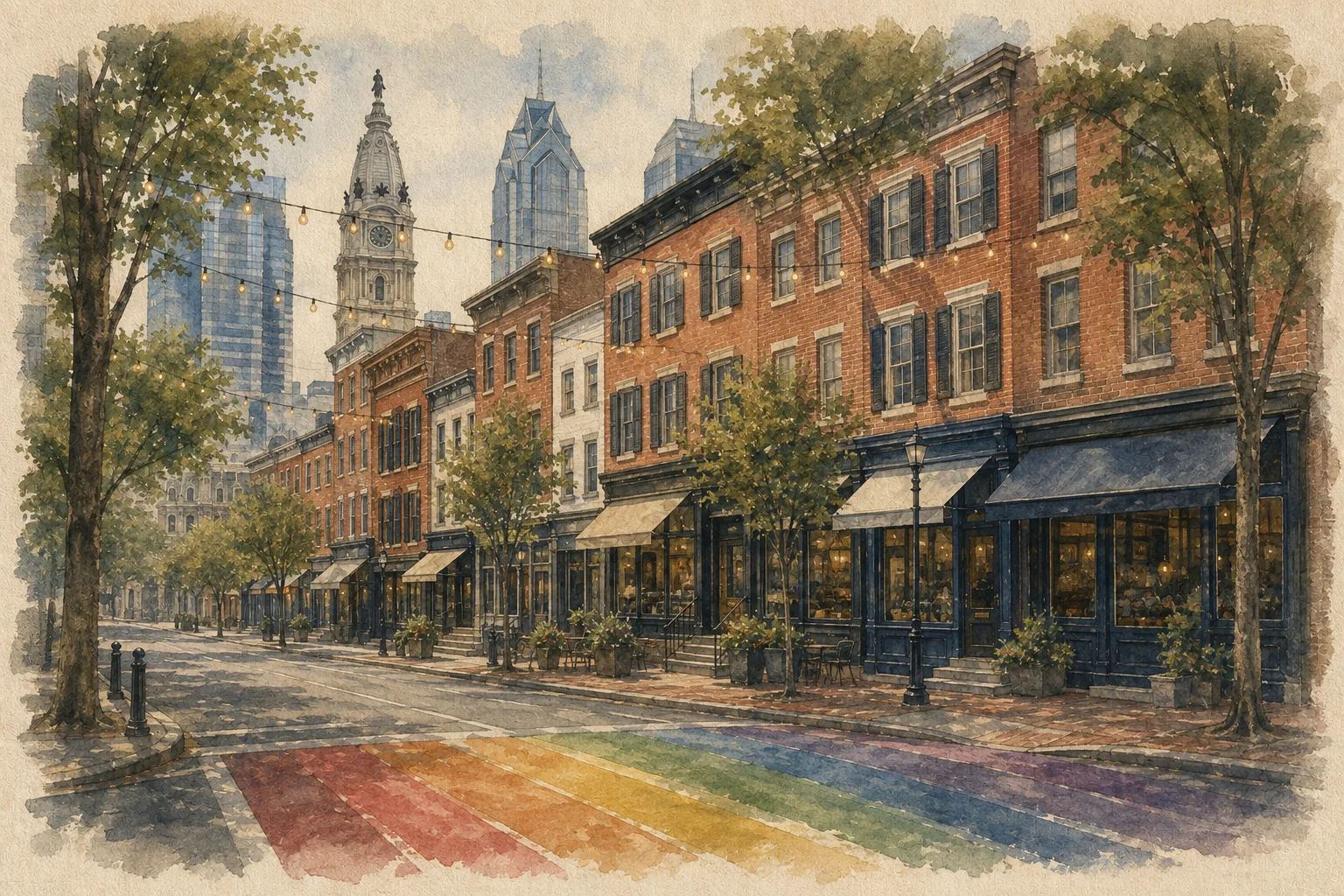
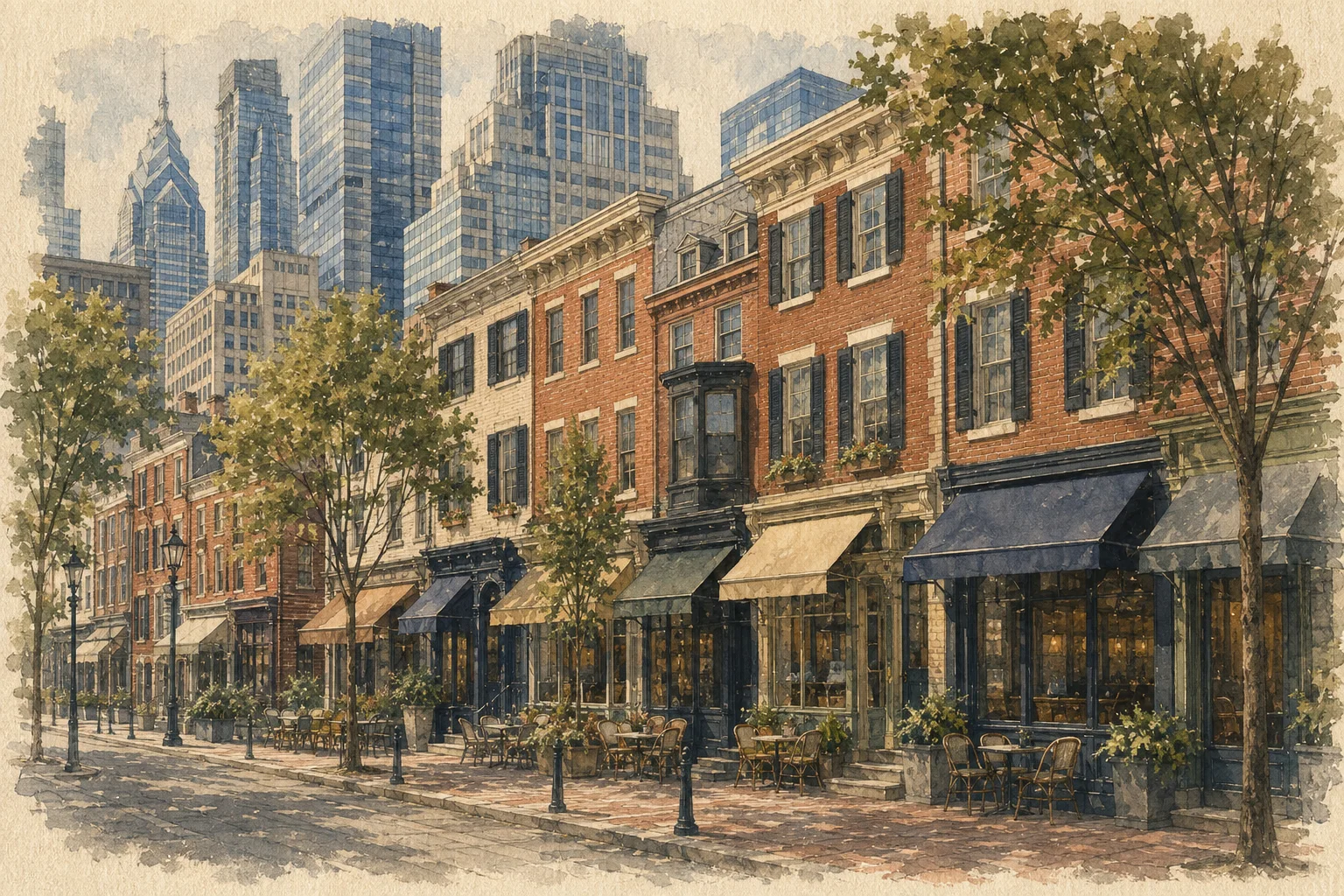
The Gayborhood doesn’t look like anywhere else in Philly because it was never meant to match. Every block here is a conversation between centuries, 19th-century brick facades pressed up against modern glass, weathered cornices shadowing rainbow crosswalks. That mismatch is the point. This is the part of Center City that aged without erasing itself.
Walk down 13th Street and you’ll see it in layers: the narrow rowhouses that survived demolition, the boutique hotels built from what used to be tenement apartments, the murals blooming along alley walls like exclamations. The mural behind Graffiti Bar, a wash of color, steel, and faces, has become a landmark of its own. It feels unplanned, like most things here, but it’s what gives the neighborhood its pulse.
To outsiders, it can feel “European” with the tight streets, the bistro tables, the spontaneous outdoor chatter. But locals will laugh at that. “It’s just Philly being small,” one resident said. The truth is, this place never tries to impress you; it just shows up. Even the construction sites, with their plywood fencing and spray-painted notes, somehow fit. The Gayborhood wears its chaos like character. Every renovation is a gamble, every facade a time capsule, every window reflection a reminder that the city is rebuilding itself, one stubborn brick at a time.
The Love and the Grit
If you spend enough time here, you realize the Gayborhood runs on two fuels: pride and patience. Pride in being one of the few neighborhoods that stayed unmistakably queer in a city that changes faster than it repairs potholes. Patience, because surviving here means accepting the imperfections, like the noise, the mess, the city fees, the endless construction, and loving it anyway.
Ask any local what keeps them here, and they’ll tell you: it’s the people. The baristas who remember your oat-milk order, the drag performers who wave from a corner before heading to rehearsal, the small-biz owners who’ve watched three mayors come and go but still open every morning at 7. It’s the resilience that defines Philly’s soul, magnified on this one tiny grid of streets.
But love here doesn’t mean blind loyalty. Locals complain loudly about the trash, the tone-deaf developers, but they do it because they care. This neighborhood isn’t polished, but it’s alive. It has that raw, emotional honesty that other cities try to bottle. You feel it most on humid summer nights, when music leaks from Time’s open doors and laughter rolls down Locust Street. That’s when you understand: this isn’t just nightlife. It’s survival wrapped in joy.
The Unwritten Rulebook (Locals’ Survival Code)
There’s no pamphlet for living in the Gayborhood, but there might as well be. Everyone picks up the same rules eventually, the kind that never get posted online but shape how the neighborhood works.
First: call it the Gayborhood. “Midtown Village” might be on Google Maps, but locals hear that and assume you’re just passing through. The name matters because it carries the weight of the people who made this a safe place long before rainbow signage became trendy.
Second: know your corners. Walnut and Sansom are where there’s light, movement, and familiar faces, and that is where people wait.
Third: don’t drive here on weekends. The parking gods do not live in Center City, and the PPA enforces that truth mercilessly. Walk, bike, or train.
Fourth: tip everyone. Bartenders, baristas, drag queens, sound techs, they’re the gears that keep this machine running. A few dollars here isn’t charity; it’s participation.
Fifth: show up. For Pride, for Open Streets, for pop-up markets, even when you’re tired, even when the city didn’t fund it. Presence is the Gayborhood’s protest.
Locals live by these codes not because they were written down, but because they were earned. Every rule comes from a story, someone’s bad night, someone else’s small victory. And that’s what makes this neighborhood feel like home: it’s not a place you visit; it’s a rhythm you learn to move with.
If You’re Moving In: The Six-Month Curve
Everyone who moves into the Gayborhood goes through the same six-month transformation, an unspoken initiation that tests your patience, adaptability, and sense of humor.
Month 1: You’re starry-eyed. The walkability feels like magic; you’re ten minutes from everything that matters. You brunch at Green Eggs Café, buy candles at Paper on Pine, and talk about how “alive” the streets feel. You tell your friends from the suburbs that you’ve found the perfect balance between city grit and charm.
Month 2: Reality hums through the walls. You start noticing the 2 a.m. glass bottles clinking in recycling bins and the 6 a.m. trash trucks that sound like thunder. You download a white noise app and finally understand why your neighbors all own blackout curtains.
Month 3: You learn your first hack. Maybe it’s how to park on Locust without a ticket, or which cashier at MOM’s Organic Market gives you the best produce tips. You stop using “Midtown Village” in conversation because someone corrected you, twice.
Month 4: You find your people. The bartender who remembers your name. The café regulars who nod when you walk in. You stop needing Yelp because word-of-mouth works better here.
Month 5: You get annoyed. The construction noise on 12th. The sidewalk crowd that never moves. The landlord who swears the HVAC works “fine.” You threaten to move to Queen Village but never do.
Month 6: You belong. You can name three drag queens, two parking hacks, and one bouncer who’ll wave you in. You stop flinching at sirens. You don’t hear the noise anymore; it’s just part of the beat. The Gayborhood has absorbed you, and you’ve absorbed it back.
The Real Center of Center City
Here’s the secret that locals never bother to explain to tourists: the Gayborhood is the real heart of Center City. Rittenhouse might have the money, Old City might have the history, but the Gayborhood has the pulse, the place where Philly breathes loudest and truest. It’s where worlds overlap without apology. You’ll see a Jefferson Hospital nurse on her lunch break next to a drag performer in full makeup buying coffee. A tech startup founder sharing a smoke with a kitchen line cook. A 70-year-old man sitting on a stoop telling stories to kids who weren’t even born when the rainbow crosswalks went in.
This is where Philly’s contradictions coexist without collapsing. It’s the square of the city that refuses to sanitize itself for anyone’s comfort. You can feel that authenticity in the uneven sidewalks, the graffiti tags that no one rushes to clean, and the small businesses that open because someone decided to try anyway.
When people talk about Center City, they’re usually describing something polished, predictable, and safe for tourists. But when locals say “Center City,” they mean this block, the part that’s still rough, still proud, still shouting above the noise.
Stand at 13th and Locust on a Friday night. Hear the hum of conversation, the mix of jazz from Time, the laughter spilling out of Fergie’s Pub, the faint pulse of a drag show upstairs somewhere. That’s not just nightlife. That’s Philadelphia’s identity condensed into one square mile.
This is where the city stops pretending and starts feeling alive. And if you stay long enough, you’ll start feeling that way too.
The Block That Refuses to Fade
Every neighborhood in Philadelphia has a story, but the Gayborhood’s isn’t written in bronze plaques or museum placards. It’s written on the walls, in the chalk menus that wash away every night and the posters stapled to light poles for shows that already happened. This place is never finished, and that’s its beauty.
For twenty years, city planners and developers have tried to name it, tame it, reshape it. They built condos, rebranded corners, slapped “Midtown Village” onto websites hoping to sell a softer version of the block. But the Gayborhood always pushes back. It changes shape, not soul. The people here refused to let the lights dim. They invented Open Streets, turned patios into mini-parades, and built new rituals from scratch.
Every night, this place proves it doesn’t need permission to exist. You see it in the drag queens still waving from bar stoops, the old-timers sitting outside Fergie’s Pub nursing a pint, the college kids who come out every weekend to find something bigger than themselves. You hear it in the jazz from Time, in the laughter from the DanDan patio, in the clang of a SEPTA bus rolling by like background percussion.
There’s grit under the glitter here, always has been. The same streets that sparkle on Friday nights are still the ones you’ll see volunteers sweeping on Sunday morning. That’s the cycle, the resilience, that defines Philly. The Gayborhood doesn’t pretend to be perfect. It just refuses to fade.
Ask anyone who’s stayed long enough, and they’ll tell you: this block holds a kind of love you can’t buy or brand. It’s loud, stubborn, heartfelt, and messy in all the right ways. You don’t visit the Gayborhood to escape the city. You come here to remember what makes it alive.
And maybe that’s the real legacy of this place. Not the festival banners, not the rainbow crosswalks, not the rebranding battles, but the heartbeat that keeps going, even when the music stops. The people here rebuild joy every weekend, sweep up the pieces, and do it again.
That’s Philadelphia in miniature: imperfect, unfiltered, unforgettable. The block that refuses to fade.
Make it yours
Your Midtown Village notes
A short list to turn what you read into your own next steps.
Saved checks stay on this device when browser storage is available. This is a personal planning list, not a property inspection or professional assessment.
Sources & next steps
Useful advice should
show its working.
These resources support the reader tools above and help you check details for your own address, date, or plans.
- SEPTA trip planner
Plan your date, direction and return journey; check service and accessibility details.
- Philadelphia Atlas
Look up an address and review available City property records.
- William Way LGBT Community Center
Check the Center’s own program and visitor updates.
These planning tools distinguish a visit from a housing decision. They do not establish current venue policies or a single community viewpoint.
Keep exploring