A little orientation
Plan a day at the South Philly sports complex
Confirm the actual venue.
Use your ticket and the host’s current information rather than an older venue name or a generic sports-complex address.
Check the wider calendar.
Look for other scheduled events before planning the day, but do not turn a calendar entry into a guaranteed traffic delay.
Use the current station name.
SEPTA’s reviewed Broad Street Line schedule names the sports-complex terminus NRG Station; check current service for your actual date.
A closer look
Before, during and after the event
The same checklist works for a game or performance when the details come from that event’s host.
Look beyond one ticket.
Use the Sports Complex Special Services District’s linked calendar to see what is listed for your day. Confirm the relevant events with their hosts, then allow room to adjust your arrival without assuming every event produces the same movement or delay.
A useful questionWhat else is scheduled, and which host details affect your own plan?
Source & next step ↗Plan using NRG Station.
Use SEPTA’s current Broad Street Line schedule for NRG Station when planning a sports-complex trip. Check your date, direction and return arrangements before leaving; the former AT&T name in older material should not guide your current station search.
A useful questionWhich service will you use to arrive, and what is your return option?
Source & next step ↗Read the rules for your venue.
For Lincoln Financial Field, use its own visitor information to check the event entrance and relevant policies. If your ticket is for another venue, follow that host’s instructions instead; admission, bags and collection arrangements should come from the actual organizer.
A useful questionWhat does your event’s host require before you arrive at the entrance?
Source & next step ↗Philadelphia’s Stadium District is one of the city’s most unusual places to live because daily life here depends heavily on the event calendar. Around Broad & Pattison, the area can feel quiet, open, and parking-lot heavy on an ordinary weekday, then completely transform during an Eagles game, Phillies playoff night, concert, or major event at the South Philly Sports Complex. This local guide from Hometress breaks down what it is actually like near Lincoln Financial Field, Citizens Bank Park, Wells Fargo Center, Xfinity Live, Stateside Live, Live! Casino, NRG Station, Pattison Avenue, and Packer Avenue, with practical insight into parking, transit, crowds, tailgating, noise, development, and what potential residents should know before moving nearby.
Stadium District Is Not a Normal Neighborhood
Philadelphia’s Stadium District does not behave like most neighborhoods in the city. It does not have the steady daily rhythm of East Passyunk, the dense rowhouse feel of Lower Moyamensing, or the restaurant-and-retail flow you find farther north in South Philly. Around the South Philadelphia Sports Complex, daily life is shaped by the event calendar first. Before you judge the area, you have to know whether you are seeing it on a quiet weekday, an Eagles Sunday, a Phillies playoff night, a major concert evening, or a weekend when more than one venue is active at the same time.
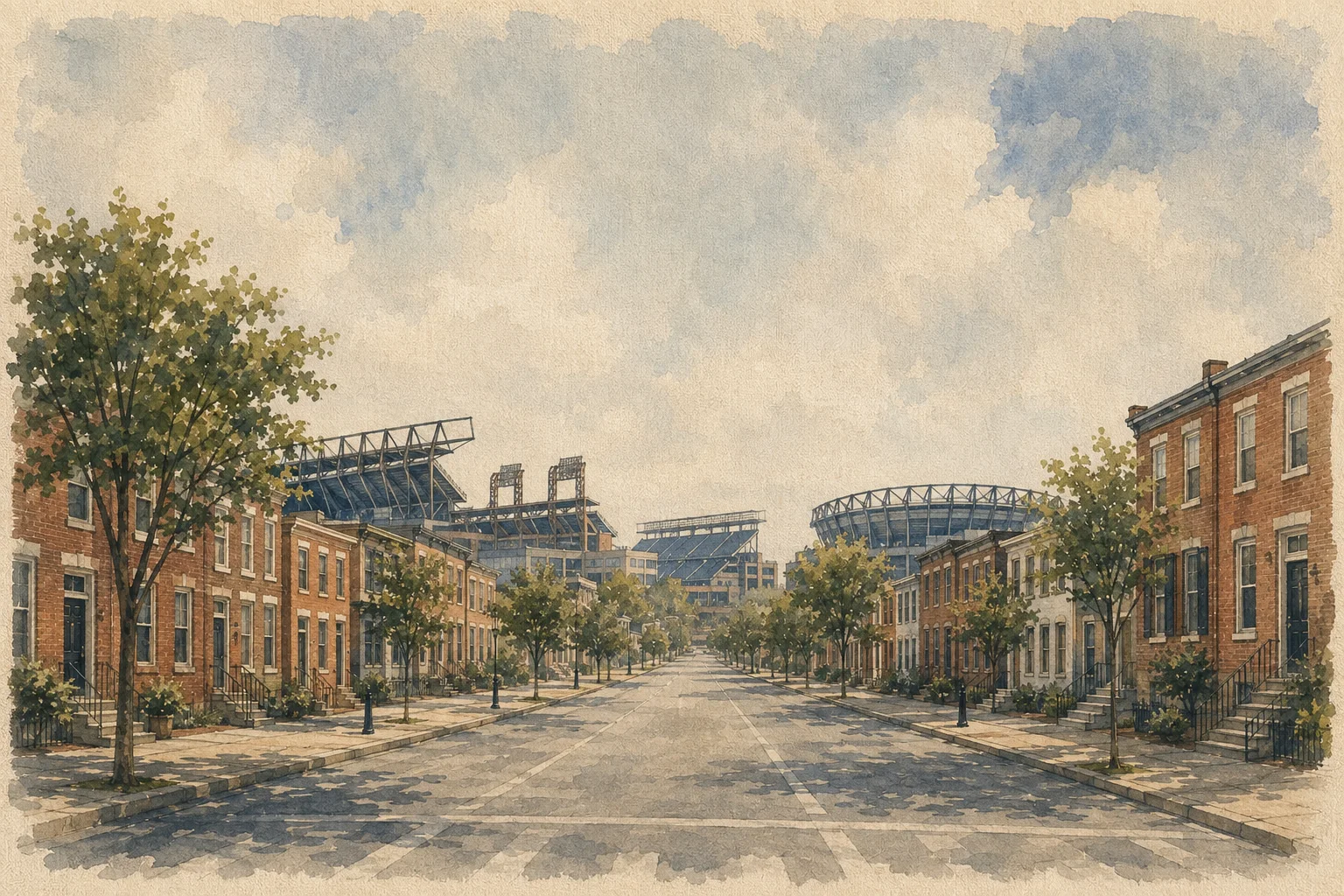
The mental center of the district is Broad & Pattison. From there, the whole area spreads out around Lincoln Financial Field, Citizens Bank Park, Wells Fargo Center, Xfinity Live, Stateside Live, Live! Casino & Hotel Philadelphia, NRG Station, Pattison Avenue, Packer Avenue, and the huge parking lots that sit between the venues. On a calm weekday, the district can feel wide open, industrial, and almost unfinished. You may notice more pavement than people, more stadium walls than storefronts, and more car infrastructure than neighborhood street life. It can feel strangely quiet for a place that is known across the city.
Then the schedule changes, and the same place becomes completely different. When the Eagles are home, when the Phillies are in Red October mode, when Wells Fargo Center has a packed concert, or when the city is preparing for major events like the World Cup, the district stops feeling empty. The lots fill, the sidewalks thicken, the Broad Street Line gets heavier, and the bars around the complex start absorbing crowds before the gates even open. A corner that felt empty earlier in the week can become a meeting point. A lot that looked like plain asphalt can become a tailgate zone. A short drive that looked harmless on a map can become the slowest part of the day.
That is the first thing to understand if you are thinking about living here or spending serious time here. Stadium District is not judged accurately in one visit. It is a place with two realities: the quiet, spacious, eventless version and the loud, crowded, high-energy version that most people associate with Philly sports. Whether you love it or regret moving near it depends on how well you understand that shift.
Where Stadium District Actually Is
Stadium District sits at the southern end of Broad Street around the South Philadelphia Sports Complex. For search purposes, “Stadium District” is useful, but many locals are more likely to describe the area by what they are going there for. Someone might say they are heading to the sports complex, going down to The Linc, catching a Phillies game at Citizens Bank Park, going to Xfinity, or taking the Broad Street Line to NRG Station. The formal neighborhood name matters, but the local language is usually tied to the venues.
Broad & Pattison is the easiest anchor. NRG Station sits there as the final southbound stop on the Broad Street Line, making it the main transit gateway for people coming from Center City, North Philly, South Philly, or anywhere that connects to the subway. From that point, Lincoln Financial Field is the big Eagles landmark, Citizens Bank Park sits nearby for Phillies games, and Wells Fargo Center pulls in Flyers, Sixers, concerts, family events, and arena shows. Xfinity Live and Stateside Live serve as the obvious pregame and postgame entertainment zone, while Live! Casino & Hotel Philadelphia adds a hotel, casino, restaurants, and late-night activity to the district.
Pattison Avenue and Packer Avenue matter because they help define how people actually move around the area. Pattison is tied closely to the stadium entrances, NRG Station, and the pedestrian flow between the subway and the venues. Packer Avenue is more of a practical edge, connecting the sports complex to bars, hotel access, Live! Casino, and some of the development conversations happening around the district. If you hear people talk about Packer and 7th, they are usually talking about the side of the district where new development and neighborhood impact start to feel more concrete.
The district also brushes up against other South Philly reference points. FDR Park is nearby, which gives residents and visitors a major green-space anchor just outside the stadium environment. The Navy Yard sits farther south and east as another major destination that affects traffic, commuting, and the wider identity of this part of the city. The airport is also close enough that some hotels around the district serve both airport travelers and stadium visitors.
Still, the core of Stadium District is not a row of restaurants or a traditional residential corridor. It is the cluster of stadiums, lots, transit, entertainment venues, and event infrastructure around Broad & Pattison. That is why maps alone do not explain it well. To understand the area, you have to understand what happens when 40,000, 60,000, or more than 100,000 people start moving through it at the same time.
Where Stadium District sits
- NRG Station
- Pattison Avenue
- Packer Avenue
- FDR Park
Schematic · not to scale
The Two Versions of Stadium District: Event Day vs. Everything Else
Stadium District has two completely different personalities. The first version is the one you see when nothing major is happening. On those days, the area can feel quiet, spread out, and oddly empty. The buildings are massive, but there may not be much street life around them. The parking lots dominate the view. The walk between places can feel longer than it looks because you are moving through open pavement, wide streets, fences, venue walls, and large-scale infrastructure instead of small storefronts and shaded blocks. If you visit only on an off-day, you may wonder why anyone talks about the district with so much intensity.
That quiet version matters for people thinking about moving nearby. It can be a positive if you like space, access to transit, proximity to FDR Park, and the ability to live near major venues without constant weekday crowds. It can also feel underwhelming if you expect the everyday walkability of other South Philly neighborhoods. Outside of event windows, the district is not built around casual wandering. You do not step outside and immediately get the same mix of corner bars, coffee shops, restaurants, stoops, and rowhouse density found in older residential parts of South Philly.
The second version appears when the venues turn on. On an Eagles Sunday, the parking lots stop being empty space and become part of the event. People arrive early, set up coolers and grills, meet friends, play music, and turn the lot into a pregame scene. Around Citizens Bank Park during a Phillies playoff run, the energy is different but just as noticeable. Red October brings its own rhythm, with fans moving through the area in waves before and after the game. On concert nights at Wells Fargo Center or Lincoln Financial Field, the crowd may feel less like a local sports ritual and more like a citywide or regional rush of visitors trying to park, meet up, eat, and get inside on time.
The same sidewalk, bar, or parking lot can feel easy on one day and impossible on another. Xfinity Live or Stateside Live might be manageable when there is no major event, then packed before a big game. A route that feels empty on a weekday can become slow and crowded when thousands of people are walking from NRG Station. A parking lot that looks like nothing special on a quiet afternoon can be someone’s regular tailgate spot during football season. That is why locals often judge the area by timing, not distance.
The biggest stress happens when multiple venues are active. A Phillies game, an arena event, and a casino or nightlife crowd can overlap in ways that make traffic, parking, rideshare, and restaurant waits much worse. The district can absorb big crowds, but it does not do so quietly. Drivers stack up at exits. Pedestrians flood crosswalks. SEPTA platforms get packed. Rideshare pickup becomes frustrating. Bars and restaurants fill earlier than expected. A visitor who planned the day based only on mileage may be surprised by how different the area feels once the event crowd arrives.
For someone interested in moving here, this two-version reality is the main thing to test. You should not tour the area only during a calm afternoon and assume that is the full experience. You also should not visit only during an Eagles game and assume it is always that loud. Stadium District is both of those places. The question is whether you are comfortable living in a neighborhood where the calendar controls the atmosphere.
What Locals Mean When They Say “Check the Schedule First”
In many Philadelphia neighborhoods, checking the weather or traffic is enough before heading out. In Stadium District, the more important question is what is happening at the sports complex. The event schedule changes everything. It affects parking, traffic, train crowds, restaurant waits, rideshare prices, noise, and how easy it feels to move through the area. A regular Tuesday and a playoff Tuesday do not belong in the same category.
That is why “check the schedule first” functions like an unwritten rule. It applies to residents, workers, visitors, hotel guests, and anyone thinking about moving nearby. If the Eagles have a Sunday 1 PM home game, the morning and early afternoon will build around tailgating, parking, and fan arrival. If there is Monday Night Football, the area carries more late-night energy, heavier postgame exits, and more noise after a normal workday. If the Phillies are in a playoff series, the crowd may arrive with a different intensity than a regular summer game. If Wells Fargo Center has a weeknight concert, people who do not normally go to the sports complex may still be driving in at rush hour. If multiple venues overlap, every normal assumption gets worse.
The schedule also changes how nearby businesses feel. A bar or restaurant that is relaxed on an ordinary night may become packed before a game. An obvious place like Xfinity Live or Stateside Live can go from convenient to overwhelming once thousands of people decide it is the easiest meeting point. Stadium concessions and nearby dining options also become part of the timing game. If you wait too long, you may spend more time in line than eating.
For residents, the schedule affects daily planning. Guests coming over during a major event may struggle to park. A quick errand can take longer if traffic is being routed around the stadiums. Noise may linger later after concerts, casino nights, or evening games. Even walking near the area can feel different when crowds are moving between NRG Station, the lots, and the venues.
For potential movers, this is one of the most important tests. Visit during a quiet weekday, but also visit during a major event. Walk the same route both times. Look at parking both times. Notice how the noise changes. Pay attention to whether the crowd energy feels exciting or exhausting. Stadium District rewards people who understand the calendar, and it frustrates people who treat it like a normal neighborhood with normal daily patterns.
Parking Is the District’s Biggest Frustration
Parking is the issue that comes up again and again around Stadium District. Even people who love the sports complex usually have a parking story, a parking warning, or a parking strategy. It is the one part of the experience that affects almost everyone who drives in, whether they are going to an Eagles game, a Phillies game, a concert, a casino night, or a packed weekend with more than one venue active.
The official stadium lots are the simplest option, but they are not always the easiest option to accept. Event parking can be expensive, and the cost feels even heavier when it gets added to tickets, food, drinks, and the rest of the day. For people coming in from the suburbs or bringing tailgate gear, paying for a stadium lot may feel unavoidable. For others, especially people who only need to attend the event and leave, the price can make them start looking for alternatives.
That is where the local parking game begins. People search for free parking, cheaper parking, side-street parking, and walking-distance parking that avoids the official lots. Some of that advice gets passed around quietly because the best spots can stop being useful once too many people know about them. A parking tip in this district is not always just a tip. It can be local currency. If someone knows a way to avoid the worst exit, dodge the most expensive lot, or get close enough without paying official prices, they may not want that information spread too widely.
The problem is that parking hacks can easily create tension with residents. A visitor may see a nearby residential block as a clever workaround. The people who live there may see it as strangers taking over the street every time the Eagles are home or Citizens Bank Park fills up. That is one of the most important differences between visiting Stadium District and living near it. For fans, the parking problem ends when they drive away. For residents, it repeats with every major event.
PPA anxiety also sits in the background of parking decisions. In Philly, parking enforcement is not an abstract concern. People think about whether a spot is legal, whether the rules change during events, whether a block gets watched more closely, and whether saving money on a parking lot could turn into a ticket or tow. That fear makes official parking more attractive for some people, even if they hate the price.
Regulars also know that lot letters matter. A first-time visitor may see the stadium lots as one giant parking field, but frequent fans know that the lot you choose can shape the whole day. Some lots are better for tailgating. Some are better for meeting friends. Some may feel easier for getting out depending on where you need to go after the game. A spot that looks close to the gate may not be the best spot if it traps you in slow-moving traffic later.
That is why parking in Stadium District is never just about distance. It is about cost, timing, enforcement, tailgating, neighborhood impact, and exit strategy. For anyone thinking about moving nearby, parking should be tested during a real event, not just during an apartment tour on a quiet afternoon. A block that looks easy on a weekday can feel completely different when the lots are full and fans start searching for cheaper options.
Tailgating: The Culture Locals Protect
Tailgating is one of the strongest cultural forces in Stadium District. To outsiders, the parking lots may look like empty pavement around big venues. To many Philly sports fans, those same lots are part of the reason the district matters. They are where people meet before the game, set up chairs, open coolers, grill food, play music, talk trash, and settle into the day long before they walk through a stadium gate.
This is especially true for Eagles games. The phrase “Go Birds” carries more weight around The Linc because the whole area starts to feel like a shared ritual. People arrive early not only to avoid traffic but because the pregame is part of the experience. The lot becomes a temporary neighborhood made of tents, grills, folding tables, jerseys, speakers, and friends who may have been meeting in the same general area for years. For longtime fans, the routine itself can feel almost as important as the game.
Tailgating also explains why parking lots are emotionally important in a way that can confuse people who only look at the land from a planning perspective. Urbanists may see too much asphalt and ask why the area is not filled with apartments, retail, parks, restaurants, or better pedestrian streets. Many fans see the same asphalt as the space that makes Philly sports feel like Philly sports. The disagreement is not only about land use. It is about what people think the district is supposed to protect.
The conflict becomes clearer when you look at the resident side. What fans experience as tradition can feel very different to people living nearby. Tailgating can mean noise, public drinking, trash, blocked streets, and crowds moving through areas that are not built like entertainment corridors. A fan may remember the food, music, and chants. A resident may remember the bottles, parking pressure, late-night noise, and cleanup.
This tension is one reason development plans around the Stadium District get so much reaction. When proposals talk about turning parking lots into a year-round entertainment district, apartments, retail, offices, hotels, or performance venues, supporters see a chance to make the area more active and useful outside of games. Skeptics see a threat to the lot culture that has defined the sports complex for decades. The question becomes whether Stadium District should become a more polished urban district or whether that polish would erase the messy, loud, informal culture people came for in the first place.
For anyone moving nearby, tailgating is not background noise. It is part of the local rhythm. You do not have to participate in it, but you have to understand it. During football season especially, the lots are not just storage for cars. They are where the district’s identity starts.
Food, Bars, and Where People Actually Go Before or After Events
Food and bars around Stadium District fall into two broad categories: the obvious choices and the more local-feeling choices. Both can be useful, but they serve different moods. If you are new to the area, it is easy to assume the closest or biggest place is automatically the best choice. Around the sports complex, closest often means most crowded, most expensive, or most affected by the event schedule.
The obvious pregame and postgame anchor is Xfinity Live, now tied into the broader Stateside Live identity. For many visitors, it is the easiest meeting point because it sits right in the action. You do not have to explain much. People know where it is, it is built for crowds, and it gives groups a simple place to gather before heading to The Linc, Citizens Bank Park, or Wells Fargo Center. During big events, that convenience is also the problem. Lines, cover charges, packed rooms, high drink prices, and crowd noise can turn the easiest option into the most exhausting one.
Live! Casino & Hotel Philadelphia adds another layer to the district’s food and nightlife scene. It gives visitors indoor dining, casino entertainment, hotel access, and a place to extend the night beyond the event itself. For someone staying nearby or trying to avoid moving the car again, that can be useful. The tradeoff is that casino dining and branded entertainment do not always feel like a local South Philly experience. They solve the convenience problem more than the authenticity problem.
Stadium concessions are part of the event too, especially at Citizens Bank Park, where ballpark food is part of the rhythm for many visitors. But like most stadium experiences, price and lines matter. The food may be part of the fun, but it is rarely the cheapest way to eat. The same applies to many obvious event spots around the complex. Places like Chickie’s & Pete’s-type bars or large sports-focused venues can feel natural before a game, but on a big day, they may also be crowded enough that timing becomes the real decision.
The more local-feeling choices sit slightly outside the most obvious event path. Philadium on Packer Avenue comes up as the kind of place people mention when they want something that feels less like a branded district and more like a South Philly sports bar. Stadium Pizza fills a different role: casual, close, simple, and useful when you want something easy rather than a full event-scene experience. Nearby South Philly food options, especially roast pork, hoagie, and neighborhood-bar type stops, can give people a better sense of place than staying only inside the stadium bubble.
The real local advice is that “near the stadiums” does not always mean the same thing as “best for your night.” If you are meeting a big group and want the obvious landmark, Xfinity or Stateside may make sense. If you want convenience without leaving the district, the casino and stadium venues may work. If you want something that feels more connected to South Philly, you may need to look beyond the biggest names and think about timing, walk distance, and whether the place will be slammed.
For potential residents, the food and bar scene is worth judging carefully. Stadium District does not have the same everyday restaurant density as other South Philly neighborhoods. It has event-driven options, big branded anchors, and scattered local spots that matter more when you know when to use them. The better you understand the schedule, the better the food and bar experience gets.
Where people actually go before and after
The guide splits the district's food and drink into the obvious anchors and the more local-feeling stops.
Xfinity Live and Stateside Live
The easiest meeting point because it sits right in the action, and built for crowds heading to The Linc, Citizens Bank Park or Wells Fargo Center. On a big event day the same convenience turns into lines and packed rooms, so timing becomes the real decision.
Best for · Big groups who want a landmark nobody has to explain
Live! Casino & Hotel Philadelphia
Adds indoor dining, casino entertainment, hotel access and a place to extend the night beyond the event itself. Useful if you are staying nearby or trying to avoid moving the car again.
Philadium
The place people mention when they want something that feels less like a branded district and more like a South Philly sports bar.
Stadium Pizza
Casual, close, simple, and useful when you want something easy rather than a full event-scene experience.
Living Near the Stadiums: What Residents Deal With
Living near Stadium District can be convenient in ways that are hard to find elsewhere in Philadelphia. You are close to the city’s biggest sports venues, close to major concerts and events, close to the Broad Street Line at NRG Station, and near useful edges like FDR Park, the Navy Yard, the airport corridor, and deeper South Philly. For someone who loves sports, works nearby, uses transit, or enjoys being close to major events, the location has obvious appeal.
The tradeoff is that the neighborhood does not fully belong to residents on event days. When the stadiums are active, thousands of people who do not live there suddenly move through the area. They park, tailgate, drink, eat, wait for rides, walk to and from the subway, and sometimes spill into nearby blocks. A quiet street can become overflow parking. A simple drive can get tangled in event traffic. A calm evening can turn louder than expected because a concert or night game just let out.
Parking is often the most personal issue for residents. Visitors may only think about whether they can find a spot, but people who live nearby think about whether they can keep access to their own block. When fans try to avoid paid stadium lots, nearby streets can become targets. That creates frustration because the burden falls on residents who may have nothing to do with the event.
Noise is another repeated part of the experience. Stadium sound, fan movement, late-night crowds, cars, music, casino traffic, and people returning from bars or games can all affect the area differently depending on the event. It may not be constant every night, but when it happens, it can feel intense. The same is true for trash and public drinking. What feels like a fun tailgate to a visitor may leave behind a mess that residents notice after everyone else has left.
The area can feel calm between events, which is why touring it only on a quiet day can be misleading. You might see open roads, easy parking, and a lot of space. That version is real, but it is incomplete. The event-day version is just as real. Anyone thinking of moving nearby should visit during a major game or concert before making a decision. Walk the area. Watch the traffic. Look at where people park. Pay attention to how sound travels. See how the crowd moves between the lots, venues, NRG Station, and nearby streets.
For the right person, living near the stadiums can be exciting. You are close to the action, close to transit, and close to some of the biggest moments in the city’s sports calendar. For someone who values predictable quiet, easy street parking, and a traditional neighborhood feel every day of the week, the district can be frustrating. The key is knowing which version of Stadium District you are signing up for.
Safety, Noise, and Late-Night Feel
Safety in Stadium District is best understood as situational. It is not the single biggest theme in the local experience, at least compared with parking, traffic, crowds, and noise. Still, the area can feel very different depending on when you are there, which route you take, and what kind of event just ended.
During major games and concerts, large crowds can make the area feel active and watched. There are more people around, more staff, more traffic control, and more visible movement between the venues, lots, and NRG Station. For some people, that makes the district feel safer because they are rarely alone. For others, the size and energy of the crowd can feel overwhelming, especially after a night game or a concert when people are tired, loud, drinking, or trying to get home at once.
The quieter version of the district creates a different feeling. On a non-event night, walking through large lots or along industrial edges can feel exposed. The scale of the buildings and the width of the roads can make the area feel less intimate than older South Philly blocks. It may not feel dangerous, but it can feel empty in a way that surprises people who only know the district from packed game days.
Noise is often the more reliable concern. Event noise, traffic, fans leaving games, casino and nightlife crowds, hotel activity, highway sounds, and occasional late-night movement all shape the area. A resident near the edge of the district may care less about whether the neighborhood is generally safe and more about whether a Monday night game will send noise down nearby blocks after bedtime.
For potential movers, the smartest approach is to test the area at different times. Visit during the day, after dark, during a quiet evening, and after a major event if possible. Notice how it feels walking from NRG Station, how the lots feel when they are empty, how the streets feel when the crowd is moving, and whether the late-night atmosphere matches your comfort level. Stadium District is not one consistent late-night experience. It depends on the calendar, the crowd, and exactly where you are standing.
Why Everyone Argues About the Future of Stadium District
The future of Stadium District is one of the biggest reasons people argue about the area. For decades, the sports complex has been defined by stadiums, arenas, wide roads, and huge parking lots. That setup works for certain things. It gives fans space to drive in, park, tailgate, and move between venues. It keeps the city’s largest event crowds concentrated in one area. It also leaves large parts of the district feeling empty or underused when there is no game, concert, or major event.
Now the district is moving toward something more layered. The expansion of Stateside Live, the presence of Live! Casino & Hotel Philadelphia, and the larger mixed-use plans around the sports complex all point in the same direction: more year-round activity. Instead of a district that wakes up mostly for games and concerts, developers and supporters want a place with restaurants, bars, hotels, apartments, offices, entertainment venues, public spaces, and more reasons to visit even when the Eagles, Phillies, Flyers, or Sixers are not playing.
Stateside Live is part of that shift.
Features like outdoor gathering areas, beer garden-style spaces, rooftop concepts, and branded nightlife create a more polished entertainment district around the stadiums.
For visitors, that can be convenient. It gives people a place to meet before the game, stay after the event, or make a full night out of being at the sports complex. Live! Casino adds another anchor, especially for people who want dining, gambling, hotel access, and late-night activity without leaving the area.
The bigger debate comes from the mixed-use plans around the district. Comcast Spectacor’s vision for the area around the former Spectrum site points toward a fuller sports and entertainment district with major commercial, residential, hotel, retail, and performance-space components. Stadium Square around Packer Avenue and 7th Street adds another layer to the conversation, with apartments, retail, and office space entering a part of South Philly long associated with event parking and stadium infrastructure. Once apartments, hotels, offices, and new venues become part of the plan, the district stops being only a sports campus and starts becoming a new kind of neighborhood.
Supporters see this as overdue. To them, the current landscape wastes valuable land. Large parking lots may work on game days, but they sit quiet much of the year. More housing, restaurants, public spaces, and entertainment could make the area feel alive outside of the event calendar. It could give visitors more to do, workers more services nearby, and residents more everyday options. It could also make the district feel less like an isolated sports complex and more like a real urban place.
Skeptics see a different future. They worry that the district will become more crowded, more expensive, and more corporate. If parking lots disappear, tailgating changes. If more apartments and entertainment venues arrive, traffic may spread beyond game days. If the area becomes more polished, some fans fear it will lose the rough, informal, parking-lot culture that made South Philly sports feel distinct in the first place. What planners call better land use, oldhead fans may read as the slow removal of tradition.
Residents have their own concerns. More year-round activity can mean more noise, more traffic, more people searching for parking, more late-night movement, and more pressure on nearby blocks. A quiet non-event night may become less common if the district adds more reasons for crowds to gather. That is why the debate is not simply pro-development versus anti-development. It is about what kind of daily life the area should have, who benefits from the changes, and who absorbs the inconvenience.
The future of Stadium District depends on whether it can become more active without making its existing problems worse. More restaurants, hotels, apartments, and entertainment could make the area stronger. They could also make parking, traffic, prices, and neighborhood tension more intense. That is why every new proposal around Packer Avenue, the former Spectrum site, Stateside Live, or the casino area gets judged against the same local questions: what happens to tailgating, where do the cars go, who pays more, and does this still feel like South Philly?
Eagles Sundays, Red October, Concert Nights, and World Cup Energy
Stadium District does not run on a normal neighborhood calendar. It runs on micro-seasons. The same streets, lots, bars, and transit stops change depending on which team is playing, what time the event starts, and how much emotional weight the event carries.
Eagles season brings the loudest identity. On home Sundays, especially around The Linc, the district feels like it belongs to the Birds. Tailgating starts early, the lots become social space, and “Go Birds” is less a slogan than a shared password. A Sunday 1 PM game has a different rhythm than a prime-time game. Afternoon games build earlier and empty earlier. Night games stretch the noise and traffic later, which matters more for residents, hotel guests, and anyone trying to move through the area after dark.
Red October changes the mood around Citizens Bank Park. Phillies playoff energy is different from football energy, but it still transforms the district. The crowd feels tense, hopeful, and celebratory in its own way. Bars fill differently. Families, longtime baseball fans, out-of-town visitors, and casual playoff crowds mix together. A regular summer Phillies game may feel relaxed compared with the pressure and volume of a postseason night.
Concert nights create another version of the district. The crowd may not know the sports complex as well as Eagles or Phillies regulars. People arrive from different parts of the region, often focused on parking, rideshare, entry lines, and finding their friends. Concert visitors may not have tailgate routines or local shortcuts. That can make movement feel more confused, especially around Wells Fargo Center or Lincoln Financial Field when a major show draws a big crowd.
Casino and nightlife activity adds a softer but more constant layer. Live! Casino and Stateside Live can keep people in the area later or bring visitors when there is no traditional game-day crowd. That kind of activity matters for residents because it can spread the district’s impact beyond the obvious sports calendar.
World Cup 2026 brings a different kind of pressure. International visitors, soccer fans, temporary stadium adjustments, signage needs, transit demand, hotel demand, and match-day movement will test the district in a way normal Philly sports events do not. Local fans know the unwritten rules of the sports complex. World Cup visitors may not. That means the district will need to be more legible to people who do not know Broad Street, NRG Station, Pattison Avenue, Packer Avenue, or which areas become jammed after events.
The most intense days are when events overlap. A Phillies game, an arena event, casino traffic, and a major bar crowd can make the district feel much larger than its map footprint. That is why asking what Stadium District is like without asking when you are there leads to the wrong answer. The district changes by season, team, venue, hour, and crowd.
The calendar that runs the district
Stadium District does not run on a normal neighborhood calendar. It runs on micro-seasons.
Eagles Sundays
Around The Linc the district feels like it belongs to the Birds. Tailgating starts early and the lots become social space. A 1 PM game builds earlier and empties earlier; a prime-time game stretches the noise and traffic later.
Red October
Phillies playoff energy changes the mood around Citizens Bank Park. The crowd feels tense, hopeful, and celebratory in its own way, and bars fill differently than on a regular summer night.
Concert crowds
A different version of the district. The crowd may not know the sports complex as well as Eagles or Phillies regulars, so movement around Wells Fargo Center or Lincoln Financial Field can feel more confused.
World Cup match days
International visitors, soccer fans, temporary stadium adjustments, signage needs, transit demand, hotel demand and match-day movement will test the district in a way normal Philly sports events do not.
When events stack
The most intense days. A Phillies game, an arena event, casino traffic and a major bar crowd can make the district feel much larger than its map footprint.
Who Stadium District Is Best For
Stadium District is best for people who like being close to energy, even if that energy is unpredictable. If you love Philly sports, enjoy the feeling of major events nearby, and do not mind planning around crowds, the area can be exciting. Being close to The Linc, Citizens Bank Park, Wells Fargo Center, Xfinity Live, Stateside Live, and Live! Casino means you are near some of the biggest moments in the city’s calendar. For the right person, that proximity is the whole appeal.
It can also work well for people who value transit access. NRG Station gives the district a direct connection to the Broad Street Line, which can make Center City and other parts of Philadelphia easier to reach without depending on a car every time. If you work near the Navy Yard, the airport corridor, South Philly, or the stadium complex itself, the location may also make practical sense. The area’s wide roads and major destinations can be convenient if your life already points toward this part of the city.
The district may appeal to people who are comfortable with a less traditional neighborhood feel. If you do not need a dense row of coffee shops, boutiques, corner restaurants, and everyday sidewalk activity outside your door, the quieter off-day version may not bother you. Some people may even like the open feel between events, especially if they care more about access than charm.
It is less ideal for people who need predictable quiet. Event-day noise, late-night traffic, tailgating, concerts, casino activity, and postgame movement can all affect the area. It is also not the best fit for someone who depends on easy street parking or wants the same daily routine regardless of the sports calendar. Parking can become stressful when visitors search nearby blocks for cheaper options, and traffic can make simple trips feel harder than they should.
People who want classic South Philly walkability may also feel disappointed. Stadium District has South Philly identity, but it does not feel like East Passyunk, Lower Moyamensing, or the tighter residential blocks farther north. It is larger, more event-driven, more paved, and more dependent on venues than storefronts.
The best fit is someone who understands the tradeoff. You get proximity to big events, transit, sports energy, and major destinations. In exchange, you accept crowd surges, schedule-driven disruption, and a neighborhood rhythm that changes dramatically from one day to the next.
Who Stadium District works for
The guide's own framing: the best fit is someone who understands the tradeoff.
- To be close to energy, even when that energy is unpredictable.
- Proximity to The Linc, Citizens Bank Park, Wells Fargo Center, Xfinity Live, Stateside Live and Live! Casino.
- A direct Broad Street Line connection at NRG Station, so Center City does not need a car every time.
- A life already pointed at the Navy Yard, the airport corridor, South Philly or the complex itself.
- An open, less traditional neighborhood feel on the off-days.
- Predictable quiet — event noise, late-night traffic, tailgating, concerts and casino activity all reach the area.
- Easy street parking, which gets stressful when visitors search nearby blocks for cheaper options.
- The same daily routine regardless of the sports calendar.
- Classic South Philly walkability; this is larger, more paved and more venue-driven than East Passyunk.
What to Do Before Moving Here
Before moving to Stadium District, visit more than once. A quiet weekday visit is useful, but it will not show you the full neighborhood. Walk the area when nothing is happening so you can feel the off-day version: the parking lots, the wide roads, the industrial edges, the distance between destinations, and the amount of everyday street life. Then come back during a major event. An Eagles game, Phillies playoff night, big concert, or multi-venue evening will show you the version residents actually have to plan around.
Check the schedule before touring an apartment. If you only see the area on a calm afternoon, ask yourself how that same block would feel when fans are parking, tailgating, walking from NRG Station, or leaving after a night game. Look at where cars go. Notice whether nearby residential streets seem vulnerable to overflow parking. Pay attention to how easy it would be for your own guests to visit during a game.
Walk the route to NRG Station. If transit access is part of the appeal, test it like you would actually use it. Notice how long the walk feels, how exposed the route is, and how comfortable you feel after dark. If possible, try the route after an event, when the platform and sidewalks are crowded. That will tell you more than a map.
Spend time around Packer Avenue and Pattison Avenue. These corridors help explain how the district functions. Pattison shows the stadium-side movement around NRG Station and the venues. Packer gives you a better sense of the practical edge, where bars, casino activity, development, hotels, and nearby blocks start to matter.
Try food and bar options beyond the obvious venues. Xfinity Live, Stateside Live, Live! Casino, and stadium concessions are useful, but they do not tell the whole story. Check whether you like the nearby local-feeling spots, casual food options, and South Philly alternatives enough to live with the area’s event-driven dining scene.
Visit after dark. Safety and comfort are situational here, so test the area at the times you are most likely to move around. A packed event night, a quiet non-event night, and a late concert exit can all feel different. Listen for noise, watch traffic, and notice how the scale of the lots and roads feels when there are fewer people around.
Most of all, ask yourself whether the calendar-driven lifestyle feels exciting or exhausting. Stadium District can be convenient, but it rewards people who plan around its rhythms.
Stadium District Rewards People Who Understand the Calendar
Stadium District is not defined by one fixed neighborhood vibe. It is defined by timing. The area around the South Philadelphia Sports Complex changes with Eagles Sundays, Phillies playoff nights, concerts, casino activity, World Cup preparation, quiet weekdays, and overlapping event days. Broad & Pattison may look calm one afternoon and feel like the center of the city the next.
For fans and event-focused residents, that energy can be the whole reason to be here. You are close to The Linc, Citizens Bank Park, Wells Fargo Center, NRG Station, Xfinity Live, Stateside Live, Live! Casino, FDR Park, and the South Philly edge of major city life. For people who like proximity to action, the district has a rhythm few places in Philadelphia can match.
For others, the same rhythm can become frustrating. Parking gets expensive or scarce. Residential blocks feel pressure from visitors. Traffic after events can drag. Bars and restaurants can swing from empty to packed. Noise can arrive late, and the district’s industrial, parking-heavy layout may feel less charming than other South Philly neighborhoods.
The best way to understand Stadium District is to stop asking what it is like in general and start asking what it is like on a specific day, at a specific hour, with a specific event happening. If you understand the calendar, the crowds, the parking logic, and the difference between off-days and game days, the neighborhood makes sense. If you do not, it can feel loud, expensive, confusing, and harder to live with than it looked on the map.
Make it yours
Your sports-complex event checklist
A short list to turn what you read into your own next steps.
Saved checks stay on this device when browser storage is available. This is a personal planning list, not a property inspection or professional assessment.
Sources & next steps
Useful advice should
show its working.
These resources support the reader tools above and help you check details for your own address, date, or plans.
- Sports Complex Special Services District information
Find the district’s sports-complex information and linked event calendar.
- SEPTA Broad Street Line schedule
Check the current station names and published service; NRG is the sports-complex terminus in the reviewed schedule.
- Lincoln Financial Field visitor information
Check event access and stadium policies with the venue.
Current SEPTA material reviewed for these tools uses NRG Station. Calendar and venue links support this trip plan, not the article’s wider historical or future-development claims.
Keep exploring