A little orientation
Ask the right questions about a Society Hill home
Identify the proposed work
Check the City's historic-property guidance before assuming a repair needs only an informal neighborhood conversation.
Keep costs property-specific
Ask about the particular condition and work required instead of applying a universal historic-home repair multiplier.
Plan a real market visit
Use Headhouse's operator information for the current vendors and arrangements you intend to rely on.
A closer look
Choose a Society Hill question
Start with a home decision or a routine you would like to make part of the week.
Find the City process
Read the City's historic-property guidance and establish the status of the Society Hill property you are considering. Describe the actual change you want to make, then ask which review applies rather than treating a civic association's advice as the final permitting decision.
A useful questionWhich City review applies to the change I am considering?
Source & next step ↗Separate the house from the reputation
Look up the exact Society Hill property in the City's tools and prepare questions about the conditions you observe. Ask for relevant records and a clear description of proposed repairs before comparing homes or estimating what ongoing care would involve.
A useful questionWhat specific condition needs a record, estimate, or specialist answer?
Source & next step ↗Check the week's market plan
Use the Food Trust's Headhouse page to check the visit details and vendors for the market you intend to attend. Plan what you want to buy and how you will carry it home, leaving room to adjust if a particular vendor is absent.
A useful questionWhich vendor or item should I confirm before making this trip?
Source & next step ↗Beautiful, impossible, and completely its own
Society Hill is where Philadelphia slows down without losing its edge — a neighborhood of gas lamps, polished brick, and unspoken rules, where beauty and order are taken seriously. Homes here run from 18th-century rowhouses with narrow stairwells to modern Pei-designed condos overlooking Headhouse Square, and they come with their own quirks: uneven floors, delicate crown molding, marble that stains if you look at it wrong.
You don't stumble into Society Hill
You arrive there on purpose. It's the quiet, curated square of the city where history is still alive and even the air feels a little better behaved. The borders are firm in local minds — Walnut to Lombard, Front to 8th — and crossing any of them means you're no longer "on The Hill." That's not a nickname. It's a cultural fence line.
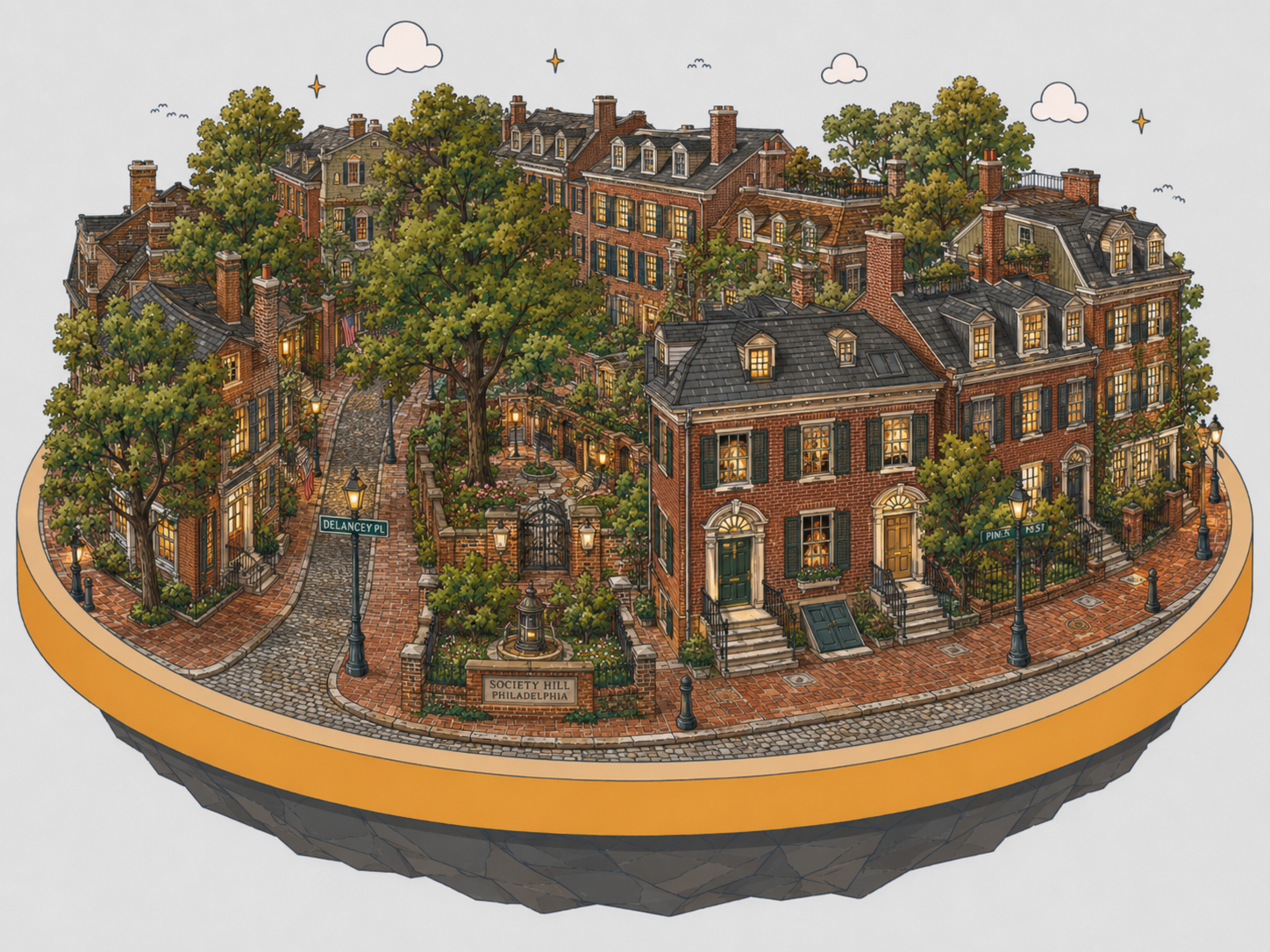
Walk east from 5th and the soundscape fades: no honking, no trash trucks roaring past. Just heels on cobblestone and elm leaves moving. At dusk, 4th and Pine glows like a postcard, light bouncing off red brick in a way photographers and wedding parties can't resist. Longtime residents still stop mid-walk there, caught off guard by how cinematic it is.
Everything here is deliberate — the low signage, the uniform stoops, the absence of visible clutter. It's a neighborhood designed not only to be lived in but to be admired. That's exactly how locals want it, and it's the thing you're really deciding about when you decide about Society Hill.
The lay of the land
The Hill is small and reads as one place, but locals draw lines inside it — mostly at 5th Street.
West of 5th
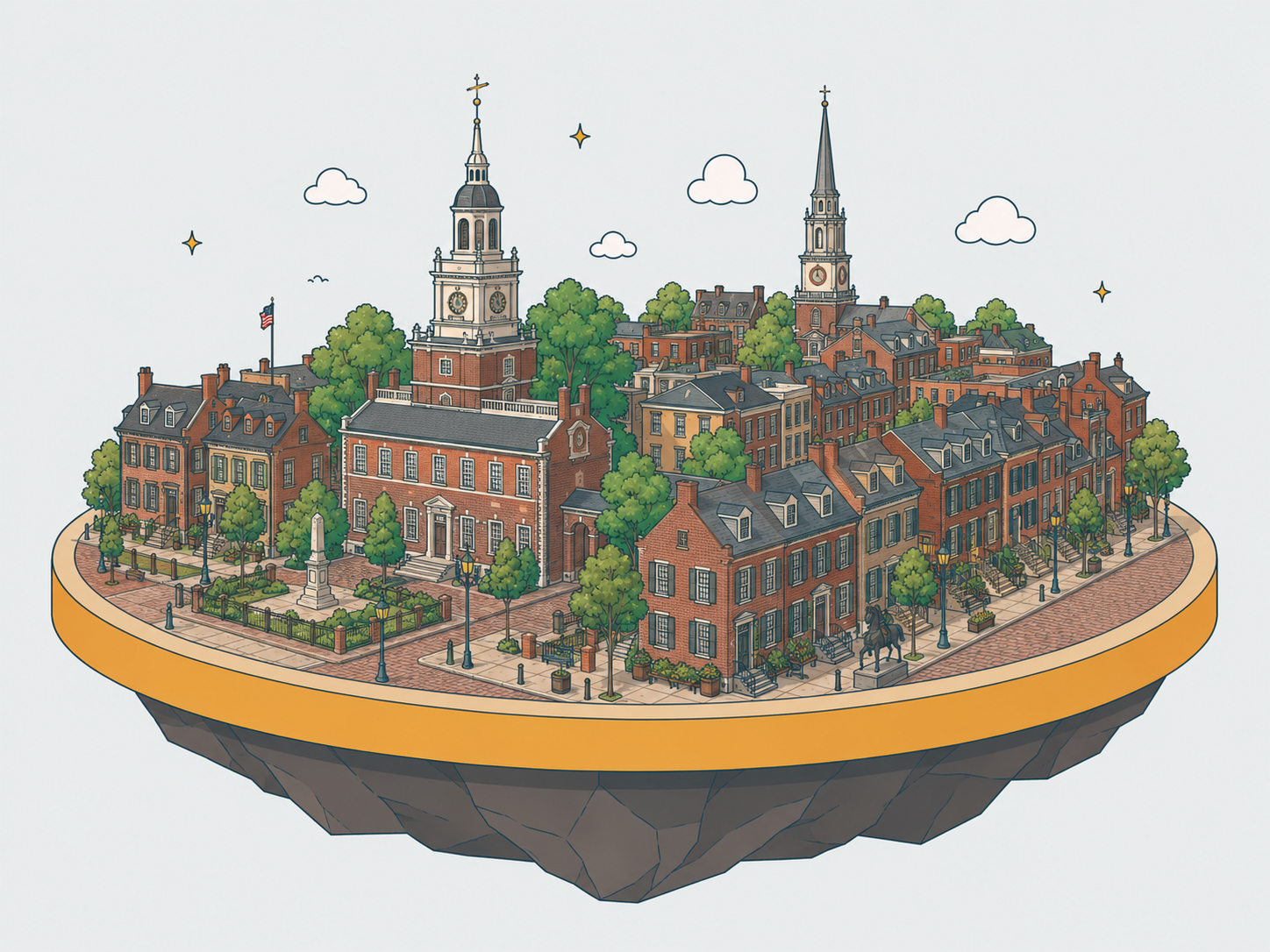
Toward Washington SquareThe city's oldest surviving rowhomes, with Flemish bond brick and worn blue shutters. This is the stretch the preservation fight was fought over, and the one the postcards are of.
East toward the river
Delancey & SpruceA different story: modernized brownstones, many of them second homes or corporate housing. Immaculate, and quieter than the blocks around them.
Society Hill Towers
I.M. Pei · above the colonial gridThe modernist curveball, rising in clean concrete contrast above everything around it. Loved and loathed in equal measure; saying “I live in Pei's towers” is local shorthand for architectural fluency.
Headhouse Square
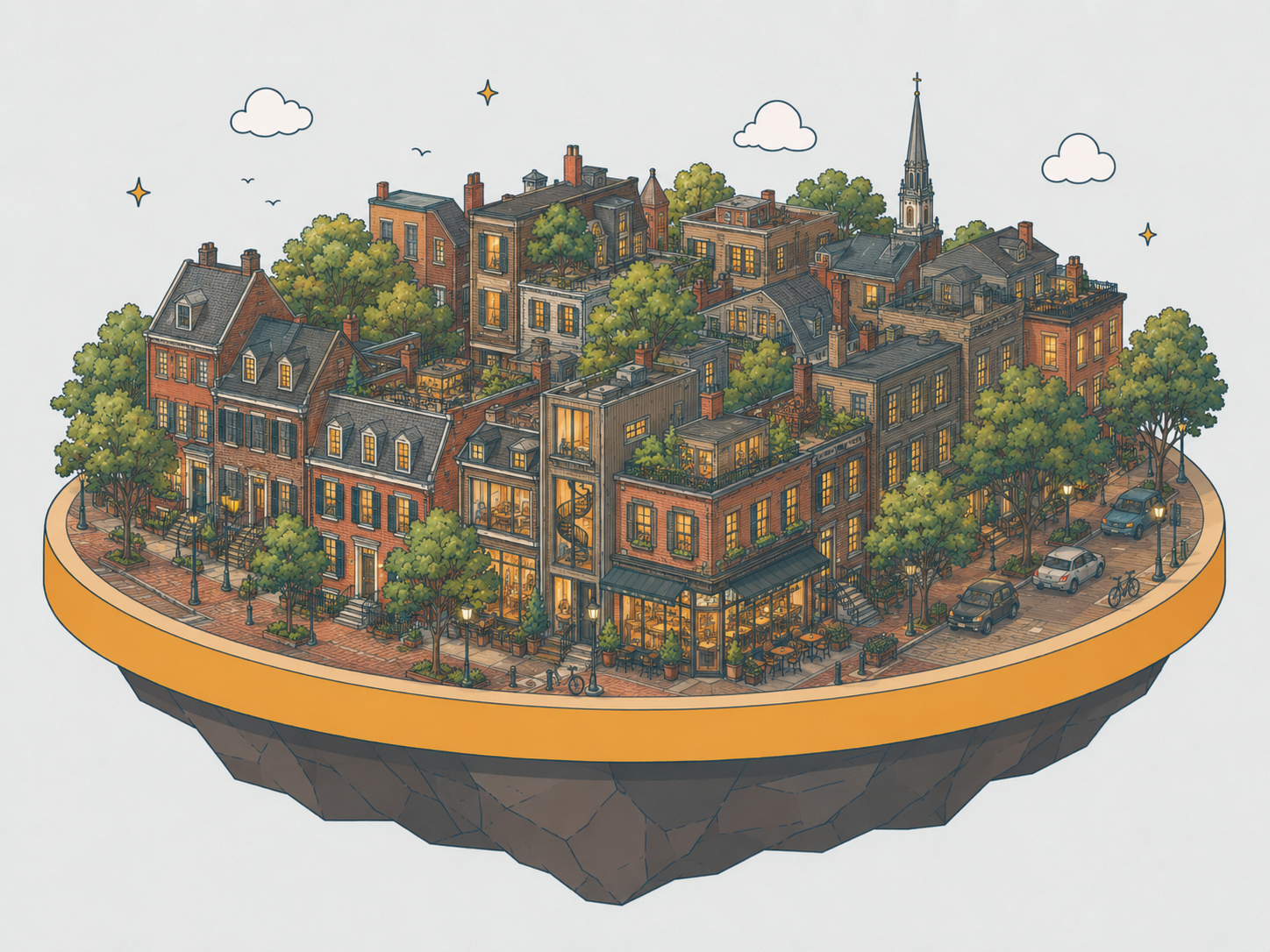
2nd & Pine · the marketThe cobblestone stretch that hosts the Sunday farmers market and functions as the neighborhood's living room. The one place on The Hill that feels least sterile.
5th & Spruce
The ACME cornerOne of the few places you can still wedge a car during daylight. Locals joke it's where you measure your blood pressure — every successful parking job feels like a minor miracle.
The architecture that owns you
Society Hill isn't just old. It's self-aware about it. The Federal and Georgian façades aren't relics; they're status symbols. These are the same homes that were nearly demolished before Philadelphia's 1950s urban renewal, saved by a preservation effort that gave the neighborhood both its beauty and its bureaucracy.
Walk down Delancey and you'll see 18th-century proportion polished by 21st-century money — brass knockers gleaming, shutters painted to match registry-approved shades. Behind every door is a story about a family that either inherited the past or paid dearly to rent it.
Owning here is less about convenience than stewardship. One long-term renter's advice, half-joking and half-serious: ask about the water pressure before you sign. The pipes groan like history itself, and every repair costs double what it would anywhere else. Then sunlight hits the brick and you forgive it. These aren't houses so much as commitments to an idea — that beauty, even when inconvenient, is worth maintaining.
The rhythm of daily life
Life on The Hill isn't fast. It's orchestrated. Mornings start with runners moving down Spruce before traffic arrives, dogs' paws tapping across cobblestone, espresso machines humming at the Headhouse cafés. By noon the streets go still again — delivery trucks clog the narrow lanes for a while, then silence, the kind that feels intentional.
Evening brings the softest transformation in the city: gas lamps flicker on, residents walk dogs past historic façades, and the parking wars quietly resume. Fridays are the breaking point. Don't have a spot by six and you're circling till eight or paying at a garage. That's the neighborhood's unofficial curfew.
The micro-clock locals actually keep
- 6:15–7:30am — the quietest streets of the day. Spruce, Pine, and Delancey belong to leash hands and joggers, and it's the safest window for a package to sit on a stoop.
- 8:00–9:00am — contractor slot. Vans take curb space for 30–60 minutes; load or unload before 8:30 or you'll get boxed in by ladders.
- 11:30am–1:00pm — courier crawl. UPS and FedEx double-park on the narrow blocks and Pine turns into a slalom. Detour on 3rd or 4th.
- 3:30–4:45pm — the soft reset. Streets calm; the best window for returns, the pharmacy, a quick errand.
- 4:50–6:10pm Friday — the choke. Street parking vanishes and the garages fill tier by tier.
- 10:00–11:00pm — whisper hour. Sound carries on brick; every voice sounds louder than it is. Stoops go inside-voices-only.
The Hill's short list
Society Hill doesn't flaunt a dining scene — it curates one. And community life happens less in bars than in rooms that look like history exhibits.
Headhouse Farmers Market
Starts breathing around 9:30am, when the first stroller-pushers and coffee devotees spill in from Pine and 2nd. Come early if you actually want produce, late if you want to socialize. By noon everything's sold out but kale and honey. The coffee stalls double as intelligence posts.
Best for · Sunday, all of it
Bistro Romano
Glows like an old-world secret — arched brick ceilings and candlelit booths, drawing couples who want romance without pretense. Reservations are a must.
Best for · a candlelit dinner
Society Hill Hotel
Regulars swear by the Wednesday happy-hour oyster deal and the espresso martinis, nursing drinks under dim bulbs while trading real-estate gossip. A room locals have long opinions about in both directions — on The Hill, memory lingers longer than branding.
Best for · Wednesday oysters
Headhouse Café
An unofficial morning office. Deals, neighborhood projects, and babysitter recommendations all get brokered here over cappuccinos — same as at the market's coffee trucks a few steps away.
Best for · the morning meeting nobody scheduled
Society Hill Synagogue
A cornerstone where multiple generations still gather for everything from Shabbat dinners to community volunteering. Even non-members call it the heart of the neighborhood, because it's where conversations still sound neighborly.
Best for · community, in the real sense
Old Pine Community Center
The quieter nerve center. Buy your Gardens Tour tickets here, drop off donations, and attend the meetings that decide everything from bike lanes to Halloween permits. Stand by the bulletin board long enough and you'll hear every kind of small-town drama in city clothing.
Best for · finding out what's actually happening
Reality check: there's no nightlife here, and that's intentional. When residents want energy they cross 4th toward Old City, or step one boundary over to South Street. The Hill keeps its own food scene mellow — Italian heritage, polite noise levels, menus with no QR codes.
Money, mortgages & the charm tax
Everything beautiful here costs something — and not only in dollars. Locals call the premium the charm tax. The figures below were last checked in July 2026; check current listings and posted rates before you plan around them.
The good & the trade-offs
- Genuinely beautiful — Federal and Georgian façades, gas lamps, cobblestone.
- Quiet by design. After 10pm you hear footsteps and little else.
- Safe and orderly, with an unusually strong civic structure behind it.
- Headhouse Market every Sunday, a real weekly ritual rather than an errand.
- Old City, Washington Square, and South Street are each a few blocks off.
- A neighborhood that visibly cares — every complaint here is proof of investment.
- Parking is the number-one rage point; 20 minutes of circling, then a garage rate.
- A PPA ticket is a rite of passage, and they work these blocks hard.
- Historic homes cost double to repair — old pipes, uneven floors, delicate detail.
- No nightlife. If you want noise, you're leaving the neighborhood to get it.
- The demographic skews older and wealthier, with corporate turnover east of 5th.
- The order can read as sterile — “beautiful, but you start missing noise.”
The civic association, and the bike war zone
Every neighborhood has a civic association. Society Hill's carries more weight than most. The Society Hill Civic Association is a nonprofit overseeing preservation, zoning, and community programs, and streetlights, signage, event permits, and development hearings all pass through it.
The newsletters read like court circulars: please adhere to established color palettes; noise permit requests must be filed ten days prior. Behind the politeness sits a web of relationships and long institutional memory — people who know who fought which zoning appeal in 1997 and who complained about trash bins on Pine.
Then there are the bike lanes. For over a decade a single proposed protected lane along Spruce and Pine has generated more outrage here than tax hikes or property assessments — printed signs, paid consultants, commissioned studies. It isn't really a car-versus-bike fight; it's a turf war between two definitions of preservation. One side believes history includes the right to park on your own block. The other argues history should evolve, and that saving lives is part of civic legacy. Same argument runs through fights over projects like the Dilworth House and the Dock Street Hotel.
Underneath all of it is the paradox everyone shares: they love The Hill's perfection even when it limits them. That's the charm tax again — the quiet acceptance that beauty and inconvenience are inseparable.
The sacred calendar
Society Hill doesn't measure time in months. It measures it in micro-seasons, passed along in bulletin boards and neighbor texts that start “Just so you know…”
Gardens of Society Hill Tour
The Civic Association's most elegant fundraiser. Normally private courtyards open their iron gates onto fountains, ivy walls, and backyard sculpture. Tickets sell out; check the Civic Association for the current price and pick them up at Old Pine Community Center. Long-timers treat it as a social debut, and newcomers figure out it's the easiest way to be accepted.
The one night order gives way
No other part of Philadelphia does Halloween like The Hill. Decorations go up early, street-versus-street competition is fierce, and kids pour in by the hundreds. The Hill-Physick House hosts its Spooky Speakeasy — part cocktail party, part haunted history tour, part fundraiser — and it sells out every year. Parking that weekend is nonexistent, and nobody minds.
Window candle season
The month the neighborhood photographs itself. Photo walkers work the blocks between 6 and 8pm, and residents set blinds for the warm-glow look.
Washington Square picnic
One of the smaller traditions that still counts, alongside the fall block cleanups that double as social hour.
The survival playbook
Living here comfortably means running a system. Locals pre-plan like chess players, and most of the plan is about a car.
Parking
- Never attempt street parking after 5pm on a Friday. Between dinner guests, event permits, and PPA patrols, every spot goes faster than a flash sale.
- Garages fill tier by tier — Abbotts Square, the Bourse, Hopkinson. Once the choke starts, validation tricks dry up.
- Some park at Whole Foods and validate for the two free hours; others take a monthly space at the Society Hill Towers Garage and stop thinking about it. As one resident put it: you pay for peace.
- "Ghost park" is the local word for the spot that seems to exist only in myth — the one that was there a second ago.
Groceries
- ACME handles the basics.
- Serious cooks do produce at the Sunday Headhouse Market.
- Wine comes from the liquor store at 5th & Spruce.
- Whole Foods covers anything organic or obscure.
Trash, and the rest of the code
Bins out no earlier than 7pm the night before and no later than 7am the next morning — latecomers risk the glare of a retired neighbor who keeps record. You don't leave cans visible after pickup. You don't play loud music outdoors. You wave to dog walkers even if you don't know them, and you never park too close to someone's steps; the cobblestone margin is sacred. Hosting a gathering means telling your neighbors, and preferably the Civic Association, out of courtesy. Mornings before 9am belong to dog walkers and joggers. Sunday afternoons are for naps, not leaf blowers.
Is Society Hill for you?
The same qualities show up on both lists. Which side they land on is entirely a matter of temperament.
- You want beauty and order, and you'll pay the charm tax to keep them.
- Quiet after 10pm reads as luxury rather than loneliness.
- You'd enjoy a Sunday market you build the week around.
- You're willing to garage a car — or not keep one at all.
- You want to live with history and accept the maintenance that comes attached.
- You want nightlife within walking distance of your door.
- You need reliable street parking on a Friday evening.
- Registry-approved shutter colors and civic-association etiquette sound exhausting.
- You want a neighborhood that changes fast — here change creeps, it never storms.
- You'd rather have square footage and modern systems than 18th-century detail.
A Society Hill home, season by season
What each season does to an 18th-century house on a cobblestone block — and the move that answers it.
Courtyards and gardens get readied for the June tour, and the first open windows pull street dust straight onto sills and old glass.
The move · A full window-and-sill pass plus detail work on molding, timed ahead of the Gardens Tour rather than after it.
Humidity settles into plaster and detailed woodwork, and the market crowd tracks Headhouse grit onto entry floors every Sunday.
The move · A light, dry pass that won't drive moisture into century-old surfaces, plus an entryway reset each visit.
Halloween puts the whole neighborhood on the stoop and hundreds of kids on the block, right as heating cycles start pushing dust through the house.
The move · A deep reset scheduled around the last week of October — vents, baseboards, and floors — so the house recovers fast.
Salt and slush arrive at the door onto original hardwood, and window-candle season means everyone can see in.
The move · Salt off original hardwood the day it lands, and glass and sills kept clear — when the candles are up, every window is on display from the sidewalk.
Keeping a Society Hill home effortless
These homes were built before modern plumbing and have been maintained ever since by people who take that personally. A reset here is about restraint and consistency — the same hands, the same routine, and a light touch on surfaces that don't forgive one.
What these homes need
- Original hardwood — uneven, old, and unforgiving. pH-neutral care, no standing water.
- Crown molding and plaster detail — holds dust in every profile; a soft, dry pass keeps it crisp.
- Marble and stone — stains if you look at it wrong, so the product matters more than the effort.
- Narrow stairwells — the defining constraint of an 18th-century rowhouse, and the reason equipment choice matters here.
- Condo access — the Towers and the newer buildings mean front desks, elevators, and sometimes a COI. Flag it at booking and we handle it.
Why trust this guide? No one paid for a kind word here. It is written from the practical side of these houses — floors that predate the plumbing, stairwells built for smaller people — and from owners who maintain homes this old and take it personally.
Make it yours
Keep these Society Hill notes
A short list to turn what you read into your own next steps.
Saved checks stay on this device when browser storage is available. This is a personal planning list, not a property inspection or professional assessment.
A few good questions
Before you make a plan.
How much does house cleaning cost in Society Hill?
Do you clean 18th-century rowhouses?
How do you handle historic hardwood and marble?
Do you clean the Society Hill Towers and other condo buildings?
Parking here is brutal. Does that affect a visit?
Sources & next steps
Useful advice should
show its working.
These resources support the reader tools above and help you check details for your own address, date, or plans.
- Work on a historic property
City guidance identifies the review process for work affecting a historic property.
- City property and zoning lookup
Opens the City's address-based zoning and permit tools.
- Headhouse Farmers Market
The market operator lists upcoming vendors, current visit details, and contact information.
City review and neighborhood advice are different sources of information. This tool does not establish repair costs, delivery safety windows, or permission for proposed property work.
Keep exploring