A little orientation
A closer look at daily life in Callowhill
Walk a real errand.
Choose a destination in Chinatown and trace the whole journey from a specific doorway, including crossings and carrying purchases home.
Ask how the loft works.
Look beyond open space to storage, heating arrangements, sound and the building’s current maintenance process during your viewing.
Confirm park access.
Check the Rail Park’s own visitor information before planning a visit around an entrance or event mentioned in the guide.
A closer look
Build a day from your address
A neighborhood impression becomes more useful when you can explain the journeys and building details behind it.
Name the route you would use.
Pick a shop or meal destination you want to research in Chinatown and locate its current address. Plan outward and return journeys from the apartment, then inspect the walking connections for your own access needs.
A useful questionWhich crossings and entrances are part of the errand you would repeat?
Source & next step ↗Check the entrance first.
Treat the Rail Park as a specific destination rather than a general promise of nearby green space. Consult its own access and event information, then decide whether the approach and activity suit the visit you have in mind.
A useful questionWhich park entrance and visit details have you confirmed for your plan?
Source & next step ↗Bring the building into focus.
Look up the property in Atlas before a viewing, then ask about the details records cannot settle. Discuss heating, ventilation, deliveries and maintenance contacts, and record anything the owner agrees to clarify after the appointment.
A useful questionWhich unanswered building question could change your decision about living here?
Source & next step ↗At Hometress, we spend a lot of time inside homes across Philadelphia, which gives us a different lens on neighborhoods like Callowhill. This is not a place you understand from a quick drive-through or a polished apartment tour. It is a neighborhood you learn through routines, through how people actually move through their space, and through the small details that shape daily life.
From our perspective, Callowhill is one of the clearest examples of a neighborhood in transition. You see it in the mix of modern apartments and older industrial buildings, in the contrast between well-designed interiors and uneven street conditions, and in how some blocks feel more developed than others. For homeowners and renters alike, that means your experience depends heavily on where exactly you are and how you structure your day.
This guide was created to reflect that reality. Instead of giving you a surface-level overview, we break down how Callowhill actually functions so you can decide if it fits your lifestyle. Whether you are moving in, already living there, or just trying to understand the area better, the goal is to give you the kind of insight that usually only comes after months of experience.
Why Callowhill Confuses So Many Newcomers
Callowhill confuses newcomers because it rarely matches the first version of itself that they see online. On one screen, it looks like a polished loft district with industrial character, stylish apartment buildings, and easy access to the rest of Center City. On the ground, it feels much less settled. A person can move there expecting a neatly packaged urban neighborhood and quickly realize that Callowhill works more like a patchwork. Some blocks feel promising and connected, while others still carry the emptiness, roughness, and uneven rhythm of a place that has not fully finished becoming what it is trying to be.
Part of the confusion comes from how often people describe the neighborhood in vague, half-committal language. Callowhill gets the kind of approval that sounds reassuring until you spend time translating it. It is often treated as manageable, workable, or fine, but that kind of label hides the real story. This is not a neighborhood that gives a clean first impression and then stays consistent. It is a neighborhood where your exact route home, your distance from the subway, and your tolerance for industrial street energy can matter more than the broad neighborhood name on your lease.
It also photographs better than it explains itself. The loft buildings, converted industrial spaces, modern apartment branding, climbing gym culture, and nearby nightlife all give Callowhill a visual identity that feels stronger than its street-level cohesion. A newcomer can scroll past polished reels, rooftop views, and apartment specials and assume the area is more settled than it actually feels during a quiet weekday evening. That disconnect creates one of the biggest misunderstandings about Callowhill. The neighborhood is not fake, but it is often marketed through its strongest angles while its daily friction stays in the background until you live it.
Another reason people misread the area is that Callowhill does not reveal itself well through generic neighborhood advice. Asking whether it is safe, walkable, convenient, or worth living in does not get you very far unless you narrow the question. Safe at what hour. Walkable along which street. Convenient if you are near what part of the neighborhood. Worth it for what kind of person. Those details matter here more than they do in places with a stronger, more predictable neighborhood fabric. In Callowhill, the difference between a tolerable routine and an exhausting one is often hidden inside those smaller decisions.
That is why people who have spent real time around Callowhill tend to speak in caveats instead of clean verdicts. They do not talk about the neighborhood as one fixed experience. They talk about it in slices. Close enough to the subway. Better near the core than the edges. Easier in daylight. Different after 11 p.m. Better if you already know your routes. That kind of language can frustrate newcomers who want a simple answer, but it is also the most honest way to understand the area. Callowhill is not a place you understand from a marketing page or a map. It starts to make sense when you realize it has to be read block by block, time by time, and habit by habit.
Where Callowhill Actually Starts to Make Sense
Callowhill starts to make sense when you stop expecting it to win on comfort first and start understanding that its main advantage is access. People do not choose this neighborhood because it is the most polished part of central Philadelphia. They choose it because it places them near enough to important parts of city life that they are willing to accept the rough edges. The area works best for people who value location as a daily tool rather than atmosphere as a guarantee.
That logic becomes much clearer once transit enters the picture.
Being close to the Broad Street Line, especially near Spring Garden station, changes the emotional math of living in Callowhill.
A person who can get to the subway quickly is not just saving time on commuting. They are reducing the number of awkward or uncomfortable moments that come from depending too heavily on the neighborhood itself to provide everything. In practical terms, that means the more easily you can plug into the rest of the city, the less Callowhill’s unfinished parts dominate your day. This is one reason locals keep circling back to transit proximity. It is not a side benefit. It is one of the neighborhood’s main stabilizers.
The same thing is true of Callowhill’s position relative to Chinatown and Center City. Being able to move south and reach more active, better supplied parts of town helps explain why so many people still defend the neighborhood even while listing its flaws. Callowhill does not have to do all the work on its own because it borrows so much from what sits around it. A resident can live in a loft-style building, use neighborhood anchor spots like the climbing gym or Rail Park, then rely on nearby districts for more complete food, transit, and street-life options. That geography is part of what makes the area livable even when it does not feel fully self-contained.
Price also plays a big role in how the neighborhood is judged. Callowhill is often defended in relative terms rather than absolute ones. It is not always framed as cheap, especially in newer buildings, but it is frequently framed as a better location deal than other places closer to the city core with a more established reputation. That relative-value argument matters because it helps explain why people put up with the neighborhood’s friction. They are not claiming it is effortless. They are claiming that the combination of location, housing style, and city access can still make the trade worthwhile.
This is also where the neighborhood’s loft character starts to matter in a positive way. For some residents, the industrial buildings and converted spaces are not just a visual bonus. They are part of the reason Callowhill feels different from generic apartment-heavy parts of the city. The area offers a kind of urban character that appeals to people who want something less polished and more textured, even if that same texture can feel cold or sparse at street level. When you combine that housing appeal with strong access to transit, nearby nightlife, and a few standout local anchors, Callowhill begins to make practical sense. It is not the kind of place that sells itself through ease. It sells itself through position.
The neighborhood also makes more sense once you understand that its best version is not all-day, every-day. It tends to work in clusters. Close to the subway, near a few anchor spots, within easy reach of Chinatown and Center City, and inside a routine that minimizes the area’s weaker points. For a newcomer, that can sound limiting. For someone who understands how Philly neighborhoods often work, it sounds normal. Callowhill is less about expecting the whole neighborhood to perform equally well and more about knowing which pieces of it make your own daily life easier.
The neighborhood borrows what sits around it.
- Spring Garden station
- Rail Park
- Chinatown
Schematic · not to scale
The Block-by-Block Reality: Why Callowhill Cannot Be Judged as One Single Place
One of the fastest ways to misunderstand Callowhill is to treat it like a uniform neighborhood. The area does not behave that way. Its strengths and frustrations are unevenly distributed, and locals tend to understand it through micro-geography rather than through one broad identity. That is why people who know the area well often give advice that sounds frustratingly specific. They are not being evasive. They are describing a neighborhood where a few blocks can change the whole feel of daily life.
The strongest version of Callowhill tends to cluster closer to the more developed core, especially around the loft buildings, the subway-adjacent stretches, and the spots that connect more naturally to Center City and Chinatown. These are the sections of the neighborhood that tend to feel more usable to newcomers because they offer quicker access to transit, better linkage to active corridors, and more confidence that the area is moving in a clearly improved direction. In those pockets, Callowhill can feel like a legitimate compromise between central access and industrial character.
The edges tell a different story. The farther you move into the quieter, rougher-feeling stretches, especially toward the north and east, the more the neighborhood’s unfinished identity becomes hard to ignore. This is where people start talking more bluntly about sketchiness, disorder, emptiness, or the sense that the area still carries too much of its older industrial and disconnected street pattern. The map may make those blocks look close to everything else, but the lived experience does not flatten that difference. In practice, the edges can feel much farther from the neighborhood’s strengths than their physical distance suggests.
This is why locals often rely on directional language when they describe Callowhill. Moving south toward Chinatown can feel like heading toward more activity, more familiarity, and a more readable urban environment. Moving toward the rougher outer stretches can feel like stepping into the version of Callowhill that still has not caught up to the neighborhood’s promotional image. That directional logic matters because it reveals how residents actually navigate the area. They are not just thinking about addresses. They are thinking about how the neighborhood changes as they move through it.
The same block-by-block reality shows up in how people talk about errands, walking, and even mood. A person can enjoy their building, like a few anchor spots nearby, and still feel that the wider neighborhood lacks a true sense of cohesion. That is not a contradiction. It is part of how Callowhill functions. There are good pockets, useful pockets, and rougher-feeling pockets, but they do not always stitch together into a smooth whole. Newcomers who fail to notice that often end up asking why the neighborhood feels so different from one corner to the next.
This unevenness is also the reason generic neighborhood marketing falls short. A leasing page might show a polished loft interior, a list of nearby attractions, and a picture of the skyline, but none of that tells you how the walk home feels after dark, how far your building sits from the blocks people actually use most, or how often a quiet-looking stretch feels more isolated than expected. In Callowhill, location inside the neighborhood matters almost as much as location of the neighborhood itself. That is what locals mean when they imply you need to do your homework. They are talking about the part that outsiders usually skip.
Why Callowhill cannot be read as one place
Its strengths and frustrations are unevenly distributed.
The developed core
Loft blocks near the subwayQuicker access to transit, better linkage to active corridors, and more confidence the area is improving.
The outer edges
North and eastQuieter and rougher-feeling. The map makes them look close to everything; the lived experience does not flatten the difference.
Heading south
Toward ChinatownFeels like heading toward more activity, more familiarity, and a more readable urban environment.
The Callowhill Timing Rule: Daytime and Nighttime Are Two Different Experiences
Callowhill changes dramatically once time enters the conversation. A lot of neighborhood debates sound contradictory until you realize people are often describing different hours rather than different realities. In daylight, the area is frequently treated as manageable. The access advantages are easier to appreciate, the neighborhood’s anchor spots feel more connected, and the industrial emptiness reads more like visual texture than a personal risk. At night, the same streets can feel harsher, thinner, and less forgiving.
That shift is one of the most consistent patterns in how people describe the area. Daytime tends to soften Callowhill’s weaker points because the neighborhood is understood through movement and proximity. You can get where you need to go, you can see the logic of the location, and you are less likely to experience the emptiness of certain streets as a problem. Once evening turns into late night, the neighborhood starts getting judged through a different lens. Streets that seemed merely quiet earlier can start to feel exposed. The distance between anchor spots becomes more noticeable. The unfinished parts of Callowhill begin to matter more than the selling points.
The strongest local warning is not a vague caution about nighttime in general. It is more specific than that. There is a repeated sense that once the hour gets late enough, especially around or after 11 p.m., solo walking becomes a much more serious concern. That threshold matters because it shows how locals actually internalize the neighborhood. They are not simply saying that city living requires awareness. They are signaling that Callowhill has a late-night version of itself that deserves different behavior.
This timing rule becomes even more important when you look at how different people experience the same conditions. Some residents, especially men describing their own routines, treat the area as mostly workable so long as basic city awareness is in place. The neighborhood is not experienced the same way by everyone. Time of day, route, and familiarity all shape how a block reads. That is why the most useful advice in this area always sounds conditional. It is based on who is moving through the neighborhood and when.
Timing also changes what counts as a problem. During the day, a sparse block can feel like a quiet transitional corridor. Late at night, that same block can feel deserted in the wrong way. A nightlife destination or popular bar can make part of the neighborhood feel lively for a while, but that does not mean the walk between places automatically feels comfortable. This is one of the reasons newcomers get tripped up. They mistake destination energy for neighborhood-wide ease. In Callowhill, those are not the same thing.
What locals seem to understand instinctively is that the neighborhood has to be read like a schedule, not just a map. There are hours when Callowhill feels useful, connected, and easy to defend. There are other hours when its rougher qualities become much harder to ignore. That is the real timing rule. The area is not static, and the people who handle it best are usually the ones who have learned when its tradeoffs stay manageable and when they start asking too much.
The Walk to Chinatown Test: Small Route Choices Matter More Than Outsiders Think
One of the best ways to understand Callowhill is to look at something that seems simple from the outside and see how locals complicate it. Walking to Chinatown sounds straightforward on paper. The distance is not extreme, the destination is one of the neighborhood’s biggest advantages, and the route looks easy enough on a map. But once people start describing the actual experience, the walk becomes a lesson in how Callowhill really works.
The important detail is not just that Chinatown is close. It is that the walk there is not emotionally identical on every street. That distinction matters because it reveals the difference between technical walkability and lived walkability. A newcomer might only ask whether the route is possible. A local will usually care more about whether it feels exposed, deserted, active enough, or intuitively comfortable. That is the more useful question, and it comes up repeatedly in how people describe moving through this part of the city.
The neighborhood’s route logic shows up in how people choose between parallel streets. Even when both paths lead toward the same destination, they do not feel the same in practice — one may be busier, better lit, or simply more familiar. That kind of difference is exactly what outsiders miss when they reduce a neighborhood to broad claims about being walkable or not. In Callowhill, route choice is not overthinking. It is part of how people move through the day.
This route-level awareness also explains why locals speak with so many caveats. They are not being dramatic when they emphasize one street over another. They are sharing the kind of detail that only becomes obvious after repeating the same walk enough times to notice patterns. Which blocks hold more people. Which stretches feel too empty. Which streets are better lit. Which direction feels more natural when heading home. These are not the kinds of insights you get from a leasing brochure or a weekend visit. They come from living through the same geography until the subtle differences become part of your routine.
The Chinatown test also helps clarify what Callowhill offers at its best. The neighborhood benefits enormously from being near places that feel more fully built out, socially active, and easy to use. Chinatown is part of the reason people tolerate Callowhill’s gaps. It gives the area nearby gravity. But the walk there reveals the larger truth. Callowhill does not reward passive movement. It rewards people who learn its rhythms, refine their routes, and stop assuming that all nearby streets deliver the same experience just because they are close together on a map.
That is why this one example matters so much. It is not only about getting to Chinatown. It is about how Callowhill teaches people to think. The neighborhood trains residents to notice details that outsiders ignore. A corner, a block, a quieter stretch, a better-lit route, a street that feels off at one hour and normal at another. Once you start seeing those differences, Callowhill begins to make more sense. Until then, it can feel confusing in a way that no generic neighborhood guide will ever fully explain.
The Best Version of Callowhill: Why People Still Choose It
Callowhill works best when you experience it through its strongest angles instead of expecting it to perform evenly across every part of daily life. People who choose to live here are usually not chasing a perfect neighborhood. They are choosing a specific combination of access, space, and character that is harder to find elsewhere in central Philadelphia at a similar level. When that combination lines up with how someone actually lives, the neighborhood starts to feel intentional rather than compromised.
One of the biggest draws is the housing itself. The loft apartments and converted industrial spaces offer something visually and spatially different from more standardized buildings. High ceilings, open layouts, and the sense of living inside a repurposed structure give Callowhill a kind of identity that feels more raw and less packaged. For some residents, that matters more than having a tidy streetscape outside their door. They are not looking for a soft neighborhood. They are looking for a place with texture.
The neighborhood also appeals to people who prefer being slightly outside the center of attention. There is a recurring sense that Callowhill is not yet overrun. It is not treated as the most obvious or crowded place to be, which can feel like an advantage if you value a bit of distance from the busiest parts of the city. That positioning allows residents to dip into more active areas when they want them and retreat back into a quieter, more industrial environment when they do not.
Another part of Callowhill’s best version is how it clusters its strengths. When you are near the subway, within reach of a few key local spots, and able to move easily toward Chinatown or Center City, the neighborhood starts to feel much more complete. It is not that Callowhill suddenly becomes fully self-sufficient. It is that the gaps become easier to work around. Residents who understand this tend to build routines that rely on proximity rather than expecting the neighborhood to provide everything in one place.
There is also a certain kind of optimism built into the experience. People see clear signs that the area is changing. New developments, improved public spaces, and the presence of active businesses create the sense that Callowhill is moving in a direction rather than standing still. That forward momentum matters because it makes the current inconveniences feel temporary rather than permanent. Even if the neighborhood is not finished, it does not feel stagnant.
At its best, Callowhill feels like a place where you are slightly ahead of the curve. You have access to the city, you live in a space with character, and you can point to specific places that make your routine work. It is not effortless, but for the right person, it feels like a deliberate trade that pays off in ways a more polished neighborhood might not.
The Anchor Spots That Carry the Neighborhood
Callowhill does not rely on a wide, evenly distributed network of amenities. Instead, it leans heavily on a small group of places that show up again and again whenever people explain why the neighborhood works at all. These spots do more than provide entertainment. They fill in gaps that the broader neighborhood has not fully solved yet.
The most important of these is the climbing gym known locally as The Cliffs or Movement. It functions as far more than a fitness facility. In a neighborhood that often gets described as lacking a strong street-level community, this is one of the few places where people reliably connect. It is where routines form, where people meet each other, and where the neighborhood feels social in a way that is otherwise hard to find just by walking around. For many residents, this single place offsets a large part of Callowhill’s otherwise sparse social fabric.
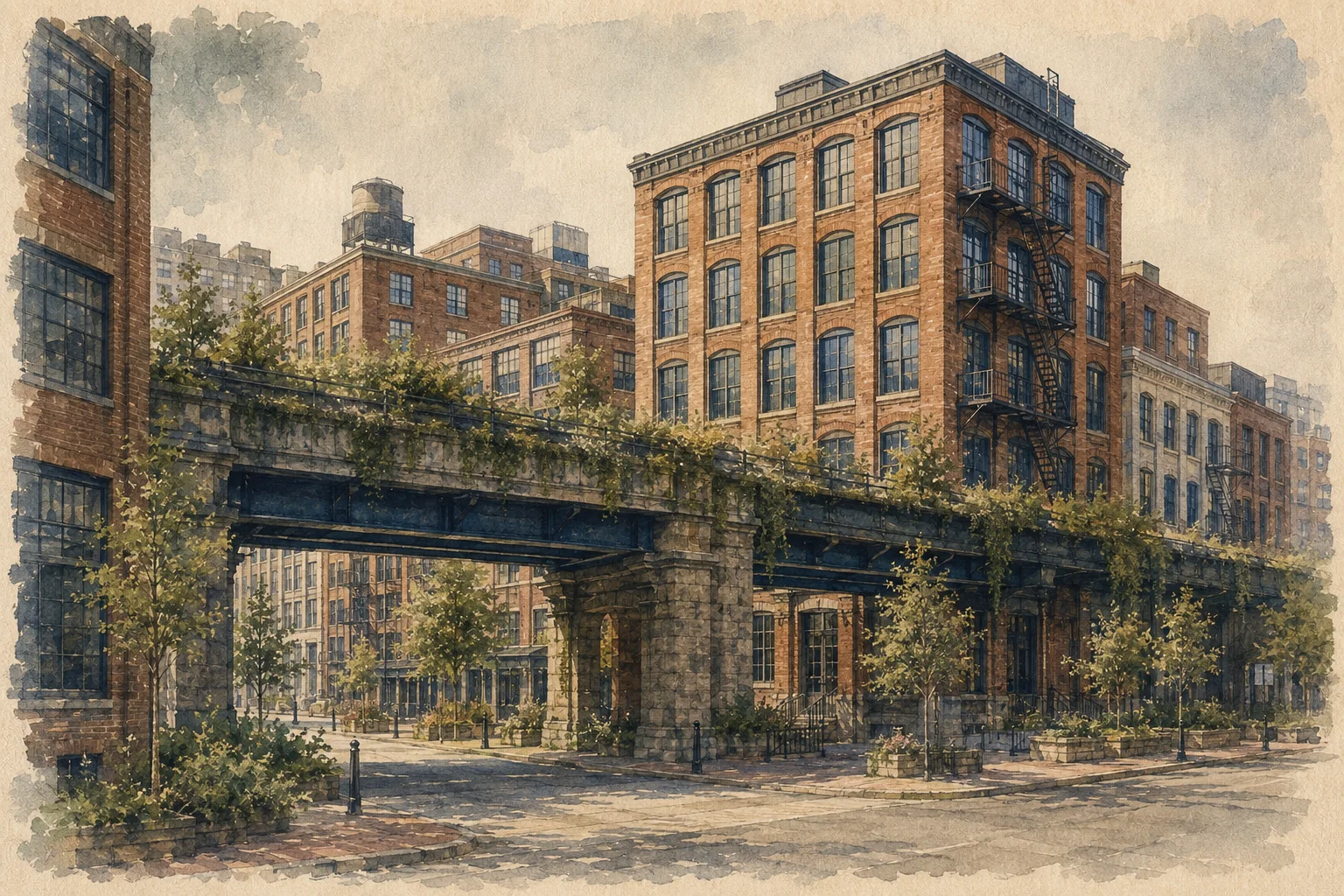
The Rail Park plays a different role, but it carries similar weight. It gives the neighborhood a visible sign of improvement and a place that feels intentionally designed rather than leftover. Spending time there changes how the area feels, even if it does not fix the broader issues around it. It is one of the clearest indicators that Callowhill is moving forward, and residents treat it as proof that the neighborhood is not stuck in its roughest form.
Love City Brewing is another recurring anchor that helps define the neighborhood’s usable social space. It is one of the places people point to when they want to show that Callowhill has real destinations, not just potential. It adds to the sense that there is something to do without leaving the area, even if that list of options is still relatively short compared to more established neighborhoods.
Callowhill Archery stands out because it captures the neighborhood’s personality in a way few places do. The fact that it operates out of a converted industrial space that once served a completely different purpose reflects the area’s broader identity. It is not a typical amenity. It is something slightly unexpected, rooted in reuse and creativity. That kind of detail gives Callowhill a distinct feel that cannot be replicated through standard development alone.
Beyond these core spots, there is a supporting orbit of restaurants, bars, and venues that help round out the experience. Places like Cafe Lift, Trestle Inn, Sazon, Roy Pitz, Prohibition Tap Room, and Union Transfer give residents options when they want to step out without traveling far. HomeGrown215 adds a more recent layer of visibility through social media and food culture. None of these places alone define the neighborhood, but together they create enough activity to make Callowhill feel connected rather than empty.
What matters most is how often the same names come up. When people defend the neighborhood, they tend to reach for the same anchors. That repetition shows that Callowhill’s identity is still concentrated rather than fully distributed. These spots carry more weight than they would in a more balanced neighborhood because they are doing more of the work.
The anchor spots that carry the neighborhood
A small group of places that show up again and again.
The Cliffs / Movement
Far more than a fitness facility — one of the few places where routines form and people reliably meet each other.
Rail Park
A place that feels intentionally designed rather than leftover, and the clearest visible sign of improvement.
Love City Brewing
One of the places people point to when they want to show that Callowhill has real destinations, not just potential.
Callowhill Archery
Operates out of a converted industrial space that once served a completely different purpose. Reuse as neighborhood personality.
Cafe Lift, Trestle Inn, Union Transfer
Options for stepping out without traveling far — enough activity to make the area feel connected rather than empty.
The Five Daily-Life Frustrations You Feel Fast
Callowhill’s strengths are easy to list once you know where to look, but its frustrations show up much faster. A newcomer does not need months to notice them. They tend to appear within the first few weeks, often in the middle of routine tasks rather than during planned outings. These are not abstract complaints. They are the kinds of things that shape how a day actually feels.
The first is the presence of street disorder and the general uneasiness that comes with it. This is not always about a single incident. It is about the cumulative effect of visible homelessness, unpredictable street behavior, and the sense that certain blocks carry more tension than others. Even when nothing happens, the atmosphere itself can feel draining, especially at quieter hours.
The second is the recurring description of the neighborhood as desolate. During the day, that emptiness can feel manageable or even calm. At night, it can feel like exposure. The lack of consistent pedestrian activity means that certain stretches do not benefit from the kind of natural surveillance that makes other neighborhoods feel easier to move through. This is one of the reasons timing matters so much here. The same block can feel neutral at one hour and uncomfortable at another.
The third frustration is the gap in everyday infrastructure. The neighborhood’s reputation as a food desert is not just a throwaway complaint. It reflects the difficulty of handling basic errands without planning around them. The arrival of a grocery option carries so much weight because it signals whether Callowhill is becoming easier to live in, not just easier to advertise. Until those gaps close, residents often rely on nearby neighborhoods to fill in what is missing.
Parking adds another layer of friction. On-street parking is treated less like a convenience and more like a gamble. The scarcity turns secure parking into a selling point rather than a luxury. For residents who depend on a car, this becomes a recurring source of stress that shapes how they plan their day.
Finally, there is the issue of how the streets themselves function. Trucks, deliveries, and industrial use patterns do not just stay in the background. They actively shape how sidewalks and lanes are used. This turns simple tasks like walking down a block into something more frustrating than expected. It is not one dramatic problem. It is a steady accumulation of small obstacles that make the neighborhood feel less comfortable than it looks.
These frustrations matter because they do not appear in the same places that make Callowhill appealing. They show up in the in-between moments. Walking home, running errands, finding parking, navigating a quiet block at night. That is where the neighborhood asks the most from its residents.
The Sidewalk Squeeze
One of the clearest and most vivid frustrations in Callowhill comes down to something simple. Walking down the sidewalk should not feel like an obstacle course, but in certain parts of the neighborhood, it does. This is not a vague complaint about city congestion. It is a very specific pattern tied to how certain buildings and operations use the street.
On some blocks, warehouses and delivery-heavy businesses extend their activity into spaces that are technically meant for pedestrians. Pallets, boxes, dumpsters, and parked vehicles take over sections of the sidewalk and sometimes even spill into the street. The result is a narrow path that forces people to squeeze through, step around obstacles, or adjust their route entirely. It is a small detail on paper, but it has an outsized effect on how the neighborhood feels.
This issue stands out because it turns a basic expectation into a daily irritation. A resident is not just navigating distance. They are navigating physical obstruction. Over time, that changes how a street is experienced. It can make a block feel less welcoming, less walkable, and more like a working zone than a residential environment. That feeling reinforces the broader impression that Callowhill still carries a strong industrial identity that has not fully transitioned into a pedestrian-friendly neighborhood.
The frustration also connects to the larger theme of respect for shared space. When sidewalks are blocked, it signals that pedestrian movement is not always being prioritized. For residents, that can feel like a constant reminder that the neighborhood is still balancing between its past and its intended future. It is not just about inconvenience. It is about what kind of place Callowhill is trying to become and how evenly that transition is being managed.
What makes this complaint especially important is how specific it is. It is tied to certain blocks, certain behaviors, and certain patterns that repeat often enough to stand out. This is the kind of detail that rarely appears in general neighborhood descriptions, but once you notice it, it becomes hard to ignore. It changes how you move, how you think about certain streets, and how you judge the area as a whole.
Callowhill’s Unwritten Rules
Callowhill comes with a set of informal rules that most residents follow without ever seeing them written down. These rules are not about strict boundaries. They are about small adjustments that make the neighborhood easier to navigate once you understand its patterns. People who learn these quickly tend to have a smoother experience. People who ignore them often end up frustrated.
The first rule is to stay close to transit if possible. Being near the subway, especially around Spring Garden, does more than shorten your commute. It reduces how much you rely on the neighborhood itself to meet your needs. That single factor can determine whether Callowhill feels convenient or constantly inconvenient.
The second rule is to treat every block as its own environment. The neighborhood does not reward assumptions based on proximity alone. Two streets that look similar on a map can feel completely different in practice. Learning which blocks feel more active, which routes are better lit, and which stretches are worth avoiding at certain hours is part of settling in.
The third rule is to respect the timing of the neighborhood. Daytime and late night are not interchangeable. Planning your movements with that in mind, especially for solo walks, is one of the most consistent pieces of local advice. This is not about fear. It is about recognizing patterns that repeat often enough to matter.
Another rule is to separate destination energy from everyday livability. A bar, venue, or popular spot can make an area feel lively for a few hours, but that does not mean the surrounding streets carry that same energy once you leave. Understanding that difference helps prevent the kind of mismatch that catches newcomers off guard.
There is also an unspoken expectation that you will plan around the neighborhood’s gaps. Whether it is groceries, laundry, or other basic errands, Callowhill does not always provide everything in one place. Residents adapt by building routines that extend slightly beyond the neighborhood itself.
Finally, there is the broader rule of doing your homework. This shows up in how people talk about the area more than in what they say directly. They expect that a newcomer will learn the routes, understand the tradeoffs, and figure out what works best for their own routine. Callowhill does not offer a single, simple way to live there. It offers a set of conditions that you learn to work with over time.
Once these rules become second nature, the neighborhood feels less confusing. It may not become easier in every sense, but it becomes more predictable. And in a place like Callowhill, predictability is often what makes the difference between feeling unsettled and feeling at home.
The Short-Term Stay Trap: Why Callowhill Can Read Very Differently to Visitors
Callowhill can feel very different depending on how long you stay and what you expect from it. Visitors and short-term guests often experience the neighborhood through its surface-level advantages. It is close to Center City, within reach of Chinatown, and near a handful of interesting places to eat or spend time. For a short visit, that can be enough to form a positive impression, especially if most of your time is spent moving between destinations rather than living through the quieter parts of the neighborhood.
The experience shifts when the stay becomes longer or more routine. Short-term accommodations can expose a different set of issues that are less visible during a quick visit. Maintenance problems, noise, and building management concerns tend to stand out more when you are not just passing through. These are the kinds of details that do not appear in polished listings but become very noticeable when they affect your daily comfort.
Noise is one of the clearest examples. A visitor might enjoy the presence of nearby nightlife or activity without thinking about how that energy carries into the late hours. Over multiple nights, the same activity can become disruptive, especially if there is little enforcement or consistency in how it is managed. What felt lively on the first evening can feel exhausting after repeated exposure.
There is also a difference in how the neighborhood itself is perceived. A visitor might judge Callowhill based on how easy it is to get to other parts of the city. A resident or longer-term guest starts to notice what it feels like to return there repeatedly, especially at different times of day. The walk back, the condition of the streets, and the overall atmosphere begin to matter more than the initial convenience.
Short-term stays also tend to highlight the gap between presentation and upkeep. A space that looks well-designed online can still feel poorly maintained in practice. Cleanliness issues, broken amenities, or slow responses to problems become much more frustrating when you are relying on that space as your temporary home rather than just a place to sleep.
The key difference is that visitors often experience Callowhill as a base for exploring the city, while residents and longer-term guests experience it as an environment they have to move through repeatedly. That repetition reveals details that a quick stay can easily miss. It does not mean the neighborhood is unworkable, but it does mean that a short visit is not always a reliable preview of what living there actually feels like.
Who Callowhill Works For, and Who Will Probably Hate It
Callowhill is not a neutral neighborhood. It tends to work very well for certain types of residents and feel frustrating for others. Understanding that difference early can save a lot of second-guessing later.
The neighborhood works best for people who value access over comfort. If being close to transit, Chinatown, and Center City is a priority, Callowhill can feel like a smart choice. It also suits people who are drawn to loft-style living and do not need a perfectly polished environment outside their building. Those who are comfortable reading their surroundings, adjusting their routes, and building routines around the neighborhood’s strengths tend to adapt well.
It also fits people who appreciate a place that is still evolving. There is a sense that Callowhill is in motion, and some residents enjoy being part of that stage rather than arriving after everything has already settled. For them, the imperfections are part of the experience rather than a dealbreaker.
On the other hand, Callowhill can be frustrating for anyone expecting a cohesive neighborhood feel. If you want consistent street activity, easy errands, and a sense that everything around you is equally developed, the area can feel lacking. The same is true for people who prefer not to think too much about when or where they walk. The need to be aware of timing and route can feel like an unnecessary burden if you are used to neighborhoods where that is less of a concern.
It is also not ideal for those who rely heavily on everyday convenience. Limited grocery options, parking challenges, and the need to plan around certain gaps can become tiring if you expect those things to be handled effortlessly within the neighborhood itself. Over time, those small inconveniences can outweigh the benefits if they do not align with your routine.
In simple terms, Callowhill works for people who are willing to trade some comfort for location and character. It tends to disappoint people who expect a neighborhood to deliver both without compromise.
Who Callowhill works for, and who will probably hate it
Callowhill is not a neutral neighborhood.
- People who value access over comfort
- Anyone drawn to loft-style living who does not need a polished environment outside the door
- Residents comfortable reading their surroundings and adjusting their routes
- People who enjoy a place that is still evolving
- Anyone expecting a cohesive neighborhood feel
- People who prefer not to think about when or where they walk
- Anyone who relies heavily on everyday convenience
- Residents who want errands handled effortlessly inside the neighborhood
How Residents Quietly Judge Whether Callowhill Is Improving
Residents do not usually measure Callowhill’s progress through big announcements or marketing language. They judge it through small, repeated experiences that reflect whether the neighborhood is becoming easier to live in over time. These measuring sticks are rarely stated outright, but they show up in how people talk about the area.
One of the clearest indicators is how the streets feel on a regular basis. If sidewalks are easier to use, if obstructions become less common, and if walking through the neighborhood requires fewer adjustments, that signals improvement. When those same issues persist, it reinforces the idea that Callowhill is still struggling to balance its industrial past with its residential future.
Another measuring stick is the presence of reliable everyday infrastructure. Grocery access carries more weight than it might in other neighborhoods because it represents a shift from being a place you visit to a place you can fully live in. The same applies to other basic needs. When errands become simpler, the neighborhood starts to feel more complete.
Safety is also evaluated in subtle ways. Residents notice patterns such as how often police are called to certain blocks, how comfortable it feels to walk home at different hours, and whether those experiences change over time. These are not headline-level events. They are part of a quiet, ongoing assessment of whether the neighborhood is becoming more stable.
Parking and traffic behavior are additional signals. If finding a space becomes less stressful or if street usage feels more organized, it suggests that the neighborhood is maturing. If those frustrations remain constant, they continue to shape how the area is perceived.
Perhaps the most important measuring stick is how much effort it takes to maintain a routine. When Callowhill improves, daily life requires fewer workarounds. Routes feel more predictable, errands take less planning, and the neighborhood becomes easier to move through without constant adjustments. When those improvements do not happen, the same patterns of planning and caution remain in place.
These are the details residents pay attention to. They are not always visible to outsiders, but they define whether the neighborhood feels like it is moving forward in a meaningful way.
The Real Way to Read Callowhill
The most accurate way to understand Callowhill is to stop looking for a single, fixed identity and start reading it as a set of conditions that change depending on how you interact with it. The neighborhood is not purely defined by its drawbacks or its advantages. It is defined by how those two sides overlap in everyday life.
Callowhill rewards people who learn its patterns. Once you understand which blocks feel more active, which routes are more comfortable, and how timing affects the experience, the neighborhood becomes easier to navigate. It may not become simpler, but it becomes more predictable. That predictability is what allows some residents to feel at home even in a place that others find frustrating.
It also helps to recognize that the neighborhood operates in layers. There is the visual layer that shows up in apartment listings and social media. There is the functional layer that determines how easy it is to run errands and move through the area. And there is the experiential layer that shapes how safe or comfortable it feels at different times. All three exist at once, but they are not always aligned.
For newcomers, the challenge is adjusting expectations to match that reality. Callowhill is not the kind of place that delivers a consistent experience without effort. It asks you to pay attention, adapt, and decide which tradeoffs you are willing to accept. In return, it offers access, character, and a sense of being in a neighborhood that is still taking shape.
That is why people who stay often describe it differently than people who only pass through. After enough time, the confusion fades and the patterns become clear. The neighborhood starts to feel less like a contradiction and more like a system. It is not perfect, and it does not try to be. But for those who learn how to read it, Callowhill becomes a place that works on its own terms.
Make it yours
Your Callowhill viewing notes
A short list to turn what you read into your own next steps.
Saved checks stay on this device when browser storage is available. This is a personal planning list, not a property inspection or professional assessment.
Sources & next steps
Useful advice should
show its working.
These resources support the reader tools above and help you check details for your own address, date, or plans.
- SEPTA trip planner
Plan your date, direction and return journey; check service and accessibility details.
- The Rail Park
Check the park organization’s access and event information.
- Philadelphia Atlas
Look up an address and review available City property records.
These are address-specific planning prompts. They make no claim about an ideal route, current venue openings or neighborhood risk.
Keep exploring