
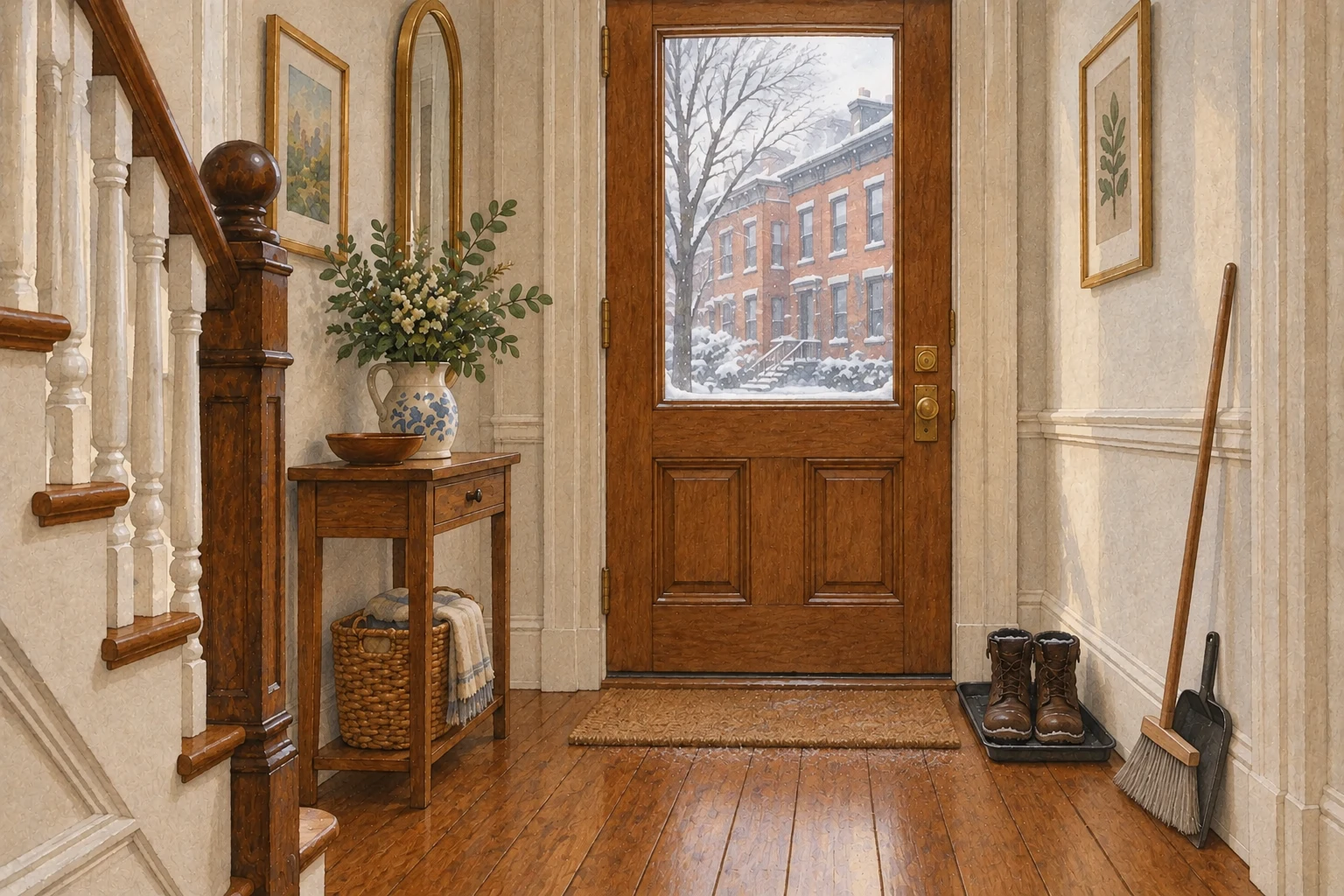
White film and grit by the front door in winter: the National Wood Flooring Association (NWFA) says salt "tends to leave a white, abrasive residue," and the guides agree on the answer, which is to stop it at the door and take the grit off dry. None of the hardwood pages we read gives a recipe for removing salt from a floor. This guide sets the pages side by side, builds a short routine for the door from their own words, and shows what a booked Standard visit's floor lines do and do not cover.
The wording comes from NWFA's "Avoiding Winter Weather Woes" (January 4, 2022), two Bruce hardwood-care pages (How to Clean Wood Floors, undated, and The Ultimate Guide to Hardwood Floor Care, April 7, 2025), the Shaw Floors hardwood care page (undated), the Carpet and Rug Institute's Salt spot solver (undated) and one City of Philadelphia release of January 23, 2026, all read on November 1, 2026. Bruce and Shaw are floor makers, so their pages are about their own floors. Your floor's maker comes first, and this guide is not their advice or the City's.
The short answer
- At the door: mats at the entrance (all three pages; NWFA and Bruce say both outside and inside), and shoes wiped or off (NWFA and Bruce).
- Grit: sweep or vacuum it up dry. Bruce says to "never use a beater bar that can scratch your hardwoods."
- Water: as little as possible. Shaw says "Don't use wet mops or steam mops."
- A removal recipe: none of the hardwood pages we read gives one for salt, so this guide gives none for a wood floor.
- The visit: the Standard sheet lists floors swept, mopped or vacuumed. It does not list removing a salt film.
Where the salt comes from
For its January 2026 storm the City said its Streets Department was "pre-treating major roadways with brine," and its Streets Commissioner said the City had "30,000 tons of salt ready." The release is about roads. Our reading, not the City's: salt put down on streets reaches a floor on the soles of shoes, the route NWFA names when it says household members "can track in mud, snow, water, and salt from the outside."
What the makers say, side by side
Each cell is the page's own wording. "Not said" means we found nothing on that point on the page we read, not that the maker disagrees.
| Point | NWFA (2022) | Bruce | Shaw |
|---|---|---|---|
| Mats | "Place multiple welcome mats outside and inside your home's entrances" | "Start by putting floor mats inside and outside entryways." | "Place walk-off mats at entrances to trap dirt and moisture." |
| Shoes | "ask everyone to wipe their shoes before entering" | "set up a boot removal station" | Not said |
| Dry removal | "sweep or dust mop your floors frequently" | "make sure you use a floor-brush attachment, and never use a beater bar that can scratch your hardwoods." The 2025 guide: "Avoid the beater bar, which can scratch the surface." | "Sweep or vacuum regularly to remove dirt and grit." |
| Water | "If you see a puddle on the floor, soak it up with a towel and don't let it sit." | "hardwood floors and water don't mix." The 2025 guide: "Never use a wet mop or excessive water" | "Don't use wet mops or steam mops." |
| Salt on the floor | "make sure to take extra precautions when cleaning so that it doesn't scratch the floor's surface" | Names "de-icing agents" among what shoes and pets bring in; no salt method | Not said |
| Indoor humidity | "between 60-80 degrees Fahrenheit, and between 30-50 percent humidity" | 2025 guide: "Maintain indoor humidity between 35% and 55%." | "Maintain consistent humidity levels (35-55%) to prevent warping." |
The humidity figures differ, so follow your own floor's maker. The only page in the table that mentions salt on the floor is NWFA's, and it asks for care so the salt "doesn't scratch," not a product or a method.
A short routine for the door
Built only from the quotes above. The order is ours.
- Mats at the door. All three pages say it; NWFA and Bruce say outside and inside.
- Shoes wiped, or off. NWFA asks everyone to wipe; Bruce suggests a boot station and says "you might want to remove your shoes regardless of weather conditions."
- Grit up dry, first. A broom, or a vacuum on its floor-brush setting with no beater bar. Our reading: dry comes before any damp cloth, because NWFA's worry is a residue that is "abrasive."
- Puddles blotted. A towel, and not left to sit.
- Anything left over goes to the maker. Bruce: "Many hardwood floor manufacturers recommend specific hardwood floor cleaners. So start by checking with them." On cleaners it says to "use a solution with a neutral pH."
If the entry is carpet
The Carpet and Rug Institute's page is titled Salt and does not mention winter or road salt. It is the closest trade-body page we found, and applying it to tracked-in salt is our reading. It says "Blot liquids with a dry, white absorbent cloth or white paper towels" and "Break up solids and vacuum." It warns that "Pouring any liquid into a dry spill may create additional problems."
It also lists a dish-detergent mix of "one fourth (1/4) teaspoon of a liquid dish washing detergent per one (1) cup of lukewarm water," with "NEVER USE A STRONGER CONCENTRATION!" and "Never use a laundry detergent of any type." Then: "Thoroughly rinse the area several times with lukewarm tap water. A mist type sprayer is recommended to prevent overwetting." For a stubborn spot it says "Always consider consulting a professional cleaner regarding any spot removal question."
What a booked visit's floor lines cover
These are the lines on the Standard checklist that touch an entry floor, and the Deep checklist includes them too. We read them from our own published sheet.
| Line on the sheet | Where it sits |
|---|---|
| "Hallway & Staircases Vacuumed And/or Mopped" | Entire house |
| "Floors Swept / Mopped / Vacuumed" | Entire house, and again in the kitchen |
| "Hardwood / Tile / Vinyl Swept and Mopped" | Bedroom |
| "Open Carpet Areas Vacuumed" | Kitchen |
| Removing a salt film, treating a stain, or cleaning an entry mat | Not named on the Standard or Deep sheet |
Three of those lines say "Mopped," while Shaw says no wet or steam mop on hardwood and Bruce's 2025 guide says no wet mop or excessive water. Bruce's undated page still describes mopping with a hardwood cleaner, under the heading "Go Easy on the Water." The sheet does not say how much water goes on which floor, and we claim no method. What settles it is the floor, so tell your cleaner whether it is solid or engineered wood, whether it is finished or oiled, and what the maker says. That is a fact only you hold.
Cleaners bring their own supplies (what that means), so the cleaner brings the tools and you bring the floor facts.
Is a winter visit worth keeping?
A visit does the floor work on the sheet above: the hall and stairs, the kitchen and bedroom floors, and open carpet areas vacuumed. It does not promise a result on a salt film, and neither do we. If the door is where the floor suffers, tell your cleaner.
An example, invented
This household is invented to show the order. It is not a customer. Priya has an oak floor inside a rowhouse front door. After the first snow she puts a mat on each side of the door and a boot tray in the hall, and asks the household to wipe their shoes. That evening she sweeps up the grit, blots a puddle with a towel and leaves the white film alone while she looks up what her floor's maker says. She books a Standard visit for the following week and tells the cleaner the floor is finished oak and where the film is.
Where to go next
For what a rowhouse's stairs and halls involve, see cleaning a Philadelphia rowhome. For what to put away before a visit, see how to prepare for house cleaners. For snow days, see the late-snow arrival window guide; for the other winter jobs, a guide to winter cleaning and preparations; for prices, the Philadelphia price breakdown. When you are ready, start a booking.
Frequently asked questions
What is the white film on my hardwood floor in winter?
NWFA says salt "tends to leave a white, abrasive residue." Its page does not say every white film is salt, and we have not seen your floor.
Can I mop salt off a hardwood floor?
Shaw says "Don't use wet mops or steam mops," and Bruce's 2025 guide says "Never use a wet mop or excessive water." NWFA asks for extra care so the salt doesn't scratch. None of the hardwood pages gives a salt-removal recipe, so check your floor's maker.
Will a Hometress cleaner remove the salt film?
The Standard sheet lists floors swept, mopped or vacuumed and carpet areas vacuumed. It does not name removing a salt film or treating a stain. Tell your cleaner what the floor is.