
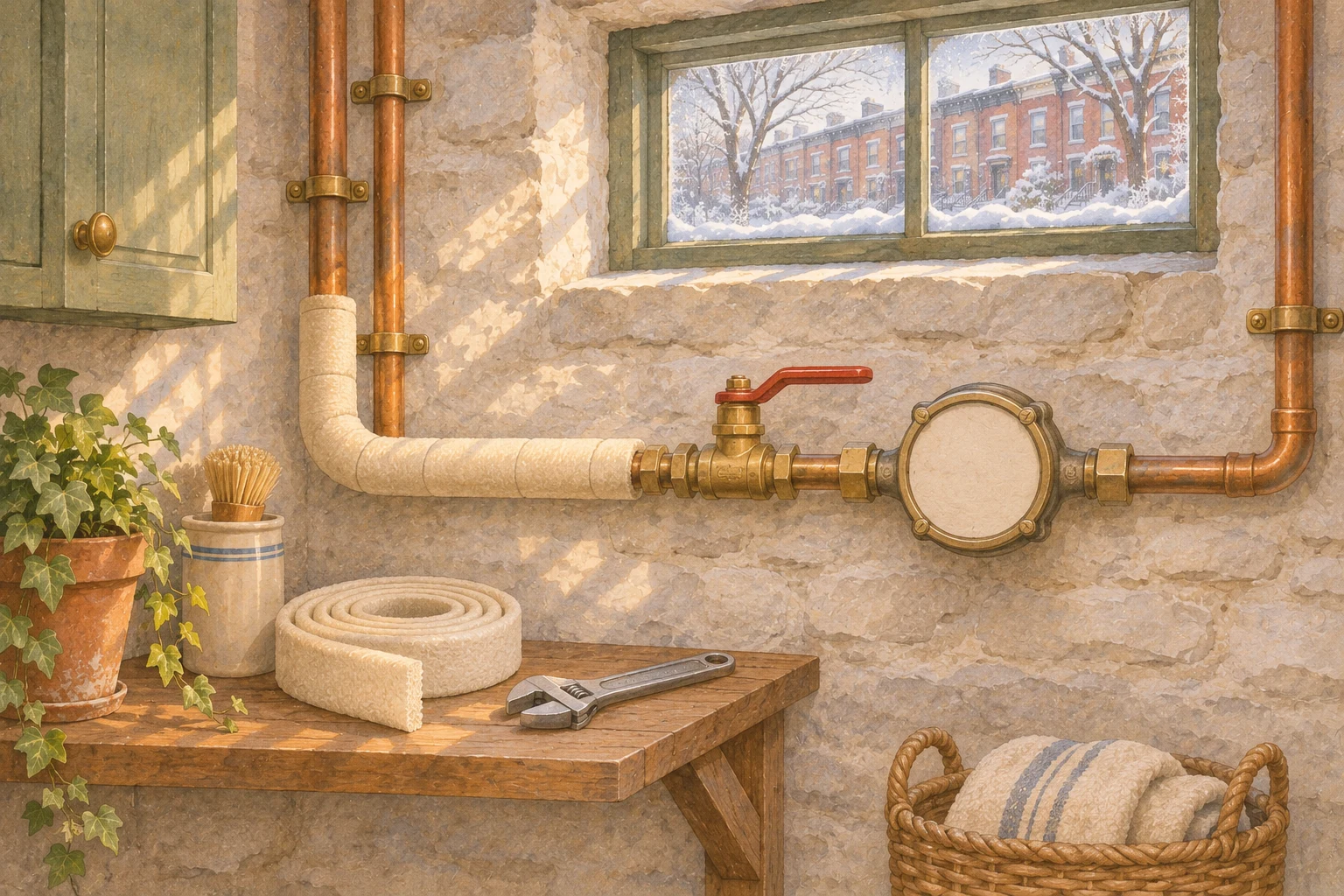
A cold snap, a visit booked for the morning, and the tap runs dry or a pipe lets go. The Philadelphia Water Department's frozen-pipe page says what to do for a damaged pipe: "Shut off the water," using "the house-side valve, near your water meter," then a licensed plumber makes the repair. Our Terms of Service add the part about the booking: a visit needs running water, and a visit booked into a dry house may be refused. This guide sets the two side by side and says what neither one covers.
Quotations come from the Department's All About Frozen Pipes and Cold Weather Solutions pages (neither shows a date), the EPA's A Brief Guide to Mold, Moisture and Your Home (last updated February 18, 2026), and our own Terms of Service and checklist, all read on November 3, 2026. The Philadelphia Inquirer reported on January 29, 2026 that the Department had responded to 147 water main breaks so far that month, a preliminary figure, so a dry tap in a hard freeze is a real winter event here. This guide is not the Water Department's advice and it is not plumbing advice.
The short answer
- No water at the tap: the Department's first step is "First, ask a neighbor if they have water." A neighbor with water points to your own pipes; a neighbor without it can mean a water main break.
- A damaged pipe: "Shut off the water." "A licensed plumber must make repairs." The Department says "we cannot fix your pipes."
- A booked visit: Section 4.2 of our Terms says "Access to running water and electricity within the home is required to perform cleaning services effectively." Service "may be refused or significantly impacted" without it.
- After the leak: the EPA says "It is important to dry water-damaged areas and items within 24-48 hours to prevent mold growth."
What the Water Department prints
| Situation | What the page says | Page |
|---|---|---|
| No water at the tap | "First, ask a neighbor if they have water." If neighbors have none, the page says it may be a water main break; if they do have water, it says your pipes have likely frozen. | All About Frozen Pipes |
| Pipes frozen, not yet thawed | "Make sure the faucet is turned on so melting water can drip out." "The first sign of freezing is reduced water flow from a faucet." | All About Frozen Pipes |
| A damaged pipe | "Shut off the water." "Use the house-side valve, near your water meter." "A licensed plumber must make repairs." "If the break is in a hot water pipe, close the valve on top of the water heater." | All About Frozen Pipes; the hot water line is on Cold Weather Solutions |
| A leaking meter | "If the meter is leaking, call (215) 685-6300." | All About Frozen Pipes |
The frozen-pipe page also warns against the obvious reflex: "Calling our hotline when your pipes break can waste time needed to secure a plumber." The number above is for a leaking meter; for a broken pipe the instruction is the valve and then the plumber. Neither page says anything about a cleaning visit.
For a Philadelphia rowhome, the prevention line most likely to matter is on the Cold Weather Solutions page: "Wrap and insulate all water pipes in unheated areas, like your basement." The same page says to keep the water meter area above 40 degrees Fahrenheit.
What a visit needs from the house
Section 4.1 of our Terms lists what cleaners do not do, including "Handling biohazards, mold remediation, dangerous materials, blood, or bodily fluids (these require specialized certified services)." Section 4.2 is the one for a dry house: "Lack of Essential Utilities: Access to running water and electricity within the home is required to perform cleaning services effectively. Service may be refused or significantly impacted if these are unavailable."
The same section ends with the money line: "If service is refused or stopped mid-way due to these customer-controlled reasons, cancellation fees (as outlined in Section 2.4) may still apply." Section 2.4 itself says that with more than 48 hours of notice "No cancellation fee is charged, and any authorization hold is released," and the shorter notice tiers are laid out in our guide to skipping, rescheduling or pausing. The Terms never use the words pipe, frozen or burst, and they do not say whether a pipe emergency changes a fee. This guide does not guess.
What to do, by situation
| Situation | What the visit can do | First step |
|---|---|---|
| No water, visit booked | Section 4.2: service "may be refused or significantly impacted." The Terms do not define "significantly impacted." | Ask a neighbor, then tell us before the day, not on it |
| A burst pipe, plumber not yet in | No checklist line deals with a leak, so there is nothing for a visit to do about it | The valve near the meter, then a licensed plumber, then a new date |
| Water back, floors or walls still damp | No checklist line dries a room, extracts water or repairs damage; the Terms exclude mold remediation | The EPA's 24-48 hour drying line comes first; book once the area is dry |
| Repair done and the area dry | The ordinary tier lines apply, the same as any visit | Book a date |
Drying questions belong to the EPA's page, not ours. It tells renters to "Report all plumbing leaks and moisture problems immediately to your building owner, manager, or superintendent." For what a Hometress visit does and does not include once the house is ready, see what a house cleaner won't do in Philadelphia.
A short card for a cold week
- Check before you sleep. The Department's page says "Check your faucets for water flow and pressure before you go to sleep and again when you wake up."
- Know your valve. The Department tells you to find the shut-off valves before an emergency; it says they are "usually near the water meter."
- Our suggestion, not the Department's: if a tap is weak or dry the evening before a visit, tell us that evening. For an advance booking, more than 48 hours of notice is the tier with "No cancellation fee," and a late call falls in a shorter one.
- Changing a visit. Our FAQ says to message us through the contact form or call, and the Terms ask for "as much notice as possible."
Frequently asked questions
Can a house cleaner work if the water is off?
Our Terms say running water is "required to perform cleaning services effectively" and that service "may be refused or significantly impacted" without it. They do not define the second phrase, so the answer on the day is not published.
Will I be charged if I cancel because of a burst pipe?
Section 4.2 says fees "may still apply" when a visit is refused for these reasons, and Section 2.4 sets the notice tiers. The Terms do not mention a burst pipe, so this guide cannot say how one is treated.
What does the EPA say about drying a wet area?
The EPA's line is "within 24-48 hours to prevent mold growth." That is the EPA's recommended window for drying a water-damaged area, not a Hometress timeline.
If water still runs but looks brown or cloudy, a different Department page applies: brown or milky tap water in Philadelphia. If the cold only makes a cleaner late, cleaner arrival windows and snow covers that, and how to prepare for house cleaners covers the rest of the day. Once the water is back on and the plumber's work is done, start a booking.