
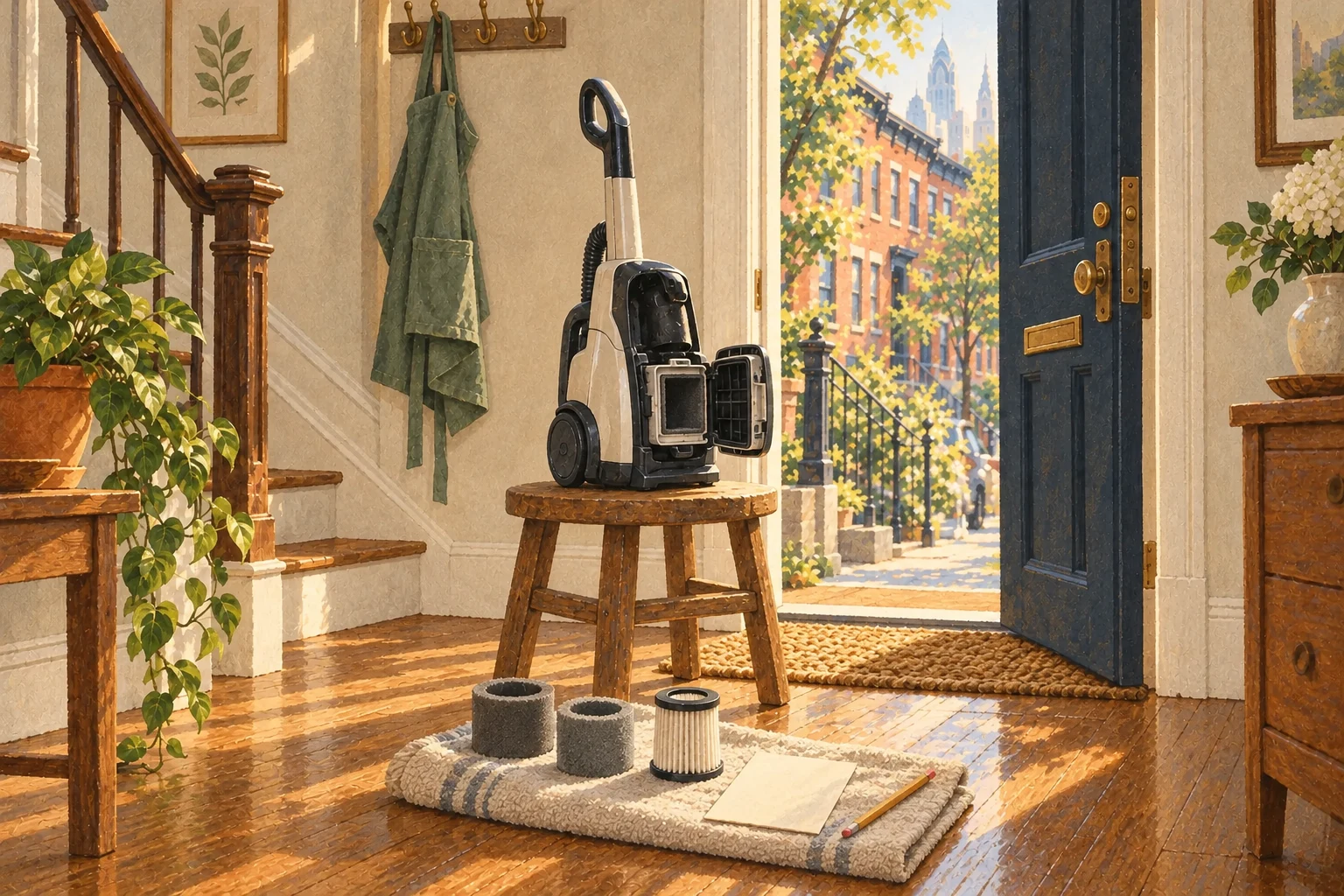
Halfway through a client’s hallway the suction drops, and you wonder whether the vacuum’s filter needs a rinse. The part might say HEPA on it, which sounds like it settles the question. It does not. Whether a filter is rinsed or replaced is decided by the maker of that model, and two makers can give opposite answers about parts that share a name.
Below is a one-page maintenance card for the vacuum you own, with two worked examples. It is a suggested personal record for independent cleaners, not a Hometress requirement, training standard or app feature, and it does not make anyone a vacuum technician. It is also not a repair guide, a buyer’s guide or a claim about air quality. The examples come from Shark’s Australian Help Centre page for the Rocket Pet Pro Cordless Handstick, IZ102, and from Miele’s operating instructions for the Dynamic U1, both read October 30, 2026. The task list comes from Hometress’s published checklist.
The short answer
- Write down the machine and the exact part before you choose an action. “HEPA” on a part does not tell you to wash it or to replace it.
- Wash only what the maker’s instructions for your model say to wash, and only the way they say to wash it.
- If the instructions say replace, replacing is the maintenance. Do not go looking for a rinse.
- If you cannot find the instruction for your model, ask the maker. Appearance, color and another model’s page are not answers.
- A rinsed filter is not ready until the maker’s drying time has passed, so plan the rinse around your calendar.
One word, two instructions
Hometress’s cleaner page answers “Do I bring my own supplies?” with: “Yes. You bring your own supplies and equipment to every visit. Households are promised professional, eco-friendly products and HEPA-filter equipment, with nothing for them to stock.” Our guide to what a cleaner carries to a first job covers the rest of the kit. This guide does not say which machines meet that promise or how well any filter performs. It starts after you own the machine and asks how to keep it in the condition its maker describes.
The Shark page covers a rinse. It says to “Rinse the pre-motor foam and felt filters every month, or as needed,” and “Rinse both filters with water only.” The part after the motor is named alongside the HEPA filter: “Rinse the post-motor or HEPA filter every 12 months, or as needed.” For each, the page says to let the filter “air-dry completely (at least 24 hours) before reinstalling.”
Miele’s manual goes the other way. Depending on the model, the vacuum comes with an AirClean, an Active AirClean 30 (black) or a HEPA AirClean 30 (white) exhaust filter. For the first, “Replace this filter every time you start a new packet of Miele FilterBags.” For the other two, “Replace this filter when the exhaust filter change indicator is completely red”. The exhaust-filter pages we read give replacement steps and no rinse instruction.
So one machine’s HEPA part is rinsed and another’s is replaced. Neither page is a rule about its brand or about HEPA filters in general; each describes one model. That is the reason to write the model next to the part before you pick an action.
Miele ties its indicator to use: “This occurs after approx. 50 hours of operation, which is equivalent to about a year of average use.” The manual does not say what a full-time cleaner’s year looks like, so go by the trigger it names, the indicator, rather than a calendar date. That reading is ours, not Miele’s.
The maintenance card
Copy this into a note, one card per machine. Work down the rows in order; the right-hand column is what to do when you cannot fill a row in.
| Field | What to write | If you cannot fill it in |
|---|---|---|
| 1. Machine | Brand and full model name, as printed on the machine or the front of its manual. | Find the label or the manual before you touch a filter. |
| 2. Part | The filter’s name as the manual calls it, such as “pre-motor foam and felt” or “exhaust filter.” | Do not guess from shape or color. |
| 3. Source | The link or page number of the maker’s instruction for this part. | No source, no wash. Ask the maker. |
| 4. Allowed action | Wash, replace or ask the maker, exactly as the instruction says, including what to wash it with. | Write “ask the maker.” Do not borrow another model’s instruction. |
| 5. Interval or trigger | What the maker states: a time, a packet of bags, an indicator. | Write “not stated” rather than a number you made up. |
| 6. Last action | The date and what you did. | Write “unknown” and start the record today. |
| 7. Ready check | What must be true before the part goes back in, including any drying time the maker gives. | Treat the part as not ready until you know. |
A blank row is information. “Not stated” is a better entry than an invented interval, and “ask the maker” is a complete action.
Two hypothetical cards
These cards are fictional. They are filled in only with what the two pages above state. Neither machine is a Hometress recommendation, and neither belongs to a real cleaner.
A cordless stick whose maker says rinse
- Machine: Shark Rocket Pet Pro Cordless Handstick, IZ102, as the Australian Help Centre page names it.
- Part: pre-motor foam and felt filters, then the post-motor or HEPA filter.
- Source: Shark’s “Product Care & Maintenance” page for the IZ102.
- Allowed action: rinse with water only, both parts.
- Interval: every month or as needed for the foam and felt; every 12 months or as needed for the post-motor or HEPA filter.
- Ready check: air-dried completely, at least 24 hours, before reinstalling.
“At least 24 hours” is a minimum, and the page offers no faster method; neither does this guide. If the machine is due on a job sooner than that, the rinse waits. That scheduling reading is ours, not Shark’s, and it is not a Hometress rule.
A bagged model whose maker says replace
- Machine: Miele Dynamic U1, from the US operating instructions.
- Part: the exhaust filter. The manual lists AirClean, Active AirClean 30 (black) and HEPA AirClean 30 (white), depending on the model.
- Source: the Dynamic U1 operating instructions, page 20.
- Allowed action: replace. The pages we read give no rinse instruction.
- Trigger: AirClean, each new packet of FilterBags; the two “30” filters, when the change indicator is completely red.
- Ready check: the manual says “Do not use more than one exhaust filter at a time,” and for the two “30” filters it has you press the exhaust filter change indicator after fitting the new one.
Which replacement part fits is a question for the maker or the seller. This guide recommends no brand and no part.
Where this meets the checklist
Three lines on Hometress’s published Standard list ask for a vacuum: “Vacuum Upholstered Furniture,” “Hallway & Staircases Vacuumed And/or Mopped” and “Floors Swept / Mopped / Vacuumed.” Our guide to what each cleaning tier includes lists every line. The card is a way to keep that one tool ready for the tasks a booking names. It does not change what a booking includes.
What this guide leaves out
It does not tell you how to open a machine, work on its motor or electrics, or run a vacuum without a filter its maker requires. Your manual covers those. Miele’s maintenance section begins: “Always disconnect the vacuum cleaner from the electrical supply for maintenance work.” Check what yours says. The guide makes no claim about air quality, allergens, germs or mold, and it recommends no product. For chemicals, lifting and leaving an unsafe job, see our guide to safety for independent house cleaners.
Where a platform fits
Hometress is a cleaning marketplace in Philadelphia. It is free to join, and cleaners carry their own insurance. If keeping your equipment in the condition its maker describes is how you already work, the application takes about five minutes. This guide does not cover pay.