
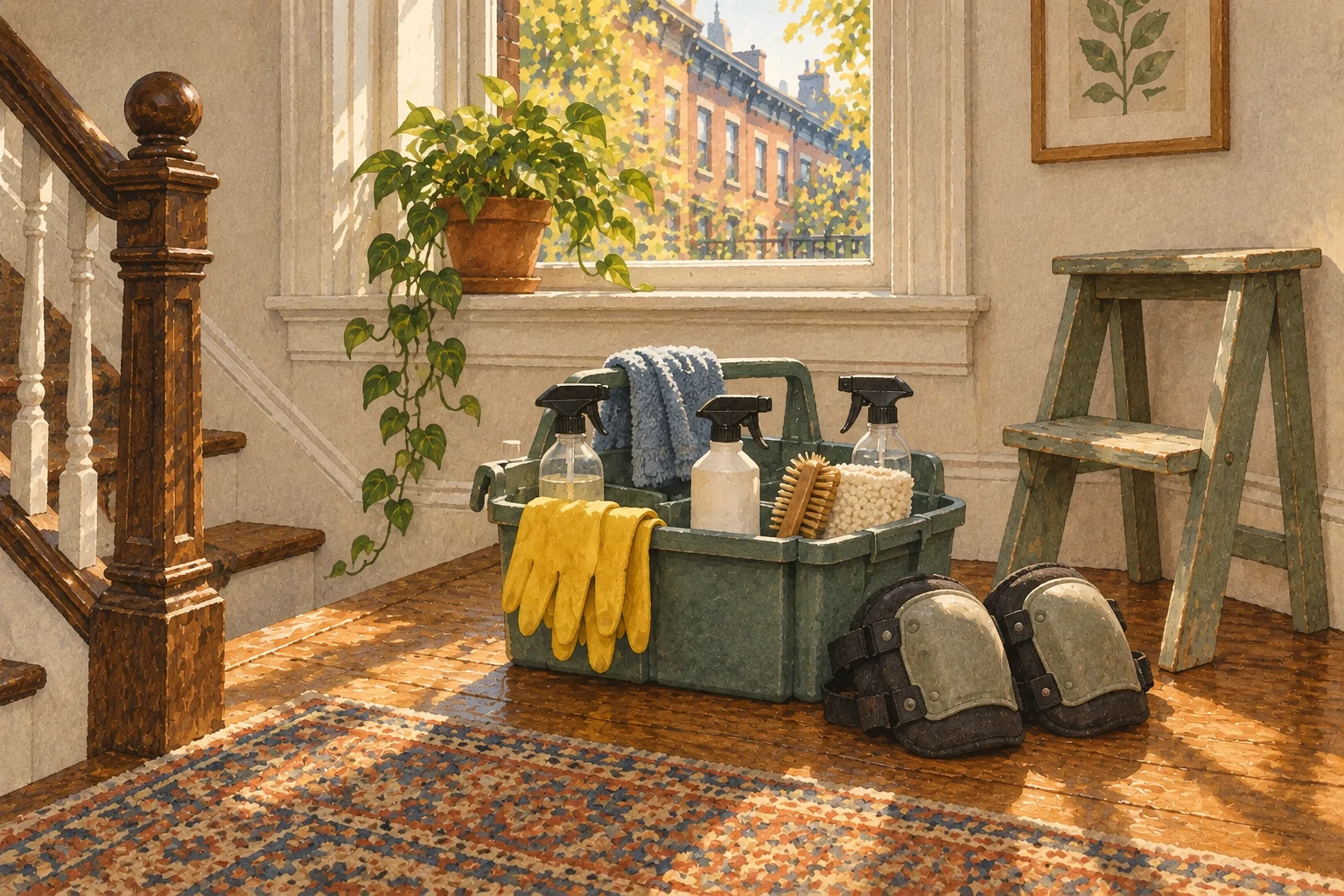
If you clean houses on your own, nobody hands you a safety plan. There is no employer to supply gloves, to tell you which products must never share a bucket, or to rotate you off a job that is wrecking your back. Three risks are yours to manage: what you mix and spray, how you lift and bend, and what you do when a home feels wrong. This guide takes the first two from public health and safety pages, then sets out what our Terms of Service say a Hometress cleaner may do when a home is unsafe.
This is a reading of public pages, not medical, legal or safety-engineering advice, and it is not a Hometress policy. We read each source below on October 19, 2026. The bleach page comes from Washington State’s Department of Health, but the chemistry it describes does not change at a state line, so it applies in Pennsylvania, Illinois and Washington alike.
The short answer
- Cleaning work carries three kinds of risk: chemicals, strain on your body, and working alone in someone else’s home. The CDC’s NIOSH lists “Heavy lifting, prolonged standing, and regular bending” and “Handling cleaning agents” among the hazards of cleaning work.
- One rule covers the worst chemical mistake: “Don’t mix bleach with ammonia, acids, or other cleaners.”
- One written right matters most when a home is unsafe: our Terms say Hometress and the referred Cleaners “reserve the right to refuse service or leave a job site.”
- What a cleaner is paid when they leave a job is not published. This guide says so instead of guessing.
Chemicals: the rule that matters most
Washington State’s Department of Health page, Dangers of Mixing Bleach with Cleaners, opens with the rule above and adds: “Mixing bleach with common cleaning products can cause serious injuries.” It is blunt about the worst case: “Very high levels can cause death.” It spells out the combinations:
| Bleach plus… | What the Department of Health page says |
|---|---|
| Ammonia | “When bleach is mixed with ammonia, toxic gases called chloramines are produced.” |
| An acid | “When chlorine bleach is mixed with an acid, chlorine gas is given off.” |
| Drain cleaners and other acids | “Sodium hypochlorite reacts with ammonia, drain cleaners, and other acids.” |
| Some oven cleaners, hydrogen peroxide and some insecticides | “Bleach also reacts with some oven cleaners, hydrogen peroxide, and some insecticides.” |
Acids are easy to miss because they hide in ordinary products. The page names vinegar, some glass and window cleaners, toilet bowl cleaners, drain cleaners and rust removal products among those that contain them. Applied to a house, that means two habits: never combine products in one container, and do not spray a second product onto a surface you have just treated with bleach until you have read both labels.
The page’s other instruction is plain: “Be sure to always read the product label before using a cleaning product.” If you are exposed to a mixture and have symptoms of illness, it says to “contact a health care provider or emergency response service (911).” We add no first-aid steps of our own.
NIOSH also lists “Handling cleaning agents” among the hazards of the job, and the conditions it says the hazards may cause include “Skin diseases, allergies, and respiratory diseases.” A Hometress cleaner brings their own supplies; the cleaner page answers the question directly: “Yes. You bring your own supplies and equipment to every visit.” That makes the label rule yours to keep, since you chose every product in the caddy.
Strain: lifting, bending and standing
The CDC’s NIOSH page, Cleaning and Custodial Services and Your Safety (dated March 3, 2026), says NIOSH has resources “to help cleaners and custodial employers and workers recognize, prevent, and reduce risks.” Its hazards include “Heavy lifting, prolonged standing, and regular bending,” and the conditions it says the hazards may cause include “Musculoskeletal disorders.”
For techniques we borrow from OSHA. Its Hospitals eTool, housekeeping section is written for hospital housekeepers and their employers, not for someone cleaning a rowhouse, and this guide does not say whether OSHA’s rules cover you. As a standard to meet, though, it is concrete:
- “Clean objects at waist level if possible, rather than bending over them,” the page says. At home, that is the difference between kneeling at the tub and folding over its rim.
- “Use knee pads when kneeling.”
- “Frequently change mopping styles when mopping (e.g., push/pull and rocking side to side) to alternate stress on muscles.”
- “Lighten a load that needs to be lifted or get help when lifting.”
- “Alternate tasks or rotate employees through stressful tasks.” You have no employees to rotate, so the part that applies to you is to alternate tasks yourself: do not scrub floors for an hour straight if the bathroom can come in between.
Section 4.1 of our Terms of Service, “Standard Service Limitations (Safety & Scope),” writes two limits into the contract. “Cleaners work safely using standard two-step stools provided by Hometress or the client. They do not climb higher (no ladders) and will only clean areas within safe reach from the floor or the step stool.” And: “Cleaners cannot move furniture or objects weighing more than 30 pounds.” They are limits on what a visit includes, and they work as safety limits too, so a cleaner who points to them is quoting the contract, not being difficult. The customer’s side of the same list is in our guide to what house cleaners won’t do in Philadelphia.
Working alone in someone else’s home
This section is habit, not sourced guidance. No page we quote gives a rule for it, and none of it is Hometress policy. These cost nothing:
- Tell someone you trust the address and the time you expect to finish.
- Keep your phone on you, not in a bag by the door.
- Know the way out before you start, and keep it clear of your equipment.
- Decide ahead of time what would make you leave, so you are not deciding it for the first time in the moment. The next section is the written list.
When a home is unsafe: what the Terms say
Section 4.2 of the Terms of Service, “Our Right to Adjust or Refuse Service,” opens: “The safety and respect of the independent Cleaners using our platform are essential. Hometress and the referred Cleaners reserve the right to refuse service or leave a job site if they encounter the following situations.” The list includes:
- Unsafe conditions: “extreme clutter or hoarding that prevents safe movement or cleaning, pest infestations, hazardous materials being present, or any situation deemed dangerous.”
- Inappropriate or threatening behavior: “Any form of disrespect, harassment, threats, discrimination, or behavior that makes the Cleaner feel unsafe or uncomfortable is grounds for immediate service termination.”
- Unsecured or risky pets: “If pets are not properly secured and pose a safety risk or significantly hinder the cleaning process.”
- A home with no running water or electricity, and a home “substantially different from what was described at booking.”
Two things stand out. The test for behavior is the cleaner’s own: it “makes the Cleaner feel unsafe or uncomfortable.” And the Terms do not define “dangerous,” and neither do we.
What the Terms do not say is what a cleaner is paid when they leave. The section’s closing note says that if service is refused or stopped mid-way for these reasons, cancellation fees “may still apply to compensate the Cleaner for their time and travel.” That is a charge to the customer, and it says “may.” It does not say what a cleaner receives, how much of the fee reaches them, or when. We do not publish that, so this guide does not guess. If it matters to your decision to join, ask Hometress through the contact page before you rely on it.
If you are thinking of joining
The cleaner page lists the vetting steps: “It’s a background check, a short reference call, and a standards walkthrough.” Two related guides cover other parts of working independently: whether independent house cleaners need insurance in Pennsylvania, and how an independent house cleaner sets up in Seattle. If you decide to apply, the application takes you through it.