
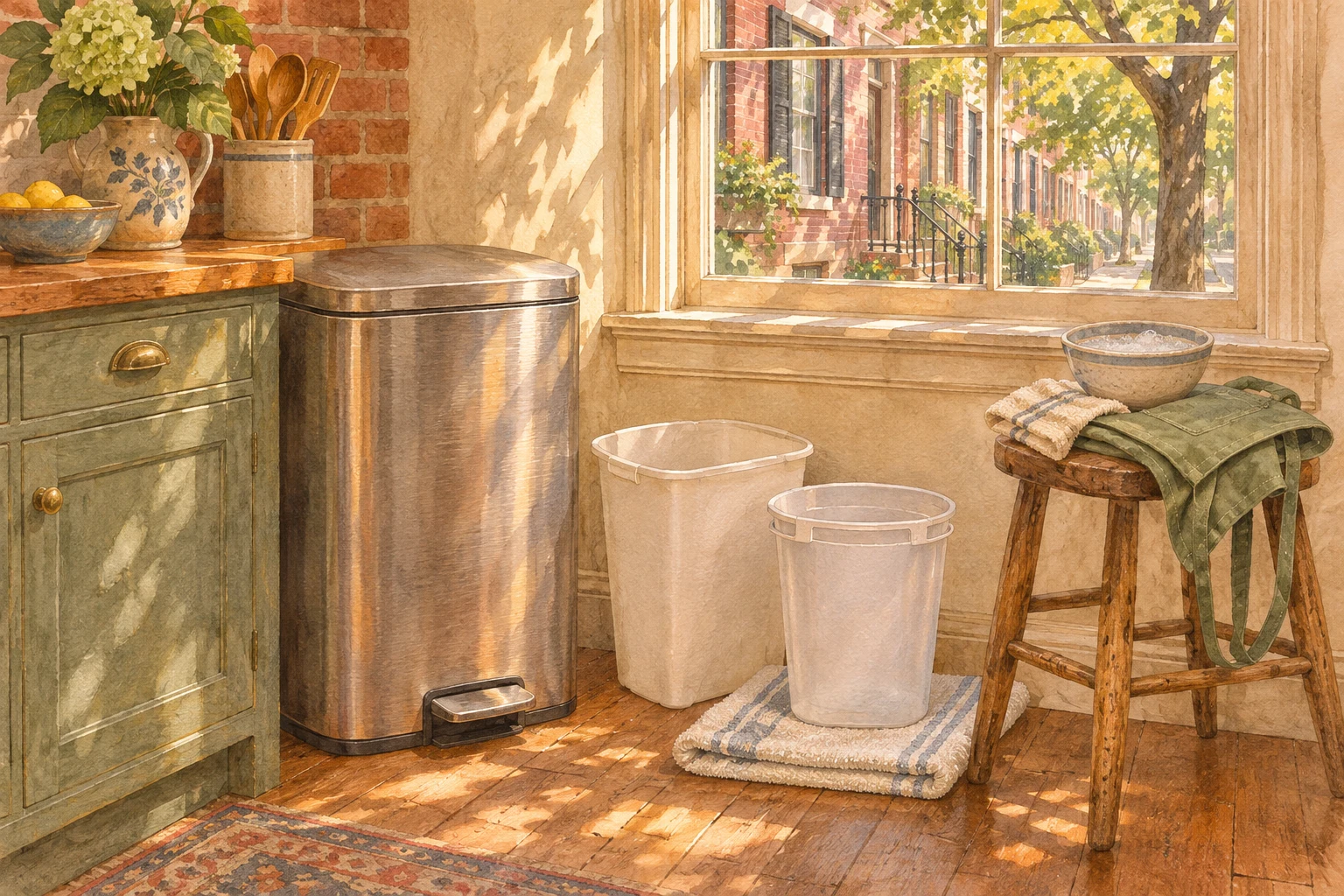
The booking says “Clean and Empty Trash Cans”, and it says it twice: once under Entire House and once under Kitchen. The can in the corner may be brushed steel with a foot pedal, or plain plastic, or a sensor can with a battery in the lid. The line names no cloth, no product and no method, and the word “bleach” means yes for one part of a can and no for another.
Below is a one-page card for that decision, with two fictional visits. It is a suggested personal record for independent cleaners, not a Hometress requirement, training standard or app feature. The rules come from three makers’ own pages, read November 2, 2026: simplehuman’s 45L Butterfly Step Can product page and its 30L Slim Step Can support page, Brabantia’s “Pedal Bin newIcon, 3L - Brilliant Steel” product sheet, and iTouchless’s “Simple Care Tips”. Those are a few cans from three makers, not every can, and this guide does not claim otherwise. The task lines come from Hometress’s published checklist.
The short answer
- The part decides, not the can. On simplehuman’s own pages one can gets two answers: no bleach on the stainless steel, and a diluted-bleach soak for the removable inner bucket.
- Stainless exterior: all three print a soft-cloth route. simplehuman says “a soft cloth, warm water and a mild detergent”, iTouchless a microfiber cloth with diluted dish soap, Brabantia a micro-fibre cloth and glass cleaner. simplehuman and iTouchless bar bleach and steel wool; Brabantia’s sheet does not use the word bleach.
- Brabantia’s sheet bars chloride on one finish: for lacquered parts, “Never use products containing chloride or hydrochloric solutions.”
- Sensor lids: only iTouchless covers them. A slightly damp cloth, the cleaning solution on the cloth and not the sensor, and no submerging or rinsing.
- Drying: iTouchless says to dry the container completely before a new liner goes in. simplehuman’s microfiber mitt has a dry side “to wipe and polish” the stainless steel.
- A smell that soap and water did not move is something to tell the client and write down.
What the sheet says and what it leaves open
Hometress’s published Standard list includes “Clean and Empty Trash Cans” under Entire House and again under Kitchen. Deep, Move and Dream Home build on Standard, so every tier carries both lines. The wording is “Clean”, not “Disinfect”: the Standard counter lines say “Disinfected”, and these two do not.
Neither line names a material, a cloth, a product, a method or a time. Our guide to what a cleaner carries to a first job pairs lines with kit items; it does not mention trash cans, so the lines have no kit entry. Our what each cleaning tier includes shows where the lines sit. This card is the care rule behind a line the kit list skips.
One more gap. iTouchless organizes its page by type and material (step pedal or sensor, stainless steel or plastic); the simplehuman and Brabantia pages are about particular products. So the card has a row for “type, material and how sure”, and an unsure row is written as unsure, not guessed.
Three makers, three sources
simplehuman’s 45L Butterfly Step Can product page and its 30L Slim Step Can support page carry the same two instructions: how to clean stainless steel, and how to clean the inner bucket. Neither page shows a date. Brabantia’s sheet is a product sheet for a 3 litre pedal bin, “© Copyright 2019”, dated 5 June 2019, with one maintenance paragraph; it lists the body and lid as stainless steel and the inner bucket as plastic. It is not a care guide, and a sheet this old may not match what the maker prints today. iTouchless’s “Simple Care Tips” page shows no date; it opens by saying “Care instructions vary by trash can type and material, such as stainless steel or plastic.”
Who says what
| Part | simplehuman | Brabantia (2019 sheet) | iTouchless |
|---|---|---|---|
| Stainless exterior | “Clean stainless steel weekly with a soft cloth, warm water and a mild detergent.” “DO NOT use steel wool, stainless steel polisher, bleach, salts or acids as these will damage the product.” | “Stainless steel is easy to clean with a micro-fibre cloth and glass cleaner.” | “use a soft microfiber cloth with mild dish soap diluted in warm water.” Under “Do not use”: “Chlorine bleach”, “Steel wool”, “Abrasive scrubbing pads”. |
| Chrome-plated and lacquered parts | Not on the page I read. | Chrome: “Do not use aggressive or abrasive products.” Lacquered: “Never use products containing chloride or hydrochloric solutions.” | Not on the page I read. |
| Plastic parts | No general plastic-parts instruction; see the inner-bucket row. | “Plastic parts can best be cleaned with a damp cloth and an all-purpose cleaning agent.” | “Use mild soap, warm water, and a soft cloth or nonabrasive sponge.” Under “Do not clean plastic surfaces with”: “Concentrated chlorine bleach”, “Extremely hot or boiling water”. |
| Removable inner bucket | “Remove the inner bucket and soak with diluted household bleach and water solution”. “Baking soda solution may work too.” | “Easy to clean – removable inner bucket.” The sheet lists the inner bucket as plastic (see the plastic-parts row). No bucket-specific method and no bleach line. | “When your model has a removable inner bucket, clean it separately using mild soap and water.” |
| Sensor-lid care | Not on the page I read. | Not on the sheet, which covers a pedal bin. | “Gently wipe the sensor area with a soft, slightly damp cloth, then dry it immediately.” “Apply cleaning solution to the cloth instead of spraying it directly onto the sensor”. “Never submerge it, place it in a dishwasher, or rinse it under running water.” |
| Drying | For the stainless steel: the mitt’s “other dry side to wipe and polish”. | Not on the sheet. | “Always dry the container completely.” “Allow the trash can to dry completely before installing a new liner.” |
Where a cell says it is not on the page, that is a statement about the page I read, not about the maker’s other documents. “Under ‘Do not use’” means a bulleted list on the iTouchless page. The mitt line is simplehuman’s sentence about its own microfiber mitt, which it offers as an alternative to the cloth for the stainless steel; the drying timing before a new liner is iTouchless’s, not simplehuman’s.
Where the makers differ
Bleach follows the part, even inside one maker. simplehuman’s cleaning section says not to use “bleach” on the stainless steel, and its inner-bucket answer on the same pages says to soak the bucket in “diluted household bleach and water solution”. The page gives no ratio of its own. It says only “Most liquid bleach bottles have instructions and directions printed”, which is not a ratio, and this guide gives none either.
iTouchless is the other way round. It never prints a bleach step. “Chlorine bleach” is on its stainless do-not list, “Concentrated chlorine bleach” on its plastic list, and its closing list says “Do not use chlorine bleach, steel wool, abrasive pads, harsh oven cleaners, or corrosive chemicals.” For a removable bucket it prints mild soap and water. The two makers’ bucket answers differ, and this card does not reconcile them: each is that maker’s rule for that maker’s can.
Brabantia’s sheet is the quietest. It never says bleach. It bars “products containing chloride or hydrochloric solutions” on lacquered parts and “aggressive or abrasive products” on chrome, and it points to an all-purpose cleaning agent for chrome-plated, lacquered and plastic parts and to glass cleaner for stainless steel. Whether a particular product counts as containing chloride is a label question this guide does not answer; the disinfectant-label worksheet is the place to start.
No page tells you to hose a can down. simplehuman says to rinse the spot with water and dry it after an adhesive remover on sticker residue; iTouchless says never to rinse a sensor lid, or a lid, hinge and pedal assembly, under running water. Otherwise water is on a cloth, a mitt or a bucket on its own.
The card
Copy this into a note, one card per can. Work down the rows in order; the right-hand column is what to do when you cannot fill a row in.
| Field | What to write | If you cannot fill it in |
|---|---|---|
| 1. Line and can | The sheet line (“Clean and Empty Trash Cans”), the room it is under, and where the can sits. | The sheet prints the line under Entire House and under Kitchen and does not say how many cans that is. Write what you found. |
| 2. Type, material and how sure | Step pedal, sensor or plain lid; steel or plastic; and whether you know from a label, the client’s note or only by looking. | Write “unconfirmed”. Do not guess from colour or shine (ours). |
| 3. Maker, model and page | The maker’s name and model from the can or the client’s note, and which of the three pages above you followed. iTouchless says to follow the instructions for your specific model. | Write “maker unconfirmed” and name the page you followed instead. |
| 4. Liner and bucket | Liner out first. Is the inner bucket removable? iTouchless says to clean a removable bucket separately. | Not removable: iTouchless says to wipe the interior with mild soap, warm water and a soft cloth, and not to pour water directly into areas connected to the lid, hinge, pedal, battery compartment, control panel or electronic components. |
| 5. Cloth and pad | The cloth you used. simplehuman and iTouchless bar steel wool on stainless; iTouchless also bars abrasive scrubbing pads. | Unsure of the finish: write that you used a cloth only. |
| 6. Product | The product or products you used on the can, by name. | Write what you used, or “none”. |
| 7. Bleach | Whether you used any, on which part, and the maker sentence you followed. The pages above: simplehuman bars it on the stainless steel and prints a diluted-bleach soak for the inner bucket with no ratio; iTouchless prints no bleach step; Brabantia bars chloride on lacquered parts. | Write “none used”, or that no maker sentence was confirmed. |
| 8. Lid, sensor and pedal | What you did to the lid. iTouchless: a slightly damp cloth on the sensor area, then dry it immediately; the cleaning solution on the cloth, not sprayed at the sensor; the lid assembly never submerged or rinsed. | Cannot tell whether a lid is a sensor lid: write “lid type unconfirmed” and what you did. |
| 9. Dry | What was dry before the new liner went in. iTouchless: dry the container completely first, and wipe stainless steel dry rather than letting it air-dry. | Not dry and you had to leave: write that, and whether a liner was fitted. |
| 10. Ask the client, and what is unresolved | A smell that soap and water did not move, a dent, a sticky hinge or a lid that will not close. | Tell the client and write what you left. For mixing products, see the safety guide linked below. |
What the sheet does not define
It does not define a can, a material, a method, a product or a time. The card above is the habit that fills the gap: write what you did, which maker’s sentence you followed and what you left. The same habit is in our final walkthrough scope check. For the other stainless surfaces in a kitchen, see the appliance-finish lookup.
Two fictional visits
These visits are fictional. The cans belong to no real client, and none of the makers has endorsed the card. The circumstances are invented; what a page says and what is our suggestion are marked separately.
A brushed stainless step can with a smell
Room and line: Kitchen, “Clean and Empty Trash Cans”. Type and material: step pedal, brushed stainless exterior, a 45L Butterfly Step Can by the client’s note, which is a model the simplehuman product page covers. Maker and page: the label on the base reads simplehuman, so you follow its pages. Liner out, then the inner bucket lifted out. The exterior gets a soft cloth, warm water and a mild detergent, as simplehuman prints it. No bleach goes on the steel, because simplehuman bars it, and no steel wool.
The smell is still there. simplehuman’s pages print a diluted-bleach soak for the bucket, and say a baking soda solution may work too, and give no ratio for either. You do not supply one. Row 7 reads “none used; maker prints a diluted-bleach soak, no ratio on the page”, and you tell the client what the page says and that the bucket is out for them to decide. You write what you left.
A sensor can with a sticky lid
Room and line: Entire House, the same line. Type and material: sensor lid, plastic body, a can the client’s note calls an iTouchless. Maker and page: the label on the lid reads iTouchless, so you follow its page, which says to follow the instructions for your specific model; the model is not on the note, so you write “model unconfirmed”. A slightly damp cloth goes to the sensor area and the sticky rim, then it is dried immediately. The cleaning solution is on the cloth, not sprayed at the sensor, and nothing is submerged or rinsed.
The body gets mild soap, warm water and a soft cloth. iTouchless’s page prints no bleach step, so row 7 reads “none used”. The inside is dried before the liner goes in. The lid is stiff at the hinge. The page says not to force the lid by hand and not to take the motor, hinge or electronics apart, so you leave it, write it in row 10 and tell the client.
What this guide leaves out
It recommends no brand, product or price. It does not say that bleach is safe or unsafe on any client’s can, and the makers’ printed text above is not our advice. It does not cover disinfection, health or ventilation, or what to do if a can is already damaged. It says nothing about what a manufacturer covers or what is owed if a surface is marked. For chemicals, lifting and leaving an unsafe job, see our safety guide for independent house cleaners. It does not cover pay.
Where a platform fits
Hometress is a cleaning marketplace in Philadelphia. It is free to join, and cleaners carry their own insurance. If writing down which maker’s sentence you followed is how you already work, the application takes about five minutes.