
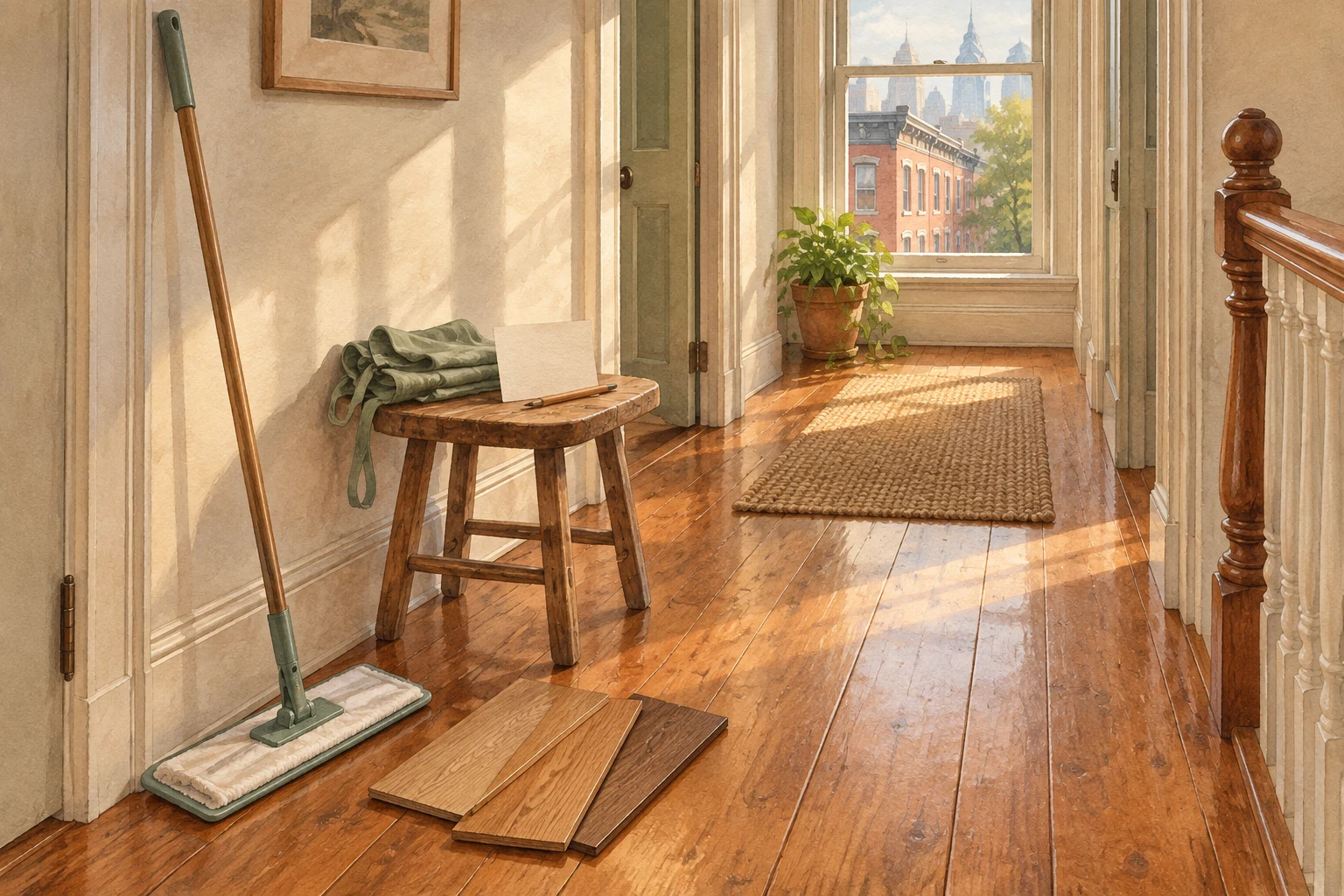
The booking says the floors get “swept and then mopped.” On a hardwood floor, the floor’s maker may say not to use a wet mop at all. The first question is not which mop to reach for. It is which floor this is, because the maker’s instructions decide how much water, if any, may touch it.
This floor-type card is a suggested personal record for independent cleaners, not a Hometress requirement, training standard or app feature. It is not a flooring guide or a buyer’s guide, and it does not teach you to identify a floor by how it looks. It rates no product; when a maker names its own cleaner, that is the maker’s instruction for its own floor, not our recommendation. The makers’ answers come from pages read October 30, 2026: Shaw Floors’ care pages for hardwood, laminate and resilient vinyl, and an article on the National Wood Flooring Association site. The task lines come from Hometress’s published checklist.
The short answer
- Identify the floor before you choose a method. Hardwood, laminate and vinyl are three different answers on water, even from one maker.
- On its own pages, Shaw says no wet or steam mops on hardwood, no washing or wet mopping with liquid on laminate, and no steam on resilient vinyl. Those are Shaw’s rules for Shaw floors, not a rule for every floor.
- The NWFA article says a damp mop, not a soaking wet one, for wood. Where an article and a maker differ, the maker of that floor outranks the article.
- If you cannot tell what the floor is, write “unknown,” use dry methods only and ask the client. That is our suggestion, not a Hometress rule.
- Tile is not covered here. We did not read a tile maker’s page, so this card makes no tile claim.
Why “mopped” is not a method
Hometress’s published Standard tier lists “Hardwood / Tile / Vinyl Swept and Mopped” under Bedroom and “Floors Swept / Mopped / Vacuumed” under Entire House and Kitchen. The public checklist page describes the bedroom line this way: “Hard floors, whether hardwood, tile or vinyl, are swept and then mopped.” Those lines say what the task is. They do not say how much water the floor will accept, and that is on the maker’s page. Our guide to what each cleaning tier includes lists every line.
Our first-job cleaning kit guide lists a mop and bucket against those lines. Read that as something to carry, not as a method for every floor. This card is the step before the bucket.
The floor-type card
Copy this into a note, one card per room. Work down the rows in order; the right-hand column is what to do when you cannot fill a row in.
| Field | What to write | If you cannot fill it in |
|---|---|---|
| 1. Room and line | The room and the booking line it serves. | Ask the client which rooms the booking covers. |
| 2. Floor type seen | Hardwood, laminate, vinyl, tile or “unknown,” in the maker’s own terms. | Write “unknown.” Do not guess from how it looks. |
| 3. How I knew | What the client told you, or a document you can name: a label, a manual or a care sheet. | Write “not confirmed” and treat the floor as unknown. |
| 4. Maker rule I checked | The maker’s care page for this floor, with the link and the date you read it. | Write “ask the maker.” Do not borrow another maker’s page. |
| 5. Water allowed | What that page says about water: none, a damp mop, steam or no steam, which cleaner. | Write “none until confirmed.” |
| 6. My method | Only what rows 4 and 5 allow. | If row 4 is blank, dry methods only. |
| 7. Ask the client first? | Yes for anything the booking line does not settle, and for any floor you could not confirm. | When in doubt, ask. |
| 8. Unresolved | Whatever the line asks for that rows 4 and 5 do not cover. | Leave it written down and tell the client. |
A blank row is information. “Unknown” and “ask the maker” are complete entries, and a guess is not. Where the line says “mopped” and the maker’s page rules out a wet mop, this is our suggestion, not a Hometress rule: use the method the page allows, or leave that part unresolved and say so. The card does not change what a booking includes; record unfinished work and discuss it with the client.
Hardwood, laminate, vinyl: three different answers
Shaw’s hardwood page is direct: “Don't use wet mops or steam mops.” Its list of things to do says “Dry mop with Shaw Hard Surface cleaner.” and “Sweep or vacuum regularly to remove dirt and grit.” It also says “Don't use harsh chemicals, ammonia, or abrasive cleaners.”
Shaw’s laminate page is stricter about liquid: “Do not wash or wet mop the floor with soap, water, oil-soap detergent or any other liquid cleaning product.” For routine care it points to sweeping, dusting and vacuuming, using “the hard surface floor attachment (not the beater bar)” on the vacuum. The page we read has no sentence about steam, so this card draws no steam rule for laminate from it.
Shaw’s resilient vinyl page starts with dry work (“Remove dirt and grit by sweeping or dust mopping daily”) and then turns to heat: “please do not use steam to clean your floors.” It gives the reason: “The extreme temperatures can cause expansion of the vinyl which could lead to wrinkles and glue bond issues.” It also says it does not recommend vinegar, because “over time it can damage your floors because it is not pH balanced.” The page says nothing about how wet a mop may be. Treat all of this as Shaw’s rule for Shaw’s product; we read no other maker’s vinyl page.
The NWFA site hosts a homeowner article dated August 6, 2025. Its byline is a floor care scientist for P&G Swiffer, so read it as an industry-site page with a brand-employee author. It says: “Use a damp mop – rather than a soaking wet one – to reduce the risk of damage.” It names two mistakes: string mops and buckets, because the method “puts too much water on wood floors,” and vinegar with water, because “its acidic nature can damage the wood floor and finishes over time.”
These pages agree on direction and differ on degree. The article allows a damp mop on wood; Shaw’s page for its own hardwood says dry mop and no wet mops. When they differ, the page from the maker of the floor in front of you is the one to follow, and row 4 of the card exists to make you look for it. Neither page says what to do when you do not know who made the floor. That is the unknown row.
When you cannot tell what the floor is
Write “unknown.” As a suggested personal rule, not a Hometress policy: use dry methods only, meaning sweeping, dust mopping or vacuuming, which is where every Shaw page above starts. Then message the client for the floor type, the maker or a care sheet. In your note, say which half of the line was done.
Two fictional visits
These visits are fictional. Each card is filled in only with what the pages above state, apart from the suggested rules, which are labelled as ours. Neither floor belongs to a real client, and no maker has endorsed the card.
A bedroom the client says is Shaw resilient vinyl
- Room and line: a fictional bedroom, for the Standard-tier line “Hardwood / Tile / Vinyl Swept and Mopped”.
- Floor type seen: vinyl.
- How I knew: the client showed a care sheet that names Shaw’s resilient vinyl. This is an assumed fact of the fictional visit.
- Maker rule I checked: Shaw’s resilient vinyl page: no steam, and vinegar not recommended.
- Water allowed: not stated. The page rules out steam, does not recommend vinegar and says nothing else about water.
- My method: sweep or dust mop, which is how the page starts. No steam, and no vinegar.
- Ask the client first? Yes: ask whether the product’s own care sheet allows a damp mop.
- Unresolved: how wet the mopped half of the line may be. The page we read does not say, so the card leaves it open instead of filling it with a guess.
A hardwood bedroom with no care sheet
- Room and line: a fictional bedroom, for the same Standard-tier line.
- Floor type seen: hardwood.
- How I knew: the client said so. Not confirmed: who made it.
- Maker rule I checked: “ask the maker.” Shaw’s page describes Shaw’s floors, and the NWFA article is a general page, so neither stands in for this floor’s maker.
- Water allowed: none until confirmed.
- My method: sweep, dust mop or vacuum only.
- Ask the client first? Yes: ask for the maker’s name or a care sheet, and whether a damp mop is acceptable.
- Unresolved: the mopped half of the line, until the maker’s answer is in hand.
What this guide leaves out
It gives no tips for identifying a floor, no repair or restoration steps and no tile rules. It rates no mop, pad or cleaner and does not say that any method leaves a floor protected or clean. It does not say which maker is right; each maker’s page describes its own floors. For chemicals, lifting and leaving an unsafe job, see our guide to safety for independent house cleaners.
Where a platform fits
Hometress is a cleaning marketplace in Philadelphia. It is free to join, and cleaners carry their own insurance. If checking the floor before the mop is how you already work, the application takes about five minutes. This guide does not cover pay.