
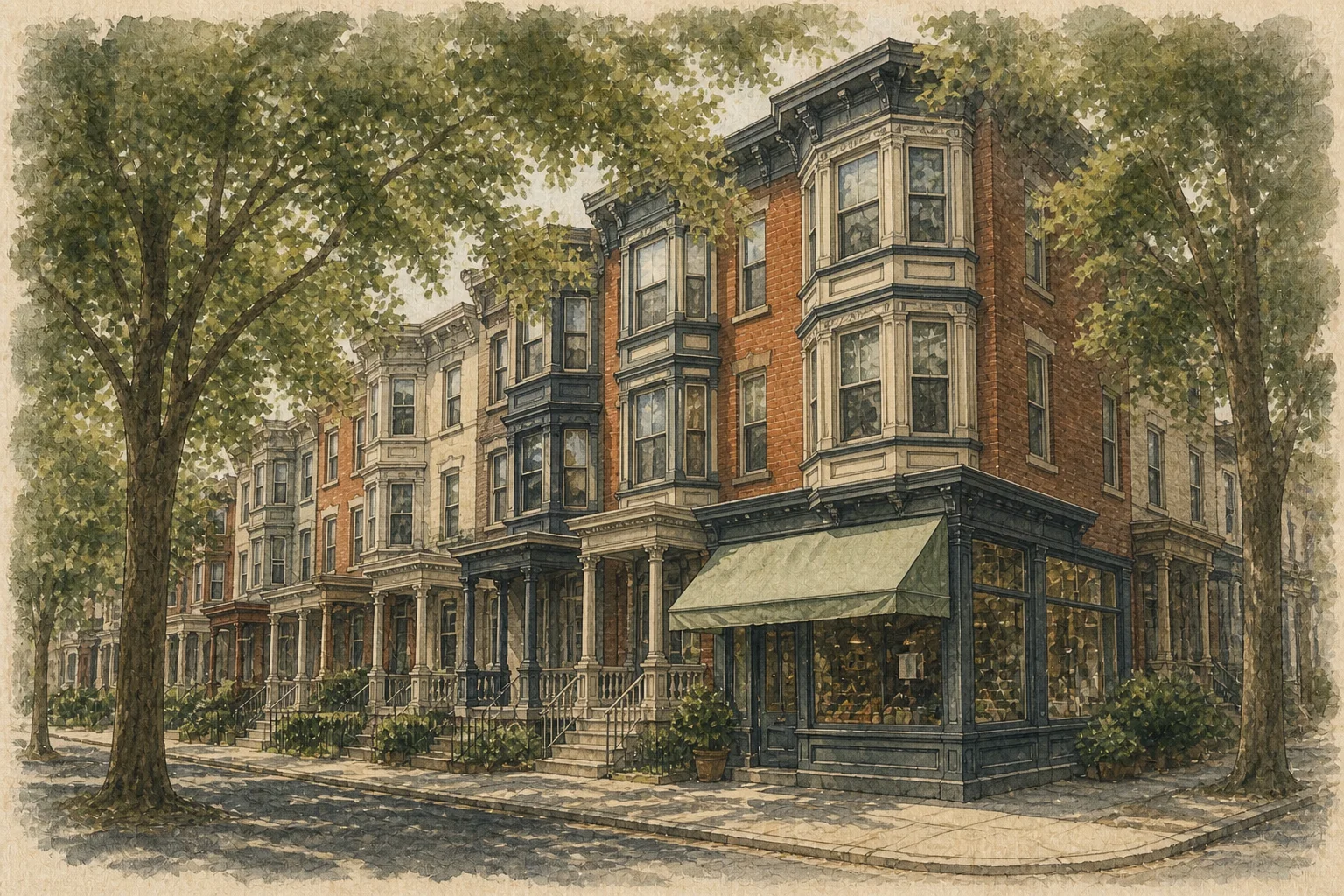
A little orientation
Compare the everyday routes through Walnut Hill
Choose a real starting point
Use the home's actual entrance for route comparisons instead of a neighborhood center pin.
Name the activity
Check a particular recreation program or facility, including access and registration, before counting it as an amenity.
Keep housing questions local
Ask about the unit and building you are viewing rather than adopting a directional neighborhood verdict.
A closer look
Try a Walnut Hill routine
Choose the practical question that would help you judge a particular address.
Connect the home with your destination
Enter a Walnut Hill address and your regular destination in SEPTA's planner. Compare the approach to Market Street with any suggested alternative, then test the return journey so the result reflects your own schedule rather than a general travel claim.
A useful questionWhich boarding point works best from this particular home?
Source & next step ↗Replace a vague amenity with a contact
Choose a recreation activity you would use near Walnut Hill and find the relevant City facility listing. Ask about the exact program and entrance, then connect it with an ordinary errand to see whether the combination suits your week.
A useful questionWho can confirm the activity I would actually use?
Source & next step ↗Prepare questions about the conversion
Look up the property's available zoning and permit information before the viewing. If the home has been divided or renovated, ask about the unit entrance, shared facilities, and maintenance arrangements; keep the answers with photographs of the actual spaces.
A useful questionWhat is shared, and who is responsible for maintaining it?
Source & next step ↗Walnut Hill is a place defined by movement, timing, and unspoken rules rather than labels or rankings. Some streets feel calm in the morning and tighter at night. Certain directions feel easier without anyone explaining why. Neighbors solve problems face to face, not through systems, and daily life runs on awareness more than assurances. This guide is about understanding Walnut Hill as it is actually lived, not how it is summarized online.
Why Walnut Hill Refuses to Fit Inside a Normal Neighborhood Guide
Walnut Hill breaks most neighborhood guides because it does not behave like a single place. It behaves like a series of micro decisions layered on top of each other. Guides usually try to answer one big question, usually some version of is it safe or is it up and coming. Walnut Hill forces a different question entirely, which is how you move through it, when you move through it, and what you understand without being told. The reason most online descriptions feel thin is not because nothing happens here, but because the rules are not spoken out loud. People who live here do not summarize. They adjust.
Another reason guides fail is because public conversation about Walnut Hill is unusually quiet. The loudest and most detailed discussions live behind closed doors, in private groups, on porches, or mid block conversations. What surfaces publicly tends to be corrective rather than explanatory. Locals spend more energy pushing back on oversimplifications than laying out neat explanations. That creates a vacuum where outsiders assume the silence means uncertainty. In reality, the silence means the knowledge is assumed. Walnut Hill operates on shared understanding, not public consensus.
There is also a mismatch between how outsiders evaluate neighborhoods and how residents do. External guides lean on rankings, scores, and broad labels. Walnut Hill residents lean on comparison, memory, and habit. It is not about whether the neighborhood is good or bad. It is about whether a specific block feels manageable at a specific time, and whether you know what manageable looks like here. Any guide that skips that step will always feel wrong to people who actually live in the area.
The Invisible Map That Locals Carry in Their Heads
Locals in Walnut Hill do not navigate by street names alone. They navigate by edges, pulls, and avoidance zones. There are places you drift toward without thinking and places you instinctively route around, even if the map says they are close. This is not fear driven behavior. It is learned efficiency. Over time, your body remembers which direction feels lighter and which direction tightens your awareness.
Direction matters more than distance. Walking a few blocks can feel entirely different depending on which way you angle yourself: some stretches put you on busier corridors, greener blocks, and spaces where foot traffic feels purposeful, and others are quieter than the map suggests.
The most important thing to understand is that locals give directions instead of evaluations. When someone explains Walnut Hill, they rarely say what it is. They say where to go and where not to linger. That is why online descriptions feel evasive to newcomers. They are not trying to be vague. They are communicating in the format that actually works here. If you learn the routes first, the rest of the neighborhood starts to make sense.
How Safety Is Actually Judged on the Ground
Safety in Walnut Hill is not measured by statistics or color coded maps. It is measured through comparison and lived calibration. Residents judge blocks relative to other parts of the city they know well. That internal scale matters more than any absolute number. A place is rarely described as safe or unsafe on its own. It is described as better than this, worse than that, or fine if you already know the area.
The most revealing question locals ask is not about crime rates. It is whether someone would walk a specific stretch alone. That question quietly bundles together time of day, familiarity, direction, and confidence. Two people can answer it differently and both be correct. One person knows the block rhythms. Another does not. That difference carries more weight than any external assessment.
Time Is the Detail No One Explains Out Loud
Timing in Walnut Hill is understood rather than discussed. People rarely attach specific hours or days to their advice, and that absence is meaningful. Once you live here long enough, you stop thinking in schedules and start thinking in shifts. Daytime has a baseline normalcy that does not need defending. Nighttime introduces a different posture, not panic, but recalibration.
Weekdays and weekends also feel distinct, even when nothing dramatic changes. Foot traffic patterns shift slightly. Noise tolerance adjusts. The same block can feel relaxed on a weekday evening and more unpredictable on a weekend night without anyone announcing the difference. Locals internalize this rhythm and move accordingly. That is why advice often sounds incomplete to newcomers. The missing pieces are assumed knowledge.
This is also why you will hear people suggest walking the neighborhood yourself before deciding anything. Not once, but multiple times, at different moments. Walnut Hill cannot be evaluated in a single pass. It reveals itself through repetition. Over time, you stop checking the clock and start trusting your sense of when a route feels right. That is when the neighborhood begins to feel navigable rather than confusing.
The Tradeoffs People Make on Purpose
People do not end up in Walnut Hill by accident. They choose it with a clear understanding that it asks something from them in return. The appeal is not about perfection. It is about balance. You get more space for the price than in nearby neighborhoods that feel more polished. You stay connected to the rest of the city without paying the premium that comes with trendier corridors. For many residents, that equation makes sense even when it comes with a learning curve.
Affordability here is not just about rent or mortgage numbers. It is about what you can tolerate day to day. Some people would rather manage uneven sidewalks and stay alert on certain walks than give up room, light, and access. Walnut Hill attracts people who are comfortable making those kinds of calculations. They understand that comfort is not uniform across the city and that no neighborhood gives everything at once.
Transit plays an outsized role in that decision. Being able to move easily toward Center City or nearby hubs changes how everything else feels. It turns Walnut Hill into a home base rather than a dead end. When you know you can leave easily, you are more willing to accept imperfections at home. That mobility is part of why people stay once they arrive.
The Complaints That Quietly Unite Everyone
For all the nuance and disagreement around safety and change, there are a few things almost everyone agrees on. These shared frustrations become a kind of shorthand. They are how neighbors bond without getting personal. The most common one is painfully ordinary. Dealing with basic errands can become unexpectedly exhausting. Package pickup, especially when it goes wrong, is one of those moments where patience runs out fast. It is the kind of hassle that feels small until you are standing in the middle of it.
Infrastructure wear is another unifying sore spot. Cracked sidewalks, potholes, and uneven streets are not dramatic enough to spark constant conversation, but they wear people down over time. You notice them on every walk, every drive, every rainy day. They signal neglect in a way that is hard to ignore once you see it. Residents may disagree on bigger issues, but no one argues that the physical upkeep feels sufficient.
Small scale crime sits in the background of these frustrations. It is rarely described with alarm. Instead, it is folded into daily planning. Locks get upgraded. Cars get checked. Awareness becomes routine. The emotional tone is not panic, but resignation. This is part of the cost of living here, and most people factor it in early.
The tradeoffs people make on purpose
People do not end up in Walnut Hill by accident. They choose it knowing it asks something in return.
- More space for the price than in nearby neighborhoods that feel more polished.
- Connection to the rest of the city without the premium of trendier corridors.
- Transit that makes it a home base rather than a dead end.
- Room, light and access, if you are willing to make the daily calculations.
- Uneven sidewalks, and staying alert on certain walks.
- Cracked sidewalks, potholes and streets that wear on you over time.
- Errands that turn exhausting — package pickup especially, when it goes wrong.
- Small-scale crime folded into daily planning: locks upgraded, cars checked, awareness routine.
Order Without Calling It In
What surprises many newcomers is how little formal authority figures into everyday problem solving. Walnut Hill operates on a social enforcement system that prioritizes relationships over reports. Calling outside agencies for minor issues is often seen as disrespectful rather than responsible. What might feel like civic engagement elsewhere can read as hostility here.
Blocks tend to regulate themselves. Longtime residents play a quiet but decisive role in maintaining order. They notice patterns. They intervene when something disrupts the flow of the street. This intervention is usually direct and personal, not bureaucratic. A conversation at the door carries more weight than a ticket or citation. That approach keeps conflicts contained and prevents escalation.
This system depends on a few simple behaviors. Acknowledging your neighbors matters. Knowing when to let something go matters even more. People who adapt to this rhythm tend to settle in. People who fight it often feel isolated. The neighborhood is not lawless. It is governed differently, with social consequence replacing formal punishment in many everyday situations.
What the Storefronts Are Really Telling You
The businesses along Walnut Hill corridors offer clues about who the neighborhood serves and how it functions. Many storefronts focus on practical needs rather than aesthetics. Tax preparation offices, hair and beauty supply shops, and straightforward food spots dominate certain stretches. To outsiders, this can look uninviting. To locals, it signals reliability and steady foot traffic.
These businesses shape the rhythm of the street. They keep people moving in and out throughout the day, which affects how safe or comfortable a block feels. Activity tied to daily needs tends to be predictable. It creates a sense of purpose rather than spectacle. That distinction matters more here than branding or ambiance.
Informal commerce also blends into this landscape without much comment. Small scale vendors appear where space allows. This is not seen as disorder. It is seen as adaptation. The presence of these sellers often indicates familiarity and tolerance rather than chaos. Reading Walnut Hill accurately means learning to interpret these signals the way residents do, not the way a polished guide might suggest.
The short list people share quietly
Walnut Hill does not inspire long recommendation lists. This is the one that comes up.
The student-run bistro at the culinary school
It feels hidden even to people who have lived nearby for years. The appeal is not trendiness — it is consistency, affordability, and the sense that you have found something meant for the neighborhood rather than visitors. Easy parking around it is part of the recommendation.
Best for · A meal that works smoothly
A Neighborhood With Weight in Its Walls
History in Walnut Hill is not packaged or polished. It exists as a layer you sense rather than a story you are constantly told. Historic homes, murals, and legacy sites sit alongside everyday routines without demanding recognition. This quiet coexistence shapes how the neighborhood carries itself. Pride here is understated. The past is acknowledged, not performed.
This approach affects how change is received. New development is watched carefully, not because residents reject progress, but because they are protective of what has already endured. There is a belief that history does not need to be marketed to matter. It proves itself through continuity. That attitude sets Walnut Hill apart from places that lean heavily on nostalgia as a selling point.
For newcomers, this means learning when to listen instead of ask. History is shared organically, often in fragments, when it feels relevant. Treating it as a backdrop rather than a headline aligns better with how the neighborhood understands itself.
The Lines People Defend Without Announcing Them
Walnut Hill residents are sensitive to how the neighborhood is described from the outside. Being lumped in with areas that face different challenges triggers frustration. So does having the neighborhood reduced to its rough edges without context. Many people feel the area is judged by appearance rather than lived reality, and that gap fuels defensiveness.
Over policing is another pressure point. Outside attention that arrives without understanding local dynamics often makes things worse rather than better. Residents tend to trust their own systems more than external oversight. When outsiders assume intervention is always the solution, it clashes with a culture built around self regulation and familiarity.
Certain phrases and reactions surface repeatedly in these moments. They signal that a line has been crossed. Learning to recognize those signals helps newcomers avoid unnecessary friction. Respect here is tied closely to nuance. Flattening the story is one of the fastest ways to lose credibility.
Who Thrives Here and Who Quickly Feels Out of Place
Walnut Hill works best for people who are comfortable with complexity. It suits those who prefer understanding patterns over demanding guarantees. Residents who settle in tend to be observant, adaptable, and patient. They are willing to learn routes, rhythms, and social cues rather than expecting clear instructions.
The neighborhood is less forgiving for people who need uniformity or constant validation. Those who rely heavily on official systems to resolve everyday issues often feel frustrated. People who interpret ambiguity as danger rather than context may struggle to relax. Walnut Hill asks for engagement, not distance.
Choosing to live here is less about lifestyle branding and more about personal tolerance. The neighborhood does not adjust itself to newcomers. Newcomers adjust themselves to the neighborhood. Those who can do that often find it rewarding in unexpected ways.
Who thrives, and who feels out of place
The guide's own answer: the neighborhood does not adjust itself to newcomers.
- People who are comfortable with complexity.
- Anyone who prefers understanding patterns over demanding guarantees.
- Residents who are observant, adaptable and patient.
- People willing to learn routes, rhythms and social cues rather than expecting clear instructions.
- People who need uniformity or constant validation.
- Anyone who relies heavily on official systems to resolve everyday issues.
- People who interpret ambiguity as danger rather than context.
- Anyone who wants distance — Walnut Hill asks for engagement.
When Familiarity Replaces Evaluation
The shift into feeling at home in Walnut Hill does not happen all at once. It happens in small moments that accumulate. You stop checking maps because your body already knows which direction feels right. You no longer narrate every walk in your head. Awareness becomes background rather than effort.
You begin to recognize faces and understand who intervenes when something stalls the block. You learn which issues deserve attention and which ones are better left alone. Frustrations still exist, but they lose their sharp edges. They become part of the landscape rather than constant irritations.
At that point, Walnut Hill stops feeling like a neighborhood you are assessing and starts feeling like one you are moving through naturally. It never becomes perfect or predictable. It becomes legible. That is the moment locals mean when they say it finally makes sense.
Make it yours
Your Walnut Hill comparison notes
A short list to turn what you read into your own next steps.
Saved checks stay on this device when browser storage is available. This is a personal planning list, not a property inspection or professional assessment.
Sources & next steps
Useful advice should
show its working.
These resources support the reader tools above and help you check details for your own address, date, or plans.
- SEPTA trip planner
Compare transit journeys using your actual stops, date, and departure time.
- Find a playground or recreation center
City facility listings provide locations and contacts for checking programs and access.
- City property and zoning lookup
Opens the City's address-based zoning and permit tools.
These checks replace broad directional advice with specific routes and property questions. The tools do not rank blocks or confirm unnamed businesses and schools.