
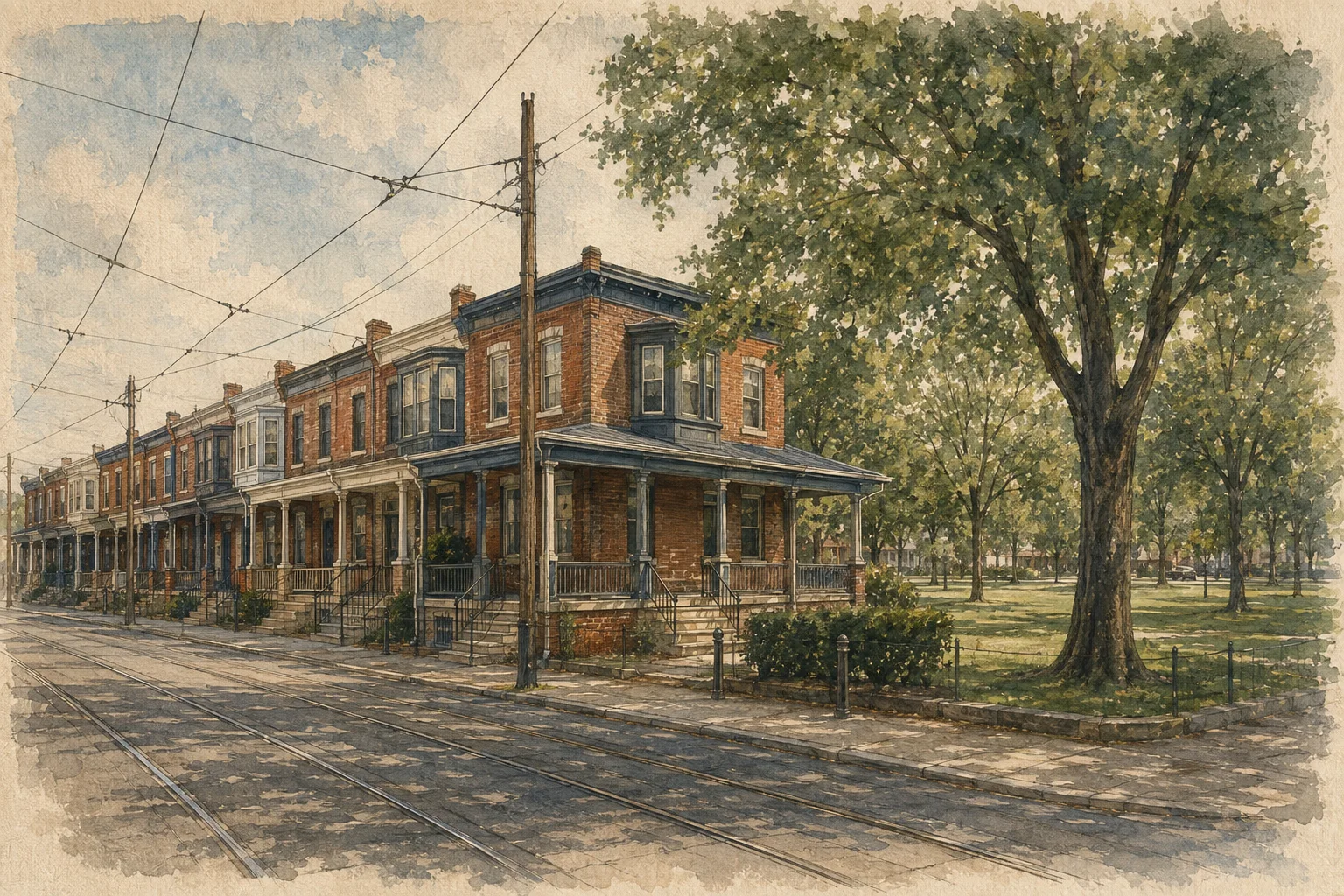
A little orientation
Build an everyday plan for Kingsessing
Check a real program
Contact the facility about the activity you need; a building on the map does not establish its current schedule.
Plan around your hours
Compare journeys at your usual departure and return times, including time spent getting to each stop.
Keep home questions specific
Use property records and a viewing to ask about repairs, access, and responsibilities at the exact address.
A closer look
Start with what you need nearby
Choose a Kingsessing routine to investigate without relying on broad neighborhood judgments.
Find the right facility contact
Search the City's facility finder for Kingsessing and open the listing for the recreation center you intend to use. Ask about the particular program, registration, and entrance you need before making it part of your weekly plan.
A useful questionWho can confirm the program and entrance I need?
Source & next step ↗Compare the trips you actually make
Use a Kingsessing address as your starting point in SEPTA's planner, then add work, school, or another regular destination. Compare travel at the relevant hours and write down where each journey requires a transfer or walk.
A useful questionWhich transfer would be hardest on my ordinary weekday?
Source & next step ↗Prepare a focused viewing
Search the home's exact address in the City's property tools and take the results to your viewing. Ask about open repair questions, shared entrances, and maintenance contacts; record answers alongside what you can actually observe inside.
A useful questionWho handles the repair questions this particular home raises?
Source & next step ↗Kingsessing is not a neighborhood you understand from the outside. It reveals itself through the details you only notice when you are actually on the block, walking the streets and seeing how people live day to day.
This guide is built to reflect that reality. Not a simplified version, not a polished pitch, but a grounded look at how Kingsessing actually works. If you are considering living here, investing here, or simply trying to understand it better, the most valuable thing you can take away is this: Kingsessing rewards attention. The more closely you look, the more accurate your understanding will be.
The Kingsessing Contradiction: Why No Honest Guide Can Be All Positive or All Negative
Kingsessing is the kind of Philadelphia neighborhood that exposes weak neighborhood writing almost immediately. If someone describes it as simply dangerous, they are leaving out the part that keeps people rooted here. If someone describes it as simply up and coming, they are leaving out the part that makes longtime locals, workers, and even interested buyers stop and measure their words. The truth of Kingsessing sits in the tension between those two instincts. It is a place where people notice beautiful old rowhomes, active community institutions, and real signs of reinvestment, while also adjusting their routines around violence and the feeling that some ordinary errands carry more weight here than they do in other parts of the city.
That contradiction is not just a branding problem. It shapes daily life. In Kingsessing, one of the most useful ways to judge a block is not by an online description or a broad neighborhood label, but by how it feels when you actually stand there and look around. Do you see contractor trucks and ladders outside houses that look actively cared for. Do you see signs that people are fixing places to live in them, not flipping them and disappearing. Does the block feel connected to something larger like the Baltimore Avenue corridor, the rec center, or a route that people actually use with some consistency. Those details matter here because Kingsessing rarely rewards abstract thinking. It is a neighborhood that keeps forcing you back into physical reality.
That is also why the strongest local perspective is usually the one that can hold two truths at once. Kingsessing does have serious violence tied to its public image, and not just as old neighborhood folklore. That reputation keeps getting reinforced by newer incidents, which means the fear is not theoretical and the caution is not outdated. At the same time, the neighborhood is not emotionally empty. Community attachment is real here. Civic organizing is real here. Pride in places like Kingsessing Recreation Center and Kingsessing Library is real here. So is the instinct to defend the neighborhood from lazy outsiders who think one headline or one drive through explains everything.
This is what makes Kingsessing hard to flatten. It can feel like a place under pressure and a place with real neighborhood life at the same time. It can produce frustration severe enough that people change how they move after dark, and still produce loyalty strong enough that residents fight to keep basketball courts open, show up to meetings at the library, push for cleanup days, and rally around public space improvements. It can make someone pause before recommending it to a newcomer, while still making that same person speak warmly about the people who live there and the institutions that hold the neighborhood together.
Any honest guide has to begin there, because Kingsessing makes no sense when stripped of contradiction. It is not a polished comeback story, and it is not a dead zone that people endure without attachment. It is a neighborhood where danger, effort, neglect, pride, grief, and everyday routine all overlap. That is the only useful starting point.
Where Kingsessing Actually Feels Different: The Block-by-Block Geography That Changes Everything
One of the fastest ways to misunderstand Kingsessing is to talk about it as though every part of it feels the same. Locals do not describe it that way, and neither should any serious guide. Kingsessing is one of those neighborhoods where the experience changes depending on which edge you are standing on, which corridor you are using, and what exactly you mean when you say you are in Kingsessing. That is why broad neighborhood summaries tend to fail. They miss the fact that this is a place of sub-zones, edges, and reference points.
The most important split in the local mental map is the difference between blocks that feel tied to Baltimore Avenue and blocks that feel deeper inside Southwest Philly.
The Baltimore Avenue side carries a different kind of gravity. Its value is not that Kingsessing suddenly turns into Cedar Park or a polished slice of West Philly. Its value is that certain Kingsessing blocks let you step into a more workable daily-life ecosystem than outsiders expect. Being able to get to Greensgrow, Mariposa Food Co-op, Firehouse Bikes, or Satellite Cafe changes how a block feels, even if those businesses are not sitting directly inside the neighborhood’s most troubled stretches. In practice, this means some parts of Kingsessing feel less isolated because they borrow momentum from Baltimore Avenue.
That proximity matters more than generic walkability language suggests. In a lot of neighborhoods, being close to a corridor like Baltimore Avenue is treated as a mild perk. In Kingsessing, it can feel like a major distinction. It affects what people imagine doing on foot, where they picture themselves grabbing something practical, and how connected they feel to the more comfortable parts of West Philly life. That is why the Baltimore Avenue edge keeps coming up in conversations about the neighborhood’s upside. It is not just about cool businesses. It is about being within reach of a different rhythm.
Once you move deeper away from those edges, the tone changes. The caution gets stronger. Advice becomes less about broad potential and more about personal threshold. This is where the local refrain that Kingsessing is block by block starts to make real sense. It is also where people stop trying to hand out definitive answers and instead tell others to feel it out themselves. That is not evasive advice. It is practical advice for a neighborhood where conditions shift fast enough that a general statement can become misleading within a few turns.
The corridor distinctions matter too. Baltimore Avenue has the strongest pull as an amenity edge. Chester Avenue feels more residential, more political, and more tied to neighborhood memory. It is the sort of corridor where local controversy, organizing, and community discussion feel easier to imagine than polished retail branding. Woodland Avenue adds another layer. It carries useful neighborhood businesses and transit movement, but it also shows more road wear and visual grit. Even if you are not consciously comparing these corridors, you feel the difference once you spend time around them.
This is why the most useful way to understand Kingsessing geography is not by drawing one clean boundary and assuming the inside behaves the same throughout. The neighborhood is better read through anchors and edges. Near the rec. Near the library. Closer to Baltimore. Along Chester. Along Woodland. Near the trolley turn at 60th and Kingsessing. Those are the kinds of reference points that make local advice more usable. They reflect how people actually talk about place once a neighborhood gets too complex for a single label to do the work.
Where Kingsessing sits
- Baltimore Avenue
- Chester Avenue
- Woodland Avenue
- Kingsessing Recreation Center
Schematic · not to scale
The neighborhood is read through anchors and edges
Not one clean boundary. Locals name a corridor or an anchor, because a general statement can become misleading within a few turns.
The Baltimore Avenue edge
The amenity edgeCertain Kingsessing blocks borrow momentum from the corridor. Being able to reach Greensgrow, Mariposa Food Co-op, Firehouse Bikes or Satellite Cafe changes how a block feels, so those blocks feel less isolated than outsiders expect.
Along Chester
Residential and politicalMore tied to neighborhood memory. The sort of corridor where local controversy, organizing and community discussion feel easier to imagine than polished retail branding.
Along Woodland
Businesses and transitCarries useful neighborhood businesses and transit movement, but shows more road wear and visual grit.
Deeper inside Southwest Philly
Away from the edgesThe tone changes and the caution gets stronger. Advice stops being about broad potential and becomes about personal threshold — people tell you to feel it out yourself rather than hand out a definitive answer.
The Real Housing Conversation: Cheap Rowhomes, Good Bones, and the Cost of the Tradeoff
Housing is one of the main reasons Kingsessing stays in the conversation for people who might otherwise write it off. The neighborhood keeps attracting interest because the rowhomes can look solid, the prices have historically felt lower than in many other parts of Philadelphia, and the built environment still gives off that old-house potential that makes some buyers feel like they are seeing an opening rather than a lost cause. The phrase good bones matters here because it captures exactly what draws people in. Kingsessing does not sell itself through sleek new construction or polished streetscapes. It pulls people in through structure, possibility, and the sense that there are homes here worth saving.
That appeal becomes stronger when paired with the visual evidence of reinvestment. One of the most hyper-local ways residents seem to judge whether a stretch is improving is by noticing contractor trucks, ladders, and visible work around lived-in houses. That is a completely different kind of neighborhood signal than a real estate brochure talking about revitalization. It is grounded, visual, and immediate. You do not need a market report to see whether people are putting money and labor into a block. You just have to notice whether someone is repairing a facade, hauling materials, or working on a home that looks occupied.
There is also an important social distinction embedded in this housing conversation. The improvement people respond to most positively is not absentee speculation. It is resident-led reinvestment. In other words, a block feels different when the visible work suggests someone is trying to make a real home rather than squeeze value out of a temporary opportunity. That distinction is especially important in Kingsessing because the neighborhood sits inside a wider Southwest Philly conversation about change, displacement, and who benefits when outside attention starts building.
This is where the cost of the tradeoff becomes impossible to ignore. Kingsessing housing may look like a value on paper, but the neighborhood asks you to consider more than square footage, brickwork, and purchase price. You have to weigh what that lower price is attached to. You are not only buying into old Philadelphia housing stock. You are buying into the block conditions around it, the route you take home, the way you think about nighttime movement, and the emotional cost of living in a place that carries both visible neighborhood effort and recurring public trauma.
That does not mean the housing case is fake. It means the housing case is conditional. Kingsessing may make sense for someone who understands urban complexity, has a high tolerance for evaluating blocks carefully, and sees real value in an old rowhome that can be improved over time. It may be much harder for someone who wants the reassurance of a neighborhood that feels consistently settled the moment they arrive. In Kingsessing, the house itself may look like the opportunity while the surrounding conditions are the real question. That is why the housing conversation never stays a housing conversation for long. It quickly becomes a conversation about thresholds, tradeoffs, and whether a person is prepared for the block-by-block reality attached to the bargain.
The Daily-Life Anchors That Make Kingsessing Feel Like a Real Neighborhood
If Kingsessing were only a collection of warnings, it would not hold people the way it does. Part of what gives the neighborhood shape are the institutions and everyday places that keep it from feeling like nothing more than a crime headline or a contested real estate zone. These are the anchors that make Kingsessing feel inhabited in a deeper sense. They create routine, memory, and neighborhood rhythm. They also reveal what residents are most protective about when the neighborhood is described too loosely by outsiders.
The strongest anchor in the neighborhood is Kingsessing Recreation Center. It functions as much more than a place to shoot around or cool off in the summer. It reads as one of the neighborhood’s core pieces of civic infrastructure, the kind of place people see as worth fighting for because it supports youth life, community gathering, and a basic sense that the neighborhood still has places where people can come together for something other than reacting to bad news. The push to keep the basketball courts open during renovations is especially telling. Residents did not treat the courts like a disposable amenity. They treated them like a meaningful part of neighborhood life. That response says a lot about what the rec center represents. It is one of the local measuring sticks for whether Kingsessing is being supported or ignored.
The scale of investment there matters too. The rebuild funding and the visible improvements, including new windows, roof work, ADA upgrades, turf, playground improvements, and paths, give residents something tangible to point to when talking about positive change.
In a neighborhood where abstract promises can sound cheap, physical upgrades at a place as central as the rec carry unusual weight.
They do not erase the neighborhood’s problems, but they do make it easier to argue that Kingsessing is not being defined only by decline.
Kingsessing Library plays a different but equally important role. Where the rec center carries physical energy, the library carries civic steadiness. Monthly community meetings happen there. Storytelling and memory work happen there. Programs tied to Hyperlocal Heritage give the neighborhood a way to record itself on its own terms instead of letting its image be set entirely by violent incidents or outside assumptions. The library feels like the quieter side of neighborhood resilience. It is where Kingsessing looks less like a place being reacted to and more like a place thinking about itself.
Then there are the smaller businesses and routine food spots that help a neighborhood feel lived in. Kingsessing Ice Cream Shop is not the kind of place that would anchor a glossy citywide best-of list, but that is exactly why it matters. It feels like a real neighborhood business, the kind of place people know, revisit, and evaluate with the blend of affection and bluntness usually reserved for something familiar. The same is true in different ways for places like Tinga Tinga Food Truck, Fred’s Water Ice, Diaz Deli Grocery, China Dragon, Baobab, and 7 Boys Cafe. Some matter because they are practical. Some matter because they are woven into local routine. Some matter because they add cultural texture or offer a small point of neighborhood pleasure. None need to be inflated into destination content to matter.
Even some of the most positive daily-life anchors in Kingsessing are really about adjacency. For certain blocks, the ability to get to Baltimore Avenue businesses is part of what makes everyday life feel more workable. That is why the neighborhood’s daily-life map does not stop at its official boundary. Kingsessing often feels most legible through a combination of internal anchors and nearby spillover. The rec center, the library, the food spots, the trolley, the Baltimore Avenue edge, the routes people actually use, all of these together create a neighborhood rhythm that cannot be reduced to one reputation.
That is the part outsiders often miss. A neighborhood does not become real only when it is easy or polished. It becomes real when people build routines around it, defend its institutions, know where to go for small comforts, and can tell you which places hold the block together when everything else feels unstable. Kingsessing has that kind of reality.
The daily-life anchors
The institutions and everyday places that keep Kingsessing from reading as nothing more than a headline.
Kingsessing Recreation Center
Much more than a place to shoot around. The rebuild brought new windows, roof work, ADA upgrades, turf, playground improvements and paths — physical upgrades residents point to when arguing the neighborhood is not being defined only by decline.
Best for · Youth life and community gathering
Kingsessing Library
Where monthly community meetings happen, and where storytelling and memory work through Hyperlocal Heritage let the neighborhood record itself on its own terms. The quieter side of neighborhood resilience.
Kingsessing Ice Cream Shop
Not the kind of place that would anchor a glossy citywide best-of list, which is exactly why it matters. People know it, revisit it, and evaluate it with the blend of affection and bluntness reserved for something familiar.
Tinga Tinga, Fred's Water Ice, Diaz Deli and the rest
Tinga Tinga Food Truck, Fred's Water Ice, Diaz Deli Grocery, China Dragon, Baobab and 7 Boys Cafe. Some matter because they are practical, some because they are woven into local routine, some because they add cultural texture. None need to be inflated into destination content to matter.
What Outsiders Usually Miss About Safety Here
Most outsiders approach Kingsessing safety as a simple yes or no question. Is it safe or not. That framing is too shallow to be useful. What actually shows up in local experience is a set of patterns that shape behavior, timing, and decision-making in ways that are not obvious unless you spend time paying attention to how people move through the neighborhood.
The first thing outsiders miss is that the neighborhood’s reputation is not just leftover history. The mass shooting in Kingsessing on July 3, 2023 still sits heavily in how the neighborhood is discussed. That is a dated event on the public record, reported at the time by the City of Philadelphia and the Philadelphia District Attorney’s Office; it describes one night in 2023 and does not describe conditions on any particular block today.
The second thing outsiders miss is how safety shows up in ordinary decisions. One of the most useful local tests is not about statistics or rankings. It is about whether someone feels comfortable going to a nearby store at night. In Kingsessing, that question often changes the answer. People adapt by ordering delivery, going earlier in the day, or avoiding certain corners after dark. This is especially noticeable around some convenience stores and takeout spots that outsiders might assume are neutral everyday places. Locals read those spaces differently, based on accumulated incidents and word-of-mouth experience.
Time of day carries more weight here than in neighborhoods that feel more stable. During the day, parts of Kingsessing can feel active, connected, and workable, especially near stronger corridors and community anchors. At night, the same blocks can shift in tone. Streets that are busy enough during daylight hours become noticeably quieter. Porches empty out. Movement becomes more intentional. This is where the unwritten rule about staying indoors after a certain hour starts to make sense. The quiet is not interpreted as calm. It is interpreted as caution.
What all of this adds up to is a version of safety that is highly behavioral. It is not just about whether something happens. It is about how people adjust to the possibility that something could happen. That includes when they go out, where they go, which routes they take, and what they choose not to do. Outsiders who only look for a yes or no answer miss that layer entirely. In Kingsessing, safety is something people manage actively, not something they assume.
The Frustrations That Keep Coming Up
Certain frustrations come up again and again in how residents describe the neighborhood. These are not isolated complaints. They are recurring pressure points that shape how people experience Kingsessing over time.
The most obvious frustration is the presence of violence and the stress that comes with it. This is not only about major incidents that make the news. It is also about the background level of awareness that something could happen. That constant adjustment creates a kind of mental load. People do not always describe it directly, but it shows up in how they talk about movement, timing, and routine.
Close behind that is frustration with city services. This leads to a sense that residents have to be more self-reliant than they should be. It also fuels the kind of organizing energy seen in cleanup efforts, meetings, and public calls for attention.
Property neglect is another recurring issue, especially when it turns into something more disruptive. The raccoon problem tied to unsafe or abandoned houses is a clear example of how a single neglected property can affect an entire block. It is not just an inconvenience. It becomes a daily stressor that people have to work around while waiting for action that may take too long.
Infrastructure wear shows up as well, particularly in the condition of streets and the impact of trolley tracks. Rough roads, potholes, and uneven surfaces are not dramatic enough to dominate headlines, but they contribute to the overall feel of the neighborhood. They affect how driving feels, how well a block is maintained, and how much attention the area seems to receive.
Then there are the smaller but persistent frustrations around everyday convenience. Complaints about limited access to certain services, lack of amenities like gyms, and general disorder may seem minor compared to larger issues, but they shape daily life in a steady way. These are the things people notice repeatedly because they affect routine, not just rare events.
What ties all of these frustrations together is that they do not exist in isolation. They layer on top of each other. A person dealing with safety concerns is also dealing with service delays, property issues, and everyday inconveniences. Over time, that layering becomes part of how the neighborhood is experienced. It is not just one problem. It is the accumulation of several.
The Local Stories That Reveal the Real Kingsessing
Some of the most useful insights about Kingsessing come from details that would never appear in a generic neighborhood guide. These are the kinds of stories and observations that only surface when people are paying close attention to specific blocks, specific corners, and specific situations.
One of the clearest examples is how residents read contractor trucks and ladders. This is not a casual observation. It is a way of interpreting whether a block is moving in a positive direction. Seeing active work on houses signals that people are investing in the area in a real way. It suggests stability and effort. That kind of visual cue carries more weight than any broad claim about neighborhood improvement.
Another example is the way certain intersections and blocks become reference points. The trolley turn at 60th and Kingsessing is one of those small details that helps people orient themselves. It is not a landmark in the traditional sense, but it is part of how locals navigate the area. The same goes for specific stretches like the 5100 block of Chester Avenue, where a single issue can spark a wider conversation that spreads far beyond that one location.
The raccoon problem connected to a neglected property is another story that captures how hyper-local issues play out. It shows how something that might seem minor at a distance becomes a serious concern when it affects daily life. It also highlights how residents often have to push repeatedly for action on issues that feel urgent to them but move slowly through official channels.
Even small structural details can become part of the neighborhood’s mental map. A leaning house with a visible support brace is the kind of image that sticks with people. It represents more than just one property. It becomes a symbol of the kind of maintenance challenges that exist in certain parts of the neighborhood.
There are also positive hyper-local stories that matter just as much. The effort to keep the rec center courts open shows how residents can influence outcomes when they organize. The presence of food options like a neighborhood ice cream shop or a food truck offering a specific deal during certain hours adds texture to everyday life. These details are not about major attractions. They are about routine and familiarity.
Events tied to healing and community, such as vigils or neighborhood gatherings, also form part of this layer. They are tied to specific places and moments, but they reflect a broader pattern of how the neighborhood responds to challenges. These moments do not erase the problems, but they show how people come together around them.
All of these stories share one thing. They are specific. They are tied to particular places, times, and situations. They do not try to generalize the neighborhood into something simple. Instead, they reveal how Kingsessing actually works on the ground. For someone trying to understand the area, these details are more valuable than any broad summary because they show how life unfolds at the level where it is actually lived.
Community Pride, Organizing, and Why Kingsessing Is Not Just a Crime Story
If Kingsessing were defined only by the incidents that make the news, it would be much easier to explain. What complicates that narrative is how often residents show up for the neighborhood in ways that do not fit into a simple decline story. There is a consistent pattern of people organizing, pushing for improvements, and protecting the spaces that still function as the backbone of daily life.
Community cleanups are one example. They are not framed as occasional feel-good events. They are treated as necessary maintenance, something that residents step into because they want their blocks to reflect effort and care even when city response feels slow. The same applies to monthly meetings at the library. These gatherings are not symbolic. They are part of how people stay informed, raise concerns, and try to move specific issues forward. Over time, this creates a rhythm of participation that gives the neighborhood a sense of continuity.
The rec center stands out as the clearest symbol of this collective effort. The push to keep the basketball courts open during renovations shows how strongly residents feel about preserving spaces that matter. It was not a quiet request. It was organized pressure. The result was not just about access to courts. It was about asserting that Kingsessing deserves functioning public space, especially for young people who rely on it. When a place like the rec center improves, it becomes something residents point to as proof that the neighborhood is still worth investing in.
There is also a quieter form of pride that shows up through storytelling and participation in projects like the library’s local history initiatives. This is not about marketing the neighborhood. It is about documenting it. It reflects a desire to control how Kingsessing is remembered and understood, rather than letting its identity be shaped entirely by crime reports or outside perceptions.
Even responses to violence often take on a collective form. Vigils, community walks, and events focused on peace and prevention are not isolated reactions. They are part of an ongoing effort to reclaim public space and reaffirm that the neighborhood is more than the incidents it has experienced. These moments are somber, but they are also structured. They show that people are not only reacting emotionally. They are organizing around those emotions.
This does not cancel out the frustrations or the risks. It exists alongside them. What it does is make it clear that Kingsessing is not passive. It is a neighborhood where people consistently try to shape outcomes, even when conditions are difficult. That effort is one of the reasons the neighborhood feels grounded rather than abandoned. It is also why any description that focuses only on danger misses a large part of what is actually happening here.
Who Kingsessing Makes Sense For, and Who Should Think Twice
Kingsessing is not a neighborhood that fits easily into a one-size recommendation. Whether it makes sense depends less on a checklist of features and more on how someone responds to the kind of tradeoffs that show up repeatedly in the area.
It may make sense for someone who understands that affordability in Philadelphia often comes with complexity. If you are looking at older rowhomes and see value in their structure and potential, Kingsessing can present an opportunity that is harder to find in more established neighborhoods. This is especially true if you are comfortable evaluating blocks carefully and making decisions based on what you observe rather than relying on broad labels. People who are used to reading neighborhoods through physical cues, proximity to anchors like Baltimore Avenue, and signs of active reinvestment tend to navigate Kingsessing more effectively.
It can also work for someone who values community infrastructure and is willing to engage with it. The rec center, the library, and local organizing efforts are not background details here. They are part of what holds the neighborhood together. If you are the kind of person who sees value in those spaces and is open to participating in the neighborhood rather than staying detached from it, Kingsessing may feel more grounded over time.
At the same time, there are clear situations where Kingsessing may not be the right fit. If you are looking for a neighborhood that feels consistently comfortable without much adjustment, the block-by-block nature of Kingsessing can be challenging. The need to pay attention to timing, routes, and daily patterns is not something everyone wants to manage. If you prefer an environment where you do not have to think about whether a short trip to a nearby store feels different depending on the hour, this neighborhood may require more awareness than you are comfortable with.
It can also be difficult for someone who expects strong institutional support to be a given. Frustration with emergency response and city services is part of the local experience, and that can shape how secure a place feels. If that layer of uncertainty weighs heavily on you, it is important to consider how it might affect your day-to-day life.
Kingsessing tends to make the most sense for people who are willing to engage with its realities rather than expect it to adjust to them. It rewards attention, patience, and a willingness to understand how different parts of the neighborhood function. For others, especially those looking for simplicity and predictability, it may feel like more work than it is worth.
Who Kingsessing makes sense for
Not a checklist of features — a question of how someone responds to the tradeoffs that keep showing up.
- You understand that affordability in Philadelphia often comes with complexity, and you see value in an older rowhome's structure and potential.
- You are comfortable evaluating blocks carefully and deciding from what you observe rather than from broad labels.
- You read neighborhoods through physical cues, proximity to anchors like Baltimore Avenue, and signs of active reinvestment.
- You value community infrastructure — the rec center, the library, local organizing — and are willing to engage with it rather than stay detached.
- You want a neighborhood that feels consistently comfortable without much adjustment.
- Paying attention to timing, routes and daily patterns is not something you want to manage.
- You would rather not think about whether a short trip to a nearby store feels different depending on the hour.
- You expect strong institutional support to be a given — frustration with emergency response and city services is part of the local experience.
The Most Honest Way to Understand Kingsessing
The most accurate way to understand Kingsessing is to stop trying to reduce it to a single story. It is not a neighborhood that can be explained through a headline, a reputation, or a quick comparison to somewhere else in Philadelphia. Its reality sits in the overlap of multiple experiences that do not cancel each other out.
It is a place where you can find solid rowhomes that still carry the character of older Philadelphia housing, and where you can also encounter blocks that require careful reading before they feel comfortable. It is a place where community institutions like the rec center and the library play an outsized role in holding things together, and where those same institutions are surrounded by ongoing challenges that residents continue to address.
It is a place where proximity matters. Being closer to Baltimore Avenue can shift how daily life feels. Being deeper inside the neighborhood can change that experience again. It is a place where movement changes depending on the time of day, where certain routines get adjusted rather than assumed, and where people rely on local knowledge more than general advice.
It is also a place where effort is visible. You see it in the houses being worked on, in the meetings that keep happening, in the events that bring people together, and in the way residents respond to both improvements and setbacks. That effort does not eliminate the neighborhood’s problems, but it does shape how those problems are experienced.
For someone trying to understand Kingsessing, the most useful approach is to treat it as a place that requires observation. Walk the blocks. Notice the details. Pay attention to how the neighborhood feels at different times. Look for the signs that residents themselves use to judge their surroundings. That is how Kingsessing becomes legible.
In the end, Kingsessing is not a neighborhood that fits into a clean category. It is a neighborhood that asks you to hold complexity and make your own assessment based on what you see and what you are comfortable with. That is what makes it difficult to summarize, but it is also what makes it real.
Make it yours
Your Kingsessing visit notes
A short list to turn what you read into your own next steps.
Saved checks stay on this device when browser storage is available. This is a personal planning list, not a property inspection or professional assessment.
Sources & next steps
Useful advice should
show its working.
These resources support the reader tools above and help you check details for your own address, date, or plans.
- Find a playground or recreation center
City facility listings provide locations and contacts for checking programs and access.
- SEPTA trip planner
Compare transit journeys using your actual stops, date, and departure time.
- City property and zoning lookup
Opens the City's address-based zoning and permit tools.
These prompts focus on practical services and the individual home. They do not repeat claims about residents, emergency response times, or safer and less safe directions.