
A little orientation
An Eastwick guide to useful next questions
Ask about the specific home.
Gather documented storm and repair information for the actual property, then bring unresolved questions to an appropriate professional before making assumptions.
Set up the information you need.
Review ReadyPhiladelphia’s alert options and official flood guidance before a problem arises, rather than relying only on informal neighborhood updates.
Plan the refuge visit directly.
Use the U.S. Fish & Wildlife Service’s current information for John Heinz refuge access and activities before choosing your outing.
A closer look
Property questions, preparation and a visit outside
These tools help you find the right information without turning neighborhood lore into a household risk assessment.
Gather the history before the conclusion.
Start with the City’s flood guidance and related resources, then ask about documented water entry, repairs and unresolved conditions at the particular address. Keep the evidence for qualified assessment; an article or a freshly cleaned surface cannot settle those questions.
A useful questionWhat documented storm and repair history can you obtain for this exact home?
Source & next step ↗Choose how to receive updates.
Read ReadyPhiladelphia’s current information and consider the alert options appropriate to your household. Keep the City’s instructions easy to find and discuss how you would share updates, rather than assuming a neighborhood chat will always supply the information you need.
A useful questionHow will your household receive and share official instructions when plans need to change?
Source & next step ↗Check the visit you intend to make.
Use the U.S. Fish & Wildlife Service’s John Heinz refuge page for current visitor and access information. Choose the activity and entrance relevant to your group, then confirm any unanswered questions before treating a general refuge reference as a complete outing plan.
A useful questionWhich refuge activity and access details have you confirmed for your group?
Source & next step ↗In Eastwick, homes are kept differently. Storage is handled with intention. Basements are treated with caution. Seasonal cleaning is not just about freshness, but about prevention and protection. What might be considered a routine deep clean in other neighborhoods often takes on a more strategic role here.
This guide is about how people actually live, think, and make decisions in Eastwick. Whether you’re preparing your home for changing weather, managing long-term upkeep, or simply trying to understand the neighborhood better, the goal is to give you clarity that matches real conditions on the ground.
The First Thing You Need to Understand About Eastwick
Before you think about price, safety, commute, or even the layout of the houses, you have to understand one thing first. In Eastwick, water is not a background issue. It is the condition that shapes everything else.
People who actually live here do not talk about flooding as an occasional inconvenience. It is something they expect, plan around, and measure their homes against. A house is not just judged by square footage or finishes. It is judged by what happened to it during past storms. The question is not whether it looks good today. The question is what it does when heavy rain lines up with the wrong conditions.
You start to see it in how conversations happen. Someone can be talking about a perfectly decent-looking property, and within minutes the discussion shifts to which storms hit that block, how the water moved, and whether the basement has ever taken damage. That shift happens naturally, like it is the most obvious thing in the world.
If you do not understand that part, everything else about Eastwick will feel confusing. The quiet streets, the space, the affordability, the access to green areas can all seem appealing. But in this neighborhood, those positives exist alongside a constant awareness of what the next storm might bring. That awareness is not dramatic. It is practical.
Once you understand that, you start to see Eastwick the way locals do. Not as a place with a flaw, but as a place where water is part of the reality you have to live with.
Why Eastwick Does Not Feel Like the Rest of Philadelphia
Even before you get into flooding, Eastwick feels different the moment you arrive. It does not move like the rest of Philadelphia, and that difference shows up in ways that are hard to explain if you are used to rowhouse neighborhoods.
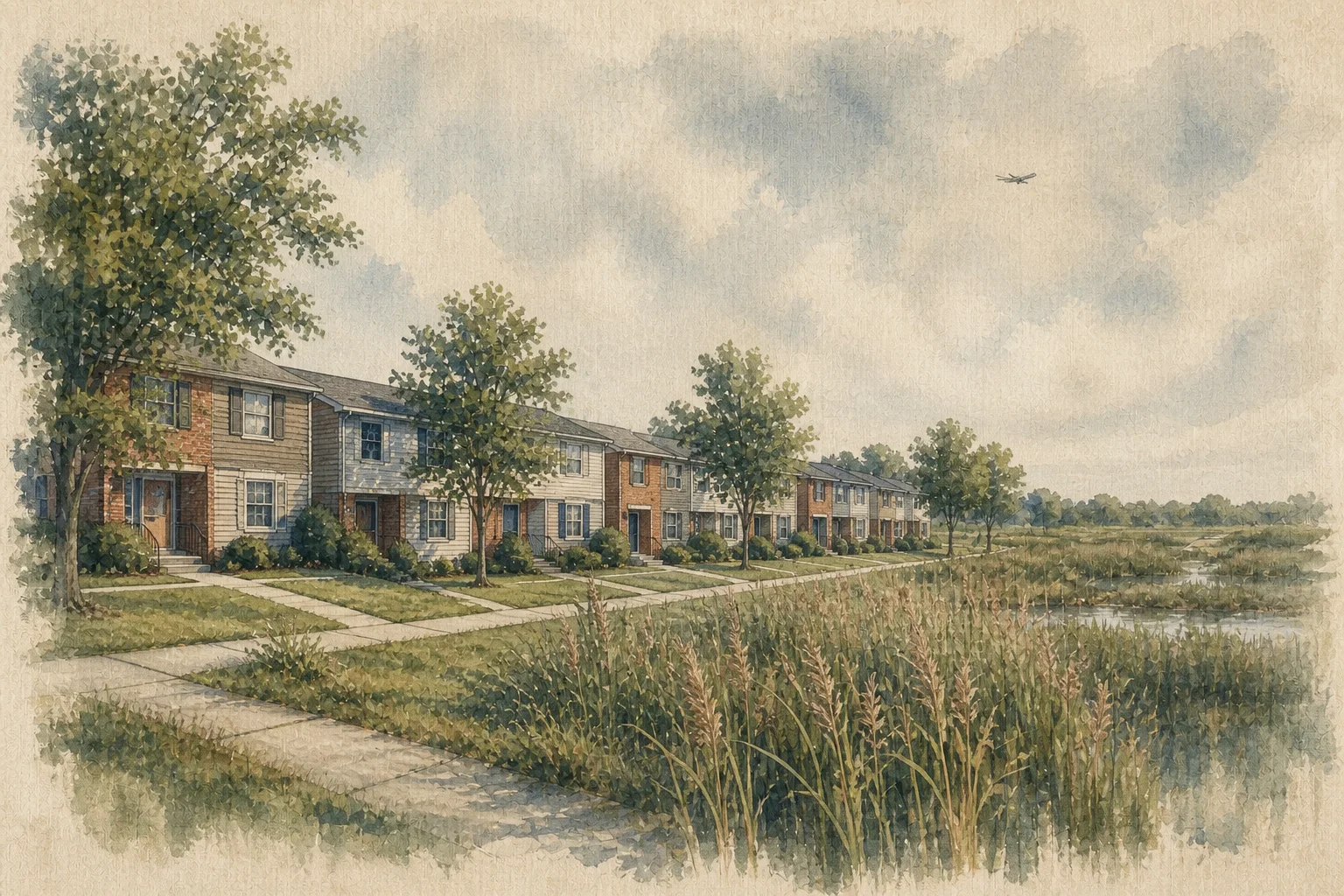
The first thing you notice is how spread out everything feels. Streets open up, houses sit farther apart, and you start seeing driveways and yards instead of tight rows of homes. There are cul-de-sacs, ranch-style houses, and stretches where the city feels quieter than expected. For some people, that is the appeal. It feels calmer, less compressed, and easier to manage day to day.
But that same layout creates a different kind of experience. You cannot rely on walking the way you might in other parts of the city. Running a quick errand is rarely a short walk. It usually means getting in the car. The rhythm of daily life shifts because of that. You plan your movements differently. You think in terms of drives, not blocks.
Island Avenue becomes a central reference point almost immediately. It is where a lot of everyday activity concentrates, from food options to quick stops. At the same time, it feels like a dividing line. It connects you to what you need, but it also reinforces how separated Eastwick can feel from the rest of Southwest Philadelphia and beyond.
That sense of separation is something both locals and outsiders notice. Many people in Philadelphia have only a vague idea of where Eastwick is or what it is like. It sits at the edge of the city in a way that makes it easy to overlook. When you are actually there, that distance feels real. It is not just geographic. It is part of the identity of the neighborhood.
Where Eastwick sits
At the edge of the city, in a way that makes it easy to overlook.
- Island Avenue
- John Heinz National Wildlife Refuge
- Eastwick SEPTA station
- The Meadows
Schematic · not to scale
The Local Logic of Flooding: What Outsiders Miss
If you ask someone unfamiliar with Eastwick about flooding, they will usually think in simple terms. If it rains a lot, things might flood. If it does not, things are fine.
That is not how it works here.
In Eastwick, people read flooding the way others read traffic or weather patterns. It is not just about rain. It is about how different factors line up at the same time. Heavy rainfall matters, but so does timing, tide conditions, and how water is already sitting in nearby areas. What happened earlier in the week can matter just as much as what is happening that day.
This is why generic information often fails people here. A map might say one thing, and a listing might describe the area in neutral terms, but locals will ask a completely different set of questions. They will want to know how a specific block behaved during a particular storm. They will want to know if water pooled, how fast it moved, and how long it stayed.
That kind of knowledge does not come from official summaries. It comes from experience and from talking to people who have been through it.
Once you start thinking this way, you realize that Eastwick is not just reacting to weather. It is constantly interpreting it. A forecast is not enough. What matters is how that forecast interacts with everything else already happening on the ground.
The Basement Rules, Storm Rules, and House Rules Nobody Explains to Newcomers
One of the fastest ways to tell if someone understands Eastwick is how they talk about basements.
In many parts of Philadelphia, a finished basement is a selling point. In Eastwick, that conversation is different. The basement is not automatically treated as reliable living space. It is treated as a risk area that needs to be managed carefully.
People adjust their homes around that reality. Storage gets elevated. Important items are kept out of lower levels when conditions look uncertain. Equipment like pumps becomes part of normal home setup rather than an afterthought. None of this feels extreme to locals. It feels like basic preparation.
There are also storm routines that develop over time. When certain weather patterns show up, people start checking specific things. They pay attention to how water has behaved in the past and adjust their actions based on that memory. It is not panic. It is repetition.
The most important part is that a lot of this knowledge is not written down anywhere. You learn it by asking the right people. Neighbors become a source of practical information in a way that goes beyond casual conversation. They can tell you what actually happened during past storms, which parts of a block held up, and which ones struggled.
For someone new, this can feel like a hidden layer of the neighborhood. But once you understand it, you realize that these unwritten rules are what allow people to live here with some level of confidence.
The Meadows: The Eastwick Name That Still Means Something
If you spend enough time around people who know Eastwick well, you will eventually hear it called something else. The Meadows.
That name is not just a nickname. It carries a different version of the neighborhood, one that existed before the current layout, before the major changes that reshaped the area. When people use that term, they are not being nostalgic for the sake of it. They are pointing to a time when Eastwick had a different relationship with its land and its community.
The Meadows refers to a place where the environment and daily life were more closely connected. Fishing, crabbing, and open land were not side activities. They were part of how people lived. The space felt more rural even though it was within city limits.
Today, that memory still shapes how people talk about Eastwick. It shows up in conversations about what was lost and what remains. It also explains why certain parts of the neighborhood are seen differently by those who have been there longer.
Understanding that name gives you a deeper sense of how Eastwick sees itself. It is not just a neighborhood defined by its current challenges. It is also a place with a remembered identity that still matters to the people who talk about it.
What Urban Renewal Did to Eastwick and Why Locals Still Talk About It
To understand why Eastwick feels the way it does today, you have to look at what happened during urban renewal. This is not background information. It is central to how the neighborhood sees itself.
Large portions of the original community were cleared. City sustainability materials say City-backed urban renewal in Eastwick displaced thousands of residents (Philadelphia Greenworks; the City Planning Commission’s Planning and Equity account says the same). Land was taken and repurposed on a massive scale. The physical layout of Eastwick changed, but so did its social structure.
For many people connected to the area, this is not just history. It is an event that explains why certain problems exist now. When people talk about flooding, development, or neglect, they often connect those issues back to the decisions made during that period.
There is also a strong sense that something valuable was removed. The earlier version of Eastwick is remembered as a place with a unique mix of people and a way of life that does not exist anymore. That loss is not abstract. It is tied to specific experiences and memories that continue to be shared.
Because of that, urban renewal is not discussed in neutral terms. It is talked about with emotion. It is part of why current proposals and plans are often met with caution or resistance. The past has made people more aware of how decisions can reshape the neighborhood in ways that are not easily undone.
Why So Many Locals Talk About Betrayal, Not Just Neglect
When people describe Eastwick’s situation, they often go beyond saying it has been neglected. The word that comes up more often, even if it is not always stated directly, is betrayal.
That feeling comes from the combination of everything the neighborhood has experienced. The displacement from urban renewal, the ongoing flood risk, the environmental pressures, and the slow pace of long-term solutions all build on top of each other.
There is a sense that Eastwick has repeatedly been placed in difficult situations without receiving the same level of attention or urgency as other parts of the city. When infrastructure issues take years to address or when plans keep getting delayed, it reinforces that perception.
This is why development proposals can trigger strong reactions. It is not just about what is being built. It is about whether the neighborhood is being asked to take on more risk or change without fully addressing the problems that already exist.
At the same time, this feeling of betrayal does not translate into passivity. It often leads to the opposite. People organize, attend meetings, share information, and push for better outcomes. That response is part of what defines Eastwick today.
Understanding this mindset is important because it explains why conversations in the neighborhood can feel intense. They are not just about current conditions. They are about a long history that continues to shape how every new decision is viewed.
Heinz Refuge and the Other Side of Eastwick
If you only listen to conversations about flooding, you miss something essential about Eastwick. There is another side of the neighborhood that people who live there bring up just as consistently, and that is its proximity to the John Heinz National Wildlife Refuge.
This is not just a nearby park that people occasionally visit. It is a defining part of how Eastwick feels. Within minutes, you can move from quiet residential streets into wide open marshland, walking trails, and bird habitats that feel far removed from the rest of the city. That shift is part of why some residents stay even when they fully understand the risks tied to the area.
For many, the refuge represents space and air that is hard to find elsewhere in Philadelphia. Instead of looking out onto dense rows of houses, you can be near wetlands, water, and open land. It changes how people experience the neighborhood on a daily basis.
At the same time, this access to nature is not separate from Eastwick’s challenges. It is connected to the same geography that makes flooding a constant concern. The beauty and the risk come from the same place. That connection is something locals understand instinctively, even if outsiders tend to focus on only one side of it.
The Beauty-and-Burden Contradiction That Defines Eastwick
Eastwick does not fit neatly into a single category. It is not simply a peaceful, nature-adjacent neighborhood, and it is not just an area dealing with flooding and infrastructure problems. It is both at the same time.
On one side, you have open space, quiet streets, and access to one of the most unique natural areas in the city. On the other, you have environmental pressures that include flood risk, industrial surroundings, and long-term concerns tied to land use and development decisions.
What makes this contradiction so important is that it is not hidden. Residents are aware of it. Conversations about Eastwick often move between appreciation and concern without treating them as separate topics. Someone might talk about how peaceful the area feels and then immediately shift to how that same landscape creates vulnerability during storms.
This duality shapes how people evaluate the neighborhood. It is not enough to say that Eastwick is beautiful or that it is struggling. Both are true, and both affect daily life. The challenge for anyone trying to understand the area is holding those two realities at the same time instead of choosing one over the other.
The Eastwick Housing Tradeoff: Space, Yards, and Quiet at a Price
From a housing perspective, Eastwick offers something that stands out in Philadelphia. You get more physical space. Homes often come with yards, driveways, and layouts that feel closer to suburban design than traditional city living.
For buyers and renters, that can be a major draw. Instead of competing for limited space in dense neighborhoods, Eastwick offers a different kind of environment. There is room to park, room to store things, and room to move around in ways that are harder to find elsewhere in the city.
That is where the tradeoff comes in. The value of that space cannot be separated from the conditions that come with it. A lower price point or a larger home does not automatically mean a better situation. In Eastwick, people look at those benefits alongside flood history, block-specific conditions, and how the area responds during severe weather.
This is why conversations about housing here feel more layered. It is not just about affordability or size. It is about how those advantages hold up over time and under stress. For some, the tradeoff makes sense. For others, it does not. The important thing is that the decision is rarely made without considering both sides.
Block by Block: Why Eastwick Advice Changes Depending on Where You Are
One of the biggest mistakes outsiders make is treating Eastwick as a single, uniform neighborhood. Locals do not do that. They talk about it in pieces.
Advice changes depending on the exact part of Eastwick you are in. Some blocks are spoken about more positively. Others come with specific warnings. Even small shifts in location can affect how water moves, how streets feel, and how people describe their experience living there.
This is where general descriptions start to break down. You cannot rely on broad statements and expect them to apply evenly across the entire area. People who know Eastwick well will often ask more detailed questions before giving an opinion. They want to know the exact street, the surrounding blocks, and sometimes even the position of the house itself.
This block-level awareness is part of how residents manage uncertainty. Instead of thinking of Eastwick as one environment, they think of it as a collection of smaller zones, each with its own patterns and reputation. That way of thinking helps explain why two people can describe the neighborhood very differently and both still be accurate.
Island Avenue: The Strip That Tells You a Lot About Daily Life in Eastwick
If you want to understand how everyday life works in Eastwick, you look at Island Avenue.
This stretch acts as the main commercial spine for the area. It is where people go for quick meals, basic errands, and everyday convenience. You see a concentration of fast food spots, small businesses, and places that serve practical needs rather than offering a destination experience.
The importance of Island Avenue is not just about what is there. It is about what is not. Because Eastwick does not have the same density of shops and walkable options as other neighborhoods, this strip ends up carrying more weight. It becomes the place you rely on when you need something nearby.
At the same time, it reinforces how the neighborhood functions. You are often driving there. You are not wandering through a cluster of options. You are going to a specific place, getting what you need, and leaving.
That pattern might feel limiting to some people, but for others it becomes part of the routine. It reflects the overall structure of Eastwick, where convenience exists, but it is concentrated and requires a different approach than what many Philadelphia neighborhoods offer.
Eastwick at Night, Eastwick in the Rain, Eastwick During Storm Season
Time matters in Eastwick more than it does in many other neighborhoods. The same place can feel completely different depending on when you are there and what conditions are present.
During the day, certain areas may feel quiet and manageable. At night, that same quiet can take on a different tone. It is not necessarily about sudden danger. It is about reduced activity, fewer people around, and a sense that you need to be more aware of your surroundings.
Weather introduces another layer. When rain becomes heavy or conditions start to shift, attention levels go up. People start thinking ahead, checking what might happen next, and adjusting their plans. A routine that feels normal on a dry day can change quickly when storms are expected.
Storm season amplifies all of this. It is when local knowledge becomes most important. People rely on what they have learned from past events, and they adjust accordingly. This is not something that is always visible to outsiders, but it is a consistent part of how residents navigate the neighborhood.
Understanding Eastwick means understanding that it is not static. It changes with time, weather, and conditions in ways that directly affect how people move through it.
Safety in Eastwick: What Locals Actually Mean
Safety in Eastwick is rarely discussed in simple terms. It is not usually described as entirely safe or entirely unsafe. Instead, people talk about it with more nuance.
There is also a difference between perception and lived experience. Some people approach Eastwick with assumptions based on broader views of Southwest Philadelphia. Others, especially those familiar with the area, describe it as manageable if you understand how it works.
Context matters. Time of day, specific location, and personal awareness all play a role in how safety is experienced. This is why advice can vary depending on who you ask and what exactly they are referring to.
What stands out is that locals tend to approach safety in a practical way. They pay attention to patterns, adjust their behavior when needed, and rely on experience rather than general labels. That approach reflects the broader theme of Eastwick itself, where understanding the details makes all the difference.
The Parking and Transit Warnings That Outsiders Learn the Hard Way
One of the clearest differences between someone who knows Eastwick and someone who does not shows up in how they handle parking and transit decisions.
On paper, certain options look efficient. The Eastwick SEPTA station, for example, can seem like a convenient solution for getting to the airport or avoiding higher parking costs. To someone unfamiliar with the area, it looks like a smart shortcut.
Locals tend to see it differently. Over time, patterns emerge around where convenience does not match reality. That is why certain pieces of advice get repeated quietly among people who live nearby. It is not about exaggeration. It is about experience.
This kind of knowledge does not show up in directions or listings. It comes from seeing what happens over time. Someone new to the area might learn the hard way that not every practical-looking option works the way they expect. Someone who has been around longer tends to avoid those situations altogether.
Understanding Eastwick means recognizing that efficiency on paper is not always the same as what works on the ground.
The Community Side Outsiders Usually Miss
When Eastwick is discussed from the outside, the focus often stays on flooding, isolation, or environmental concerns. What gets missed is how active and engaged the community actually is.
There is a consistent pattern of residents showing up, organizing, and staying involved in what happens around them.
This includes attending meetings, sharing information with neighbors, and taking part in local initiatives that address everything from flood resilience to development plans.
Community events also play an important role. Spaces like the recreation center and local parks become gathering points where people connect, especially for families and younger residents. These moments do not always get attention in broader conversations, but they are part of everyday life.
What stands out is the level of participation. Eastwick is not a place where people simply accept conditions as they are. There is a strong sense that residents have to stay informed and involved because decisions directly affect how the neighborhood functions.
This creates a different kind of community dynamic. It is not just about proximity. It is about shared awareness and a willingness to engage with what is happening.
Why Eastwick Residents Are Protective About Certain Things
Spending time around Eastwick, you start to notice that certain topics bring out a protective response from residents.
One of those is the neighborhood’s history. The memory of what Eastwick used to be and how it changed is not treated casually. When people talk about it, there is a sense that the story has been misunderstood or simplified by outsiders. That is why locals often push back when the area is reduced to a single narrative.
Another point of protection is how Eastwick is described in the present. Residents tend to resist portrayals that only focus on problems without acknowledging the community itself. They recognize the challenges, but they also want the neighborhood to be seen as more than a collection of issues.
Green space is another area where this protectiveness shows up. Land that might look empty or underused to someone passing through often has a different meaning locally. It is tied to environmental function, flood behavior, and the overall character of the neighborhood.
These reactions are not random. They come from a history of decisions being made without fully considering the people who live there. Being protective is a way of making sure that the neighborhood is not misunderstood or reshaped without input.
The Real Debate: Hidden Gem, Hard Pass, or Both?
Few neighborhoods create as much divided opinion as Eastwick. Depending on who you ask, you can get completely different answers about whether it is a good place to live.
On one side, there is the argument that Eastwick offers something rare. You get more space, quieter streets, easier parking, and access to natural areas that feel far removed from the rest of the city. For buyers or renters looking for those qualities, the neighborhood can seem like an opportunity.
On the other side, there is a clear focus on the risks. Flooding, environmental concerns, and the long history of planning decisions make some people view Eastwick as a place that comes with too much uncertainty.
What makes this debate meaningful is that both perspectives are grounded in real experiences. The positives are not exaggerated, and the concerns are not imagined. They exist at the same time, and people weigh them differently based on what matters most to them.
This is why Eastwick resists simple labels. It can feel like a strong fit for one person and completely wrong for another. The disagreement is not about facts. It is about how those facts are interpreted.
Who Eastwick Works For and Who It Usually Does Not
Understanding Eastwick becomes easier when you look at it through the lens of fit rather than trying to decide if it is good or bad.
It tends to work better for people who prioritize space, quiet, and practical living conditions. Those who value having a yard, a driveway, and less density often find the layout appealing. Proximity to the airport and access to natural areas can also be a plus for certain lifestyles.
At the same time, Eastwick can be frustrating for people who expect a more typical Philadelphia experience. If walkability, dense amenities, and constant activity are important, the neighborhood may feel limiting. The need to drive for most errands and the concentrated nature of local businesses can take some adjustment.
The biggest factor is how comfortable someone is with the tradeoffs. People who are willing to learn the area, understand its patterns, and factor in its risks are more likely to see its value. Those looking for simplicity and predictability often find it harder to adapt.
This is not a neighborhood that fits everyone. It tends to reward people who approach it with a clear understanding of what it offers and what it requires.
The Unwritten Rules of Eastwick
There are certain things people in Eastwick learn that are rarely spelled out directly.
One of the most important is to rely on local knowledge. Talking to neighbors and understanding what has happened on a specific block is more useful than relying on general information. Experience carries more weight than official descriptions.
Another rule is to treat weather seriously. Conditions that might not seem significant elsewhere can have a bigger impact here. Paying attention to patterns and reacting early becomes part of daily life.
There is also an understanding that not all parts of Eastwick function the same way. Advice is often given with location in mind, even if it is not always explained in detail. Recognizing those differences helps avoid assumptions that can lead to problems.
Finally, there is an awareness that the neighborhood operates on a different rhythm. Convenience, movement, and decision-making follow patterns that are shaped by its layout and environment. Adjusting to that rhythm is part of settling in.
These unwritten rules are what allow people to navigate Eastwick effectively. Without them, it is easy to misread how the neighborhood works.
Who Eastwick works for, and who it usually does not
The guide's own frame: look at it through the lens of fit rather than trying to decide if it is good or bad.
- People who prioritize space, quiet, and practical living conditions.
- Those who value having a yard, a driveway, and less density.
- People who want proximity to the airport and access to natural areas.
- People willing to learn the area, understand its patterns, and factor in its risks.
- People who expect a more typical Philadelphia experience.
- Anyone for whom walkability, dense amenities, and constant activity are important.
- Anyone unwilling to drive for most errands — running a quick errand is rarely a short walk.
- Those looking for simplicity and predictability.
What Eastwick Feels Like Once You Stop Looking at It Like an Outsider
At first glance, Eastwick can seem difficult to understand. It does not match the expectations people often have for Philadelphia neighborhoods. It feels quieter, more spread out, and shaped by factors that are not immediately visible.
But once you move past that first impression, the neighborhood starts to make more sense.
You begin to see how the space, the water, the history, and the community all connect. The same features that make Eastwick appealing are tied to the challenges it faces. The same conditions that create concern also shape how people organize, adapt, and support each other.
It becomes clear that Eastwick is not defined by a single narrative. It is not just a place with problems, and it is not simply an overlooked opportunity. It is a neighborhood where people live with a set of realities that require awareness, adjustment, and involvement.
For someone who takes the time to understand it, Eastwick stops feeling confusing and starts feeling consistent. The patterns become recognizable. The tradeoffs become clearer. And the neighborhood reveals itself as something that cannot be reduced to a quick summary.
That is when Eastwick begins to feel less like an outsider’s question and more like a place with its own logic.
Make it yours
Your Eastwick household reference list
A short list to turn what you read into your own next steps.
Saved checks stay on this device when browser storage is available. This is a personal planning list, not a property inspection or professional assessment.
Sources & next steps
Useful advice should
show its working.
These resources support the reader tools above and help you check details for your own address, date, or plans.
- Philadelphia flood guidance
Find official flood preparation and response guidance and linked resources.
- ReadyPhiladelphia
Review the City’s emergency alert service and enrollment options.
- John Heinz refuge visitor information
Check the U.S. Fish & Wildlife Service’s visitor and access guidance.
These prompts are not a flood-risk assessment or remediation plan. Official instructions and property-specific professional advice remain separate from routine household cleaning.