A little orientation
Plan the Rhawnhurst journeys you would repeat
Check the actual crossing.
Plan the complete journey around Roosevelt Boulevard, including walking connections, instead of treating a nearby destination as automatically easy to reach.
Observe your own timetable.
For a home near the guide’s school or corridor references, visit when relevant to your routine without assuming a fixed neighborhood rhythm.
Use a named park destination.
Choose the Pennypack access you want and confirm it through official information before adding it to a weekly plan.
A closer look
Turn nearby into a usable connection
Distance on a map is only part of an errand or park visit.
Read updates for your connection.
Consult the City’s Route for Change information for the Roosevelt Boulevard stretch relevant to your journey. Separate planned work from current arrangements, then identify the actual crossing and transit connection rather than assuming a future improvement is already usable.
A useful questionWhat does your journey require at the Boulevard, and what is confirmed now?
Source & next step ↗Use your own travel times.
Choose a confirmed destination along Castor Avenue or another guide reference and plan from the actual home address. Compare the trip at the times you would use it, including the return with shopping and any transfer or access requirements.
A useful questionWhich ordinary errand reveals the most about how this address fits your day?
Source & next step ↗Choose the visit before the entrance.
Decide what your household wants from a Pennypack visit, then research the entrance and facility information that fit that activity. Check current notices and ask specific access questions rather than using the park’s presence as a general neighborhood amenity score.
A useful questionWhich Pennypack activity and access point would actually suit your household?
Source & next step ↗This guide covers what daily life in Rhawnhurst actually looks like beyond listings, rankings, and surface-level descriptions: how different one block can feel from the next, how routines shape comfort, and how small details inside and outside the home affect how people live.
Rhawnhurst is a neighborhood where consistency depends on your exact location and your daily habits. Some homes are on quiet, tree-lined streets where families have lived for years. Others are closer to busier roads or higher-traffic areas where noise, foot traffic, or surrounding conditions change the experience. Because of this, many homeowners focus not just on where they live, but how they maintain their space to stay comfortable.
Rhawnhurst, Philadelphia: What It’s Really Like Block by Block, Hour by Hour
If you search for Rhawnhurst online, you’ll usually find the same descriptions repeated. It’s quiet, it’s family-friendly, and it has that suburban feel without leaving Philadelphia. All of that is technically true, but it only tells part of the story. What actually defines Rhawnhurst is not the neighborhood as a whole. It is how your exact block feels at a specific time of day.
Someone living on a tree-lined street off Napfle might tell you the area feels calm, predictable, and safe enough to walk a dog at night. A few blocks away, another resident might describe the same area differently. Both perspectives exist at the same time, and neither one is wrong.
That is the first thing you have to understand about Rhawnhurst. It is not one consistent experience. It is a collection of small, very different pockets that change depending on where you stand and what time it is.
You also start to notice how timing shapes daily life. The same street that feels quiet on a Sunday morning can feel busy and chaotic during weekday school hours. Areas near Northeast High School, for example, shift dramatically depending on when students are coming and going. You might hear activity from blocks away during the day, then almost nothing at night.
Even the background noise tells you something about where you are. If you are closer to Roosevelt Boulevard, you will hear the steady flow of traffic at almost all hours. If you are further inside the neighborhood, the sound shifts to sirens in the distance or the occasional aircraft passing overhead.
Living in Rhawnhurst is less about the neighborhood label and more about understanding your immediate surroundings. People who are comfortable here tend to know their routes, their timing, and the small details that shape their day. People who are not comfortable usually expect the entire area to feel the same, and that expectation rarely holds up.
- Roosevelt Boulevard
- Castor Avenue
- Pennypack Park
- Northeast High School
Schematic · not to scale
Why Rhawnhurst Feels Like the Suburbs Until You Look Closer
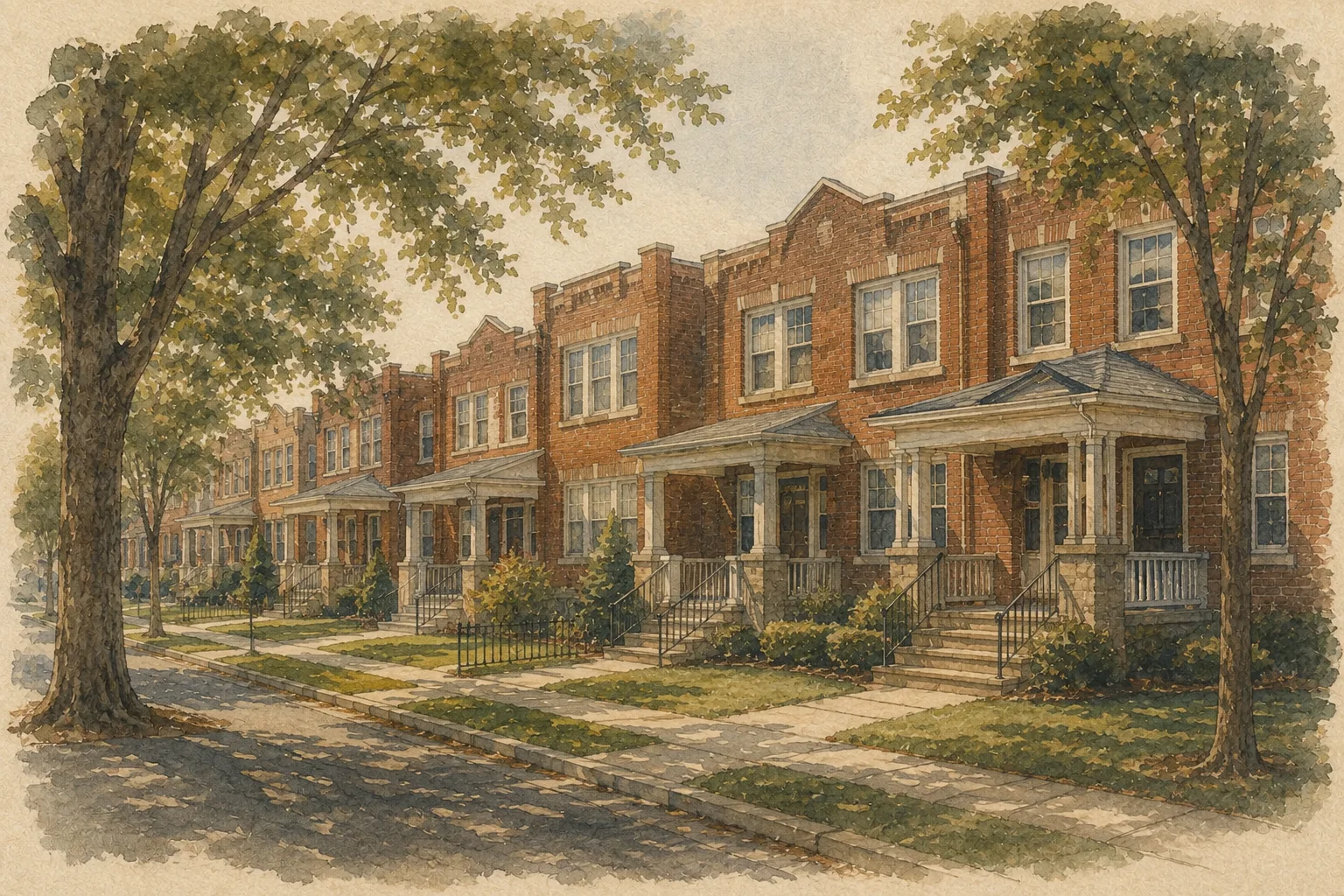
At first glance, Rhawnhurst gives off a very specific impression. You see twin homes with driveways, small lawns, and streets lined with trees. Compared to more densely built parts of Philadelphia, it feels more open, more residential, and less crowded. For many families, that is exactly what draws them in.
On quieter blocks, especially those set back from major roads, the atmosphere can feel calm and predictable. Neighbors wave, people walk their dogs, and kids spend time outside. It is easy to understand why many residents describe the area as a place to raise a family.
But the longer you spend here, the more you start to notice the layers underneath that first impression.
One of the biggest shifts comes from proximity. The closer you get to Roosevelt Boulevard, the more the environment changes. What looked quiet from a distance becomes louder, faster, and more intense. The steady movement of cars, the sound of traffic, and the general pace of the road can carry into nearby blocks.
Then there are the smaller signals that don’t show up in photos or listings. Sirens from nearby medical facilities, occasional aircraft overhead, and the movement of people during certain hours all add to the experience. None of these things dominate the neighborhood, but they shape how it feels once you live there.
Certain streets also carry a different reputation than others. Blocks around the larger apartment clusters are often described differently than the surrounding rowhome streets. The difference is not always obvious when you first visit.
The result is a neighborhood that can feel suburban in one moment and distinctly urban in the next. The shift is not dramatic. It is subtle and gradual, but it is always there.
The Street Level Reality Most Guides Do Not Explain
One of the biggest mistakes people make when trying to understand Rhawnhurst is thinking of it as a single, uniform neighborhood. Locals rarely describe it that way. Instead, they talk about specific streets, corners, and routes.
If you mention Napfle Street to someone who lives in the area, you are likely to hear it referenced as a stable, quieter block. If you bring up Tyson Avenue, you might hear that it is generally fine, depending on where you are. These kinds of comments are not about the neighborhood as a whole. They are about very specific micro-areas.
At the same time, residents describe the neighborhood block by block rather than as a single place.
The same pattern applies to areas near Roosevelt Boulevard. The issue there is less about crime and more about environment. The traffic, the noise, and the unpredictability of drivers make it a place people move through quickly rather than linger.
Then there are zones that change depending on the time of day. Around Northeast High School, for example, the atmosphere during school hours can feel completely different from the rest of the day. Groups of students, increased foot traffic, and general noise create a temporary shift that disappears once the school day ends.
Because of all this, residents develop what is essentially a mental map of the neighborhood. They know which blocks feel comfortable, which ones they avoid, and which routes are easiest depending on where they are going. This is not something you will find on a map. It is learned over time through daily experience.
That is why locals often suggest walking the area yourself rather than relying on descriptions. Two streets that look identical online can feel very different in person, especially at different times of day.
The micro-areas locals actually name
Locals rarely describe Rhawnhurst as one place. They talk about specific streets.
Napfle Street
Tree-lined blocksReferenced as a stable, quieter block — safe enough to walk a dog at night.
Tyson Avenue
Generally fine, depending on where you are.
Near the Boulevard
Roosevelt Boulevard edgeLess about crime than environment. People move through quickly rather than linger.
Around Northeast High
School hours onlyA temporary shift in noise and foot traffic that disappears once the school day ends.
Everyday Life in Rhawnhurst and the Importance of Routine
Daily life in Rhawnhurst revolves around convenience and routine. It is not a neighborhood where people are constantly exploring new places or walking long distances to get around. Instead, most residents build a predictable pattern that makes day to day life easier.
The core of that routine is the convenience loop. Grocery runs, quick stops, and errands are usually centered around familiar spots like ACME, Wawa, and nearby shopping areas such as Bell’s Corner. These locations are close enough that they become part of everyday life, not special trips.
Because of this, having a car is almost essential. While there are bus routes, including the 59, they are typically used as a backup rather than a primary mode of transportation. Most people rely on driving for work, errands, and anything outside their immediate area.
That reliance on driving shapes how people organize their day. Errands are often grouped together to avoid unnecessary trips, especially during busy hours. People learn which times are easier to get in and out of certain areas and adjust their schedules accordingly.
There is also a strong sense of familiarity in how people move through the neighborhood. Instead of trying new routes, many residents stick to the same streets and patterns. Over time, those routines become part of how they manage both convenience and comfort.
This predictability is part of what makes Rhawnhurst appealing to some. It offers a structured, repeatable way of living where you know what to expect. At the same time, it can feel limiting to those who prefer a more walkable or spontaneous environment.
Driving in Rhawnhurst and How the Blvd Shapes Your Day
If there is one thing that consistently affects daily life in Rhawnhurst, it is Roosevelt Boulevard. Locals rarely use its full name. They simply call it the blvd, and it plays a bigger role in how the neighborhood feels than most people expect.
The road itself is wide, busy, and constantly moving. Traffic flows at high speeds, and drivers often move aggressively, especially during peak hours. Even if you do not drive on it every day, you feel its presence. The noise carries into nearby blocks, and the pace of traffic influences how people plan their routes.
For those who do use it regularly, driving can feel unpredictable. Being cut off, dealing with sudden lane changes, and navigating fast moving traffic are common experiences. Over time, people adjust by becoming more defensive drivers and choosing their routes carefully.
The impact of the blvd is not limited to driving. It also affects how safe certain areas feel for pedestrians. Crossing near major intersections can be uncomfortable, and many residents are cautious about where and when they walk, especially with children.
Inside the neighborhood, driving comes with its own set of challenges. On some residential streets, stop signs are not always respected the way you might expect. This leads to a more cautious approach, where people pay close attention at intersections rather than assuming other drivers will stop.
There are also occasional incidents that reinforce this caution. Situations that escalate from minor disagreements into more serious confrontations leave an impression, even if they are not part of everyday life. These stories travel quickly and become part of how residents think about safety on the road.
As a result, driving in Rhawnhurst is not just about getting from one place to another. It is about awareness, timing, and knowing which routes work best for you. For many residents, learning how to navigate the blvd and the surrounding streets is one of the first steps to feeling comfortable in the neighborhood.
Safety in Rhawnhurst: Why You Will Hear Completely Different Opinions
Ask ten people about safety in Rhawnhurst and you will likely hear ten different answers. Some will describe it as a quiet place where families live comfortably and walk their dogs at night. Others will tell you it is changing and not as safe as it used to be. Both perspectives exist at the same time, and the difference usually comes down to location and routine.
On certain residential blocks, especially those set away from major roads and apartment clusters, the day to day environment can feel calm. Neighbors know each other, people spend time outside, and there are few visible problems. In those areas, residents often feel comfortable going about their routines without much concern.
A few blocks away, the experience can shift. The mix of rowhomes, larger apartment buildings, and commercial frontage changes street by street, and residents notice the difference.
Time also plays a role in how safe a place feels. A street that feels fine during the day may feel different late at night. The same applies in reverse. Some residents are comfortable walking at all hours, while others adjust their routines based on time of day. These differences are not random. They come from personal experience, and those experiences shape how people view the neighborhood.
In Rhawnhurst, safety is not a single answer. It is a series of individual experiences tied to specific blocks, specific times, and personal thresholds. Understanding that helps explain why opinions vary so widely.
The “It’s Getting Worse” Narrative and Where It Comes From
One of the most common phrases you will hear about Rhawnhurst is that it is changing. People who have lived in the area for a long time often describe a shift in the neighborhood over the past decade or more. They talk about a different atmosphere, a stronger sense of familiarity, and fewer issues on their streets.
This does not mean the entire neighborhood has declined in the same way. Instead, the feeling comes from small, visible changes that accumulate over time. Increased reports of break ins, more noticeable drug activity, and a general sense that things are less predictable all contribute to that perception.
For some residents, the change is gradual and manageable. They adjust their routines, stay aware of their surroundings, and continue living comfortably. For others, a single experience can trigger a stronger reaction. Seeing something unexpected on your block, hearing about an incident nearby, or noticing a pattern that was not there before can shift how you feel about where you live.
The idea that the neighborhood is getting worse is not always based on statistics. It is based on lived experience. It comes from what people see on their own streets and how those observations compare to the past. Even if conditions vary from block to block, the overall sentiment tends to spread through conversations and local discussions.
That is why this narrative carries so much weight. It reflects how people feel about the direction of the neighborhood, not just what is happening at any given moment.
The Small Details That Quietly Shape Daily Life
In Rhawnhurst, it is often the small, specific details that have the biggest impact on how people live. These are not the things you see in listings or general descriptions. They are the moments that change behavior.
Another factor is the presence of teenagers during school hours. Around Northeast High School, the environment shifts noticeably during the day. Groups of students move through the streets, and the overall level of activity increases. It is not necessarily unsafe, but it can feel crowded and unpredictable compared to quieter times.
This creates a pattern where people adjust their schedules. Some choose to avoid certain routes during school hours. Others plan errands for times when the streets are calmer. The same location can feel completely different depending on when you pass through it.
Weekends bring another shift. Many parts of Rhawnhurst become noticeably quieter, especially in residential areas. Without school traffic and weekday routines, the pace slows down. This contrast between weekday and weekend is one of the subtle rhythms of the neighborhood.
Over time, these details shape how people move, when they go out, and which areas they prefer. It is not about avoiding the neighborhood. It is about learning how it changes and adapting to those changes.
Why Certain Incidents Stay With People
Every neighborhood has incidents, but in Rhawnhurst, specific events tend to leave a lasting impression. These moments shape how people think about safety, even if they are not part of everyday life.
When something happens in a familiar location, it carries more weight. An incident near a place people pass regularly becomes part of the local conversation, because it sits on the routes people use every day.
Timing also matters. Events that happen in broad daylight, such as late afternoon, can feel more unsettling than those that occur late at night. They challenge the assumption that certain times are always safe. Once that assumption changes, people begin to rethink how they move through the neighborhood.
Other stories, such as those involving disputes that escalate or incidents tied to specific buildings or businesses, circulate through conversations and online groups. Even if they are isolated, they influence perception. People remember where something happened and adjust their behavior accordingly.
These events do not define Rhawnhurst as a whole, but they contribute to the overall feeling of uncertainty that some residents describe. Over time, they become part of the shared understanding of the area, influencing decisions about where to go and when.
Community, Diversity, and the Tension Beneath the Surface
Rhawnhurst is often described as a diverse neighborhood, and that is one of its defining characteristics. Families from different backgrounds live in close proximity, and that diversity is visible in everyday life, from schools to local businesses.
For many residents, this is a positive aspect of the neighborhood. It creates a mix of cultures and experiences that can make the area feel welcoming and dynamic. Schools are sometimes described as having a wide range of backgrounds, which reflects the broader community.
At the same time, diversity does not always translate into harmony. Some residents point to underlying tensions that can surface in conversations, both in person and online. Discussions about the neighborhood, especially in local groups, can become heated, with strong opinions about change, responsibility, and the direction of the area.
These tensions are not unique to Rhawnhurst, but they are part of the local experience. They show up in debates about development, in disagreements about community standards, and in how people talk about safety and change.
Despite this, there is also a strong sense of local identity. Many residents take pride in their block and their immediate community. It is common for people to defend their street and push back against negative perceptions of the neighborhood as a whole.
This combination of diversity, pride, and tension creates a complex social environment. It is not something you fully understand from a distance. It becomes clearer as you spend time in the neighborhood and see how people interact with each other and with the changes happening around them.
Where Locals Actually Go in Rhawnhurst: Parks, Food, and Everyday Spots
Daily life in Rhawnhurst is not built around major attractions or destinations. It revolves around a handful of places that residents return to regularly, forming routines that feel familiar and predictable over time.
Pennypack Park is one of the most important parts of the neighborhood experience. It stretches across a large portion of the area and offers walking trails, open space, and a break from the surrounding streets. For many residents, it is where they go to reset. Whether it is a morning walk, an afternoon with a dog, or a quiet moment away from traffic, the park provides a sense of space that is hard to find elsewhere in the city.
There are also lesser known areas within Pennypack that locals tend to keep to themselves. These include quieter sections of the creek and spots where dogs can get into the water. People who know these locations treat them as part of their routine, and they are not usually advertised or shared widely. Knowing where to go within the park is part of what separates long time residents from newcomers.
Food and casual hangout spots play a different role. They are not about exploration or trying something new every week. Instead, they are about consistency. Places like The Rhawnhurst serve as neighborhood anchors where people go for wings, drinks, or a night out. It is the kind of place where you can expect a familiar environment, whether you are there for a game, a casual evening, or one of the regular activities like karaoke or darts.
Along Castor Avenue and nearby streets, smaller establishments like Rhawnhurst Cafe offer a similar sense of familiarity. These are not destination restaurants in the broader city sense. They are part of the neighborhood’s daily rhythm. You stop by for something quick, you recognize faces, and over time it becomes part of your routine.
There is also a strong culture around local food preferences. Residents compare pizza spots, sandwich shops, and takeout options, often with clear opinions about which places are better than others. It is less about finding the best in the city and more about knowing which spots in your area you can rely on.
In Rhawnhurst, where you spend your time is closely tied to habit. The same park, the same food spots, and the same routes become part of everyday life.
The everyday spots
Not destinations — the handful of places residents return to on repeat.
Pennypack Park
Walking trails, open space, a break from the surrounding streets. Where people go to reset.
The Rhawnhurst
A neighborhood anchor for wings, drinks, karaoke or darts.
Rhawnhurst Cafe
You stop by for something quick, you recognize faces.
Bell's Corner
The convenience loop, alongside ACME and Wawa.
Winter, Trash, and Everyday Stress Points in Rhawnhurst
Living in Rhawnhurst means dealing with the same city issues found across Philadelphia, but with local patterns that shape how those problems are experienced day to day.
Winter is one of the clearest examples of how the neighborhood changes. When snow hits, routines shift immediately. Cars need to be cleared, sidewalks need to be shoveled, and movement through the neighborhood becomes more difficult. At the same time, a small local economy emerges around snow removal.
It is common to see posts from teenagers offering to shovel sidewalks, driveways, and cars for a fee. These offers appear frequently after snowstorms and are part of how the community responds to the weather. Alongside these, there are also individuals promoting paid services, sometimes with contact numbers shared publicly.
This creates a mix of opportunity and caution. While many of these services are legitimate, there is also a level of skepticism. Residents talk about scams, repeated requests for money, and situations where people feel taken advantage of. Over time, a pattern develops where experienced locals learn to distinguish between genuine help and questionable offers.
Outside of winter, another major frustration is city services, particularly around trash. Collection timing and sidewalk upkeep vary block by block, and residents adjust their expectations accordingly.
Issues like delayed trash pickup, complaints through city systems, and general dissatisfaction with services are common topics of discussion. These conversations often play out in neighborhood groups, where frustrations can build quickly.
Infrastructure problems also surface from time to time. Water main breaks, damaged roads, and other disruptions remind residents that maintenance is not always consistent. When these issues occur, they can affect daily routines in very direct ways.
There is also ongoing concern about development. Discussions around zoning, new construction, and changes to existing properties can become heated. Some residents worry that certain types of development will bring unwanted activity or alter the character of the neighborhood. These concerns often lead to community meetings and involvement with local organizations.
All of these factors combine to create a baseline level of stress that residents learn to manage. It is not constant, but it is part of the overall experience of living in the area.
The Unspoken Rules Every Rhawnhurst Resident Learns
Over time, people who live in Rhawnhurst develop a set of habits that guide how they move through the neighborhood. These are not written down anywhere, but they are widely understood.
The first is to know your immediate area. Not every block is the same, and understanding your surroundings is essential. People learn which streets feel comfortable, which ones they prefer to avoid, and how those preferences change depending on the time of day.
Timing is another key factor. The neighborhood can feel very different depending on when you are out. School hours, late evenings, and weekends each have their own rhythm. Residents adjust their routines to match these patterns, choosing when to run errands or take certain routes based on what feels easiest and most predictable.
Driving also comes with its own expectations. The presence of Roosevelt Boulevard and the general behavior of drivers in the area mean that caution is necessary. People do not assume that others will follow traffic rules consistently. Instead, they pay attention, slow down when needed, and stay aware of what is happening around them.
Another part of daily life is staying alert to small changes. Whether it is a new pattern of activity on a block, a recurring issue in a certain area, or information shared through local groups, residents tend to keep track of what is happening around them. This awareness helps them adjust their routines as needed.
There is also an understanding that certain information is kept within the community. Local spots, preferred routes, and personal routines are not always shared openly. These details are part of how people maintain a sense of comfort and control in their environment.
Following these unwritten rules is not about being cautious all the time. It is about learning how the neighborhood works and adapting to it.
Is Rhawnhurst the Right Fit: What to Expect Before You Move
Rhawnhurst appeals to a specific type of resident, and understanding that can help set realistic expectations.
For families, the neighborhood offers space, relatively affordable housing compared to other parts of Philadelphia, and a more residential feel. Homes with driveways, quieter streets, and access to parks like Pennypack are significant advantages. For those looking for a balance between city access and a more suburban environment, this can be an appealing combination.
People who are comfortable driving tend to adapt well here. Since most errands and daily activities involve getting in a car, those who are used to that lifestyle often find the transition easy. The ability to move between shopping areas, work, and other parts of the city without relying heavily on public transportation is a key part of living in Rhawnhurst.
At the same time, the neighborhood may not be ideal for everyone. Those who prefer a highly walkable environment with easy access to restaurants, entertainment, and services on foot may find it limiting. The need to drive for most activities changes how daily life feels compared to more central areas of the city.
Consistency is another factor. Because the experience of the neighborhood varies by block and time, people who are looking for a uniform environment may find it unpredictable. Adjusting to the differences between streets, as well as changes throughout the day, requires a level of flexibility.
Before moving, it is important to experience the neighborhood directly. Walking the area during different times of day, observing traffic patterns, and getting a sense of the surrounding blocks can provide a clearer picture than any description.
Rhawnhurst can work well for those whose expectations align with its realities. For others, the differences between what they expect and what they experience may be more noticeable.
Is Rhawnhurst the right fit?
- You want space and housing that's relatively affordable for Philadelphia.
- Homes with driveways, quieter streets, and access to Pennypack matter to you.
- You're comfortable driving — people who are tend to adapt well here.
- You like a predictable, repeatable routine where you know what to expect.
- You prefer a highly walkable environment with services on foot.
- You'd rather not own a car — the 59 bus is used as a backup, not a primary ride.
- Boulevard traffic moves fast and drivers often move aggressively.
- You want a uniform neighborhood; the experience varies by block and by hour.
Why Some People Stay and Others Decide to Leave
Deciding whether to stay in Rhawnhurst often comes down to how residents feel about the direction of the neighborhood and how it fits into their daily lives.
For many, the reasons to stay are straightforward. The housing is more affordable than in other parts of Philadelphia, especially for those looking for space. The presence of parks like Pennypack provides a place to unwind, and the overall structure of the neighborhood supports a routine that feels manageable and familiar.
There is also a sense of stability on certain blocks. Neighbors know each other, routines are established, and the environment feels predictable. For residents who find the right pocket, that consistency can be enough to outweigh the challenges.
On the other hand, some people reach a point where they feel less comfortable. This can come from a single experience, such as encountering something unexpected on their street, or from a broader sense that the neighborhood is changing in ways they do not like. The idea that the area is getting worse, whether based on personal experience or general perception, plays a significant role in these decisions.
Over time, these feelings can influence whether someone chooses to stay or move on. For those who feel confident in their surroundings and have adapted to the neighborhood’s patterns, Rhawnhurst continues to meet their needs. For others, the uncertainty or frustration becomes enough to look elsewhere.
In the end, Rhawnhurst is not defined by a single narrative. It is shaped by individual experiences, specific locations, and personal expectations. Whether someone stays or leaves often depends on how those factors come together in their daily life.
Make it yours
Your Rhawnhurst route notes
A short list to turn what you read into your own next steps.
Saved checks stay on this device when browser storage is available. This is a personal planning list, not a property inspection or professional assessment.
Sources & next steps
Useful advice should
show its working.
These resources support the reader tools above and help you check details for your own address, date, or plans.
- Roosevelt Boulevard: Route for Change
Find official project information and the linked update channels.
- SEPTA trip planner
Plan your date, direction and return journey; check service and accessibility details.
- Philadelphia Parks & Recreation Finder
Find named public facilities and their contact information.
These are journey-planning tools. They do not repeat the guide’s Napfle Street safety assurance or classify any block by risk.
Keep exploring