
A little orientation
Look closely at a Mayfair home and routine
Match the records to the home.
Check the full address before reviewing available property information, and ask the owner to explain anything that does not match.
Ask what the quote includes.
Compare written housing terms, maintenance responsibilities and unresolved work together; a low-looking monthly figure is only one part of the offer.
Try the avenue as an errand.
Choose a specific Frankford Avenue destination you would use, then test the journey instead of relying on a business-reputation scorecard.
A closer look
An address, an agreement, an errand
Keep the parts of your decision visible instead of relying on a broad impression of the neighborhood.
Start with the exact property.
Look up the address in Atlas and note available records that need explanation. Check that the unit and building in your housing conversation match the information you are reviewing, then bring specific questions to the owner rather than drawing conclusions alone.
A useful questionDo the address, unit and available records match the home being offered?
Source & next step ↗Make maintenance part of the comparison.
Use the property research as a starting point for a conversation about repairs and responsibilities. Ask the owner to describe how maintenance is reported and what work remains outstanding, then keep that answer alongside the written housing offer.
A useful questionWhat responsibility or unresolved repair could change how you compare this offer?
Source & next step ↗Choose an errand worth repeating.
Identify a current business you would use on Frankford Avenue and confirm its address directly. Plan a trip from the proposed home, including the return with purchases, so the corridor becomes a practical part of your comparison.
A useful questionWhich confirmed errand tells you most about living at this particular address?
Source & next step ↗At Hometress, we believe the best way to understand a neighborhood is to look beyond surface impressions and study how people actually live there day to day. Mayfair is one of those places where reputation depends entirely on who you ask, which block they live on, and what time of day they experienced it. That is why this guide focuses on real lived patterns rather than generic summaries. Instead of broad claims, we highlight the details locals pay attention to: how streets change after school hours, how business reputations spread through word of mouth, which corners feel different from others, and why longtime residents talk about the past when describing the present.
How Locals Actually Define Mayfair (Orientation + Insider Framework)
If you ask ten people where Mayfair begins and ends, you will get ten slightly different maps. Official boundaries matter less here than lived ones. Residents define Mayfair by landmarks, intersections, and which side of a street you stand on rather than what a city map says. Someone might tell you they live in Mayfair, but if they are closer to Bridesburg or Port Richmond, longtime locals may quietly consider that a different experience altogether. That distinction is not about snobbery. It comes from years of watching how conditions shift block by block.
Language is one of the fastest ways to tell whether someone actually knows the neighborhood. People rarely say Frankford Avenue. They call it the avenue. They do not say Northeast Philadelphia in conversation. They say NE. The commercial strip is simply the strip. Everyday objects become jawns. Even identity is coded in shorthand. Saying you grew up here is not small talk. It signals authority. It tells others you understand the rhythm of the streets, the personalities of certain corners, and which routes feel fine in the afternoon but different at night.
Orientation here is hyper-local. One corner of an intersection can feel lively and normal while the opposite corner feels tense. Longtime residents instinctively register those differences. Newcomers usually notice only after living here awhile. That is why advice from locals often sounds oddly specific. Instead of saying a block is good or bad, they might tell you which side of it is better or which direction to walk after dark. Those details are not exaggerations. They are the real navigation system people rely on.
There is also a subtle credibility ladder. Lifelong residents sit at the top because they can compare present conditions to decades past. People who moved in recently tend to see more positives. Those who left often speak with the strongest emotions, either nostalgic or relieved. Understanding Mayfair means understanding that all three perspectives coexist and constantly interact.
The Core Identity Conflict That Defines Mayfair
The defining feature of Mayfair is not a landmark or street. It is a disagreement. Residents do not agree on what the neighborhood currently is. Some describe it as a stable, community-oriented place with parks, youth programs, and neighbors who look out for each other. Others describe it as declining, messy, and nothing like it used to be. Both groups are convinced they are stating obvious facts.
This disagreement shows up everywhere. One person points to low violence and friendly neighbors. Another points to trash, disruptive tenants, or a business that changed hands. These are not abstract arguments. They come from daily experience. Someone who lives on a quiet block with long-term homeowners sees a different reality than someone dealing with constant turnover next door.
The argument becomes more intense when people start explaining why change is happening. Some residents attribute problems to economic or housing shifts. Others interpret those explanations as coded prejudice. That tension has become part of the neighborhood’s social climate. Conversations about decline often turn into debates about motive, and debates about motive quickly turn personal. Even neighbors who agree on what they see may disagree about what it means.
Underneath the arguments is a shared measuring system that locals rarely say out loud but consistently use. They judge Mayfair against its own past. They evaluate blocks by upkeep and storefront quality. They pay attention to whether familiar faces are still around. They notice how often businesses turn over. These everyday indicators matter more to residents than statistics or official reports. The neighborhood’s reputation is built from these small observations, repeated daily.
The disagreement that defines Mayfair
The guide's central claim: the defining feature of Mayfair is not a landmark or street, it is a disagreement. Both columns are what residents say, not a verdict.
- A stable, community-oriented place with parks, youth programs, and neighbors who look out for each other.
- Low violence and friendly neighbors.
- Front lawns in a city where many neighborhoods have rowhomes flush with the sidewalk.
- Streets noticeably broader than other parts of the city — open and calm during quiet hours.
- Blocks where residents have stayed for decades, described as steady and dependable.
- A neighborhood that is declining, messy, and nothing like it used to be.
- Trash, disruptive tenants, or a business that changed hands.
- Cleanliness that varies dramatically by block — one street over can feel like a different environment.
- Housing turnover frequent enough that it becomes harder to build trust or maintain consistency.
- Neighborhood groups where arguments escalate quickly.
Housing Reality and Block Level Survival Knowledge
Housing decisions in Mayfair are rarely based on listings alone. Residents treat finding a place like an investigation. Ownership records matter. People check who owns a property before considering it. If the landlord lives far away or is hard to identify, that can be enough to rule out a rental. This behavior is not paranoia. It comes from repeated stories of maintenance problems and unresponsive owners.
Visual signals carry enormous weight. Locals often read a block the way someone else reads a review. Yards that look neglected, dogs that appear poorly cared for, or clusters of trash outside certain homes can instantly change how a street is perceived. These details act as shorthand for how the property is managed and how stable the surrounding tenants might be. Whether those signals are always accurate is less important than the fact that residents trust them.
Specific streets sometimes become examples people reference when explaining what to avoid. Certain blocks are mentioned in conversations about police visits, loud disputes, or high tenant turnover. These references spread by word of mouth rather than official documentation. Over time they become part of local knowledge, the kind you only learn after living here or talking to someone who has.
The strongest lesson locals share is simple but rarely stated directly. In Mayfair you do not choose a neighborhood. You choose a block. Two streets that look identical on a map can feel completely different once you live there. That is why longtime residents advise walking around at different times of day before committing to a place. They know firsthand that the true personality of a street reveals itself slowly.
Timing Map, When Mayfair Changes Personality
Mayfair is not the same place all day. Time matters as much as location. In the early afternoon when schools let out, certain areas feel louder and more crowded. Residents who know the routine adjust their routes automatically. They may avoid specific corners or errands during that window, not because something always happens but because that is when activity peaks and tension can rise.
Nighttime creates another shift. Some streets that feel perfectly comfortable during daylight can feel less welcoming after dark, especially for people walking alone. Locals rarely describe this in dramatic terms. Instead they talk about it like weather. They know which routes feel normal at night and which ones they personally skip. The pattern is understood rather than announced.
Weekly rhythms matter too. Certain intersections develop reputations for weekend activity, particularly on Sundays when car gatherings and loud driving sometimes occur. Residents who have lived nearby for years can predict when noise will spike or when traffic will feel chaotic. They plan around it the way someone else plans around rush hour.
Even businesses can change personality depending on the hour. A diner that feels warm and familiar during the morning rush can feel completely different late at night if lighting changes, staffing shifts, or food freshness varies. Locals do not talk about these differences as complaints. They talk about them as known facts. Knowing when to go is considered part of knowing the neighborhood.
The Avenue, Frankford Avenue as Mayfair’s Real Spine
If Mayfair has a center of gravity, it is Frankford Avenue. Residents treat it as the neighborhood’s measuring stick. When they talk about whether the area is improving or declining, they almost always reference what is happening along that corridor. It is where people shop, eat, notice new businesses, and compare present conditions to memory.
Longtime residents often recall a period decades ago when the avenue was dense with retail options and felt like a destination. Today the mix looks different. Storefronts have shifted toward other types of businesses, and locals pay close attention to those changes. The kinds of shops on a block become signals that residents interpret as indicators of the neighborhood’s direction. Whether that interpretation is optimistic or pessimistic depends on who you ask, but everyone agrees the avenue tells the story.
Certain landmarks still anchor the strip. Buildings with strong visual character stand out as points of pride and familiarity. Historic theaters and well known restaurant locations serve as orientation markers, the kind people use when giving directions. Even small details like a notoriously tight parking lot near a popular spot become part of local lore.
The avenue also carries emotional weight because of what is no longer there. When a long-standing establishment closes, residents often treat it as a turning point rather than just a business change. These closures become timestamps that people use to describe the neighborhood’s evolution. Instead of saying a certain year, they might describe events as happening before or after a particular place shut down. That is how central the avenue is to how Mayfair understands itself.
Business Reputation Ledger (Local Scorecard)
Local businesses in Mayfair are not judged casually. Residents keep mental scorecards that track consistency, service attitude, and whether a place feels like it still belongs to the neighborhood. Reputation travels quickly because customers talk to each other, compare notes, and remember details for years. A business is rarely seen as simply good or bad. It is usually described with nuance based on specific experiences.
Family owned establishments tend to receive the most loyalty. A long running pizza shop on the avenue is often treated like a neighborhood institution, especially because many residents grew up eating there. People associate it with reliability and tradition, including small rituals such as preferred toppings that locals recommend to each other. At the same time, mistakes like missing ingredients or unfriendly counter interactions get remembered and retold, not out of hatred but because expectations are higher for places considered part of the community.
The diner on the strip illustrates how nostalgia shapes perception. Residents speak about it with affection tied to its history and familiarity. Yet they also describe noticeable differences depending on when they visit. Late evening visits are sometimes associated with dimmer lighting, a less lively atmosphere, and food that does not match daytime experiences. That contrast becomes part of its reputation rather than a dealbreaker. People keep going because the place represents continuity.
Some businesses develop reputations that lean negative due to repeated customer conflicts. A beverage distributor along the avenue is often discussed in terms of pricing disputes, product quality concerns, and tense interactions with management. Specific incidents involving warm kegs or unexpected charges have circulated enough that they function like cautionary tales. Even residents who have never had an issue may approach transactions there more carefully because they have heard the stories.
Other named spots come up less frequently but still form part of the local map. A waterfront cafe known for arguments with patrons, a neighborhood veterinary clinic associated with dismissive service, and the site of a former big box store now linked to street encounters all contribute to how residents mentally navigate the area. These places act as reference points when locals explain directions or warn someone what to expect.
Over time residents develop practical habits to protect themselves from disappointment. They check takeout orders before leaving. They inspect containers for damage. They feel beverage containers to confirm temperature. These routines are not paranoia. They are adaptations learned from experience and shared through conversation.
Everyday Frustrations That Unite Residents
Despite disagreements about the neighborhood’s overall condition, residents tend to agree on the same everyday annoyances. These shared frustrations form a kind of unofficial common ground that cuts across age, background, and opinion. People may argue about causes, but they recognize the same symptoms.
Visible litter is one of the most frequently mentioned irritations. Trash accumulation outside certain homes or along sidewalks becomes a symbol people point to when discussing decline. Even residents who otherwise praise Mayfair acknowledge that cleanliness varies dramatically by block. The difference can be stark enough that walking one street over feels like entering a different environment.
Housing turnover is another recurring concern. When neighbors change frequently, residents say it becomes harder to build trust or maintain consistency. Longtime locals often associate stability with familiar faces and predictability. Rapid turnover creates uncertainty, which they interpret as a warning sign even if nothing explicitly negative happens.
Business inconsistency also ranks high on the frustration list. Residents expect neighborhood establishments to feel dependable. When service quality fluctuates or pricing feels unclear, it stands out more sharply than it would in a commercial district where customers are anonymous. Because people return to the same places repeatedly, small disappointments accumulate into reputation.
Online drama completes the set of shared complaints. Neighborhood groups and discussion threads can become spaces where arguments escalate quickly. Even people who avoid participating often read them, which means the tension still affects how they perceive neighbors. The result is a strange mix of community closeness and digital friction.
Underlying all these frustrations is a common comparison to the past. Residents frequently measure present conditions against earlier memories, whether from decades ago or just a few years back. That habit reinforces the feeling that changes are happening even when the pace is gradual.
Safety Perception Map, Locals’ Version
Safety in Mayfair is described less as a statistic and more as a feeling that shifts depending on context. Some residents speak confidently about feeling comfortable walking around and interacting with neighbors. Others describe situations where they become more cautious, particularly at night or in specific locations. These perspectives do not cancel each other out. They reflect different daily routes, schedules, and personal experiences.
Intersections often play a major role in how safety is perceived. Busy corners that attract traffic or gatherings may feel unpredictable compared to quieter residential stretches. Residents who live nearby learn which intersections to pass through quickly and which ones they consider routine. That knowledge develops gradually and is rarely written down anywhere. It is shared casually through conversation.
Timing also influences perception. Certain days of the week bring louder activity or more cars, which changes how the same street feels. Longtime residents can anticipate these patterns and adjust accordingly. They may plan errands earlier or later depending on what they expect that day to bring. To outsiders the area might look unchanged, but locals recognize subtle signals that indicate when conditions are shifting.
News events and isolated incidents can shape neighborhood reputation for a long time. Even when something happens outside Mayfair’s exact boundaries, it can still influence how people talk about the area. Stories spread quickly and sometimes become shorthand explanations for broader concerns. This does not mean every fear reflects constant danger. It means perception is influenced by memory as much as reality.
The result is a layered safety map that only makes sense once you have lived with it. Residents do not describe the neighborhood as entirely safe or entirely unsafe. They describe it as a place where awareness and timing matter.
Visual Identity and Street Texture
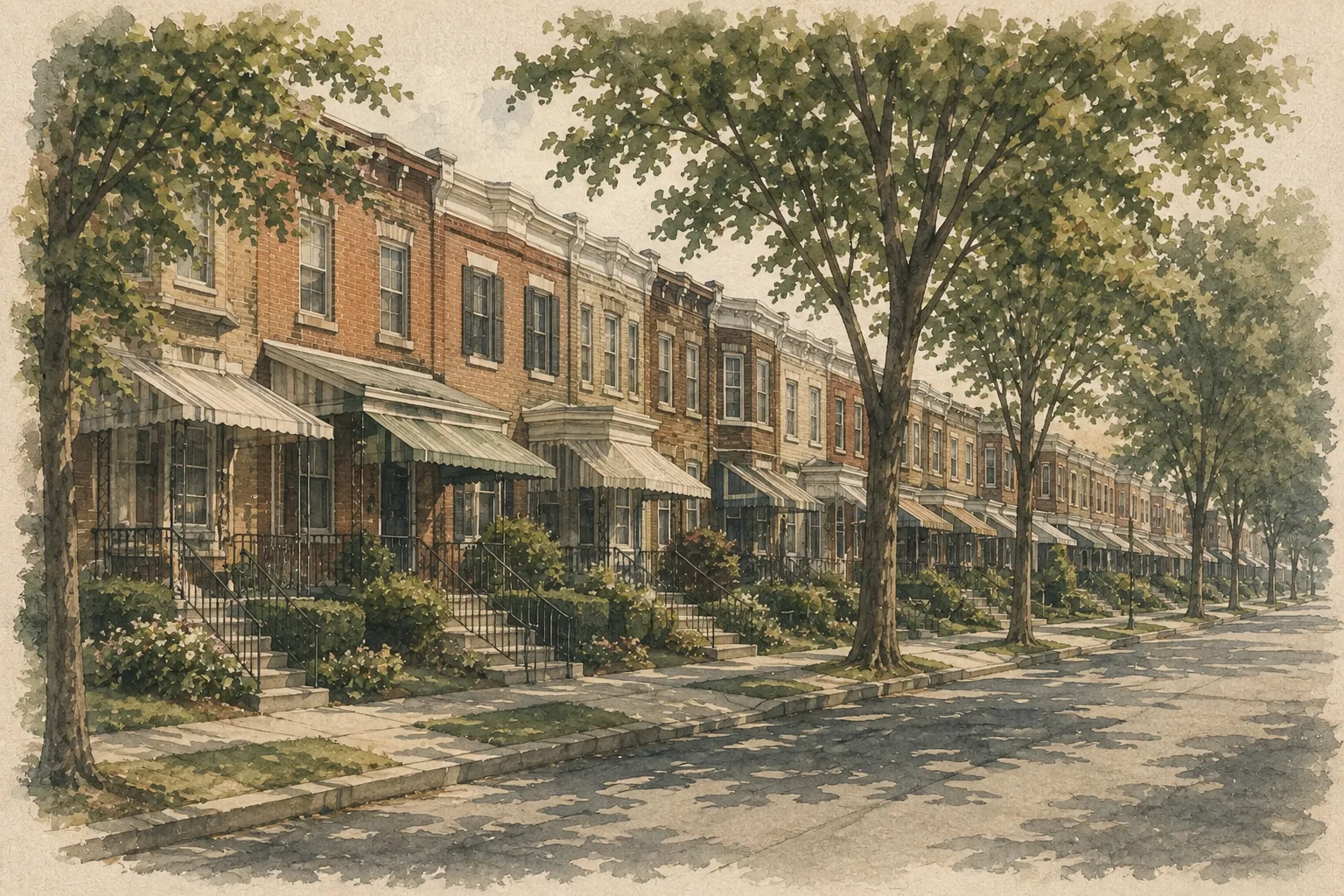
The physical look of Mayfair communicates a surprising amount of information to those who know how to read it. One of the first things newcomers notice is the presence of front lawns. In a city where many neighborhoods have rowhomes flush with the sidewalk, patches of grass stand out. Locals often see them as part of Mayfair’s personality rather than just landscaping.
Trampolines appear often enough in yards that residents sometimes joke about them as a neighborhood trademark. Their presence says something about the kinds of households living there, especially families with children. At the same time they can create practical concerns, such as crowded sidewalks or limited space near curbs. Even small details like this shape how a block feels to walk through.
Street width also contributes to the area’s character. Some roads feel noticeably broader than those in other parts of the city, which affects traffic flow and noise levels. People who have lived in narrower neighborhoods often remark on the difference right away. Wide streets can feel open and calm during quiet hours but louder when cars speed through.
Visual upkeep varies sharply from one block to the next. Well maintained houses and tidy sidewalks signal stability, while neglected properties can shift perception instantly. Residents rely on these visual cues when forming opinions about a street. They may not articulate why a block feels comfortable or uncomfortable, but they often base that feeling on what they see.
Certain buildings serve as visual anchors that residents reference when giving directions or describing where they are. Distinctive facades, recognizable theaters, and long standing storefronts act as orientation points. Even if someone rarely visits those places, they remain part of the neighborhood’s mental map.
In Mayfair appearance is not superficial. It is information. Locals read it the way others read street signs, using it to decide where to walk, where to linger, and how they feel about the environment around them.
Migration Pattern and Local Status Hierarchy
Movement in and out of Mayfair is not random. It follows patterns that longtime residents recognize immediately. One of the strongest patterns involves people who grew up in the neighborhood and later relocated to surrounding suburbs. These individuals often remain emotionally tied to Mayfair even after leaving. They still talk about it, monitor what is happening, and compare present conditions to their memories. Their perspective carries unusual weight in local conversations because they can describe changes across decades rather than years.
Length of residency functions almost like a social credential. Someone who has lived in Mayfair for thirty years is treated differently from someone who arrived last summer. This hierarchy is rarely announced openly, yet it shapes how opinions are received. Longtime residents tend to speak with authority, especially when discussing how things used to be. Newer residents often describe the neighborhood more positively because they lack that historical comparison. People who moved away frequently speak in strongest terms of all, either praising the past or explaining why they felt compelled to leave.
This layered status system creates three overlapping groups that influence the neighborhood narrative. Loyal lifers still living there often defend Mayfair while acknowledging flaws. Former residents act as commentators with long memory. New arrivals focus on present experience rather than history. The interaction between these groups keeps the local conversation dynamic and sometimes tense.
Migration also affects perception of stability. When a block has residents who have stayed for decades, it is described as steady and dependable. When turnover is high, the same block may be viewed as uncertain even if nothing dramatic has happened. That interpretation becomes part of how people decide where they want to live. In this way movement itself becomes one of the strongest signals residents use to judge the neighborhood.
The Unwritten Rules of Living in Mayfair
Many of the most important guidelines for living in Mayfair are never formally stated. Residents absorb them through observation and experience. One of the first lessons is that you should evaluate a block carefully before committing to it. Walking through at different times of day reveals patterns that a single visit would never show. This habit is so common among locals that it functions as a basic survival skill rather than a special precaution.
Timing is another rule that shapes daily life. People who know the area well adjust their routines based on when certain streets are busiest or loudest. They choose routes strategically rather than automatically. Outsiders might see that behavior as overly cautious, but residents see it as practical awareness developed over time.
There is also a strong expectation of loyalty toward neighborhood businesses, especially those that have been around for years. Supporting local establishments is considered part of being a good neighbor. At the same time residents balance that loyalty with watchfulness. They double check orders, confirm prices, and pay attention to details because experience has taught them that consistency cannot be assumed.
Another unspoken rule involves communication. Public arguments with neighbors or online confrontations are widely viewed as risky. People learn quickly that it is safer to observe discussions quietly than to jump into them. This does not mean residents are passive. It means they understand that escalation can spread faster than resolution.
Perhaps the most important rule is that reputation is always local. Judging Mayfair as a whole rarely makes sense to people who live there. They focus instead on individual streets, specific corners, and known patterns. That mindset shapes everything from housing decisions to daily routines.
What Outsiders Consistently Misunderstand
People who are unfamiliar with Mayfair often approach it with assumptions that locals consider inaccurate or incomplete. One common misunderstanding is the expectation that the neighborhood will follow the same development trajectory as trendier parts of the city. Residents tend to view that assumption as unrealistic. They do not see Mayfair as a place waiting for rapid transformation. Instead they see it as an area shaped by gradual shifts that rarely match outside predictions.
Another misconception involves how strongly nostalgia influences local opinion. Outsiders may interpret references to the past as exaggeration, but for residents those memories serve as a benchmark. When someone says something has changed, they are comparing it to a specific earlier period they personally experienced. Without that context, the comment can sound dramatic when it is actually precise.
Visitors also tend to underestimate how much block level variation matters. To someone passing through, several streets might look identical. To a resident, each one has its own reputation and personality. Ignoring that nuance leads outsiders to oversimplify the neighborhood. Locals often react defensively when they hear broad statements about Mayfair because those statements overlook distinctions they consider obvious.
Another misunderstanding involves loyalty. From the outside it can seem contradictory that residents complain about certain conditions while still defending the neighborhood. In reality that combination is normal. Criticism reflects familiarity, while defense reflects attachment. Both come from the same place, which is a long relationship with the area.
Final Reality Snapshot The True Mayfair Experience
Mayfair is best understood as a neighborhood defined by coexistence of opposites. Pride and frustration exist side by side. Familiarity and change are visible on the same block. Some residents see stability while others see decline. None of these views cancel each other out. Together they form the actual experience of living there.
Daily life here is shaped more by small details than by large headlines. A street’s reputation might hinge on how clean it looks, how often neighbors change, or whether a particular corner feels calm at night. These factors matter more to residents than official statistics or outside commentary. People trust what they observe firsthand.
Memory plays a powerful role in how the neighborhood is interpreted. Longtime residents carry mental snapshots of earlier decades and measure present conditions against them. That comparison influences how they talk about businesses, housing, and the avenue. Even when they recognize improvements, they still reference what once existed. The past is part of the present conversation.
What makes Mayfair distinctive is not a single attraction or landmark. It is the accumulation of lived knowledge. Residents navigate using cues that are invisible to outsiders, from timing patterns to visual signals on a block. Learning those cues takes time. Once learned, they shape how someone moves, shops, and interacts.
The truest description of Mayfair is that it cannot be summarized in one sentence. It is a place where perception depends on perspective, where reputation depends on location, and where understanding depends on experience. Anyone who spends enough time there eventually develops their own version of the map, and that personal map becomes the only one that really matters.
Make it yours
Your Mayfair viewing checklist
A short list to turn what you read into your own next steps.
Saved checks stay on this device when browser storage is available. This is a personal planning list, not a property inspection or professional assessment.
Sources & next steps
Useful advice should
show its working.
These resources support the reader tools above and help you check details for your own address, date, or plans.
- Philadelphia Atlas
Look up an address and review available City property records.
- SEPTA trip planner
Plan your date, direction and return journey; check service and accessibility details.
Atlas supports property research, not an inspection or legal conclusion. Business mentions and neighborhood reputation claims remain separate from these tools.
Social Ecosystem, Where Real Neighborhood Life Happens
Understanding Mayfair requires knowing where residents actually talk to each other. Official announcements and city pages matter less than informal digital spaces. Local Facebook groups, neighborhood forums, and review platforms function as real time information networks. They are where people share updates, warn each other about problems, and debate what is happening around them.
These spaces operate under their own social rules. Participation can be risky because disagreements sometimes escalate quickly. Residents often advise newcomers to observe quietly before posting. Reading discussions without commenting is considered the safest way to learn what is going on. Those who jump in too fast may find themselves pulled into arguments about parking, neighborhood behavior, or sensitive topics that spiral beyond the original issue.
Despite the tension, these platforms remain essential. They are often the fastest way to find out about lost pets, upcoming events, or sudden disruptions on a particular street. People rely on them because they provide information that rarely appears anywhere else. Even those who dislike the drama continue checking them because the practical benefits outweigh the annoyance.
Moderators in these groups sometimes struggle to keep discussions under control, especially when threads attract large numbers of participants. When conflicts erupt, they can involve personal accusations or attempts to expose private information. Stories about such incidents circulate widely, reinforcing the idea that digital interactions with neighbors should be handled carefully.
In effect, these online spaces mirror the neighborhood itself. They are crowded, opinionated, occasionally chaotic, and full of useful knowledge if you know how to filter it. Learning to navigate them is considered part of learning how to live in Mayfair.