
A little orientation
Get to know Bridesburg through ordinary routines
Choose an everyday destination.
Use Orthodox Street, Buckius Street or the recreation center as a guide reference, then confirm the actual place you need.
Ask how to participate.
Contact an event or community organizer directly rather than treating an article’s description as an invitation or current schedule.
Visit with a question.
Decide what you want to learn about the home or route, and avoid turning one encounter into a neighborhood verdict.
A closer look
Make the first visit useful
A little preparation helps you learn something concrete without needing to decode an unwritten social rule.
Find the activity that fits.
Look up the Bridesburg recreation center in the City’s facility finder and ask about the program that interests you. Confirm the location, access and enrollment arrangement before planning a visit around a general description of community life.
A useful questionWhich activity interests you, and who can confirm how to take part?
Source & next step ↗Connect the errands you need.
Use an actual destination on Orthodox or Buckius Street to test a journey from the home you are considering. Compare walking and transit connections with the things you will carry and the times you need to travel.
A useful questionWhat would an ordinary errand look like from your proposed front door?
Source & next step ↗Keep a record of the questions.
Look up the property address, then ask about the home’s access, maintenance and any proposed work. Bring the questions to a viewing and save the answers; neighborhood reputation cannot establish the condition of an individual house.
A useful questionWhich house-specific detail would you need clarified before taking the next step?
Source & next step ↗At Hometress, we spend a lot of time inside Philadelphia homes and neighborhoods, and Bridesburg is one of those places that reveals itself slowly and selectively. On the surface, it can look quiet, traditional, even unremarkable. But once you start paying attention to how people move, where they gather, and what they protect, a much more complex picture emerges. This guide breaks down the unspoken rules, social boundaries, and daily rhythms that shape life in Bridesburg. It is written for people who want to understand how the neighborhood actually functions, not how it is described in real estate blurbs or surface level reviews. Whether you live nearby, recently moved in, or are trying to decide if Bridesburg fits your life, this is the context locals learn over years, not weekends.
Why Bridesburg Reads You Before You Read It
Bridesburg does not announce itself with landmarks or signage. It introduces itself through reactions. The first thing you notice is not a building or a block but the way your presence is registered. People clock who belongs and who does not without saying anything. That awareness sits in the air, especially on residential streets where familiarity functions like a gate. Longtime residents move with ease because they know the rhythm. Outsiders feel the difference immediately because the neighborhood notices pauses, hesitations, and unfamiliar patterns.
This part of the city still operates on recognition rather than anonymity. Faces matter more than addresses. Routine matters more than intention. It is the kind of place where taking the same walk at the same hour every day quietly counts for something, and where changing that routine draws attention. Bridesburg feels different because it runs on memory and pattern, not discovery. You are stepping into a place that already knows itself very well and is not particularly interested in explaining itself to newcomers.
Where Bridesburg sits
- Orthodox Street
- Buckius Street
- Bridesburg Rec Center
Schematic · not to scale
Invisible Lines and Quiet Gatekeeping
Bridesburg is governed by borders that do not show up on maps. These borders are social, generational, and enforced through observation rather than confrontation. People know who grew up here, who married in, and who arrived recently. This awareness shapes everything from how children are perceived on the street to which adults get acknowledged at corner stores or community events.
One of the clearest examples of these invisible lines appears during seasonal moments that disrupt routine. Halloween is the most obvious. On that night, streets that are normally predictable feel charged. Families from nearby areas arrive, and suddenly the unspoken boundary between who is from here and who is not becomes visible. Conversations afterward are not about candy. They are about where people came from and whether they should have been there at all.
Even shorthand language reinforces these borders. Locals refer to nearby neighborhoods with abbreviations that outsiders would not recognize, and those abbreviations carry judgment. Children are sorted into categories based on where they are assumed to be from. These distinctions affect how behavior is interpreted. The same action can be seen as harmless or threatening depending on which side of the social line someone is placed.
Belonging in Bridesburg is cumulative. It builds through repetition, not introduction. People who expect immediate acceptance often misread the neighborhood. The social border is not hostile by default, but it is firm, and it requires time to cross.
Where the Air Feels Lighter
Despite the intensity that defines much of Bridesburg, there are pockets where the tone shifts immediately. These places are not numerous, but they are significant. One of the most consistent examples is I Knead Coffee. It stands out not just because of what it serves, but because of how it feels to be there. The atmosphere is more open, more relaxed, and less guarded than the surrounding streets.
People describe this spot as a highlight for a reason. It hosts small events, supports local creatives, and shows up during holidays in ways that feel genuinely community-focused. The crowd inside often looks different from the one outside, and that difference matters. For newcomers especially, it becomes a place where the neighborhood feels approachable rather than watchful.
Locals quietly direct people here when they are trying to ease someone into the area. It functions as a buffer, a place to reset before stepping back into the broader environment. These safe spots do not erase the challenges of Bridesburg, but they provide relief. They show that another version of the neighborhood exists, even if it is contained to a few addresses.
Understanding where the vibe shifts is part of learning how to live here. These locations offer insight into what Bridesburg could be more often, and they explain why some residents remain hopeful even when the larger atmosphere feels heavy.
Pizza as Proof You Belong
Food is one of the few neutral languages in Bridesburg. While people may disagree about almost everything else, there is surprising alignment around where to eat and what counts as legitimate. Renzi’s Pizzeria sits at the center of that agreement. It is not treated as a discovery or a recommendation. It is assumed knowledge. Talking about it signals familiarity, not taste exploration.
Orthodox Street functions as more than a location. It is a reference point. When locals talk about food, they often anchor it to that stretch rather than naming cross streets or neighborhoods. The details matter here. How the tomato pie is served, the expectation around sauce placement, and the fact that people will drive in specifically for it all act as quiet credibility checks. If you know these things, you sound like you belong. If you do not, you sound new.
What makes food important in Bridesburg is not trendiness but consistency. These places have survived without reinvention. They are used to measure everything else. When someone says a new spot is good, they are not comparing it to a citywide favorite. They are comparing it to what has already earned trust here. Food becomes a shared ground because it is one of the few spaces where identity does not immediately divide people.
The Scent That Follows You
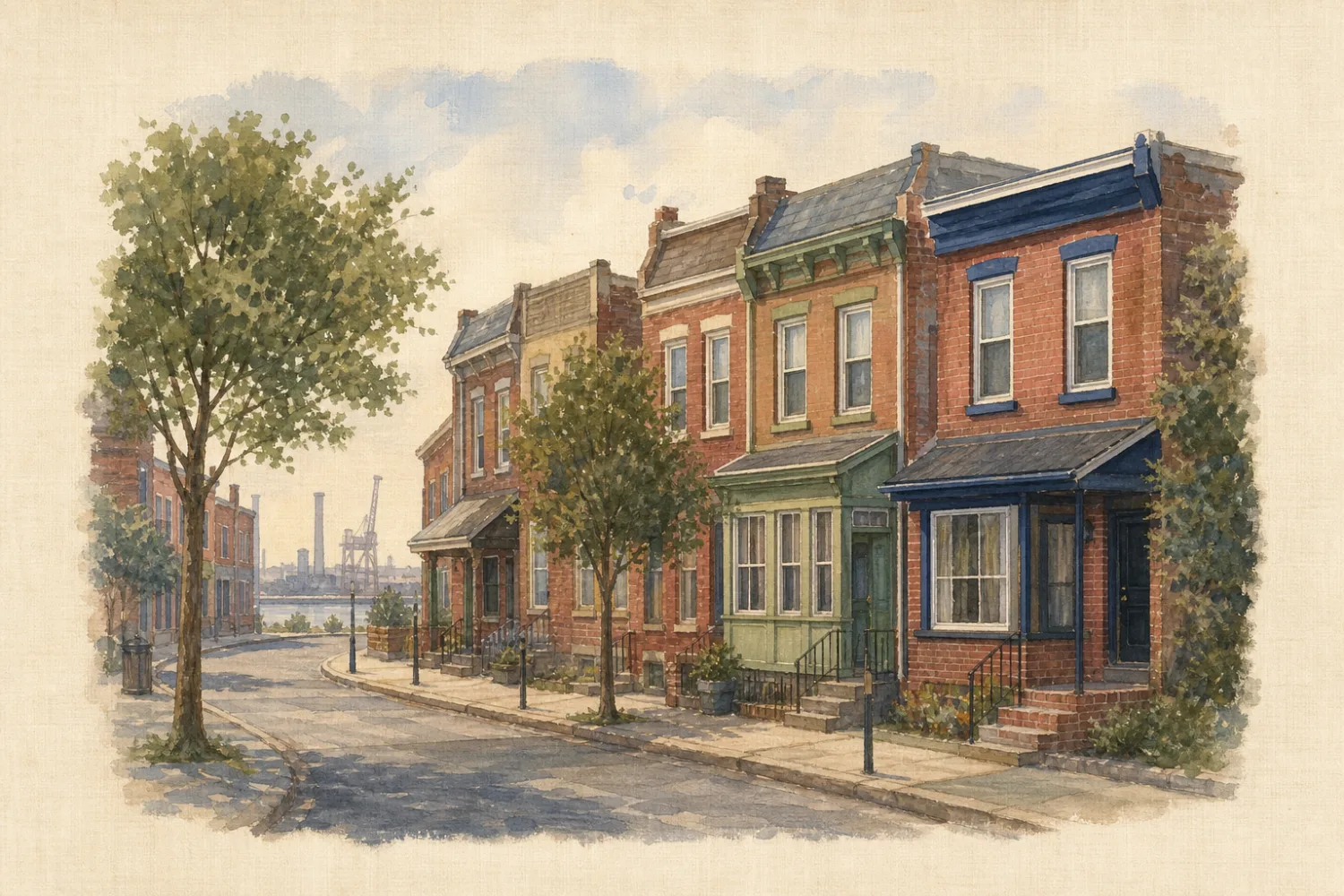
Bridesburg has a sensory reputation that precedes it. The smell is part of the neighborhood’s identity, whether people want to acknowledge it or not. Some days it is faint. Other days it announces itself before you even realize where you are. Residents know which conditions make it worse and which routes make it unavoidable.
The sewer narrative is the most common explanation, but it is rarely discussed in technical terms. It shows up through humor and exaggeration, often framed as something you notice while driving through. The jokes circulate widely, and even people who live here repeat them. At the same time, those same jokes can trigger defensiveness, especially when they come from outsiders.
You do not escape this reputation by living here. You learn how to talk about it. Whether through humor, dismissal, or quiet frustration, the smell becomes something everyone accounts for in their own way.
Where Decisions Really Get Made
Official channels tell only part of the story in Bridesburg. Real influence flows through meetings, group pages, and schedules that locals treat as common knowledge. The Bridesburg Community Action Alliance is one of the most important nodes in this system. It acts as an information filter, an organizer, and sometimes a gatekeeper.
The Bridesburg Rec Center is where these dynamics become visible. Meetings there are not optional for anyone who wants to stay informed. Wednesday nights at 7pm form a predictable rhythm. Miss enough of them, and decisions will happen without you. Show up consistently, and you start to understand how much of neighborhood life is managed face to face.
Online groups reinforce this structure. They are tightly moderated and not designed for casual participation. Overposting, advertising, or asking questions that signal unfamiliarity can lead to removal. These spaces reward people who already know the rules and punish those who treat them like open forums.
Power here is not hidden, but it is localized. It favors people who invest time rather than those who make noise. Understanding that difference is key to navigating Bridesburg without constantly feeling behind.
Numbers That Trigger Arguments
Development in Bridesburg is discussed through specific sites, not abstract concepts. Certain locations have become shorthand for larger fears about change, and proposed projects there are referenced repeatedly as examples of development that feels imposed rather than integrated.
Zoning is the other flashpoint. Residents already wary of industrial expansion say the approval process can feel like confirmation that decisions are made elsewhere.
What fuels anxiety is not just the projects themselves, but the feeling that vigilance is required at all times. People track zoning notices closely because missing one can mean losing the chance to object. Addresses become rallying points, and numbers become symbols of threat or loss.
This is why development conversations here rarely feel theoretical. They are personal. They tie directly into long-standing concerns about air quality, traffic, and identity. Change is not evaluated on potential benefit alone. It is weighed against a deep fear of being overridden.
The Rituals That Hold the Line
Tradition in Bridesburg is not background decoration. It is the glue that holds identity together. Events like the Memorial Day parade and the Bridesburg 5K are treated as proof that the neighborhood is still intact and worth defending. Participation matters. Showing up matters. These gatherings reinforce who belongs and who is committed to the place beyond personal preference.
Much of this pride is framed through family and children. Activities described as being for the kids carry special weight and are rarely questioned. They serve as moral anchors in a neighborhood that often feels under scrutiny. When traditions are criticized, the response is rarely about the details of the critique. It is about protecting the idea that Bridesburg is a good place with good people doing their best.
This is why pride and defensiveness often travel together here. Traditions become shields against outside judgment and internal doubt. They allow residents to point to continuity even when other aspects of the neighborhood feel unstable or contested.
The things that repeat
Tradition here is not background decoration. Showing up is how belonging gets built.
Community Action Alliance meeting
At the Bridesburg Rec Center. Not optional for anyone who wants to stay informed — miss enough of them and decisions will happen without you.
The Memorial Day parade
Treated as proof that the neighborhood is still intact and worth defending. Participation matters. Showing up matters.
The Bridesburg 5K
The other gathering that reinforces who is committed to the place beyond personal preference.
Kirkbride Arts pop-ups
Time-specific and understated, often lasting only a few hours. A different crowd and a different energy — creativity and small-scale connection rather than tradition.
A Quieter Current Beneath the Surface
There is another version of Bridesburg that does not dominate the conversation but quietly exists alongside it. This version appears in art spaces, pop up markets, and short run events that feel different from the usual neighborhood rhythm. Kirkbride Arts on Buckius Street is one of the clearest examples. When something happens there, it is often time specific and understated, lasting only a few hours.
These moments attract a different crowd and create a different energy. The focus is on creativity, small scale connection, and shared effort rather than tradition or defense. People who attend often describe it as a breath of fresh air. It feels less watched and less coded.
What limits the reach of this alternative current is not lack of interest but scale. These events remain small and occasional. They do not attempt to redefine the neighborhood. Instead, they offer a parallel experience for those who know where and when to look.
The three addresses locals name
Food is one of the few neutral languages here, and a couple of rooms where the tone shifts.
Renzi’s Pizzeria
Not a discovery or a recommendation — assumed knowledge. How the tomato pie is served and the expectation around sauce placement act as quiet credibility checks. People drive in specifically for it.
Best for · The tomato pie
I Knead Coffee
The most consistent place where the tone shifts. More open, more relaxed and less guarded than the surrounding streets. It hosts small events, supports local creatives, and shows up during holidays in ways that feel genuinely community-focused.
Best for · A first visit to the neighborhood
Kirkbride Arts
The clearest example of the quieter current — art spaces, pop-up markets and short-run events. People who attend describe it as a breath of fresh air.
Lessons Nobody Hands You
Living in Bridesburg comes with a set of rules that are rarely explained. Language is one of them. Using local shorthand correctly signals awareness. Getting it wrong marks you as new. Group spaces have their own codes. Posting too much or in the wrong way can lead to removal without warning. These spaces are curated by people who expect familiarity, not onboarding.
Timing is another rule. Showing up matters, but showing up at the wrong time can work against you. Meetings follow a predictable cadence. Events are often short and specific. Missing them means missing information that will not be repeated elsewhere.
There is also an expectation of observation before participation. Locals watch how newcomers move, speak, and react before opening up. Trying too hard or pushing too fast can backfire. Acceptance here is earned quietly through consistency rather than declared through enthusiasm.
A Place That Chooses Its People
Bridesburg is not designed to work for everyone, and that is not an accident. It rewards people who value routine, tradition, and familiarity. It challenges those who expect immediate openness or neutrality. For some, the neighborhood feels grounding and protective. For others, it feels restrictive and exhausting.
Both experiences can be true at the same time. The same structures that create belonging for one person can create exclusion for another. Understanding this duality is essential to making sense of the place. Bridesburg does not soften itself to accommodate new narratives. It waits to see who adapts.
For those who stay, the neighborhood becomes legible over time. Patterns emerge. Safe spaces reveal themselves. The rules become clearer. For those who leave, it often confirms a feeling they sensed early on. Bridesburg is not a mystery once you understand how it operates. It is a place with strong opinions about itself, and it expects the people who live there to make peace with that reality.
A place that chooses its people
The guide's own closing position: both experiences can be true at the same time.
- People who value routine, tradition and familiarity.
- Anyone willing to build belonging through repetition rather than introduction.
- People who invest time face to face rather than making noise.
- Anyone who observes before participating — acceptance is earned quietly through consistency.
- Anyone who expects immediate openness or neutrality.
- People who expect immediate acceptance, who often misread the neighborhood.
- Anyone treating the local group pages as open forums — they reward people who already know the rules.
- Anyone who tries too hard or pushes too fast, which can backfire.
Make it yours
Before your Bridesburg visit
A short list to turn what you read into your own next steps.
Saved checks stay on this device when browser storage is available. This is a personal planning list, not a property inspection or professional assessment.
Sources & next steps
Useful advice should
show its working.
These resources support the reader tools above and help you check details for your own address, date, or plans.
- Philadelphia Parks & Recreation Finder
Find named public facilities and their contact information.
- SEPTA trip planner
Plan your date, direction and return journey; check service and accessibility details.
- Philadelphia Atlas
Look up an address and review available City property records.
The prompts support a first visit and home research. They do not claim to describe how every Bridesburg resident welcomes newcomers.