
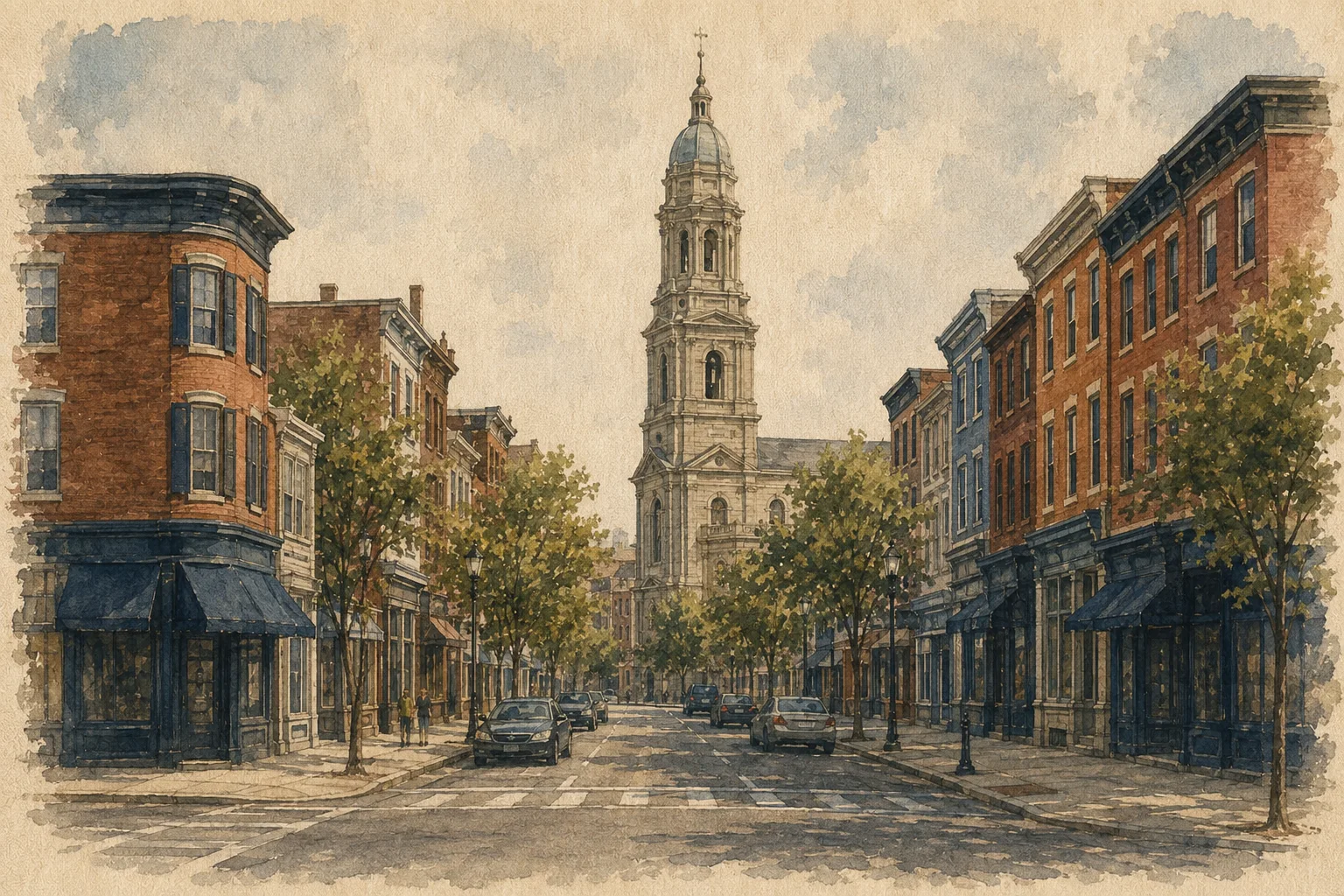
A little orientation
Find your own starting point in North Philadelphia
Narrow the question.
A large district label cannot settle a housing or travel decision; begin with the specific address that matters to you.
Find useful local contacts.
Look up a library or public service you would actually use and save its own current contact information.
Keep observations separate.
Date what you notice on a visit, and distinguish it from a claim about how every block or resident behaves.
A closer look
Turn a broad guide into a useful plan
Choose one daily journey, one community resource and one practical question to follow up.
Start with two real addresses.
Enter your starting point and destination in the transit planner rather than judging access from the North Philadelphia label. Compare the trip at your actual travel times, including the return and the walking connection at either end.
A useful questionWhich daily journey do you need this particular address to support?
Source & next step ↗Find a branch you would use.
Search the Free Library directory from your address and read the relevant branch’s services and access notices. Contact the branch about a particular program or resource instead of assuming every location offers the same help on the same days.
A useful questionWhat would you like a nearby library to help you do?
Source & next step ↗Find the right reporting route.
For a non-emergency City service question raised by the guide, use Philly311 to identify the appropriate request channel. Record the address and clear observations, and keep the reference information so you can follow up on the actual request.
A useful questionWhat is the exact issue, location and next step for your request?
Source & next step ↗This guide covers North Philadelphia as its residents describe it: the blocks people argue about online, the quiet streets that never make the news, and the routines that only make sense once you have lived them. This guide was created to reflect that reality, not the simplified version outsiders rely on. North Philadelphia is not a headline or a single story. It is a collection of blocks shaped by timing, habit, and unspoken rules that determine how people actually live here.
This guide is meant to give you the kind of understanding that usually takes months to develop. It focuses on how residents navigate daily life, how reputations form and spread, and why certain frustrations feel deeply personal. We do not flatten the area into good or bad, safe or unsafe. Instead, we show how locals measure livability, adapt to challenges, and protect what works. If you are new to North Philadelphia or trying to understand it beyond surface narratives, this guide is written to meet you where the reality actually is.
What “North Philly” Actually Means (And Why Outsiders Get It Wrong)
When people say North Philly, they usually mean a feeling rather than a place. Outsiders use it as a single label that bundles crime, drugs, and decay into one idea. Locals almost never do that. People who actually live here rarely introduce themselves as being from North Philly without immediately adding a qualifier, a cross street, a block, or at least a directional cue. That instinct alone tells you everything. North Philly is not one neighborhood and it is not one experience. It is a collection of very different realities that happen to share a name outsiders find convenient.
Part of the misunderstanding comes from how reputation travels faster than geography. Kensington dominates the conversation even for people who have never stepped foot there, and that shadow stretches far beyond its actual boundaries. Entire sections of North Philly that operate on totally different rhythms still get flattened into the same story. Online, anything north of Vine gets lumped together. On the ground, that framing breaks down almost immediately. Residents navigate by lived knowledge, not by what a map or headline suggests.
Another reason outsiders get it wrong is that they expect consistency. They assume that if an area is labeled rough, it must feel rough everywhere and at all times. North Philly does not work that way. It changes by block, by hour, and sometimes by which side of the street you are standing on. People who live here understand that saying North Philly without context is meaningless. It signals that the speaker has not spent enough time here to know what actually matters.
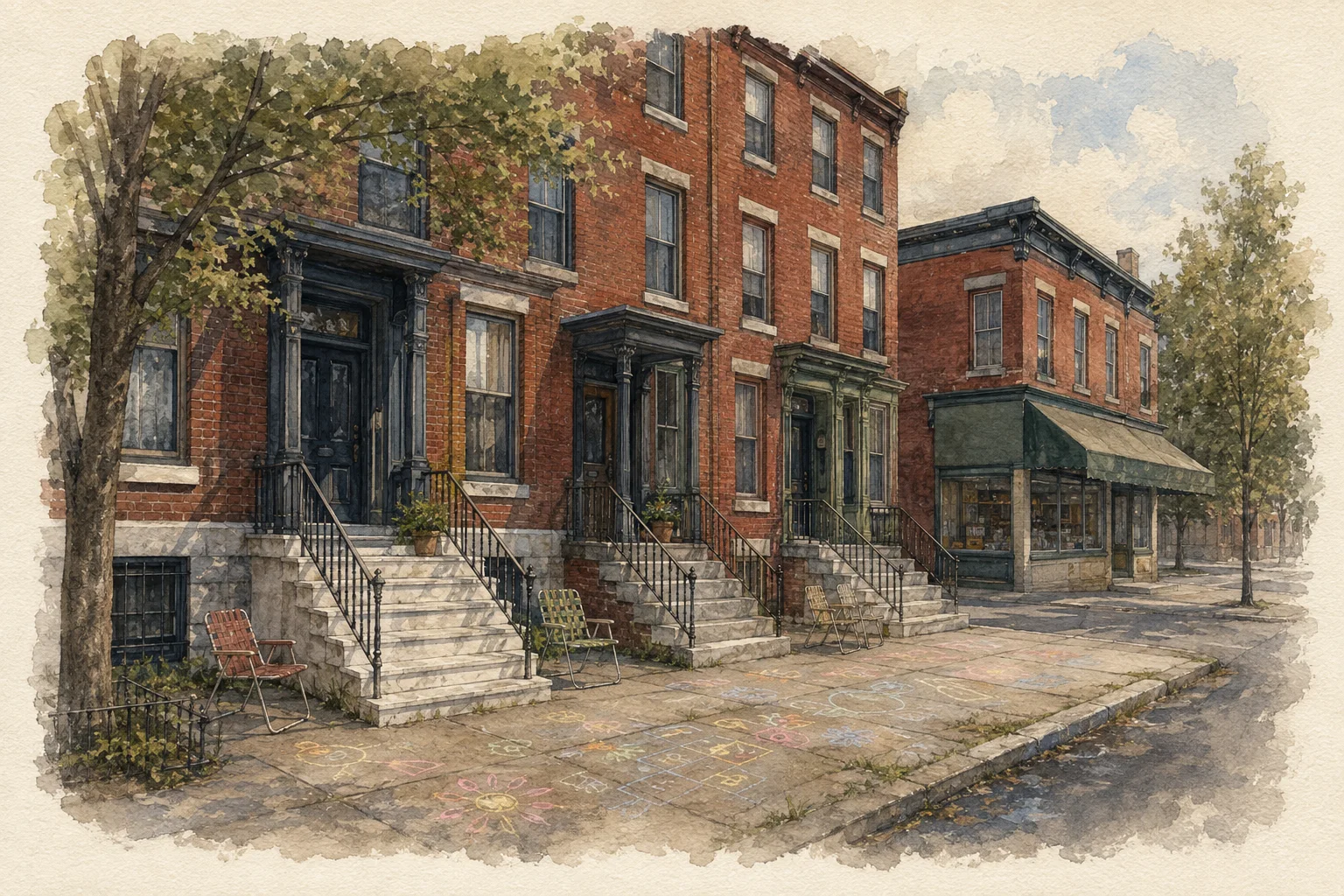
The Real Geography: Blocks Matter More Than Neighborhood Names
In North Philly, the block is the unit of measurement that counts. Neighborhood names are secondary and sometimes irrelevant. Two blocks that share the same zip code can feel like entirely different worlds depending on cleanliness, traffic, foot activity, and who tends to be outside at certain hours. Locals learn this quickly and structure their lives around it.
A good block is not defined by aesthetics. It is defined by predictability. Predictability means you know what the street sounds like on a Tuesday night. You know whether people linger outside or disappear after dark. You know if trash day stays contained or turns into overflow that sits for days. These are the signals residents use, not the labels printed on real estate listings.
Time of day matters just as much as location. A street that feels manageable in the afternoon can feel completely different late at night. Locals adjust routes, errands, and routines accordingly without announcing it. They do not frame these decisions as fear. They frame them as common sense. Outsiders often miss this because they look for blanket rules. North Philly operates on situational awareness instead.
The Baseline Reality: Grit Is Not a Phase Here
Grit in North Philly is not something people expect to outgrow. It is not a transitional condition or a temporary rough patch waiting for improvement. It is the baseline reality people build their lives around. That does not mean constant chaos. It means constant friction. Things take longer. Problems repeat. Small inconveniences stack up. Residents learn to operate inside that environment rather than waiting for it to change.
Locals are very good at distinguishing between disruption and danger. Loud does not always mean unsafe. Messy does not automatically mean violent. Outsiders often conflate the two and assume that tolerance equals indifference. It does not. It is adaptation. People here know what is normal for their block and what is not. That knowledge is practical and deeply local.
This is also why pride and frustration coexist so closely. People can love where they live while being exhausted by it. They can defend their neighborhood fiercely while openly acknowledging its flaws. That tension is part of the culture. It shapes how people talk, how they move, and how they respond to criticism from anyone who has not earned the right to make it.
Violence Isn’t Abstract Here, It’s Timestamped
When violence comes up in North Philly, it is rarely discussed in vague terms. People talk about exact blocks, intersections, and times of day. Those details matter because they inform behavior. A story about a dispute that escalated overnight carries a different weight than a headline about crime in general. Residents store these specifics and quietly adjust their routines.
The phrase minor dispute carries particular gravity here. It signals how quickly situations can spiral when tensions are already high. That awareness shapes social behavior. People avoid confrontations. They choose when to speak and when to let things go. This is not cowardice. It is risk calculation learned through experience.
Timing is another layer outsiders often miss. Late night incidents recalibrate how a block feels even during the day. A place that was previously tolerated becomes avoided after certain hours. These shifts are rarely announced or debated. They spread through casual conversation and shared understanding. Over time, they become part of the mental map residents carry with them.
Growing Up With It: Desensitization and Survival Psychology
For people who grow up in North Philly, exposure to instability starts early. Violence, loss, and disruption become part of the background of daily life. That does not mean they do not feel it. It means they learn how to function alongside it. Language becomes calmer. Reactions become measured. Outsiders sometimes mistake this for numbness, but it is closer to endurance.
Children and long time residents often speak about traumatic events without dramatic framing. That tone can be jarring to newcomers who expect visible alarm. What they are hearing instead is normalization as a survival strategy. When instability is frequent, emotional escalation becomes unsustainable. People conserve energy by staying level.
Grief still exists, but it surfaces differently. It appears in private conversations, community rituals, and moments of collective pause rather than public displays. Understanding this distinction is critical. Silence does not mean safety. It often means experience.
Kensington’s Shadow and the Cost of Being a Symbol
Kensington exists in the public imagination as shorthand for everything people fear about Philadelphia, and that shadow stretches far beyond its actual boundaries. For North Philly residents, this creates a constant burden of association. Blocks that function nothing like Kensington still get treated as extensions of it by outsiders who rely on viral footage and headlines instead of lived experience. The result is a neighborhood identity shaped by a place many residents do not live in and do not control.
What makes this especially heavy is how visibility works. The suffering in Kensington is public, repeated, and easy to film. That makes it attractive to people looking for content rather than understanding. For residents, the problem is not awareness itself. It is the way attention strips people of dignity and turns a complex crisis into a spectacle. When entire communities become symbols, the everyday lives happening alongside the crisis get erased.
There is also a quieter, more practical interaction with this visibility. Families pay attention to what appears online not out of curiosity, but out of concern. Videos are scanned for familiar faces and signs of life. This is not something most outsiders imagine when they talk about awareness. It is a survival response shaped by the absence of reliable systems of care.
Trash, Dumping, and Why It Feels Personal Here
Trash in North Philly is not just an eyesore. It directly changes how people move through their own streets. Overflowing piles narrow sidewalks, attract pests, and signal neglect in a way that affects safety and morale. When dumping becomes routine, residents feel like their block is being used as a disposal site by people who do not have to live with the consequences.
This is why trash arguments escalate so quickly. Blame shifts between neighbors, the city, and outsiders who drive in to dump and leave. Each explanation carries an accusation of disrespect. People are not just angry about garbage. They are angry about being treated as disposable. That feeling turns logistical problems into moral ones.
Timing matters here as well. After service disruptions or holidays, dumping spikes in predictable ways. Residents notice patterns and adjust expectations, but patience runs thin when the same corners become repeat offenders. Over time, trash becomes a measure of whether anyone is paying attention at all.
When the City Stops Answering: 311, Infrastructure, and Fatigue
Repeated attempts to report problems without results reshape how residents relate to the city. When calls go unanswered or reports disappear into a system that never responds, people stop believing that escalation leads to change. This is not apathy. It is exhaustion built from repetition.
Infrastructure failures intensify this fatigue. Collapsing streets, long term detours, and blocked access points affect daily routines in ways that compound stress. These issues often appear suddenly and linger far longer than promised. When repairs stall, residents are left to reroute their lives around problems they did not create and cannot fix.
The most damaging part is the uncertainty. Without clear timelines or follow up, people are forced to assume that conditions may not improve. That assumption becomes baked into decision making. Routes change. Expectations lower. Trust erodes quietly.
Vacant Houses and the Fear Nobody Shows Off
Vacant houses introduce a type of fear that does not make headlines but shapes daily behavior. Structurally unsound buildings threaten collapse, invite pests, and destabilize entire rows of homes. Living next to a vacant property means constantly monitoring sounds, smells, and signs of movement in walls that are not yours.
This fear is rarely talked about publicly because it feels mundane and ongoing rather than dramatic. People adapt in small ways. Doors close more gently. Windows stay shut. Children are steered away from certain spots without explanation. These adjustments become routine, even as anxiety simmers underneath.
Official warnings do not always bring relief. Notices can be ignored or removed, and months can pass without meaningful intervention. During that time, residents are left managing risk on their own. The stress of waiting, not knowing when something might give way, is often heavier than fear of crime.
The Transplant Conflict: It’s About Behavior, Not Origin
Resentment toward newcomers in North Philly is often mischaracterized as hostility toward outsiders themselves. In reality, the conflict is about behavior. Long time residents are sensitive to how new arrivals talk about the area, what they complain about first, and whether they attempt to adapt before demanding change.
Comparisons to other cities, especially when framed as improvements, land poorly. They signal that the neighborhood is being evaluated rather than understood. Complaints about noise, parking, or aesthetics carry more weight here because they often ignore the context locals have already learned to navigate. What feels like feedback to a newcomer can feel like disrespect to someone who has spent years adjusting to the same conditions.
This is why identity loss surfaces so strongly in these conversations. People are not just reacting to demographic change. They are reacting to the feeling that the rules are being rewritten by those who have not earned familiarity with the place. Adaptation is welcomed. Imposition is not.
Online Neighborhood Spaces Make Everything Worse
Online neighborhood spaces amplify the worst parts of local tension while stripping away context and restraint. What might be a manageable disagreement in person becomes volatile once it is posted publicly. Screens flatten tone, reward outrage, and remove the social cues that normally keep people from escalating. In North Philly, that shift carries real risk.
Residents learn quickly that visibility cuts both ways. Posting too much detail can invite harassment, retaliation, or doxxing. Even well intentioned warnings can spiral into accusations and threats once others pile on. As a result, many people read far more than they post. Silence online is often a form of self protection, not disengagement.
These platforms also distort priorities. Minor issues attract massive attention while serious problems get buried under arguments. Political shorthand and moral grandstanding derail conversations that could have been practical. Over time, trust erodes and the idea of collective problem solving feels less realistic than simply staying out of the spotlight.
Informal Power Structures: Oldheads, Scammers, and Borders
In the absence of reliable systems, informal power structures fill the gaps. Longtime residents often act as unofficial referees, calling out behavior that violates local norms and warning others about patterns they have seen before. These figures carry credibility built on longevity and familiarity rather than titles.
At the same time, those same spaces attract people looking to exploit community goodwill. Scammers cycle through familiar narratives, adjusting details but relying on the same emotional triggers. Even when exposed, the behavior persists because compassion and skepticism coexist uneasily. Not everyone wants to be the person who doubts someone in need.
Borders also function as informal power lines. Adjacent neighborhoods draw hard distinctions between who belongs and who does not, often using coded language. These boundaries are enforced socially through complaints, watchfulness, and exclusion rather than physical barriers. Understanding where those lines sit is part of learning how to move through the area without friction.
How Blocks Heal Themselves (When They Can)
Despite everything, blocks sometimes find ways to reset. Healing rarely comes from outside intervention. It comes from residents reclaiming space together. Shared meals, music, and simple gatherings bring people back outside after periods of fear or isolation. These moments matter because they restore a sense of normalcy and collective ownership.
The process is fragile. It depends on trust, timing, and the willingness to be visible again. When it works, the atmosphere shifts. People linger longer. Conversations resume. The block feels inhabited rather than endured. These changes are subtle but meaningful to those who live there.
Not every block gets this chance, and not every attempt succeeds. But when recovery does happen, it reinforces why people stay. It reminds residents that community exists alongside instability, even if it has to be rebuilt repeatedly.
The Rules You Learn Without Being Taught
North Philly operates on a set of unwritten rules that newcomers absorb slowly. Do not escalate conflicts unless absolutely necessary. Do not record or broadcast someone else’s suffering. Do not post identifying information online. Do not assume boundaries are obvious. And above all, do not complain before listening.
Language matters. Knowing how people refer to places, situations, and each other signals awareness. It shows that you have paid attention long enough to understand context rather than relying on stereotypes. This is less about slang and more about respect.
The final lesson is humility. Living here reshapes how people assess risk, patience, and belonging. Those who adapt learn when to speak, when to move, and when to let things be. Those who cannot often leave frustrated, convinced the place is broken. Locals know better. They know it is complicated, demanding, and alive, and that understanding it takes time.
The rules you learn without being taught
The legacy guide's own account of what earns standing here and what costs it.
- Listening before complaining — the body's last rule, and the one it weights heaviest.
- Adapting rather than imposing: adaptation is welcomed, imposition is not.
- Knowing how people refer to places, situations, and each other. It signals awareness.
- Adjusting routes, errands, and routines quietly, without announcing it.
- Humility about risk, patience, and belonging.
- Escalating conflicts when it is not absolutely necessary.
- Recording or broadcasting someone else's suffering.
- Posting identifying information online.
- Assuming boundaries are obvious.
- Comparing the place to other cities as an improvement. It lands poorly.
Make it yours
Build a small local reference list
A short list to turn what you read into your own next steps.
Saved checks stay on this device when browser storage is available. This is a personal planning list, not a property inspection or professional assessment.
Sources & next steps
Useful advice should
show its working.
These resources support the reader tools above and help you check details for your own address, date, or plans.
- SEPTA trip planner
Plan your date, direction and return journey; check service and accessibility details.
- Free Library locations
Find a branch, its services and current access notices.
- Philly311
Find the appropriate channel for a non-emergency City service request.
These are orientation and service tools. They do not rate neighborhoods, infer personal risk or stand in for residents’ individual experiences.