
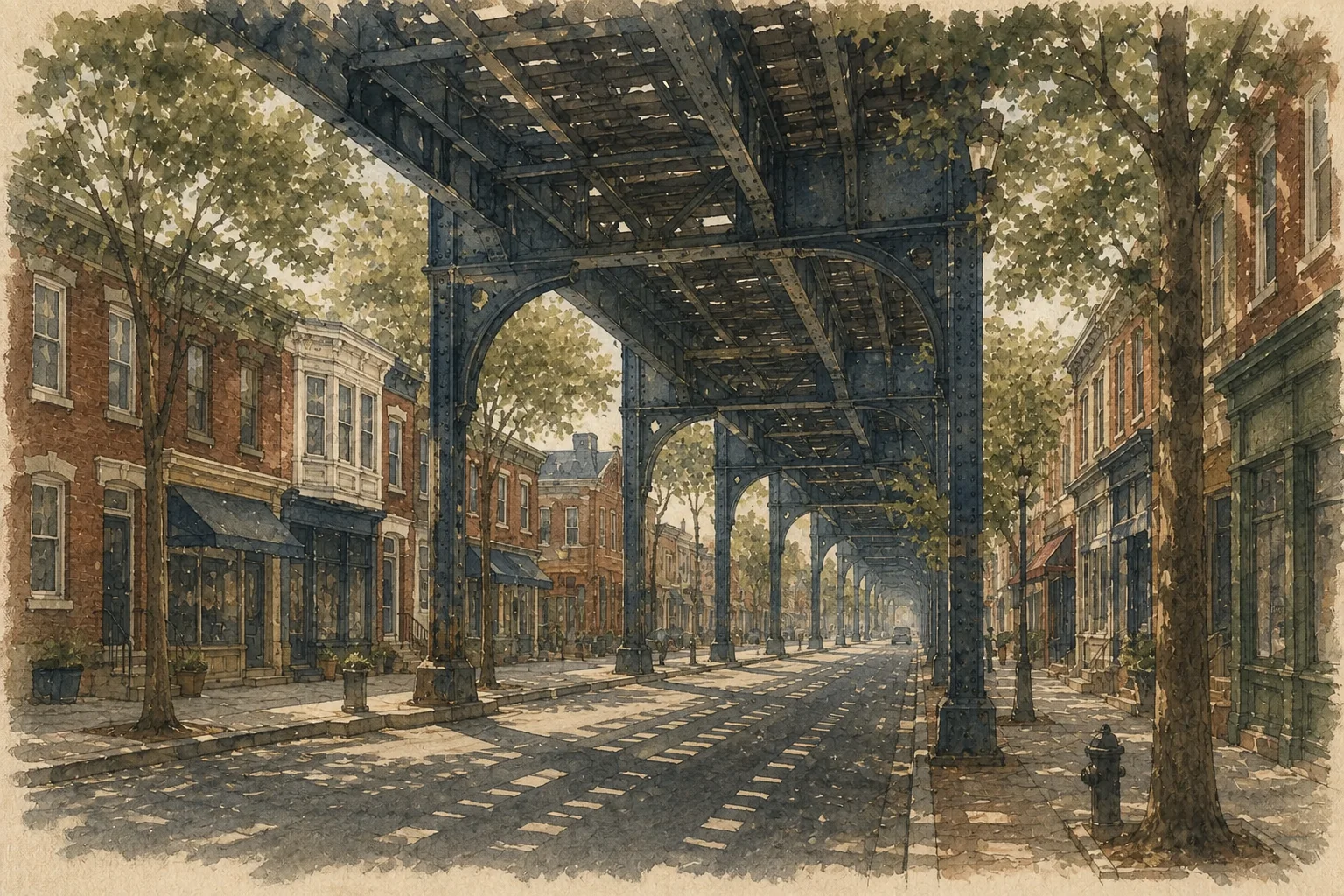
A little orientation
Make a practical Frankford plan
Plan through the interchange.
If your journey involves Frankford Transportation Center, check the particular service, direction and connection you need for your travel date.
Use named places.
Look up Overington Park or a specific destination from the guide rather than relying on an avenue-versus-side-street rule.
Inspect the housing question.
Public records and a viewing can help you prepare questions, but neither a neighborhood label nor a listing settles property condition.
A closer look
Three checks for daily life
These tools help with travel, public space and housing research without assigning risk to a street.
Use the actual transfer.
Plan the journey through Frankford Transportation Center for your own departure time and destination. Read the current service information and confirm access details that matter to you, then check how the return connection works later in the day.
A useful questionWhich service and walking connection would you use in each direction?
Source & next step ↗Research Overington as a destination.
Find Overington Park through the City’s facility information and contact the relevant team about an activity or access question. Put that answer into your plan rather than using the park’s name as a general claim about nearby blocks.
A useful questionWhat do you want to do there, and what needs confirming first?
Source & next step ↗Ask about the particular house.
Look up the home’s address in Atlas and note records you want explained by the owner or agent. During a viewing, ask about maintenance responsibility, shared access and any visible conditions that need qualified assessment before a decision.
A useful questionWhat does this house need you to understand before a housing commitment?
Source & next step ↗Frankford is one of Philadelphia’s most misunderstood neighborhoods. This guide covers its housing, transit and access, and everyday logistics. The neighborhood is complex, intense, and shaped by hyper local patterns you can only recognize once you’ve walked its blocks, waited for the El at specific hours, or learned the difference between living on the Ave and living two streets off. This guide was created to help anyone who lives or works in Frankford navigate its unique rhythms.
The Neighborhood With Two Realities
Frankford is the kind of place where two truths can exist at the exact same time. You can walk past a row of tidy brick homes with neighbors chatting from their porches, turn the corner, and suddenly land in a pocket that feels like a collapsing version of Kensington. It is affordable, loud, transit heavy, unpredictable, tightly knit in strange and specific ways, and defined by block to block contradictions that Google Maps could never capture.
People who know Frankford do not talk about it as an emerging hotspot or a secret gem waiting to be discovered. They talk about it as a place you endure, adapt to, navigate carefully, and sometimes love through gritted teeth. Longtime residents carry a memory of theaters and postwar shops that once lined the Ave. Newer transplants learn quickly that the current Frankford is a mix of open air addiction, all day noise, hardworking families, dirt bike packs, corner store crowds, and some of the most hyper local rules in the city.
This guide is not for someone passing through. It is written for the person who might actually live here, commute here, or find themselves regularly on Frankford Avenue or near the El. Everything ahead comes from lived experience patterns: where people stand, where they refuse to stand, which blocks feel safe at 11 AM but not at 7 PM, and why neighbors treat the porch as both lookout post and sanctuary. What you’re about to read is what you only learn after months of paying attention.
Where Frankford sits
- Frankford Avenue
- Frankford Transportation Center
- Overington Park
- Leiper Street
Schematic · not to scale
How Locals Divide the Neighborhood
Frankford is not one neighborhood. It is a set of micro territories that change dramatically every few blocks. Locals rarely describe it as a whole because lived experience narrows down to intersections, corners, and the direction you happen to approach them from.
The spine of everything is Frankford Avenue. It carries the buses, the El crowd, the storefronts, and almost all of the neighborhood’s chaos. The running rule is simple: the closer you live to the Ave, the heavier the noise, the foot traffic, the street commerce, the trash, and the unpredictable encounters. The farther back you go onto side streets, the more breathing room you find, though that comfort level changes sharply every couple of blocks.
Certain intersections have reputations that speak for themselves. The meeting point of Frankford and Ashburner is where many locals first realized the addiction crisis creeping north from Kensington into their own doorstep. Montgomery and Frankford is known for the constant return of one aggressive individual who cycles through police and EMS visits but never seems to disappear. The Frankford Transportation Center is both a lifeline for commuters and a site of major violence, with crowds providing safety during rush hour and danger after the waves thin out.
Some pockets feel almost self contained. The blocks around Overington Park are quieter and more residential, with a porch culture that almost shields residents from the volatility only a few streets away. Leiper Street has its own neighborhood energy that feels steadier than most. Then there are the borderlands near Lehigh Ave, where dirt bikes rip through intersections, junkie traffic spills over, and some residents insist the area is changing while others see the same patterns repeating.
To understand Frankford is to understand this patchwork. Two homes one block apart can feel like different worlds.
How locals divide the neighborhood
Frankford is not one neighborhood. It is a set of micro territories that change dramatically every few blocks.
The Ave
Frankford Avenue — the spineIt carries the buses, the El crowd and the storefronts. The running rule: the closer you live to the Ave, the heavier the noise, the foot traffic and the street commerce.
The side streets
A few blocks backThe farther back you go, the more breathing room you find — though that comfort level changes sharply every couple of blocks. Some side streets offer quiet pockets where you can hear yourself think.
Around Overington Park
Quieter and residentialAlmost self-contained, with a porch culture that nearly shields residents from the volatility only a few streets away.
Leiper Street
The steadier stretchIts own neighborhood energy, described by residents as steadier than most.
Morning Calm, Afternoon Hustle, Nighttime Edge
Frankford has its own rhythm and the neighborhood feels completely different depending on when you step outside. Every timeframe has its unwritten rules.
Morning belongs to commuters and school traffic. People heading to the El move quickly and deliberately, especially around the Frankford Transportation Center. Crowds make that area feel safer in the early hours, and those who rely on transit quietly plan their days around these morning rush windows. Schools add another layer. When the bell rings, entire blocks shift. Kids stream toward the end of certain streets, and the noise level jumps instantly.
Afternoons are for errands and side street life. This is when corner stores fill up, the postal routes become active, and porches turn into outdoor living rooms. Many residents prefer running their errands now because the Ave, though busy, has a predictable kind of daylight congestion compared to what comes later. On some quieter blocks you’ll see neighbors sweeping their sidewalks or chatting across the railing while keeping a half eye on who walks by.
Night belongs to sirens, loud music, parties, and the uneasy unpredictability that shows up only after sunset. The same blocks that feel manageable at 2 PM can feel completely different at 9 PM. Gunshots echo more often at night, sometimes distant, sometimes far too close. Apartment buildings like The Frankford gain a sleepless churn of young partiers, shady guests, and music that blasts without pause. Parents keep children inside. People who commute late try to avoid long waits at the terminal or deserted platforms. It is during these hours that the neighborhood’s fragility becomes clearest.
Frankford does not hide who it is. It simply reveals itself in time segments.
Rules No One Says Out Loud
People who survive Frankford long term follow safety patterns that never appear in real estate brochures. They are learned through repetition, observation, and the collective knowledge passed through neighborhood groups, town watch posts, and family warnings.
The first rule is geographical. Living directly on Frankford Avenue means living inside the storm. The Ave hosts prostitution, drug activity, homeless encampments, constant foot traffic, and unpredictable confrontations. Moving a few blocks back onto residential side streets changes the daily experience, although every area has its flare ups. The master rule is simple: distance from the Ave is distance from risk.
The second rule is timing. The El is most manageable during rush hour when sheer volume of people creates its own shield. The same platforms late at night feel exposed and uneasy. Residents plan errands by light levels, not convenience. After dark, everything sharpens. Even blocks that feel calm in the day can become tense when the sun goes down.
The third rule is conflict avoidance. Honking unnecessarily can provoke heated responses on certain streets. Using a porch voice with a stranger hanging around your steps works better than raising your tone. People learn how to ask someone to move from their stairway, how to cross the street casually when sensing a volatile moment, and how to retreat without escalating.
The fourth rule is collective awareness. Neighborhood groups and town watch pages act as real time safety alerts. Residents know the patterns around specific intersections because someone posts about it daily. People track which corners have repeat aggressive individuals or sudden surges in activity. Information spreads fast, and that shared alert system often replaces reliance on police, especially when emergency calls ring without answer.
Frankford survival is not dramatic. It is practical. It is knowing where to be, where not to be, and when silence is safer than confrontation.
The Crisis at the Doorstep: Living Beside Addiction
Frankford lives in the shadow of Kensington’s open air drug market, and the spillover is no longer subtle. Certain corners now feel like extensions of K and A, with people slumped against buildings, moving in slow unpredictable patterns, or gathering near abandoned structures. Residents recognize the signs of Tranq and fentanyl use without needing explanations. The crisis shows up in the bodies of people who drift through the area: slow motion movements, dazed collapses, wounds left untreated for months, and an exhaustion that is heavy enough to change the mood of a whole block.
Ashburner Street became a turning point for many locals when they realized the crisis had fully arrived. Individuals began appearing regularly, occupying the same corner day after day in poses that made the neighborhood feel closer to Kensington’s core. Montgomery and Frankford gained its own reputation for a man whose aggressive episodes repeatedly drew emergency responders, only for him to reappear in the same spot hours later. These patterns create a sense of being stuck in a loop, with help arriving but nothing changing.
Everyday life bends around this reality. People step over individuals lying on sidewalks or leaning in doorways. They keep an eye on stairwells and porches to make sure no one is using substances there. Parents shield children from scenes that would be shocking anywhere else. The emotional weight is tangible. Residents feel frustration toward dealers, sadness for the people consumed by the drugs, and fatigue from witnessing suffering at scale.
A newer phenomenon complicates everything. Online creators visit the area hoping to capture dramatic footage of addiction, wandering the streets with cameras aimed at people in distress. Locals see them as intruders who turn misery into entertainment. This digital attention only increases the sense that the neighborhood is being consumed by outside narratives that ignore the human toll.
Frankford is living next to one of the worst drug crises in the country, and the daily visibility of it shapes how people walk, plan, and protect themselves.
Homes You Stay In Until You Can Leave
Housing in Frankford follows its own emotional logic. People rarely arrive thinking this is their forever neighborhood. Most move in because it is affordable and reachable by transit. They stay because they need time to save, or because the rent is manageable, or because their family has roots on their block. Frankford teaches you quickly that living here is not about falling in love with a street. It is about adapting to it.
Blocks vary sharply. Some side streets offer quiet pockets where you can hear yourself think. Others are dominated by school traffic, alleyway noise, or kids running the block without supervision. The rows closer to Frankford Avenue deal with nonstop foot traffic, sirens, and the churn of addiction. Apartments near major intersections operate like revolving doors, with guests coming and going through the night.
Even when people describe their street as peaceful, they also acknowledge that the peace is fragile. A new tenant moves in and suddenly the block dynamic changes. A corner store reopens and foot traffic shifts. A vacant house on the next street attracts new activity overnight. You learn that Frankford housing is not just about the structure you live in but the micro ecosystem around it.
Many long term residents talk about a slow erosion. The area felt better years ago. The rise in guns, trash, drugs, and unchecked youth behavior has changed their sense of home. Others insist some pockets are stabilizing thanks to neighbor vigilance and daytime police presence. These worlds exist side by side. The shared understanding is that Frankford is a place where people live for now, not forever, even if they have been here for twenty years.
Transit Hacks, Street Logic, and the Noise of Machines
Getting around Frankford is less about transportation choices and more about survival strategy. The El is the backbone of mobility, and residents treat it with practical respect. It is crowded enough during rush hours to feel like a temporary shield. At quieter hours, especially late at night, stations and platforms feel exposed. People time their commutes around these cycles, choosing to arrive when crowds peak to avoid isolated waits.
Buses connect the grid, but delays can turn a simple ride into an exercise in vulnerability. People remember moments when someone waiting for a bus was assaulted without warning, which adds another layer to travel decisions. Buses near the Frankford Transportation Center are especially unpredictable due to the volume of distressed individuals in the area.
Cars offer more control but bring their own chaos. Drivers here honk aggressively, sometimes out of habit and sometimes out of stress. Locals know certain intersections can trigger confrontations if drivers escalate too quickly. Potholes can feel more like improvised speed bumps. Illegal car meetups pop up on the edges, drawing police and creating sudden traffic freezes.
Bikes and scooters move through Frankford in their own rhythm. Cyclists weave cautiously near the Ave, watching for sudden pedestrian movements. On the border near Lehigh, dirt bikes travel in packs, cutting across lanes and intersections. Their sound announces them before they arrive. To an outsider it may seem lawless. To residents it is a familiar part of the audio landscape.
Frankford transit works best for those who study its patterns. The fastest route is usually the one that avoids the wrong moment.
Sound, Smell, and the Constant Drift of Frankford
Frankford is not quiet. If you live here, you hear everything. The Market Frankford line rattles along its tracks. Sirens cut through the night. Dirt bikes roar past in groups. Music spills from houses, cars, and gatherings. Corner stores operate with open doors and constant chatter. Even when streets seem calm, the neighborhood rarely sleeps.
Trash has its own presence. Certain blocks maintain themselves meticulously. Others collect bags, bottles, or half eaten food left near bus stops. Piles of dog waste occasionally block apartment entrances. In summer, heat amplifies the smell of everything. The Ave carries odors from takeout spots, smoke clouds, and the sharp chemical scent of cleaning agents used on sidewalks after incidents.
Animals contribute to the ecosystem. Large raccoons use the small two way streets as nightly pathways. Stray cats watch from porches or alleys. Residents know what it means when animals outnumber people on a block after dark. It usually points to a street that has surrendered to neglect.
Environmental frustration comes from repetition. People sweep their sidewalks daily only to see trash return within hours. Loud arguments erupt late at night. Fireworks and gunshots compete for recognition. A car alarm sounds for twenty minutes because its owner is asleep or far away. Yet through this noise is a sense of acceptance. You learn to sleep with white noise. You learn which sounds signal excitement and which signal danger. Frankford has its own sensory language, and you will learn it whether you want to or not.
The Food Spots People Actually Go Back To
Frankford is not known for refined dining. It is a landscape of practical comfort food, surprise gems, and chaotic experiences where the food is worth the frustrations around it. Locals know which places justify the trip and which are better avoided unless desperate.
A few spots have earned near obsession. Jordan Johnson Seafood on the Ave inspires intense loyalty for its fried platters and seasoning style that people swear they crave weekly. OK Hot Chicken gained traction after opening its halal friendly smashed burger line, drawing customers who are willing to navigate the surrounding area for a reliably satisfying meal. Certain pizza shops spark fierce debate, especially the tomato pie loyalists who argue that Frankford versions beat out better known city favorites.
Frankford food culture is built on coping. You choose your spots based on both taste and the likelihood of leaving with your patience intact.
The spots people actually go back to
Not refined dining — practical comfort food and a few surprise gems that justify the trip.
Jordan Johnson Seafood
Inspires intense loyalty for its fried platters and a seasoning style people swear they crave weekly.
Best for · A fried platter you will think about all week
OK Hot Chicken
Gained traction after opening its halal-friendly smashed burger line, drawing customers who want a reliably satisfying meal.
The tomato pie shops
Certain pizza shops spark fierce debate here, especially the tomato pie loyalists who argue that Frankford versions beat out better known city favorites.
Best for · Tomato pie, and the argument about it
Where the Neighborhood Argues With Itself
Frankford’s online world is its own storm system. Facebook groups, town watch pages, hyper local Reddit threads, and TikTok overlays create a digital mirror of the neighborhood’s daily life. These spaces are where residents document crime, argue about addiction policy, expose shady landlords, share safety footage, and sometimes tear each other apart.
The neighborhood groups function as real time alert systems. Someone sees an aggressive individual on Montgomery and Frankford and the post appears within minutes. Another resident hears gunfire near a corner store and uploads the clip. People debate whether someone standing on a corner is dangerous or just down on luck. Discussions about Safehouse, mobile health vans, and harm reduction efforts spiral into heated comment chains reflecting years of tension.
Town watch groups are calmer but equally revealing. They post volunteer hours, community patrol photos, and reminders about recent incidents. Many residents rely on these updates more than official channels because emergency response is often slow. These groups also act as archives of neighborhood memory, documenting the rise and fall of different blocks.
The drama channels are their own spectacle. Clips of dirt bikes ripping through intersections, arguments on stoops, or neighborhood disputes get shared widely. Some creators film addiction without empathy, sparking outrage among locals who feel exploited by outsiders. Others attempt to show the real conditions without sensationalism, earning cautious respect.
Frankford online is not a place of unity. It is a digital extension of the neighborhood’s contradictions, frustrations, hopes, and protective instincts. If you want to understand the pulse of Frankford, you watch what people post when they think only their neighbors are reading.
Echoes of a Corridor That Lost Its Footing
Long term Frankford residents carry a memory that newer arrivals never see. There was a time when Frankford Avenue functioned like a true commercial spine. Postwar blocks buzzed with theaters, clothing shops, bakeries, and storefronts that anchored the community. People remember feeling safe walking home from evening movies or picking up a meal without scanning corners. The decline did not happen overnight. It unfolded year by year, storefront by storefront, until the landscape became something its own elders barely recognized.
The transformation accelerated as addiction and poverty took hold in Kensington and gradually pushed north. Violence followed the same path. Families that had been in the neighborhood for decades watched their blocks shift around them. Some moved deeper into the Northeast. Others stayed because of family ties, financial limitations, or hope that the cycle might reverse.
Frankford today is built on layers of this history. You can still spot hints of the neighborhood’s better days in the architectural bones of the Ave and in the older residents who speak with a kind of nostalgic patience. Beneath that nostalgia is a painful honesty. Frankford did not crumble all at once. It eroded. Every shuttered business, every abandoned house, every gunshot, every new wave of addiction added another crack in the structure. Yet the memory of what it once was keeps many people anchored, even when they no longer feel at home.
Survival Tactics You Only Learn by Living Here
Frankford has no official rulebook, but everyone who lasts longer than a few months learns its unwritten system. The first lesson is spatial. You keep your world small. You master your immediate blocks before exploring anything else. You know which alleys to avoid, which corners attract the wrong kind of attention, and which side of the street feels safer depending on the time of day.
The second lesson is tone control. Raising your voice at the wrong person can escalate quickly. Polite firmness gets better results than confrontation, especially when someone is trespassing on your steps or lingering near your door. People use calm words and measured gestures because emotional intelligence is its own safety tool.
The third lesson focuses on movement. You do not stand still for too long in exposed areas. You do not cut through certain short blocks just because they look convenient. You cross the street when your instincts tell you to. You wait for buses near crowds, not isolated shelters. You use the El during peak hours whenever possible, even if that means adjusting your schedule.
The fourth lesson is information awareness. Neighborhood Facebook groups and town watch alerts are not entertainment. They are daily briefings. You learn who the recurring problematic individuals are, which intersections are heating up, and when a new pattern emerges. Residents create their own collective intelligence network because official systems often lag behind.
These habits are not paranoia. They are adaptations. They turn the unpredictable into the manageable. They are how you build a sense of control in a neighborhood that challenges it constantly.
Who Thrives, Who Struggles, and Who Should Think Twice
Frankford works best for people who need affordability, access to transit, and the ability to tolerate a neighborhood that is intense, imperfect, and constantly shifting. Car free commuters find the El invaluable. Individuals who grew up in similarly chaotic environments often adapt quickly because the sensory overload feels familiar. People with strong family roots nearby have built in support networks that help them navigate the tough spots.
For others, Frankford is far more difficult. Families with young children struggle with the reality that outdoor play is limited and that walks to the corner store bring too much risk. Anyone sensitive to noise, conflict, or visible addiction carries emotional weight every time they step outside. People seeking a quiet residential environment will not find it on or near the Ave. Even side streets that feel calm can produce sudden bursts of activity that shatter the illusion of stability.
Visitors often misunderstand the neighborhood entirely. They expect something closer to Fishtown’s edge or Port Richmond’s grit and end up shocked by the level of visible suffering and street level volatility. Some travelers stay in short term rentals and enjoy their trip, but that depends heavily on timing, luck, and whether their building has responsible management. Others walk away rattled by experiences they never expected.
Frankford is not for everyone. It demands resilience, awareness, and flexibility. Those who choose it often do so because their priorities outweigh the daily challenges. Those who cannot adapt feel the strain quickly.
Who thrives, and who should think twice
The guide's own answer: Frankford is not for everyone, and it demands resilience, awareness and flexibility.
- People who need affordability and access to transit.
- Car-free commuters, who find the El invaluable.
- People who grew up in similarly chaotic environments and adapt quickly.
- People with strong family roots nearby and built-in support networks.
- Families with young children, where outdoor play is limited.
- Anyone sensitive to noise, conflict or visible addiction.
- People seeking a quiet residential environment, which does not exist on or near the Ave.
- Anyone who requires stability and predictability.
Deciding How Much Risk You Can Carry
Frankford requires a personal calibration of comfort and caution. People who choose to live here accept that risk is not an occasional event. It is a daily calculation. Your tolerance level determines your routines. If you can handle noise, unpredictable encounters, and the rough edges of a neighborhood in transition, you may find a workable rhythm. If you require stability and predictability, the environment will test you constantly.
The decision starts with geography. Living a few blocks off Frankford Avenue reduces exposure to chaos, though nothing eliminates it entirely. Proximity to the El is convenient but carries its own hazards. Side streets with stronger community presence offer better chances of day to day normalcy.
The decision also involves time. People who work early shifts often feel safer because daylight favors them. Night owls face the neighborhood at its most volatile. Parents evaluate whether the internal safety strategies they adopt are enough to protect their kids. Renters weigh how long they can manage the stress against the financial advantage of staying.
Frankford without filters is a neighborhood that forces clarity. It asks whether you are prepared to live with constant sensory pressure, visible suffering, and the unpredictability of street life. Some people find strength in adapting. Others decide quickly that the price is too high.
Choosing to be here is choosing how much of yourself you are willing to give the neighborhood. Frankford will not soften for you. It will simply show you its reality and wait for your answer.
Make it yours
Your Frankford planning notes
A short list to turn what you read into your own next steps.
Saved checks stay on this device when browser storage is available. This is a personal planning list, not a property inspection or professional assessment.
Sources & next steps
Useful advice should
show its working.
These resources support the reader tools above and help you check details for your own address, date, or plans.
- SEPTA trip planner
Plan your date, direction and return journey; check service and accessibility details.
- Philadelphia Parks & Recreation Finder
Find named public facilities and their contact information.
- Philadelphia Atlas
Look up an address and review available City property records.
These checks do not infer risk from distance to Frankford Avenue or certify a route, property or business as safe.