
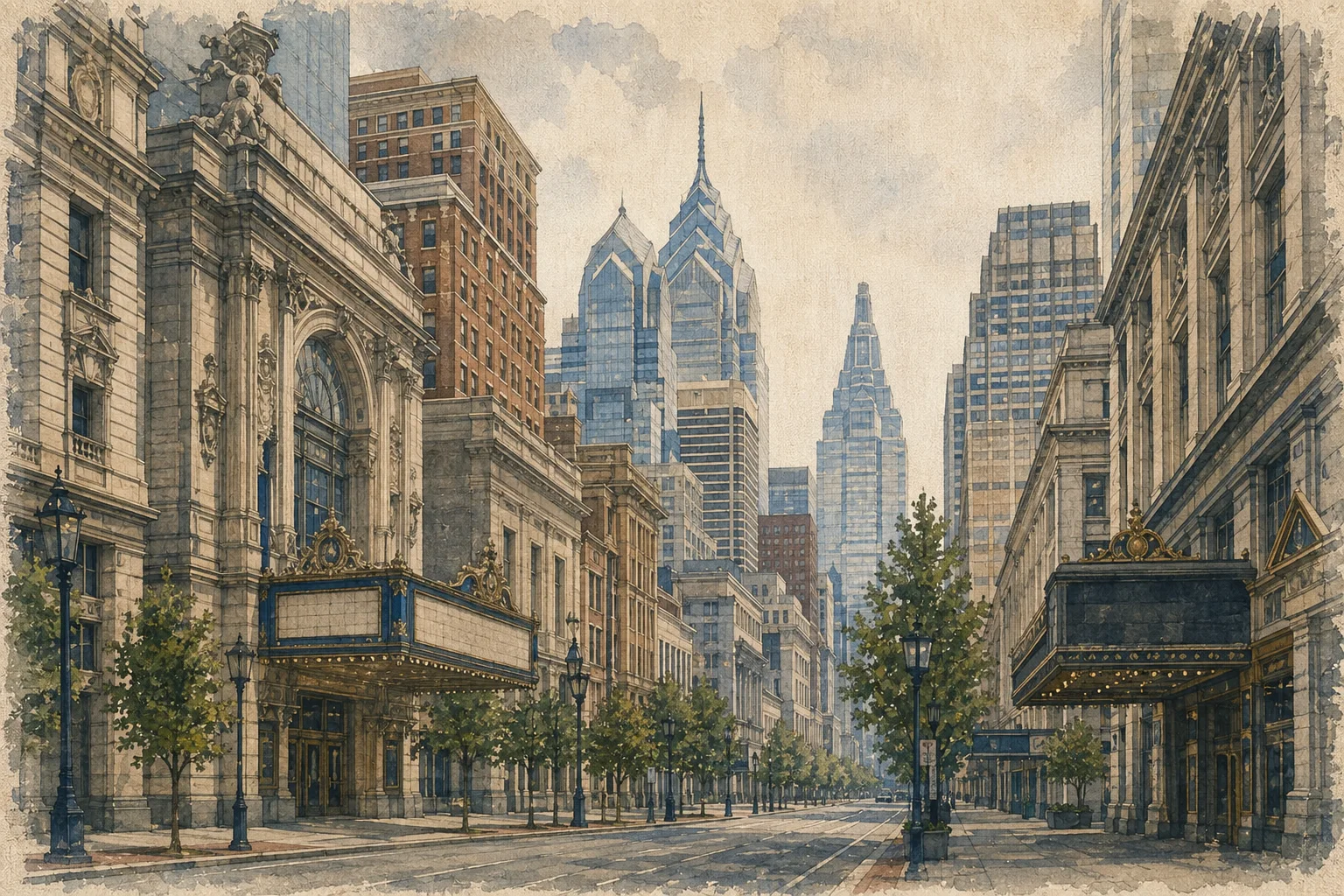
A little orientation
Make a South Broad show night work
Read the venue name.
Check the actual performance location and entrance; a South Broad address is more useful than a general district label.
Leave room between bookings.
Confirm meal and performance times separately, allowing for the walk and any entry arrangements your party needs that evening.
Plan the way home.
Look up the return journey for your date before leaving, then keep one workable alternative with your ticket details.
A closer look
Three checks before the curtain
Use the organizer’s information for your performance, rather than a general rule about theater-night timing.
Find the correct door.
Start with the performance listing and your ticket, especially when the guide mentions the Kimmel Center or Academy of Music. Check the venue’s visitor information for entry, access requests and any instructions specific to your event.
A useful questionDoes everyone in your party know the venue, entrance and ticket arrangement?
Source & next step ↗Work backward from arrival.
Plan your trip to the actual venue address, then look up the return after the performance. Compare the walking connection with your party’s needs rather than assuming every station entrance or transfer will suit everyone.
A useful questionWhat does your complete trip look like before and after the performance?
Source & next step ↗Keep the exit in mind.
If you drive, compare official parking options and read the facility’s current terms. Check how to reach the venue on foot and whether your parking arrangement covers the whole evening, including dinner or a delayed departure.
A useful questionWill the parking terms still work if your evening runs later?
Source & next step ↗If you’ve ever walked down South Broad expecting a seamless cultural strip and instead found yourself navigating crowds, construction, and confusing flow, you’re not alone. The Avenue of the Arts is one of Philadelphia’s most important corridors, but it is also one of the most misunderstood. At Hometress, we spend a lot of time working inside Center City homes and listening to how locals actually talk about their neighborhoods, and this stretch comes up more than most. People love the theaters, the energy, and the sense that something is always happening, but they are just as quick to point out the friction, especially around parking, timing, and the ongoing AveArts 2.0 transformation. This guide is built from real local patterns, not surface-level recommendations. It shows you how the avenue actually works block by block, hour by hour, so you can experience the best of it without running into the same mistakes most visitors make.
The Philly Reality Check: What Avenue of the Arts Actually Feels Like Right Now
If you show up expecting a polished cultural boulevard from start to finish, you will feel like something is off within minutes. The Avenue of the Arts is both one of Philadelphia’s most important streets and one of its most actively disrupted ones. It is the stretch of South Broad running from City Hall down toward Washington Avenue, and right now it is in the middle of a long, expensive transformation that locals refer to as AveArts 2.0.
That means your experience depends heavily on when and why you are there. Walk it at 2 PM on a weekday and you are navigating around barriers, uneven pedestrian flow, and sections that feel like a project in progress. Come back at 7 PM before a show and the exact same block shifts. Lights come on, people gather in waves, and the street starts to feel like the version you probably expected in the first place.
This contradiction is not subtle. Locals do not talk about the avenue as a single experience. They talk about it in layers. There is the version that exists on paper, the version that exists at night, and the version you actually deal with during the day.
The biggest mistake people make is treating it like a passive destination. This is not a place you just drift into and figure out as you go. It is a place you move through with intent. You think about when you are arriving, how you are getting there, what block you are actually aiming for, and how you are leaving. If you do that, it delivers. If you do not, it can feel frustrating very quickly.
Where the Avenue sits
- South Broad
- The Kimmel Center
- The Academy of Music
- Walnut Locust
Schematic · not to scale
Where You’re Actually Standing: How Locals Break Down “The Avenue”
On a map, the Avenue of the Arts looks like one continuous stretch. On the ground, locals break it into pieces whether they realize it or not.
The most stable reference point is the Kimmel Center block, roughly between Spruce and Pine. This is where the current redesign work is most visible and where a lot of events, tours, and programming orbit. When people talk about improvements or construction progress, they are often talking about this specific section even if they do not say it directly.
A little north of that, the Academy of Music zone carries more of the traditional theater energy. This is where you feel the older identity of the avenue most clearly. It is also where conversations about parking tend to spike because this is where a lot of people try to drive in for shows.
Then there is the hotel and mixed-use stretch, where visitors tend to cluster. This is where the avenue starts to feel more like a tourist corridor, with heavier foot traffic, visible street activity, and a mix of energy that is not just tied to performances.
Finally, there is what locals refer to indirectly as further south. Nobody draws a hard line, but the tone shifts as you move past the main theater concentration. You start to see more caution in how people describe the area. It is not about avoiding it entirely. It is about being more aware of your surroundings and not assuming every block carries the same energy as the Kimmel Center area.
You will also hear people say South Broad more often than Avenue of the Arts. That is the more natural way locals refer to the street. When someone says The Ave, they are usually talking about a specific venue or nightlife experience rather than the full cultural corridor. The terminology itself tells you how they are experiencing the space.
How locals break down the Avenue
On a map it is one continuous stretch. On the ground it is four different streets.
The Kimmel Center block
Roughly Spruce to PineThe most stable reference point, and where the redesign work is most visible. Events, tours, and programming orbit here.
The Academy of Music zone
A little north of the KimmelWhere the older identity of the avenue reads most clearly, and where parking conversations spike because people drive in for shows.
The hotel and mixed-use stretch
The visitor clusterHeavier foot traffic and visible street activity. This is where the avenue starts to feel like a tourist corridor.
Further south
Past the main theater concentrationNobody draws a hard line, but the tone shifts. Locals describe it with more caution, and read the block rather than assume.
Timing Is Everything: How the Same Block Feels Completely Different by Hour
The single most important thing to understand about this stretch of Broad Street is that time changes everything.
During the day, especially on weekdays, the avenue can feel slow and fragmented. Construction zones interrupt the flow, sidewalks narrow in places, and the energy is inconsistent. You are moving through a space that is still being built into something else.
Evenings flip that completely. Around the pre show window, usually between 6 PM and 7 PM, the street starts to fill in. People arrive with a purpose, restaurants pick up, and the theater crowd gives the avenue a clear rhythm. This is when it feels closest to what most people expect from a major performing arts district.
Then comes the part that locals think about more than visitors do. The exit. Once shows end, especially on busy nights, the street compresses again. Foot traffic spikes, ride pickups cluster, and parking garages start backing up. This is when timing matters just as much as location.
Weekends intensify everything. Friday and Saturday nights bring larger crowds and heavier congestion. Weeknights are more manageable but still follow the same pattern. Summer adds another layer with block parties and scheduled programming that can activate the street earlier in the day, especially around the Kimmel Center block.
Locals plan around all of this without thinking about it too much. They pick arrival windows, avoid certain exit times, and adjust depending on the day. If you treat every visit the same way, the avenue will feel inconsistent. If you treat time as the main variable, it starts to make sense.
The numbers that shape a night here
The Only Reason You’re Here: The Theater Circuit That Still Delivers
Everything else about the Avenue of the Arts can be debated. The construction, the traffic, the future of the corridor. The one thing that consistently holds its ground is the theater circuit.
The Kimmel Center, the Academy of Music, and the surrounding venues are why people keep coming back. This is not a street you visit randomly and hope something interesting happens. It is a place you go because you have a show, a performance, or a specific cultural event in mind.
Locals treat it that way. The typical flow is simple but intentional. You arrive with enough time to move through the area without rushing. You grab food nearby or plan something around the show. You attend the performance. Then you leave with a strategy, not guesswork.
That last part matters more than most people expect. The difference between a smooth night and a frustrating one often comes down to how you exit the area, not how you enter it.
What keeps the avenue relevant is that the experience inside the venues still delivers. The performances, the acoustics, the atmosphere inside these spaces continue to justify the effort it takes to get there. Even people who complain about everything else rarely question the value of the shows themselves.
That is the core of the avenue. Not the sidewalks, not the renderings, not the branding. The reason people still deal with the friction is because once you are inside those spaces, the experience feels worth it.
The Parking Reality: Why Locals Don’t Do It the Way You Think
If you plan to drive straight into the Avenue of the Arts, park in the most obvious garage, and leave right after your show, you are setting yourself up for the most common mistake people make here. Parking is not just inconvenient. It is the part of the experience that locals talk about the most, and usually with frustration.
The main issue is not finding a spot. It is getting out. After a show lets out, hundreds of people move toward the same exits at the same time. The Avenue of the Arts garage becomes a bottleneck where cars stack, inch forward, and wait far longer than expected. What felt like a simple plan on arrival turns into a slow, compressed exit with no easy way to pivot.
Locals think about this before they even leave home. They are not just choosing where to park. They are choosing how they are going to leave.
The most common workaround is positioning slightly east of Broad, closer to Locust or Spruce. Smaller garages in that direction tend to feed into less congested exit paths. It might add a few minutes of walking before the show, but it saves significantly more time and stress afterward.
Another option is valet at places like Academy House, especially if you want a controlled exit experience within a short walk of the theaters. It is not the cheapest route, but it removes the uncertainty that comes with self parking.
Then there are the smaller optimizations that locals stack together. Using parking apps to secure spots ahead of time. Avoiding the main entrance to the largest garages. Arriving earlier than necessary to avoid peak inflow. Even choosing weekday performances when possible because the exit pressure is noticeably lighter.
The pattern is consistent. Visitors think about convenience on the way in. Locals think about the exit before anything else.
The Transit Move: How to Do the Avenue Without the Stress
The reason you keep hearing the same advice is because it works. If you want to experience the Avenue of the Arts without dealing with parking friction, you take transit.
The Broad Street Line runs directly along this corridor, and stops like Walnut Locust place you within a short walk of the main venues. This changes the entire experience. Instead of planning around garage exits and traffic patterns, you step off, walk a few blocks, and you are already in the center of where you need to be.
This is why locals repeat the same guidance over and over. Do not drive unless you have a specific reason to. The difference between arriving by car and arriving by train is not small. It shifts the night from something you have to manage carefully into something that feels much more straightforward.
Transit also removes the pressure of timing your exit. When the show ends, you are moving with the crowd instead of sitting in it. There is still density, but it is movement rather than gridlock.
For many people who use the avenue regularly, this is the default approach. They do not debate between parking options. They skip that decision entirely and build their plan around the train.
The Safety Map: What “Big City Precautions” Actually Means Here
When people talk about safety on the Avenue of the Arts, they rarely describe it in absolute terms. Instead, they describe it in gradients. It depends on where you are standing, what time it is, and how you are moving through the space.
The theater-heavy blocks around the Kimmel Center and the Academy of Music feel the most structured. There is consistent foot traffic, visible activity, and a sense of shared purpose tied to events. This is where most visitors spend their time, and it is where the avenue feels the most predictable.
As you move further south, the tone becomes less defined. It is not that the area becomes unsafe in a dramatic way. It is that the environment feels less anchored to the theater rhythm. You see fewer show crowds and more general street activity, which changes how people carry themselves.
This is where the phrase big city precautions comes in. It is not a warning to avoid the area. It is a reminder to stay aware of your surroundings, especially if you are alone or unfamiliar with the blocks.
Foot traffic concentrates around the hotel and theater zones, especially before and after show times. Locals tend to keep moving and stay focused on their route.
The key difference between visitors and locals is not fear. It is adjustment. Locals read the block, the crowd, and the time, and they subtly shift how they move. That awareness is what keeps the experience smooth.
The Construction Layer: Living Through AveArts 2.0
Right now, the Avenue of the Arts is not just a destination. It is a project in motion. The AveArts 2.0 plan stretches from City Hall down toward Washington Avenue, covering ten blocks with phased improvements that include redesigned sidewalks, added greenery, and changes meant to calm traffic along Broad Street.
The most visible activity is concentrated around the Spruce to Pine section near the Kimmel Center. This is effectively the pilot block where you can see what the future version of the avenue is supposed to look like. It is also where you feel the disruption most clearly.
Sidewalks narrow or shift, pedestrian flow is redirected, and certain sections feel temporarily disconnected from the rest of the street. None of this is constant across the entire corridor, but it is enough that you notice it as you move through.
Reactions to this are split in a very specific way. There is real interest in the idea of a greener, more pedestrian friendly Broad Street. People want a version of the avenue that feels calmer and more intentional. At the same time, there is frustration with how long it is taking and how disruptive the process feels day to day.
The timeline is a major part of that tension. Knowing that this work stretches across years changes how people experience it. It is not a short inconvenience. It is something they have to plan around repeatedly.
If you understand that you are visiting during a transition period, the experience makes more sense. You are seeing both the current state and the intended future layered on top of each other. That is why the avenue can feel uneven. It is still becoming what it is supposed to be.
The Debate Locals Actually Care About: Is This for Artists or Developers?
Underneath all the talk about sidewalks, trees, and traffic flow, there is a deeper question that keeps coming up. Who is this street actually being built for?
The closure of UArts shifted the tone of that conversation in a big way. What used to be a steady presence of students, artists, and creative energy along parts of South Broad suddenly became uncertain. That gap did not just remove activity. It raised concerns about what replaces it.
At the same time, properties like the Arts Bank building moved into redevelopment territory, with new ownership and plans that lean toward residential and commercial use. When you combine that with high-profile projects like Arthaus and other luxury-driven developments, the direction starts to feel less abstract.
This is where the split happens. Some people see investment and long-term stability. More residents, more activity, more money flowing into the corridor. Others see something else. They see an arts district being reshaped into a high-end residential zone that still uses the language of culture but slowly reduces the presence of working artists.
That tension shows up in how people talk about the avenue. Pride in the theaters and institutions is still strong. But there is also a protective instinct around what makes the area an actual arts space rather than just a branded one.
It is not a clean debate with a clear side. It is an ongoing question that sits underneath everything else. Every new project, every sale, every closure gets filtered through it.
The Best Moments to Catch the Avenue at Its Peak
If you hit the Avenue of the Arts at the right time, it feels exactly like it is supposed to. The key is knowing when that actually happens.
Evening show nights are the most reliable. Around the hour before performances start, the street fills in naturally. People are moving with purpose, restaurants pick up, and the lighting across the theaters brings the corridor together. This is when the avenue feels cohesive instead of fragmented.
Summer adds another layer. Block parties and scheduled programming activate the street earlier in the day, especially around the Kimmel Center area. You might see a sequence where live performances start mid afternoon, followed by DJs or community programming that carries into the evening. These events create a version of the avenue that feels open and accessible, not just tied to ticketed entry.
There are also smaller timing details that locals track. Academy tours that run during block party days, short performance windows that happen in the late afternoon, and event schedules that turn a normal weekday into something more active for a few hours.
Restaurant Week is another moment when the avenue shifts. The ability to pair a show with a structured dinner at a fixed price changes how people plan their night. It brings in a crowd that might not come otherwise and adds a sense of occasion that extends beyond the theaters themselves.
When all of this lines up, the avenue feels complete. The movement, the lighting, the programming, and the density all reinforce each other. Outside of these windows, the experience becomes more uneven.
The Free and Underrated Experiences Locals Actually Use
You do not need a ticket to make the Avenue of the Arts worth your time. Some of the most consistent ways locals engage with the area have nothing to do with buying into a performance.
Block parties are the most obvious entry point. They bring structured programming into the open, with music, performances, and a steady flow of people that changes the feel of the street. These are not side events. They are one of the few times the avenue feels fully shared instead of segmented between venues.
Walking the corridor itself is another layer that gets overlooked. The stretch offers visual landmarks, public art, and views that change depending on where you are standing. From City Hall perspectives to smaller installations along the way, there is enough variation to make a simple walk feel intentional.
There are also more specific elements that are easy to miss if you are not looking for them. The Music Walk of Fame markers, public art pieces, and cultural references tied to the avenue’s history give the street depth beyond its current construction phase.
Black history markers and guided content around the corridor add another dimension. These are not always front and center, but they are part of how locals interpret the space when they move through it with more context.
What stands out is that people who know the area do not always treat it as a place to spend heavily. They use it as a route, a backdrop, and a space that can still deliver something interesting without requiring a full night plan.
The Nightlife Split: Theater Energy vs Venue Chaos
Not all activity on the Avenue of the Arts feels the same, even if it is happening within a few blocks. There is a clear difference between the structured energy of the theaters and the more unpredictable environment around certain nightlife venues.
Inside the main arts institutions, the experience is controlled. You know when things start, when they end, and what the environment will feel like. The crowd is there for a shared purpose, and the flow in and out of the building follows a pattern that is easy to anticipate.
That changes when you move into venue-driven nightlife spaces. A concert room like The Ave Live runs on a different rhythm than a theater: later, louder, and without a fixed curtain time.
It is not that one is better than the other. It is that they serve different expectations. The issue happens when people assume they are interchangeable. Someone expecting a polished arts experience can be caught off guard by a venue that leans heavily into high-volume, high-density nightlife.
Locals separate these mentally. They know when they are going out for a show and when they are stepping into a nightlife environment that may come with more intensity. That distinction helps them avoid mismatched expectations.
Understanding this split is important because it shapes how the avenue feels overall. The same street can deliver a refined, structured evening or a chaotic, crowded one depending on exactly where you go and what time you arrive.
The Food Strategy: Dinner and a Show Without Overpaying
Dining on the Avenue of the Arts is not about exploring a wide range of everyday food spots. It is about timing your meal around a show and making the experience feel complete without overspending or rushing.
Locals approach this with a clear structure. You eat before the show, not after. The window usually falls between 5:30 PM and 6:45 PM depending on curtain time. Waiting until after often puts you back into crowd compression, limited options, or delayed seating.
Restaurant Week is when this strategy becomes even more effective. Fixed price dinners around forty dollars change the equation. Instead of guessing where to go or worrying about cost creeping up, you can plan a full dinner and show night without overthinking it. This is one of the few times the avenue feels accessible from a value perspective.
Places like Volvér and other nearby restaurants fit into this structure. They are not everyday stops. They are part of a planned night. You go because you are already committing to the area, not because you are casually exploring dining options.
That is the key distinction. The avenue is not a food-first destination. It is an occasion corridor. If you treat dining as part of a larger plan, it works well. If you treat it like a place to wander and discover something last minute, the experience becomes less reliable.
The Unwritten Rules of South Broad
Nobody hands you a rulebook when you step onto South Broad, but the patterns are consistent enough that locals follow them without thinking.
Do not drive unless you have a reason to. If you do, plan your exit before you even arrive. The difference between a smooth night and a frustrating one often comes down to how you leave the area.
Time your visit around something specific. A show, a block party, a scheduled event. The avenue works best when you are moving with its natural rhythm instead of against it.
Stay aware as you move further south. The tone shifts gradually, and locals adjust without making a big deal out of it. You do not need to avoid entire sections. You just need to stay aware of your surroundings and keep moving with purpose.
Expect some friction. Construction, crowding, and uneven flow are part of the current reality. Planning around that makes the experience feel intentional instead of frustrating.
Use the language locals use. Saying South Broad instead of the full name signals familiarity. Knowing what people mean when they refer to The Ave or AveArts 2.0 helps you read conversations and situations more accurately.
These are small adjustments, but together they change how the avenue feels.
What Locals Actually Use to Judge the Avenue
People do not evaluate the Avenue of the Arts the way a brochure does. They are not asking whether it looks impressive. They are asking whether it works.
The first measure is movement. Can you get in and out without unnecessary stress. If parking, traffic, or crowd flow breaks down, the entire experience feels worse no matter how good the show was.
The second is whether the experience feels worth the effort. A strong performance can outweigh a difficult arrival. A mediocre night will not. This balance is constantly being evaluated in real time.
The third is authenticity. Does the avenue still feel like a place for actual arts and culture, or is it becoming something more curated and detached. Conversations around UArts, Arts Bank, and new developments all feed into this.
The fourth is whether the reality matches the promise. People hear about transformation, revitalization, and long term improvements. Then they walk the street and compare that to what is actually happening on the ground.
This is why you see so many mixed opinions. Someone can genuinely love the theaters and still complain about everything around them. Both can be true at the same time because they are measuring different parts of the experience.
The Bottom Line: When It’s Worth It and When It’s Not
The Avenue of the Arts is at its best when you approach it with a plan.
Show nights, especially when you arrive early and leave with a strategy, are when the area delivers consistently. Summer events and block parties add another layer where the street feels more open and connected. Restaurant Week makes it easier to build a full night without overspending.
It becomes frustrating when you treat it casually. Dropping in without a plan, driving without thinking about your exit, or visiting during the middle of the day expecting a finished environment all lead to a more uneven experience.
The avenue rewards informed behavior. If you align your timing, your route, and your expectations with how the area actually functions, it works. If you rely on assumptions, it can feel like too much effort for what you get.
When it's worth it, and when it isn't
The legacy guide's bottom line, which turns entirely on whether you arrive with a plan.
- Show nights, when you arrive early and leave with a strategy.
- Summer events and block parties, when the street feels more open and connected.
- Restaurant Week, which makes a full night possible without overspending.
- Arriving by transit, stepping off near Walnut Locust instead of dealing with parking.
- Dropping in without a plan and treating it casually.
- Driving without thinking about your exit.
- Visiting in the middle of the day expecting a finished environment.
- Parking in the most obvious garage on Broad and expecting a quick exit after the show.
Quick Local Cheat Sheet (Execution Layer)
Best arrival strategy
Arrive early for your show and position yourself within a short walk of your venue. If possible, use transit and step off near Walnut Locust to avoid dealing with parking altogether.
Worst mistake to avoid
Parking in the most obvious garage on Broad and expecting a quick exit after the show. This is where most people lose time and patience.
Best time windows
Evenings before shows for the most consistent energy. Summer afternoons into evenings during block party days for a more open and active street experience.
Where not to park
The main Avenue of the Arts garage during peak show nights if you want a fast exit. Look east toward Locust or Spruce for better positioning.
When to take transit
Anytime you are attending a major show or event. It removes the biggest source of friction and simplifies the entire visit.
Where the vibe changes
As you move further south past the main theater cluster, the environment becomes less structured. Stay aware and adjust your movement accordingly.
What to check before going
Look at current AveArts 2.0 construction updates, event schedules, and any street closures or programming. Timing and conditions change how the avenue feels on any given day.
Make it yours
Your show-night checklist
A short list to turn what you read into your own next steps.
Saved checks stay on this device when browser storage is available. This is a personal planning list, not a property inspection or professional assessment.
Sources & next steps
Useful advice should
show its working.
These resources support the reader tools above and help you check details for your own address, date, or plans.
- Ensemble Arts Philly
Find the performance, venue and visitor information for your ticket.
- SEPTA trip planner
Plan your date, direction and return journey; check service and accessibility details.
- Philadelphia Parking Authority
Check official parking information; read the restrictions at the actual space.
Official links support performance logistics. The tools do not verify restaurant offers or certify the guide’s wider construction and street-condition claims.