
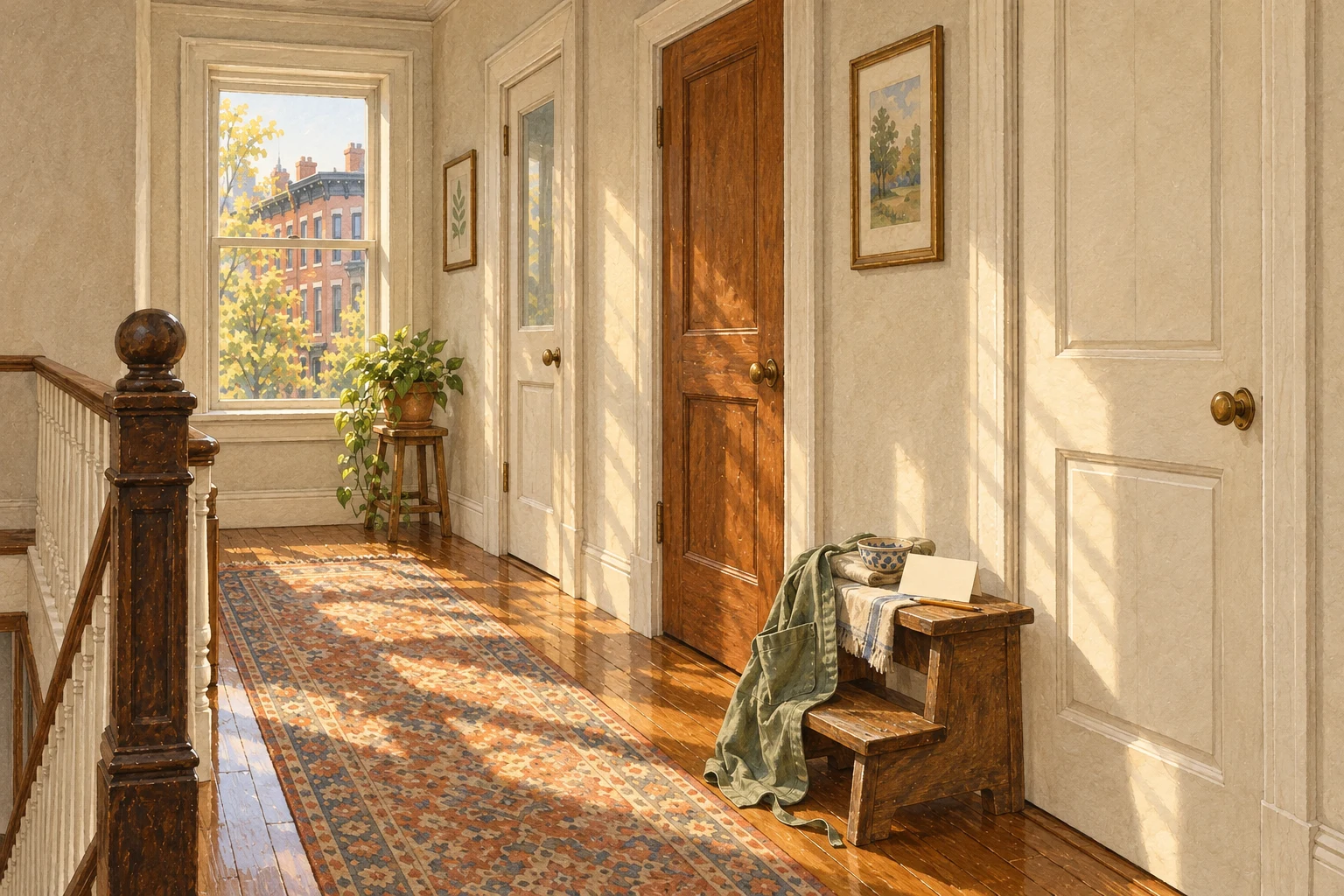
The booking says “Clean Interior Doors (6 max)”. You are in a hallway you have never seen: a painted door with a scuff at hand height, a stained one beside it, a third with a glass panel. The line names no cloth, no cleaner and no way to count to six.
Below is a one-page card for that decision, with two fictional visits. It is a suggested personal record for independent cleaners, not a Hometress requirement, training standard or app feature. The rules come from three door-maker documents, read November 1, 2026: a JELD-WEN care guide, a Therma-Tru FAQ page and a Masonite wood-door guide. Only one is written about routine cleaning of a door, and none covers a door of unknown make; this guide does not claim otherwise. The task line comes from Hometress’s published checklist.
The short answer
- Start with mild soap and water and a soft cloth. JELD-WEN’s door-surface line says to “Clean dirt/debris with mild soap and water and rinse clean”, and its materials list names “Baby shampoo or mild soap and water.”
- Do not scour. JELD-WEN says “Do not scour.” and “Avoid excessive rubbing and over-cleaning.” Masonite says “Do not use abrasive or caustic cleaners on the door.”
- JELD-WEN lists vinegar-based cleaners (“use on glass only”), citrus-based cleaners and window cleaners among substances that “may damage protective finishes”. Therma-Tru and Masonite do not mention them.
- Therma-Tru is the outlier: in a finishing FAQ for its fiberglass doors it names mineral spirits or all-purpose cleaners such as Top Job, Mr. Clean or Pine Sol. That is one maker’s advice for one product, not a rule for the door in front of you.
- On a painted door, treat sheen as a clue to pressure. Benjamin Moore’s wall-cleaning guide, a paint maker’s and about walls, says higher sheens are easier to clean and lower sheens need a gentler touch.
- Ours, not theirs: damp, not wet, dry the door after, and ask the client before any solvent. The sheet does not say how to count to six, so write down how you counted.
What the sheet says and what it leaves open
Hometress’s published Move list includes “Clean Interior Doors (6 max)”, and Dream Home, which is Move plus its own lines, inherits it. It is not on the Standard or Deep lists; our guide to what each cleaning tier includes says “Windows and interior doors are capped at six each.” Standard has two lines that touch a door, “Wipe Down Door Handles and Light Switches” and “Dust Light Fixtures / Door Frames / Shelves (up to 9ft)”, and Dream adds “Clean Knobs, Cracks, and Crevices”.
The “(6 max)” is the only limit the line prints. The sheet we read does not say whether a closet door, both faces of one door, a pocket door or a door with a glass panel counts as one of the six, and it gives no method or product. Our final walkthrough guide reads a printed limit such as “(6 max)” as part of the task, so the count is worth writing down. The Terms add two boundaries: cleaners “do not climb higher (no ladders)” and “will only clean areas within safe reach from the floor or the step stool”, and they do not perform specialized tasks including “Removing paint, stubborn marks, construction debris, or substances needing industrial chemicals/tools.”
Three door makers and a paint maker
JELD-WEN’s Care and Maintenance: Interior and Exterior Doors (JCM005) is a six-page guide for “wood, fiberglass and steel doors”; it is marked “JCM005 7/24” and ©2024. Its door-surface line sits under “Door Surface Cleaning and Hardware Lubrication”. Therma-Tru’s FAQ page has a question, “What do I use to clean the door with?”, in a run of finishing questions about its fiberglass doors, right after the contents of its stain kit; the “provided mineral spirits” are that kit’s. The page gives no date and does not say interior or exterior. Masonite’s Wood Door Care & Finishing guide (©2017, two pages) opens “Wood doors should be treated like fine wood furniture.” and has one cleaning sentence, in step 4 of “Preparation for Finishing”.
So only JELD-WEN’s guide is about routine cleaning of a door surface; the other two lines are cleaning as preparation for stain or paint. Benjamin Moore’s sheens page and guide to cleaning painted walls are paint-maker pages, and the second is about walls. They are here for what sheen means, not as door rules. No page we read covers an older painted wood door or a hollow-core molded door; that is a statement about our reading, not about what exists.
Who says what
| Question | JELD-WEN (JCM005 7/24) | Therma-Tru FAQ answer (no date) | Masonite (©2017) |
|---|---|---|---|
| Where the line sits | Door-surface cleaning and precautions, in a care guide for wood, fiberglass and steel doors. | A finishing FAQ for its fiberglass doors, after the stain-kit question. | Step 4 of preparation for finishing a wood door. |
| Cleaner named | “Baby shampoo or mild soap and water.” | “either the provided mineral spirits or an all-purpose cleaner such as Top Job, Mr. Clean or Pine Sol” | Not mentioned. |
| Cloth | “Several clean, soft, non-abrasive, absorbent lint-free dry cloths” | “a clean, dry rag” | “Clean the door thoroughly with a cloth to remove all dust and foreign materials.” |
| Rubbing and tools | “Avoid excessive rubbing and over-cleaning.” “Do not scour.” “Avoid using metal tools, razor blades, or other sharp objects and abrasive cleaners.” | Not in that answer. | Not mentioned. |
| Cleaners to avoid | “Vinegar-based cleaners (use on glass only)”, “Citrus-based cleaners (lemon, etc.)”, “Window cleaners” and “Any other industrial or abrasive cleaners”, listed as substances that “may damage protective finishes”. | Not in that answer. | “Do not use abrasive or caustic cleaners on the door.” |
| Rinse and dry | “Clean and rinse one area at a time.” Door surface: “rinse clean”. | “Rinse soap off thoroughly.” “Allow to dry completely.” | Not mentioned in its cleaning line. Step 5 of the same section says “Doors must be dry before finishing.” |
| Glass in the door | “Do not allow cleaners to puddle or collect at glass edges near glazing materials.” A separate “Cleaning Glass” section has its own steps, which this card does not use. | Not in that answer. A separate answer says the screen must be removed to clean the glass of a screen-vented door, and names no cleaner. | A line about using caution when cleaning glass so as not to scratch it (paraphrased). |
“Not mentioned” means we read that document’s care text, searched it for the topic and found no sentence. “Not in that answer” means the Therma-Tru answer we selected does not say it; the rest of that FAQ page is below. Neither is permission.
Therma-Tru’s page has three more cleaning lines outside that answer. Before touching up a nick in a stained finish it says “Clean area first with mineral spirits or an all-purpose cleaner.” After stripping a door it says to wash with “a mild soap and water”. For a multi-point locking handleset it says “Avoid the use of caustic cleansers or chemicals since they will remove the handleset’s protective coating.” The first two are repair and refinishing steps and the third is about hardware, so the card does not apply them to a door face.
Where the makers differ
JELD-WEN and Therma-Tru do not contradict each other about one door: they write about different products and jobs, JELD-WEN about caring for a door, Therma-Tru about getting a fiberglass door ready to finish. But a cleaner who reads both gets two answers. JELD-WEN warns off citrus, vinegar (except on glass), window cleaners and “industrial” cleaners for the finish; Therma-Tru names all-purpose cleaners and mineral spirits. Of the three documents, one excludes vinegar for the door finish and two say nothing about it, so the only vinegar rule here is JELD-WEN’s own, plus our cautious default below.
Our suggestion, not a Hometress rule: use the overlap of mild soap and water, a soft non-abrasive cloth, no scouring and nothing abrasive or caustic. Keep citrus, vinegar and window cleaner off a door finish of unknown make: JELD-WEN lists them for its own doors, and none of the other pages we read says they are safe on a door. If you can identify the maker, its own instructions come first. Use a damp cloth, not a wet one, and dry after. Ask the client before any solvent or all-purpose cleaner, because the only door maker we read that names them writes for its own fiberglass product.
What sheen tells you
Benjamin Moore’s sheens page says “Semi-gloss is particularly durable and stands up well to repeated cleanings.” and “It is often recommended for moldings and trim.” It says Pearl is used “as well as for trim details, such as doors, window frames, base moldings, and crown moldings”. Its wall-cleaning guide says “Generally speaking, the higher the gloss or sheen, the easier it is to clean” and “Lower sheens like flat, matte, and eggshell require a gentler touch.” That is a wall guide and says nothing about a door’s paint, so treat it as a direction, not a rule.
Our suggestion: do not guess a sheen from the look of a door. If the client’s note or a paint label does not say, treat it as a lower sheen: lighter pressure, soap and water only, and write “finish unknown”. Masonite’s maintenance list names four signs that a wood door’s finish needs attention: “Hairline cracks in the finish”, “Changes in the color of the finish”, “Flaking or scaling of the finish” and “Dullness or chalkiness of the finish”. It is a list for the owner, not a cleaning rule. If you see flaking or chalkiness, ours is to stop rubbing and write it down.
The card
Copy this into a note, one card per door. Work down the rows in order; the right-hand column is what to do when you cannot fill a row in.
| Field | What to write | If you cannot fill it in |
|---|---|---|
| 1. Item and line | The room and the sheet line, “Clean Interior Doors (6 max)”. | Write the room and a short description. |
| 2. Count | This door’s place out of six, and how you counted: each door once, both faces, closet and pocket doors in or out. The sheet does not say (ours). | Write “count unclear” and ask the client before door seven. |
| 3. Kind of door | Painted wood, stained wood, fiberglass, glass-panelled: only as the door, a label or the client says. JELD-WEN writes for wood, fiberglass and steel; no page we read covers hollow-core. | Write “kind unknown.” Treat it as a finished wood door (ours). |
| 4. Finish and sheen | Painted or stained, and the sheen, only if the client’s note or the paint label says. Lower sheens need a gentler touch (Benjamin Moore’s wall guide). | Write “finish unknown.” Treat it as a lower sheen (ours). |
| 5. Tool | A soft, non-abrasive, lint-free cloth (JELD-WEN; Masonite names a cloth). No metal tools, razor blades or other sharp objects (JELD-WEN). No scouring (JELD-WEN). | Write what you used. |
| 6. Cleaner | Mild soap and water (JELD-WEN). Not vinegar, citrus or window cleaner on the finish (JELD-WEN lists them). Nothing abrasive or caustic (Masonite; JELD-WEN). Any solvent or all-purpose cleaner: ask first (ours). | Write what you used, or “soap and water only.” |
| 7. Moisture and drying | Damp, not dripping, and dry the door after (ours). Rinse soap off (Therma-Tru; JELD-WEN says rinse clean). | Write any wet marks or streaks you left. |
| 8. Pressure and area | One area at a time and no excessive rubbing (JELD-WEN). A mark that will not lift gently: stop, do not scrub, write it down (ours). | Write “mark remains” and where. |
| 9. Panels, glass, handles, reach | Glass panel: keep any glass spray off the door finish around it (ours) and do not let cleaner collect at the glass edges (JELD-WEN). Handles have their own Standard line. The top of a tall door: only from the floor or a two-step stool (Terms). | Write “not reached” and why. |
| 10. Ask the client, and what is unresolved | Yes or no, and what you asked. Then what you could not confirm, for your own note and the client. | Yes, for a mark that remains, an unknown finish you would have to wet, a failing finish, or door seven. |
The boundaries
The Terms set the edges. The top of a door beyond a two-step stool’s reach is outside the visit; the reach worksheet works out where that line falls. A mark that will not lift with soap and water is a note, not a stronger product. The card does not change what a booking includes: record unfinished work and discuss it with the client.
Neighbouring lines have their own guides: door handles sit with light switches (our switch and outlet guide), and a glass panel is glass (our interior window guide). The generic checks that come before any product are in our surface-by-surface check.
Two fictional visits
These visits are fictional. The doors belong to no real client, and none of the makers has endorsed the card. The circumstances are invented; what a source says and what is our suggestion are marked separately.
A painted door with a scuff
Room: an upstairs hallway. Line: “Clean Interior Doors (6 max)”. Count: the second door of six, counted once with both faces; I wrote that down. Kind and finish: painted satin wood, as the client’s note says; the maker is unknown. Tool: a soft, lint-free cloth. Cleaner: mild soap and water. Moisture: damp, not dripping, dried after (ours). Pressure: one area at a time, light. A scuff at hand height lifted halfway and then stopped lifting. I stopped instead of rubbing harder: JELD-WEN says to avoid excessive rubbing, and the Terms list “stubborn marks” among tasks cleaners do not perform, so I treated a mark that would not lift gently as one. Our suggested note, not a Hometress wording: “I washed the door with mild soap and water and a soft cloth. A scuff at hand height is lighter but still visible. I did not scrub or use a stronger cleaner. Tell me if you would like it done differently.” Unresolved: the scuff. The steps come from JELD-WEN and Masonite; “damp, not dripping” and the stop are ours.
A glass-panelled door at the cap
Room: a dining room. Line: “Clean Interior Doors (6 max)”; this is the sixth door. Count: each door once, both faces, the closet door in; I wrote that down and told the client. A seventh door, a pantry door, is not cleaned: the cap is six, so I wrote it down for the client to decide. Kind: a wood door with a glass panel; the maker is unknown. Cleaner: mild soap and water on the wood, with a separate dry cloth for the glass. The glass followed the window guide; around the panel I kept any glass spray off the door’s finish (ours), because JELD-WEN lists window cleaners among substances that may damage protective finishes, and I did not let cleaner collect at the glass edges, as JELD-WEN says. Unresolved: whether the client wants the seventh door.
What this guide leaves out
It recommends no brand, product or price: Top Job, Mr. Clean and Pine Sol appear only as Therma-Tru’s words, and the card does not adopt them. It gives no method for an older painted wood door or a hollow-core door, because we found no maker page for either. JELD-WEN’s weatherstrip and glass-stain sections, which are about other parts of a door, and its glass-cleaning steps are not used. It does not advise on repairing or refinishing a door, or on who is responsible if a finish is already damaged. It does not cover pay.
Where a platform fits
Hometress is a cleaning marketplace in Philadelphia. It is free to join, and cleaners carry their own insurance. If checking a door’s finish before you wet a cloth is how you already work, the application takes about five minutes. This guide does not cover pay.