
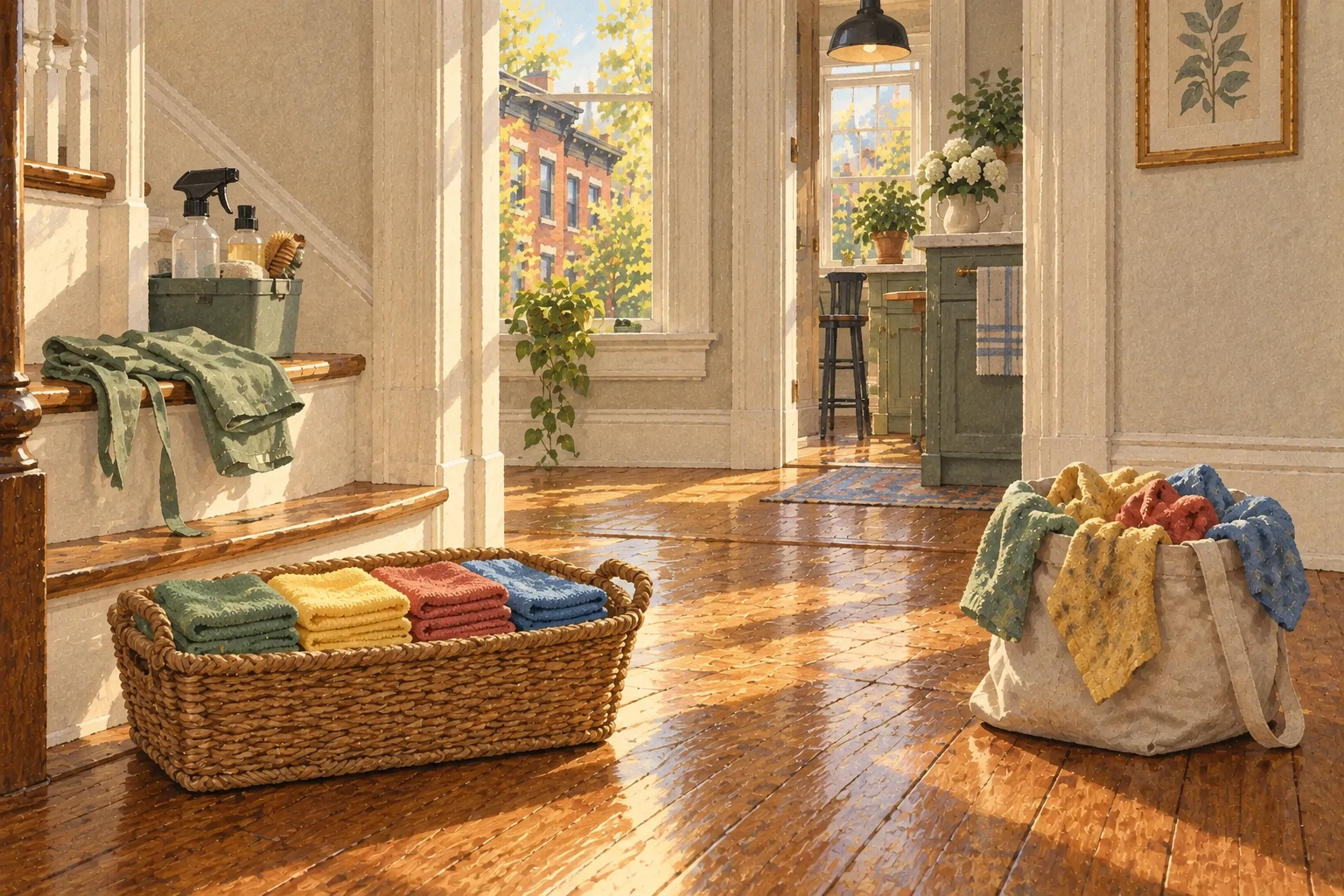
A red cloth can still be a used cloth. Color answers one question: where does this cloth belong? It does not answer the other one: is this cloth fresh? The color-coding guides we read stop at the first question. This guide adds the second, so a long day with several bathrooms does not depend on your memory of which cloth went where.
This is a suggested personal workflow for independent cleaners, not a Hometress rule, requirement or app feature. We found no cloth colors, cloth counts or laundering rules in the provider page or the published checklists, and this guide adds none. The task examples come from the published cleaning checklists and the sources below, all read October 29, 2026.
The short answer
- Give every cloth two labels: a zone (where it works) and a status (clean or used).
- Pick your own small color map, and write the zone word on the cloth or its tag as well as the color.
- Keep clean stock and used stock in separate containers. A used cloth does not go back into clean stock during a visit.
- If a zone runs out of clean cloths, stop and re-plan. Do not reuse a used cloth as if it were fresh.
- Reset between homes with a checklist. This guide gives no fixed cloth count, because the right number depends on your method and the booked work.
Color tells you where, not whether
The zone idea is well established. Rubbermaid Commercial’s microfiber FAQ describes “Assigning a cloth or pad color to each zone or task”. The page is about facility cleaning, and its examples are restrooms and patient areas, so it supports the principle and not a house-cleaning standard. It also gives colors as examples; we found no universal color-to-room code there, so any map you use is a choice you make.
Home-sized charts exist. House Digest, a consumer site, pairs blue with mirrors and glass, green with the kitchen and food prep, yellow with sinks, faucets and showers, and red with toilets. The Prime Cleaner, a cleaning company, describes separate colors for bathrooms, kitchens, glass and general surfaces and says, “When a cloth is used in the bathroom, it stays in the bathroom.” Both pages are clear about zones. In the versions we read, neither describes how to keep clean cloths apart from used ones during a visit, or what to do when a zone runs out. We cannot say what any company does beyond its published page; that gap is simply the part this card covers.
The two-axis cloth card
The zone belongs to the cloth for its whole life: a toilet cloth stays a toilet cloth. The status changes during the day: clean at the start, used once it has touched a surface. So store the two differently. The label and color hold the zone. The container the cloth sits in holds the status.
Below is an example map built from lines in the published Standard checklist. The colors are placeholders. Choose your own, and write the word on the cloth or a tag too: shades can look alike in a dim bathroom, and not everyone sees colors the same way. A marker and a strip of tape are enough.
| Zone | Example label | Example lines from the published checklist |
|---|---|---|
| Kitchen | Green + “KITCHEN” | “Countertop Disinfected And Wiped Down”; “Wipe Down Refrigerator Front” |
| Bathroom surfaces | Yellow + “BATH” | “Clean Sink Bowl, Faucet And Drains”; “Clean Showerhead, Faucets, and Handles” |
| Toilet | Red + “TOILET” | “Clean Entire Toilet / Behind Toilet / Toilet Handle” |
| Dusting | Blue + “DUST” | “Dust Window Sills / Ledges”; “Dust & Clean Countertop / Bedside Table” |
Some lines cross zones, and the card is where you decide them in advance. “Wipe Down Door Handles and Light Switches” appears in the whole-house list, so it can happen in any room. Pick a cloth for it before the visit (a dusting cloth, say) and make sure it is never the toilet cloth. Our guide to the published cleaning tasks lists every line, so this guide does not repeat them.
Color also does not change what a task asks for. The Standard line “Countertop Disinfected And Wiped Down” names disinfecting as part of the work, and a labeled cloth does not do that on its own. This guide is not a disinfection protocol, and it makes no claim that any color system prevents cross-contamination.
Clean stock, used stock and the middle of a job
- Before the visit, sort clean, dry cloths by zone and load them where you can reach them without opening every bag.
- At the start of each zone, take a clean cloth of that zone’s label from clean stock.
- When a cloth is finished for now, it goes straight into the used container, not back into a pocket, over your shoulder or onto the clean pile.
- Keep the two containers visibly different (different bag, different side of the tote) so you can tell them apart at a glance.
The rule underneath is the same one a commercial laundry guide gives: how to wash microfibre cloth in commercial settings says, “Never mix freshly washed towels with used ones.” That advice is written for commercial facilities. Here it becomes a layout for your pack.
When a zone runs out of clean cloths
Do not cross the map and do not quietly recycle a used cloth. Check the rest of your pack for a clean cloth with that zone’s label. If there is none, write down the task as open, with the reason, and say so plainly in your message afterward, as you would for any unfinished included line. This guide does not tell you whether to wait, cancel or reschedule; that depends on the booking and on how Hometress handles it, which this guide does not describe.
The provider FAQ says, “You bring your own supplies and equipment to every visit.” That makes a shortage a packing problem on your side, and the reset checklist below is meant to prevent it.
Reset before the next home: a copyable checklist
Copy this into a note. It has no cloth count on purpose. How many cloths a visit needs depends on the rooms, their condition, the booked tasks and how you work, and we do not publish a cloths-per-room formula.
- Used container: emptied into the wash. Clean stock is only what has been washed and dried.
- Washing: follow the care label on the cloths you bought. If they are microfiber, the commercial care guide says, “Do not clean microfibre towels with cotton cloths, rags, or other fabrics,” and “Avoid powder detergent, fabric softener, or any scented product.” This guide gives no wash temperature, bleach rule or lifespan.
- Restock by zone: every label has clean cloths for the next booked visit’s tasks, counted against the work, not a rule of thumb.
- Labels: re-mark any faded color, tag or word before the cloth goes back into clean stock.
- Containers: used bag empty, clean pouches full, and the two still easy to tell apart.
- Spare: hold back clean cloths you do not plan to use, so one dropped or stained cloth does not strand a zone.
Where this fits in your kit
Cloths are one line in a bigger pack. Our guide to what a house cleaner carries to a first job covers the rest of the kit, and what households are told about supplies is in our supplies guide for customers. The card here is only about how you use and reset the cloths once they are packed.
Where a platform fits
Hometress is a cleaning marketplace in Philadelphia. It is free to join, and cleaners carry their own insurance. If a routine like this is how you already run a visit, the application takes about five minutes. This guide does not cover pay; the cleaner page is where Hometress publishes that.