
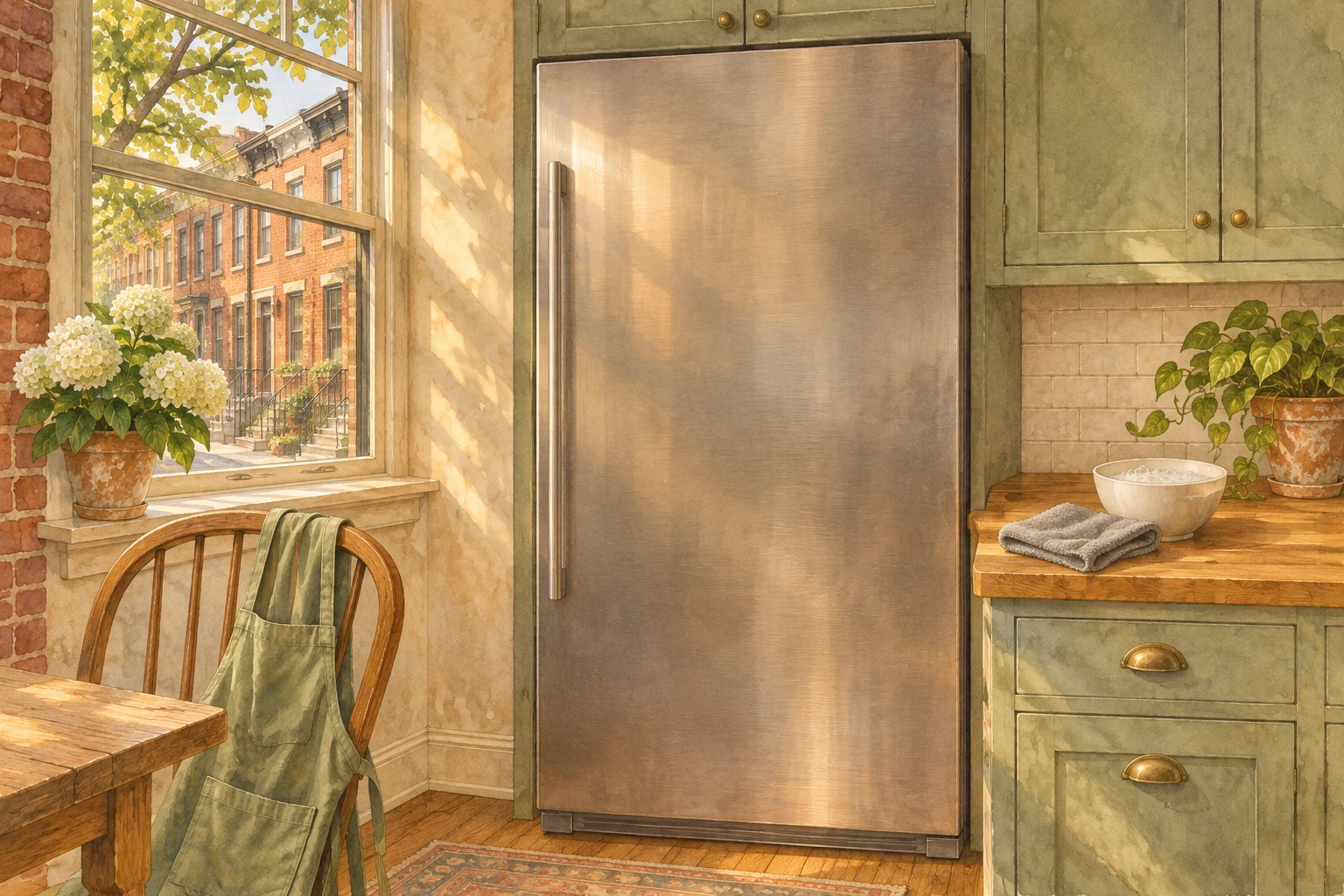
For routine fingerprints and smudges, use the soft cloth and mild-cleaning method specified for your appliance's finish, then dry the front thoroughly. Warm water and mild soap are Whirlpool's starting point for its fingerprint-resistant stainless steel. Paper towels are on its avoid list, even though they appear in popular stainless-cleaning guides. A coated refrigerator door needs its own care instructions, not a stronger polish borrowed from a different surface.
Find the finish before choosing a cleaner
Look up the appliance's model in your manual or the maker's support site. Check the exterior-finish instructions, not the directions for the inside, a steel sink or a pan. If you have several stainless-looking appliances, check each one separately rather than assuming the refrigerator's method suits the dishwasher too.
For example, Whirlpool has a separate page for fingerprint-resistant stainless steel. It identifies a clear coat and says unsuitable tools and products "may scratch and/or dull the clear coat of the fingerprint stainless steel door." That is why the word stainless is not enough to choose a cleaner. A familiar-looking front can have a finish with different restrictions.
Wipe gently, then dry with the right cloth
For the Whirlpool finish above, the instruction is "Wash the exterior surfaces and gaskets with warm water and mild soap or detergent." It then says to wipe and dry, recommending a clean microfiber or soft clean cloth and thoroughly dry surfaces. Set out a clean washing cloth and a dry finishing cloth before you start, rather than reaching for whatever towel happens to be beside the sink.
For the wiping technique, Clean Mama suggests putting the cleaning solution on the cloth and working in sections, followed by a dry buff. Apply that technique with a product your appliance's instructions allow. There is no need to work through the guide's vinegar and oil options simply because the first pass leaves a mark.
Follow the visible grain when the care instructions call for it. Frigidaire refrigerator care guide says "Always clean, wipe & dry with the grain to prevent scratching." Thermador refrigerator cleaning guide explains that the grain can run vertically, horizontally or diagonally. Its stainless-exterior method is mild soapy water and a soft cloth, followed by thorough drying. Look at the direction on the front you are actually wiping, rather than assuming every door runs the same way.
Keep the wipe and the dry finish as separate steps. Follow any rinse instruction in your own manual, then finish with its permitted cloth. Do not leave drying as an afterthought: Whirlpool's coated-finish instructions and Thermador's stainless instructions both explicitly include it. Neither makes drying a promise that every mark or streak will disappear.
Why paper towels, vinegar and oil are not universal shortcuts
Tom's Guide offers several stainless-cleaning methods and includes drying with "a separate microfiber cloth or paper towel". Whirlpool specifically lists paper towels among the things to avoid on its fingerprint-resistant clear coat. The useful choice is not whichever towel is closest; it is the cloth allowed for your finish.
The same distinction applies to products. Clean Mama and Tom's Guide both discuss vinegar and oil. Whirlpool's fingerprint-resistant page mentions neither, so do not read its silence as permission or as a ban. If your own instructions do not address a product, ask the maker rather than experimenting on the door. A spot test does not replace checking whether the product is allowed.
A stainless conditioner also has boundaries. Thermador's instructions say "Do NOT apply the conditioner to logos, control labels, black stainless steel, or appliance interiors." That is a limit on the conditioner in that guide, not a reason to polish every stainless-looking part of the appliance. Treat the front, its labels and other finishes according to their own instructions.
When a mark does not wipe off
Stop before switching to a rough pad or a stronger product. Whirlpool's coated-finish avoid list includes soap-filled scouring pads, abrasive or harsh cleaners, chlorine-bleach products, steel-wool pads, gritty washcloths and paper towels. Its warning is that these may scratch or dull the clear coat. Frigidaire also rules out chloride and bleach cleaners on stainless; Thermador rules out abrasives and chlorine cleaners on its stainless exteriors.
If the permitted routine leaves a mark, contact the appliance maker with the model and a description of it. Do not turn a wipe-down into a scratch-removal or restoration attempt. A mark that remains is a reason to get more specific advice, not proof that the front needs a gritty paste or another coat of oil.
What a Philadelphia cleaning visit covers
Hometress's Standard checklist includes "Wipe Down Refrigerator Front". The Deep checklist adds "Wipe Down Major Appliances Exterior (2 Max)". Move and Dream Home inherit both lines. The two-appliance cap belongs to that Deep exterior line; it is not a promise to wipe every appliance in the kitchen. For the rest of the room, use the kitchen guide.
Those checklist lines name a task, not a particular cleaner, polish or scratch treatment. Share the model's exterior-care instructions and any finish restriction when arranging the visit. Do not treat a booked exterior wipe as a restoration service: Terms section 4.1 lists "Removing paint, stubborn marks, construction debris, or substances needing industrial chemicals/tools" among the tasks cleaners do not perform.
In Philadelphia, you can book a clean for a refrigerator-front wipe on Standard or the broader appliance-exterior line on Deep. Keep the care instructions with the appliance so the finish is part of the conversation, not a guess at the counter.
Frequently asked questions
Can fingerprint-resistant stainless steel be dried with paper towels?
Whirlpool says not to use paper towels on the fingerprint-resistant finish covered by its care page. It recommends a clean microfiber or soft clean cloth. Check your own model before extending that rule to another appliance.
Does a Standard clean cover every stainless appliance?
Standard names the refrigerator front. Deep adds the major-appliance exterior line with its two-appliance cap. Neither wording means every stainless-looking surface or scratch treatment is included.