
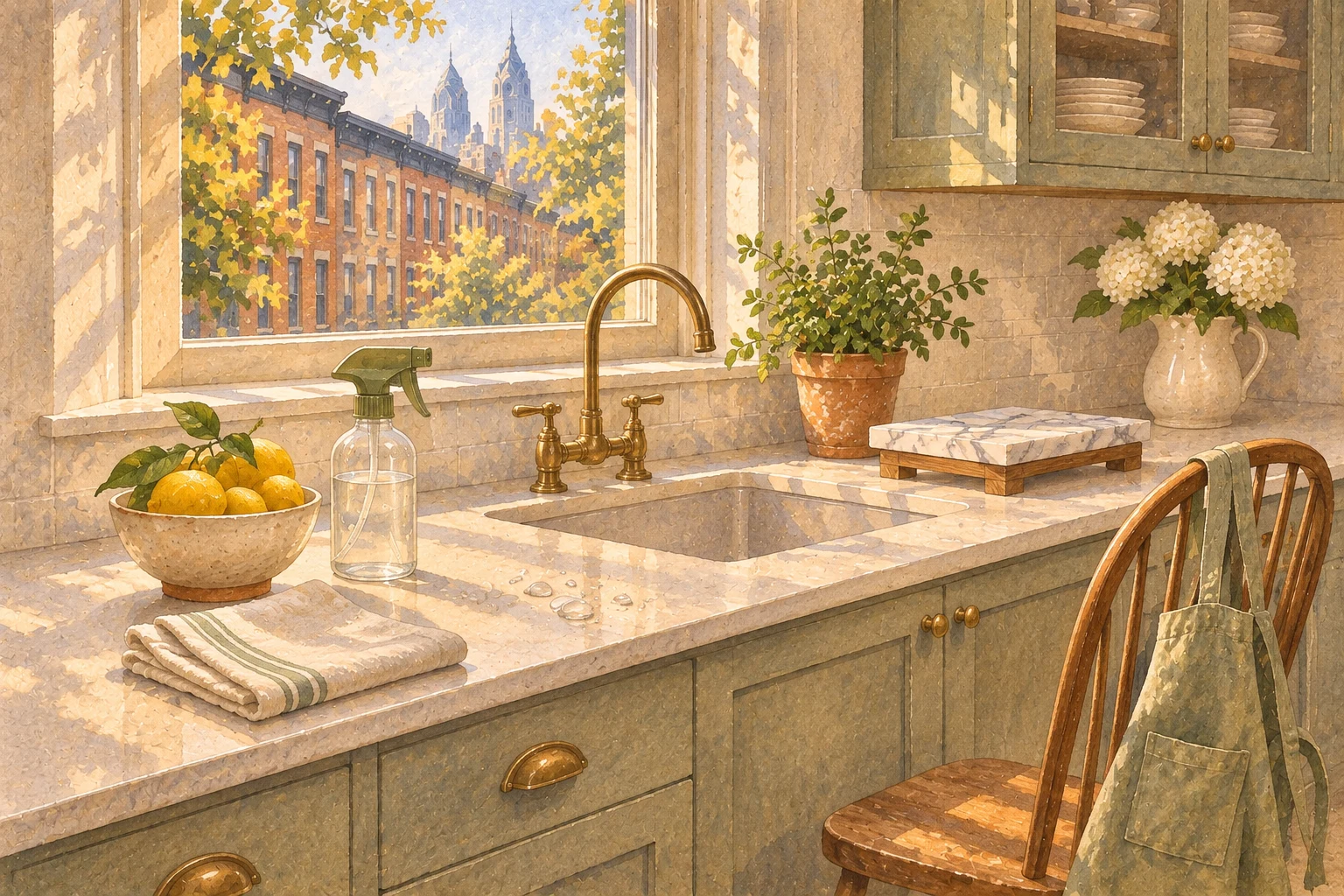
Warm water, a soft cloth and a little mild soap is the everyday routine quartz and marble makers print, and it cleans without disinfecting. A disinfected counter takes a product whose label says it disinfects, a counter maker whose care page does not rule it out, and a surface left wet for the label's contact time. On marble, keep acids off the stone altogether. A dull patch that soap and water leaves alone may be an etch, which the Natural Stone Institute sends to a stone restorer, not a scouring pad.
Everyday cleanup on quartz
Cambria says its quartz needs "a little warm water, soft cotton cloth, and mild soap, if desired". Caesarstone asks for "a soft cloth or a non-abrasive scourer dipped in warm water mixed with a mild detergent", then a rinse and a dry cloth, and it says to wipe up wet spills so patina does not form. Both makers also print what to keep away. Cambria names bleach, oven cleaners, Comet, Soft Scrub and S.O.S. pads, warns against abrasive scrub pads, and lists strong alkaline, acid and oxidizing cleaners "whether high, neutral, or low pH", so check a product against the maker's list rather than the pH on its label. Caesarstone's list includes oil soaps, tarnish removers, furniture cleaners and "wipes", and it asks you to try any product on an inconspicuous spot first.
Everyday cleanup on marble
The Natural Stone Institute says to clean stone with "a neutral cleaner, stone soap, or a mild liquid dishwashing detergent and warm water". The acid rule matters more here than on quartz. The Institute says "Products containing lemon, vinegar or other acids may dull or etch calcareous stones", which are the stones made mainly of calcium carbonate, and Home Made Simple says marble is mostly that. UseNaturalStone.org, the Institute's consumer campaign, lists tomatoes, citrus fruits, juices, alcohol and vinegar among the acidic things in a kitchen, and its restorers recommend a mild soap or a stone cleaner whose label says it is for stone. Scouring powders and creams, the Institute adds, "often contain abrasives that may scratch certain stones".
Cleaning is not disinfecting
The EPA draws the line: "Cleaning removes dirt and organic matter from surfaces using soap or detergents", while "Disinfecting kills viruses and bacteria on surfaces using chemicals". For a registered product it says to follow the label directions and watch the contact time, "how long the surface must remain wet". Soap and water on a counter is cleaning, however good the result looks.
Two popular counter guides go further. Marble.com's quartz guide, last updated January 1, 2026, offers isopropyl alcohol and water, or dish soap and water if the soap is antibacterial. Home Made Simple gives a 1:1 isopropyl alcohol and water spray for both quartz and marble, then a wipe and a dry. Neither sets its recipe against a maker's care page or gives a contact time for disinfecting, and the Cambria and Caesarstone pages print no disinfecting method at all. Read those recipes as one site's suggestion, not a ruling on your counter.
Disinfecting wipes show the gap. Home Made Simple says a bleach-free wipe is fine on properly sealed stone "from time to time", while Caesarstone lists wipes among the things to keep off its quartz. A general guide and a maker's own instructions disagree there, and the maker's page is the one to follow for your counter. For quartz, pick a product whose label says it disinfects, check it against that page, try it on an inconspicuous spot and keep the surface wet for the time the label gives. For marble, start with a product whose label says it is for stone.
A dull patch: dirt or damage?
Wipe the spot with warm water and mild soap, rinse it thoroughly and dry it with a soft cloth. The Natural Stone Institute says too much soap or cleaner may leave a film and cause streaks, so a dull patch is worth rinsing before you decide it is damage. If it is still dull, it may not be residue. On marble, the restorers quoted by UseNaturalStone.org say anything acidic can etch it, "which looks like a dull spot or burn mark", and the Institute notes that some materials etch the finish without leaving a stain. For etched areas it says to contact "your stone dealer or call a professional stone restorer for refinishing or repolishing". On quartz, Cambria says its stone never needs sealing or polishing, that sealers and other topical treatments "will wear off and cause the gloss to appear dull or inconsistent", and that no stone is scratch-proof, with markings more visible on monotone designs.
What a Hometress visit does to the counter
The Standard kitchen lists "Countertop Disinfected And Wiped Down" and "Dust & Clean Countertop", and the public kitchen page words the first as "Countertops are disinfected, then wiped down." Deep adds "Deeply Scrub Countertop Surfaces" and Move adds "Deep Scrub of Kitchen Countertops". None of those lines names a product, a pad, a counter material or a contact time, so they do not say how a quartz or marble counter is handled, and no line on any tier polishes, seals or repairs stone. The Terms also leave out removing "paint, stubborn marks, construction debris, or substances needing industrial chemicals/tools". The kitchen checklist guide and the kitchen checklist page show which tier lists which kitchen lines.
If your counter is quartz or marble, say so when you book. The Terms ask you to tell us during booking if you want a cleaner to use a specific product, with clear instructions for its safe and effective use, and the guide to what cleaners bring explains how that works. A line such as "Honed marble, warm water and mild soap only, nothing acidic" or "Cambria quartz, warm water and mild soap" puts your counter's care instructions in front of us before the visit. It is a request, not something the checklist promises.
The order we would use between visits
- Wipe spills when they happen with warm water and mild soap, then rinse and dry the surface.
- On marble, keep citrus, vinegar, tomato and wine off the stone, and use cutting boards, trivets and coasters.
- Find your counter's maker or stone type and read its care page before you buy a spray.
- Buy a disinfectant only if its label says it disinfects, follow the contact time, and try it on an inconspicuous spot first.
- Add the maker and finish to your booking so the next visit starts from the right instructions.
If your counter is in a Philadelphia home, book a clean and add the counter's maker and finish to the request.
Frequently asked questions
Can I use disinfecting wipes on a quartz counter?
Check your maker first. Caesarstone lists wipes among the things to avoid on its quartz, Home Made Simple allows a bleach-free wipe on properly sealed stone from time to time, and Cambria's care page does not mention wipes.
Is vinegar safe on marble?
No. The Natural Stone Institute says products containing lemon, vinegar or other acids may dull or etch calcareous stones.
Will a cleaner polish out a dull spot on my counter?
No tier lists polishing, sealing or repairing stone. The Natural Stone Institute points etched areas to a stone dealer or professional restorer.