
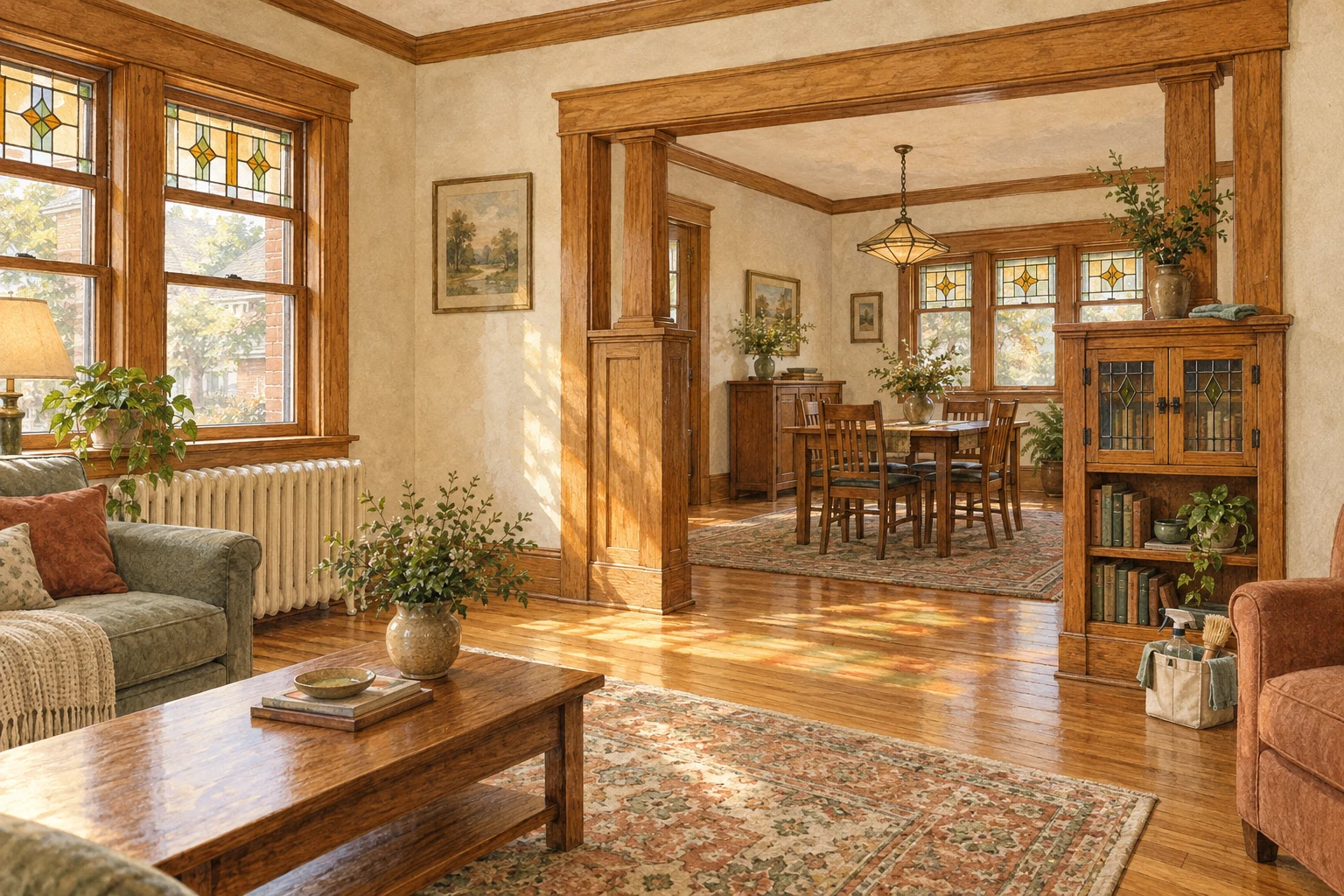
A Chicago bungalow cleans in a line. The house runs front to back on a narrow lot, with the living room, dining room and kitchen down one side and the bedrooms and bathroom down the other, a basement under all of it and sometimes a finished room in the attic. The parts that make it a bungalow, the leaded art glass, the stained wood trim and built-ins, the plaster walls and the radiators, are also the parts a generic checklist either skips or scrubs too hard. This guide walks the house in order, says where each method comes from, and marks the few things that are repairs rather than cleaning.
Hometress does not take bookings in Chicago yet. Online booking is open in Philadelphia only, and Chicago has a waitlist, so nothing here is a Chicago price or a promise of Chicago service. We are a cleaning marketplace, not a preservation contractor. The facts about the houses come from the Chicago Bungalow Association, the National Register of Historic Places and the Chicago Architecture Center, and the care methods come from the National Park Service and the U.S. Environmental Protection Agency. We read every page cited here on October 29, 2026.
Why a bungalow cleans differently
There are a lot of them, and they are remarkably alike inside. The Chicago Bungalow Association, a nonprofit, says that "with more than 80,000 bungalows still standing today, the housing style represents nearly one-third of the city’s single-family housing stock." Its definition is brick, built from 1910 to the mid-1930s, "1-½ stories above a full basement," with "generous windows, sometimes with leaded art glass," and a "rectangular shape: narrow at the front and rear ends, longer on the sides."
The National Register's Chicago Bungalows documentation form, which notes that Mayor Richard M. Daley launched the City's Historic Chicago Bungalow Initiative in September 2000, describes the floor plan precisely: "two to three bedrooms with one bathroom on one side and the living room, dining room, and kitchen (in order from front to rear) on the other side." The same form says the house was designed for living "all on one floor," with unfinished attic and basement spaces "providing practical service and storage areas."
That history explains most of what follows. The main floor is two parallel lanes. As built, one bathroom served the whole household. And the basement and attic were built as work and storage space, so even where they have been finished they tend to be half living room, half utility room, and they clean that way.
Plan the route: two lanes, front to back
Because the plan is so regular, the same route works in most bungalows. This is our suggested order, not a rule from any of the sources:
- Attic room first. The National Register form says that as first built, most bungalows had "steep unfinished stairs leading to the unfinished attic from behind a door that opened in the vicinity of the kitchen." Dust from up there comes down at the back of the house, so get it moving before the main floor is done.
- Dry work on the main floor, both lanes, from the front of the house to the back: high dusting, windows and sills, trim, built-ins and radiators.
- Wet work: the bathroom, then the kitchen.
- Floors last, starting in the front room and ending at the kitchen and back door, so you never walk back across a floor you have already done.
- Basement on its own pass, with its own cloths. More on why below.
The two ends of the house deserve a look. At the front, the Chicago Architecture Center notes that the porch "might be replaced by an enclosed front room, shifting the entrance and steps to the side of the house," and the National Register form says some square front bays "resemble a sunroom, with windows on all three sides." That is a lot of glass and sill in one small room. At the back, the Chicago Bungalow Association's maintenance guide says "Most bungalows have a (very cold) enclosed back porch." In many houses it works as the mudroom, so sweep and wipe it on a mild day and do not leave a damp floor to freeze.
Leaded and art-glass windows
Art glass shows up where the house wanted to be looked at. The National Register form says bungalows with polygonal front bays "often use the bay as a focal point on which to showcase art glass windows," and that dining room windows are "usually three in number." If a built-in bookcase or buffet has leaded glass doors, the same rules apply to them.
The National Park Service's Preservation Brief 33 on stained and leaded glass is the clearest source on cleaning it. Its order is "Water alone should be tried first (soft water is preferable)," and "If water alone is insufficient, the next step is to use a non-ionic detergent." Then the warning that matters most at home: "Acidic, caustic, or abrasive cleaners should never be used. They can damage glass. Most common household glass cleaners contain ammonia and should not be used either. Cleaning products should have a neutral pH."
The Park Service's shorter guide to stained glass care adds the technique. "Do not spray the surface directly. Instead, spray a soft cloth or cotton swab with water or cleaning product and clean the window from top to bottom." Rinse with a damp cloth, dry with a soft one, and "be mindful of tears in the came or sharp edges on solder joints that could snag on cloth." Between cleanings, "Windows should be gently dry-wiped with a soft cloth on a monthly basis," and "Any heavy-duty cleaning should always be done by a professional."
One trap is specific to bungalow owners. The Chicago Bungalow Association's maintenance guide includes a homemade window cleaner of "2 tsp. vinegar" in "1 qt. warm water." That is a reasonable mix for plain panes, but vinegar is an acid, and Brief 33 says acidic cleaners should never be used on stained glass. Keep the vinegar bottle for the clear windows and use plain water on the art glass.
Three more things to check before you wipe:
- Painted detail. Brief 33 says "Painted glass must never be cleaned before the stability of the paint is confirmed, and only then with great caution." If a panel has painted shading or lettering, test one corner with a barely damp swab. If anything lifts, stop.
- Bulges. "Minor sagging and bulging is to be expected in an old window," the brief says, but "if the bulged area moves when pressed gently, or if surrounding glass is breaking, it is time to address the problem." Wipe a bowed panel with no pressure at all, and if it flexes, leave it for a stained-glass specialist.
- Dirt between the layers. If storm windows cover the art glass, check the gap. The Park Service's guide says "Dirt and debris between the protective glazing and stained glass window may be a sign that the protective glazing is not properly sealed," and condensation inside is a sign it may not be properly ventilated. Wiping will not fix either one.
Wood trim and built-ins
The National Register form treats the woodwork as part of what makes a bungalow historic: "Interior features and details should remain intact, such as decorative trim and built-ins." In practice that means the stained wood around the doors and windows, oak or otherwise, and any built-in bookcase or buffet.
The best plain-language source on dusting old finished wood is the Park Service's Conserve O Gram 7/5, "Dusting Wood Objects" (September 2002). It is written for museum furniture, so it is stricter than a home needs to be, but the method carries over:
- Look first. "Finishes that are unstable (e.g., flaking, cracking, lifting edges)" should not be dusted at all.
- Vacuum before you wipe. The leaflet calls vacuuming "the most effective and least damaging way to remove dust from stable finished wooden surfaces," using a clean brush attachment "parallel to the wood grain." A small brush tool reaches the corners of door casings and bookcase shelves.
- If you use a cloth, "turn the cloth frequently, presenting a clean surface to the object with each pass," and wipe with the grain.
- Damp-dust only after a test. "If there is any question as to whether the finish is water-soluble, test with a dampened cotton swab in a hidden area," then follow the damp cloth with a dry one.
- Skip feather dusters, which "scatter the dust into the air," commercially treated dust cloths, and aerosol or liquid polishes, which the leaflet says "frequently contain silicones" and "tung, lemon, or linseed oil."
On polish, the two sources differ. The Bungalow Association's guide offers a recipe of "2 tsp. lemon oil and 1 pint mineral oil." The Park Service's museum leaflet lists commercial liquid polishes, which "frequently contain silicones" and oils including lemon, under "Do Not Use," and its companion leaflet on silicone says that once a silicone wax is applied, "it can be difficult to remove." Our reading: dusting is the routine job, and polishing original woodwork is a separate decision for the owner, made on purpose and not as part of a weekly clean.
Plaster walls and ceilings
If your walls are original, they are almost certainly plaster. The Park Service's Preservation Brief 21 says plaster "was the wall surface chosen for nearly all buildings until the 1930s or 40s," which covers the whole bungalow era, and that it "provided a durable surface that was easy to clean."
Easy to clean means dry first. Vacuum the tops of door and window casings and the ceiling corners with a soft brush, then damp-wipe only the places hands touch: around light switches, door edges and the wall beside the bed. Wring the cloth nearly dry and test a low, hidden spot before you go over a painted wall.
Some of what you see on old plaster is not dirt, and Brief 21 sorts it out:
- Hairline cracks "are not a serious cause for concern as long as the underlying plaster is in good condition." They are a patching job, not a cleaning one.
- White powder or dry bubbles, especially on an outside wall or in the basement. On plaster over masonry, "salts from the masonry substrate come in contact with water" and migrate to the surface "as dry bubbles or efflorescence." The brief says "the source of the moisture must be eliminated." Brushing the powder off tidies the wall, but it will come back while the wall is wet.
- A sag or bulge, most often in a ceiling. When plaster loses its grip on the lath it becomes "loose or bowed," and "especially to ceilings, gravity will simply cause chunks of plaster to fall to the floor." Do not push a duster into a bowed ceiling. Leave it and call a plasterer.
Then there is the paint. The Bungalow Association's Bungalow Maintenance 101 guide says "Lead paint is present in almost all vintage homes as it was commonly used in homes built before 1978." Its advice for dust is to "Use a vacuum with HEPA filters and wet-clean thoroughly," and in general to use "wet cleaning" so particles are not just moved around and into the air. If paint is chipping on a window sill or the trim, the paint is the problem to solve first, and dry sanding or scraping it is not a cleaning task. Our rowhome cleaning guide walks through EPA's lead-dust advice in more detail.
Radiators and radiator covers
The maintenance guide says "When Chicago bungalows were built, most heating systems were comprised of a boiler, radiators, and piping." If yours still heats that way, cleaning the cast iron is simple once the heat is off: lay a towel down, brush between the sections from the top, and catch the dust with a vacuum held underneath.
The bungalow-specific part is what surrounds the radiator. The guide's tip reads: "Heated air should flow freely around each radiator. Decorative covers should have plenty of openings, and never install heavy curtains in front of the radiator. Try to leave a space of several inches between the radiator and any furniture." So when you clean, lift off any radiator cover and vacuum the floor and wall it hides, clear the cover's top shelf rather than dusting around what sits on it, and when you put the sofa back, leave the gap.
The back of the house: kitchen and the one bathroom
With one bathroom for two or three bedrooms, as most were built, that room carries everyone in the house every day, and it is the one to keep up between bigger cleans. Two details are worth adding to the usual routine. The maintenance guide's calendar includes "Clean kitchen and bathroom exhaust fans," and its mold advice is to use those fans and make sure they vent to the outside. And the Bungalow Association's design guidelines note that glass block windows are "often used for basement and bathroom windows." If yours has one, wipe the blocks and scrub the mortar joints gently with a soft brush, since that is where damp collects.
The kitchen sits in a back corner next to the rear door, so it takes whatever comes in from the alley and the porch. Finishing the floors there, as in the route above, means the last floor you mop is the one nearest the door.
The basement: half finished, half working
The National Register form quotes Chicago designers of the period calling for "a good basement, which for a small building should include the entire ground plan to accommodate laundry, store and fuel rooms and heating apparatus." The Chicago Architecture Center notes that "Attics and basements could be finished for extra room," and the Bungalow Association publishes a finished-basement design scheme, so a basement today is often a finished room at one end and the boiler, laundry and storage at the other. Clean them as two different rooms. Give the finished side the same dusting and floor care as upstairs, and give the utility side a dry pass for cobwebs, lint and dust, with cloths you do not carry back up to the kitchen.
Moisture is the basement's real cleaning issue. The maintenance guide's calendar says to "Monitor basement humidity," keeping it under 60%, and to "Clean out basement window wells." EPA's guide to mold and moisture gives the same ceiling, "below 60 percent (ideally between 30 and 50 percent)." The Bungalow Association's basement flooding page lists the warning signs of seepage as "water stains on the floor, peeling paint, or powder-covered brick," which means the white dust on a basement wall is a message about water, not something to scrub away.
After water comes in
Where the water came from decides who should clean it up. The same flooding page explains that Chicago has a combined sewer system: "In a combined sewer system, sanitary sewage and stormwater drain into the same pipes," and the first flood type it lists is backup "through Drains, Sump Pumps, Sinks, Tubs & Toilets." EPA's guide is direct about that case: "If the water and/or mold damage was caused by sewage or other contaminated water, then call in a professional who has experience cleaning and fixing buildings damaged by contaminated water." Put those two together and the practical rule for a bungalow is plain: water that came up through a floor drain is not a house-cleaning job.
For clean water, such as a leak or seepage, EPA says "It is important to dry water-damaged areas and items within 24-48 hours to prevent mold growth." Mold under about 10 square feet, "less than roughly a 3 ft. by 3 ft. patch," is in most cases a job you can handle yourself; EPA's advice is to "Scrub mold off hard surfaces with detergent and water, and dry completely," and it warns that carpet and other porous materials "may have to be thrown away if they become moldy." The maintenance guide puts the first step even more plainly: "Always address the source of the moisture first!"
One more basement caution. Old boiler rooms can have wrapped pipes, and EPA's asbestos page says you generally "can't tell whether a material contains asbestos simply by looking at it." Its advice is "If in doubt, treat the material as if it contains asbestos and leave it alone," and "Don't dust, sweep, or vacuum debris that may contain asbestos." If pipe or boiler wrap is crumbling, sweep around it, not under it, and have it looked at.
The attic room
The National Register form says the unfinished attic, "illuminated with gable end windows or front, back, or side dormers, provided a space into which a family could expand when resources permitted." The Chicago Architecture Center notes the front roof "might contain a central dormer window, providing light to an attic room." Where a family did expand, the result is the bungalow's most awkward room to clean: sloped ceilings, short knee walls with small doors to the eaves, one dormer window and a steep stair.
- The slopes. Dust the sloped ceiling with an extension duster rather than standing on a bed. Where the slope meets the knee wall is the corner where dust and cobwebs collect.
- The knee-wall doors. Behind them is unfinished space under the roof, often used for storage. The maintenance guide lists "Below your knee walls" among the typical places that need air sealing in a Chicago bungalow, so expect drafts and dust there. Wipe the doors and the floor in front of them; if loose insulation is visible inside, leave it alone for the same reason as the boiler pipes.
- The dormer. Its sill and the recess around the window hold dust the way the front bay does, and they are easy to reach, so they are worth doing every time.
- The stair. Carry a caddy, not a bucket, on a steep stair, and vacuum the treads from the top down after the room is done.
Attic rooms run warm in summer under a roof, so in July and August clean up there early in the day.
What to tell any cleaner before the first visit
Whoever cleans your bungalow, these are the details worth handing over on paper, because none of them shows on a standard checklist:
- Which windows and built-in doors are art glass, whether any have painted detail, and that they get water and a soft cloth only: no ammonia, no vinegar.
- Which woodwork is original, and whether you want it dusted only or polished, and with what.
- Whether the radiator covers lift off.
- Which parts of the basement are in scope, and which areas around the boiler should be left alone.
- Whether the attic room is part of the clean, and how steep the stair is.
- Any bowed ceiling, loose plaster or chipping paint to avoid.
For reference, here is what our own published checklists say. Every tier includes "Dust Window Sills / Ledges" and "Dust Accessible Vent Covers (up to 9ft)." "Clean Interior Windows (6 max)" and "Clean Finished Basement (30 mins)" are lines in our Move checklist, not in Standard or Deep. Radiators and art glass are not named lines on any of them, which is why we would write them down for any cleaner, us included. The full lists are on our cleaning checklist page.
Questions bungalow owners ask
Can I use a regular glass cleaner on leaded windows?
Not according to the National Park Service. Brief 33 says most common household glass cleaners contain ammonia and should not be used, and that acidic cleaners should never be used. Start with plain water on a soft cloth.
Is the white powder on my basement wall dirt?
Usually not. The Bungalow Association lists "powder-covered brick" as a sign of seepage, and the Park Service describes the same salts appearing on plaster over wet masonry. Brush it off if you like, but it points to water that needs fixing.
Where Hometress fits
Hometress is a cleaning marketplace that connects customers with independent cleaning professionals. If you rent and are moving out, our Chicago move-out cleaning checklist covers the deposit side, and our guide to Seattle's older homes works through many of the same old-house questions for that city. Online booking is open only in Philadelphia today, so there is no Chicago price or cleaner to offer here yet. If you live in the Bungalow Belt and want to hear when that changes, join the Chicago waitlist.