
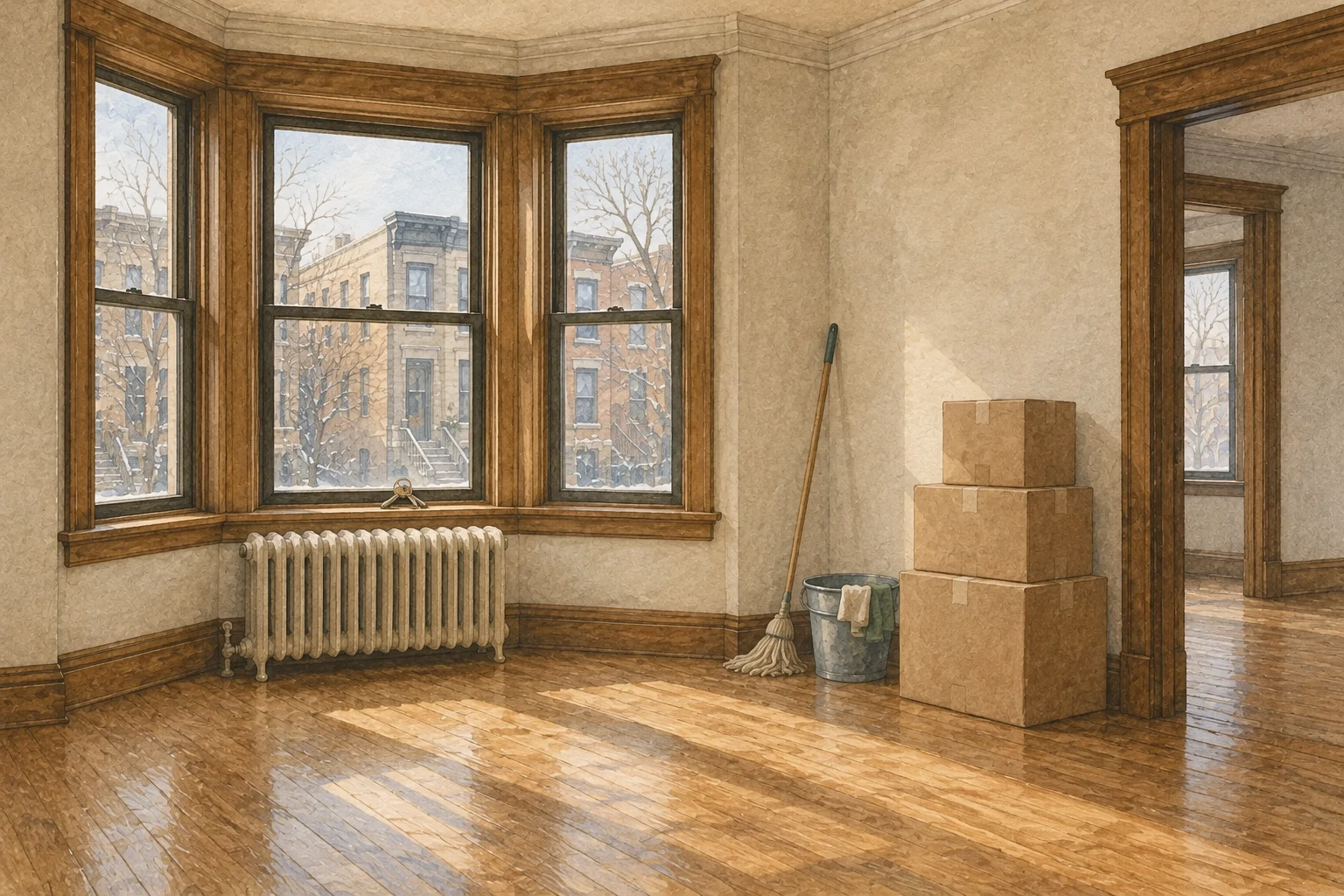
Leave the unit the way you found it, minus normal wear and tear, and you have done what a Chicago landlord can fairly ask. Under the city's Residential Landlord and Tenant Ordinance (RLTO), a landlord may deduct only two things from your security deposit: unpaid rent and a reasonable amount to repair damage you caused. If they deduct for damage, they owe you an itemized statement within 30 days of the day you vacate, and the rest of your deposit with interest within 45 days. Below are the deadlines, a Chicago move-out cleaning checklist you can work through room by room, and a way to document the handover.
One thing up front: Hometress does not take Chicago bookings yet. Chicago is on a waitlist, so nothing here is a Chicago quote. What we can offer is our published move-out checklist and prices, which work as a yardstick whether you clean the place yourself or hire someone.
What a Chicago landlord can deduct, and when the money is due
Security deposits fall under sections 5-12-080 and 5-12-081 of the Chicago Municipal Code. The City's own RLTO summary lays out the clock, and it is shorter than most tenants expect.
| When | What the ordinance requires |
|---|---|
| Day 0 | You vacate the unit. Both clocks below start from this date. |
| Within 30 days | If the landlord is deducting for damage, they must deliver or mail an itemized statement of the damage with the estimated or actual cost to repair or replace each item. If the statement uses estimates, the landlord has 30 more days to send paid receipts, or a certification of actual cost if their own employees did the work. |
| Within 45 days | The landlord returns the deposit and the required interest, minus unpaid rent and any damage deductions. |
| If the rules are not followed | The tenant is awarded damages equal to two times the security deposit plus interest, according to the City's summary. |
"Damage" here means damage caused by you, by anyone under your control or by anyone on the premises with your consent, and the repair cost has to be reasonable. Normal wear is excluded by name. Each deduction has to show up as a line item with its cost.
Interest is paid each year on deposits held more than six months, at a rate the City Comptroller sets. For 2026 it is 0.01%. As an illustration, a $1,500 deposit earns $1,500 × 0.01% = $0.15 in a year. The interest is small; the deadlines are what matter.
Is a cleaning charge a valid deduction?
The sources disagree, so here is what each says. The ordinance names two deductions: unpaid rent, and a reasonable amount to repair damage, "reasonable wear and tear excluded." Cleaning is not listed by name. Brabender Law, a Chicago law firm, writes that cleaning fees are not a valid deduction unless the cleaning is needed to fix actual damage beyond normal wear and tear. Illinois Legal Aid says that if a tenant leaves the property in disrepair, the landlord may use the deposit to clean the apartment, fix damage and replace broken parts.
Both can be true. Ordinary dust and a lived-in kitchen are wear and tear. Baked-on oven grease, a tub coated in mold or a unit left full of trash is where a landlord can argue the condition amounts to damage. The practical answer is to leave the place clean and photograph it, so the question never comes up. This is general information from public sources, not legal advice.
What to check when the statement arrives
- The date. Count 30 days from the day you vacated and note when the statement was mailed or delivered.
- The line items. The ordinance asks for each damaged item and a cost to repair or replace it, so a single lump sum for "cleaning and repairs" does not fit that description.
- The receipts. The City's summary says paid receipts are attached. If the costs are estimates, receipts or a certification of actual cost are due 30 days later.
- Your photos. Match each charge to what you photographed on handover day. A charge for something your photos show clean is worth disputing in writing.
- Wear and tear. Paint faded over a long tenancy is the kind of charge the wear-and-tear exclusion exists for.
Which rentals the ordinance covers
The City's summary lists what the RLTO does not cover, including units in owner-occupied buildings with six or fewer units and owner-occupied co-ops and condominiums. If your landlord lives in your two-flat, check which rules apply before you rely on the dates above. The summary also says lease terms that conflict with the applicable parts of the RLTO are unenforceable, so a lease clause is not the last word.
A change may be coming
On June 29, 2026, the mayor and the Department of Housing introduced the Protecting Renters Ordinance, a modernization of the RLTO that the City says bans hidden junk fees. We have not confirmed that it has passed. Check chicago.gov for the current text before you rely on any figure here.
The Chicago move-out cleaning checklist
Your benchmark is the condition you received, so pull out your move-in photos or inspection sheet first. For a professional standard, our Move checklist has 60 points: the 50 in a Deep clean plus ten move-clean extras. Three of those ten are worth planning around: the inside of the oven, the inside of the refrigerator and the inside of the cabinets, the last two emptied beforehand. The full list is on our Move cleaning checklist, and what each tier adds shows how it builds on the others.
Kitchen
- Oven: racks out, interior and exterior degreased, door glass wiped.
- Stovetop: burners, drip pans and surround scrubbed.
- Refrigerator and freezer: emptied, shelves and drawers washed, door seals wiped.
- Inside cabinets and drawers: emptied and wiped.
- Countertops, sink and faucet scrubbed; dishwasher interior and filter checked.
- Microwave inside and out.
Bathrooms
- Toilet, including the base and behind it.
- Tub or shower: soap scum, grout and any glass door tracks.
- Sink, vanity top, mirror and the inside of the cabinet.
- Exhaust fan cover and floor corners.
Bedrooms and living areas
- Closets emptied; shelves and rods wiped.
- Baseboards spot-cleaned, plus interior doors and light switches.
- Interior windows and sills.
- Floors vacuumed or mopped edge to edge, including under where furniture stood.
- Everything of yours out. Leftover belongings or trash give a landlord an easy line item.
Chicago-specific spots
- If you have radiators, wipe the fins and the wall and floor behind and under them.
- Window tracks and sashes, where grit collects.
- The entry floor, stairwell and back porch landing, where winter salt leaves a white film.
- Laundry and basement storage areas cleared and swept.
Work from the top down and finish with the floors. Dust ceiling fans, vents and light fixtures first, then cabinets and appliances, then counters and sinks, then bathrooms, and vacuum and mop last, backing out of each room so you do not walk on a finished floor. Start the oven before anything else in the kitchen, because the cleaning product needs time to sit while you move on.
If you are short on time, protect the jobs that show the most: the oven, the refrigerator, the bathrooms and the floors. If you hire for only part of the move-out, hand off the oven, the refrigerator and the cabinets, which need emptying or soak time before they can be wiped.
A four-week timeline for a Chicago move-out
| When | What to do |
|---|---|
| 4 weeks out | Find your move-in photos and your lease's cleaning and deposit language. Confirm whether the RLTO covers your unit. Decide whether you will clean or hire. |
| 2 weeks out | If hiring, book now. Ask your landlord in writing what condition they expect and whether they will do a walk-through with you. |
| Moving day | Clean after the last box is out. Anything done earlier gets dirty again. |
| Handover | Take your photos, return the keys, and email your landlord the date you vacated and your forwarding address. That date starts both clocks. |
| Day 30 | The landlord's deadline for an itemized statement if they are deducting for damage. |
| Day 45 | The landlord's deadline to return the deposit and interest. |
If either date passes without word from your landlord, take your dated photos and your move-out email to a tenant-rights organization or an attorney. The two-times-deposit remedy is real, but it is yours to pursue.
How to document the handover
Photograph in daylight with the lights on, after the last bit of cleaning. Shoot these, in this order:
- A wide shot of each room from the doorway.
- The oven with the door open and the racks out.
- The open refrigerator and freezer.
- Inside the kitchen cabinets and drawers.
- The tub or shower, the toilet and the bathroom floor.
- Every closet, plus the radiators, window tracks and baseboards.
- The floors from a low angle, so streaks and scuffs show.
Keep the original files rather than edited copies, and email them to yourself and your landlord the same day so the timestamps are on record. Line them up against your move-in photos. If you hired a cleaner, keep the receipt and the checklist they worked from. If your landlord will not do a walk-through, say so in the same email.
Do it yourself or hire someone: what it costs
Doing it yourself costs supplies and time you may not have in a move week. Hiring costs money. For a Chicago yardstick, here is what one Chicago company, Fresh Tech Maids, publishes for 2026, next to our published Move prices.
| Home | Fresh Tech Maids, Chicago | Hometress published Move price |
|---|---|---|
| Studio | $150 to $220 | $335 |
| 1 bed, 1 bath | $180 to $250 | $340 |
| 2 bed, 1 bath | $220 to $350 | $350 |
| 3 bed, 2 bath, Cozy size | $300 to $450 | $375 |
OCD Cleaning Chicago lists $150 to $250 for studios and $300 to $600 for larger units. Our Move prices are one-time, before tax, from the published catalog our booking uses in Philadelphia today; Chicago prices are not published. They run higher than these ranges for a studio or a one-bedroom and land inside them at two and three bedrooms. We would rather say so than pretend otherwise.
The better question is what the quote covers. Before you hire anyone, us included, ask:
- Is the price flat for the home, or hourly? If hourly, how many hours do they expect for your unit?
- Are supplies and equipment included?
- Does it cover the inside of the oven, the refrigerator and the cabinets? A quote that skips them is pricing a lighter clean than the checklist above.
- Are interior windows and doors, baseboards and any basement or storage space included?
- What happens if you are unhappy after the visit, and how long do you have to say so?
- How will the cleaner get in, and what is the fee if they cannot?
Our cost guide shows the full price for any home size, and the same questions apply to us.
Where Hometress fits for a Chicago move-out
We cannot book you in Chicago today, but you can join the Chicago waitlist. Until then, use the checklist above to judge any quote. If you do hire a cleaner, inspect the same day. Our White Glove Guarantee asks you to tell us within 48 hours of a visit; after a review, the remedy is generally a free re-clean of the areas in question, or a partial or full credit or refund. Hometress cleaners are background-checked and supplies are included. We have written the same guide for Seattle and Philadelphia.
Frequently asked questions
Do I need to hire a professional cleaner to get my deposit back in Chicago?
No. The RLTO does not require professional cleaning; it limits deductions to unpaid rent and damage beyond normal wear and tear. A lease that demands professional cleaning may say otherwise, and the City says conflicting lease terms are unenforceable. Whether a particular clause conflicts is a question for a tenant-rights organization or an attorney.
Can my Chicago landlord charge a cleaning fee?
The ordinance does not list one, and some Chicago law firms read it narrowly, while other sources say a landlord may use the deposit to clean a unit left in disrepair. Leave it clean and photograph it.
What counts as normal wear and tear?
Section 5-12-080 excludes reasonable wear and tear without listing examples. The test is whether the condition comes from ordinary use over the length of your tenancy or from something you or a guest did. Paint faded over years is wear; a hole in a door is damage. Dirt that wipes off is neither, which is why leaving the unit clean takes the argument away.
How long does a landlord have to return my security deposit?
45 days from the date you vacate, with interest. If they deduct for damage, the itemized statement is due within 30 days. The City's summary adds a seven-day deadline after a fire.
Do I get interest on my deposit?
Yes, if it was held more than six months. The 2026 rate is 0.01%, so expect cents rather than dollars.
Should I clean before or after the movers?
After. Clean once, after the last box leaves, so the photos you take show the unit as you hand it over.
What if my move date changes?
Cleaning dates move with it. With Hometress, rescheduling and cancellation terms are on our customer policy page; with any company, ask what notice they need. Your deposit clocks start when you vacate, not on the lease end date.
Does Hometress clean in Chicago?
Not yet. Join the Chicago waitlist and keep the checklist above handy.