
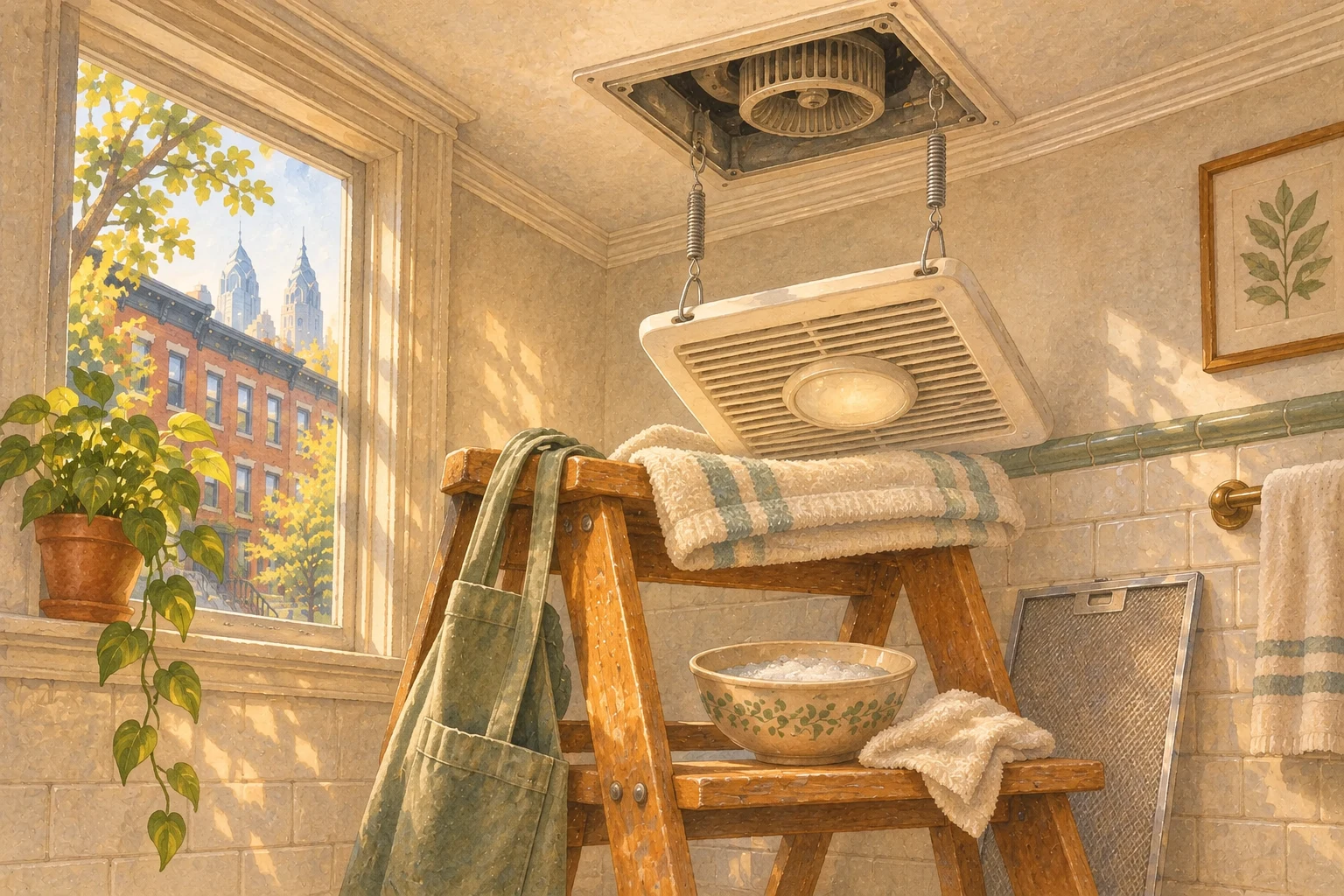
The Standard checklist has three lines about vents, and each starts with the same verb: “Dust Accessible Vent Covers (up to 9ft)” under Bathroom, the same words under Bedroom, and “Dust Kitchen Vent Covers (up to 9ft)” under Kitchen. The companies that make bathroom fans and range hoods use different verbs. Their own instructions say to take the grille or filter off and wash it, with the power off first.
Below is a one-page card for that gap, with two fictional visits. It is a suggested personal record for independent cleaners, not a Hometress requirement, training standard or app feature, and it does not tell you to remove a grille or to leave one in place. The rules come from the makers’ own documents, read November 2, 2026: Broan-NuTone’s Model 750 installation guide and Models 763 and 763N guide, Panasonic’s WhisperCeiling DC series installation instructions and a copy of its FV-0511VQ1 instructions, and two Broan-NuTone range hood manuals, the BCSQ1 range hood manual and the ALT1 and ALT2 manual. That is a few models from two makers, not every fan and not every hood, and this guide does not claim otherwise. The task lines come from Hometress’s published cleaning checklist.
The short answer
- The sheet’s verb is dust. In the documents above, the cleaning instructions for a fan grille are to remove it and wash it, after the power is off. None of the pages I read describes dusting the face of a grille.
- All six documents tie cleaning to the power. Broan’s two fan guides say to “lock out service panel” before cleaning; Panasonic’s two booklets say to disconnect the power source before working on the unit; and each of the six prints a safety line to switch power off at the service panel and lock the disconnecting means before servicing or cleaning.
- Each maker sets its own water limit: Broan’s Model 750 guide says a wood-framed grille “should not be immersed”; Panasonic says not to put its grille into hot water and to dry it after.
- A range-hood grease filter is not dusted in the Broan hood manuals. They say to clean it in a warm dishwashing detergent solution, and that it is dishwasher safe.
- The sheet does not say which kind of vent a bedroom or kitchen “vent cover” is. When you cannot tell, write that you could not tell, and ask the client.
What the sheet says and what it leaves open
Hometress’s published Standard list has the three lines above, and Deep, Move and Dream Home build on Standard, so every tier carries them. Dream Home also lists “Clean Outlets, Switches, And Vents”. No line says wash, remove, unscrew, or filter. None says what a vent cover is made of, whether it sits over a fan, a heating-and-cooling register or a hood, or what to use on it.
The “(up to 9ft)” in each line is a reach limit, and our reach guide covers that part: where the vent cover is, and whether a two-step stool gets you to it. This card is the other half, what the cover is and what its maker says to do. For the same habit across other lines, see the surface-by-surface check and the appliance-finish lookup.
The sources, and what they are
Broan-NuTone’s Model 750 installation guide has a “Use and care” section with relamping and cleaning steps; it shows no date. The Models 763 and 763N guide covers a fan and light combination, with separate steps for the lens and grille and for the fan assembly; it also shows no date. Panasonic’s WhisperCeiling DC series installation instructions covers the models FV-0511VQL1, FV-1115VQL1 and FV-0511VQCL1, and the copy of the FV-0511VQ1 instructions covers FV-0511VQ1, FV-1115VQ1 and the VQC1 sensor model; both are marked Panasonic Corporation 2017, and the cleaning precautions quoted below appear in both; only the FV-0511VQ1 copy prints the grille-removal step. The two Broan-NuTone range hood manuals each have a “Cleaning and Maintenance” section on page 6. The hood manuals are not bathroom-fan documents, and the fan documents say nothing about a hood.
Who says what
| Step | Broan-NuTone fan guides (750; 763 and 763N) | Panasonic fan booklets (DC series; FV-0511VQ1) | Broan-NuTone range hoods (BCSQ1; ALT1 and ALT2) |
|---|---|---|---|
| Before touching it | Model 750: “DISCONNECT ELECTRICAL POWER SUPPLY AND LOCK OUT SERVICE PANEL BEFORE RELAMPING, CLEANING, OR SERVICING THIS UNIT.” Models 763 and 763N print the same sentence without “relamping”. | “Disconnect power source before working on unit.” The safety page also says: “Before servicing or cleaning unit, switch power off at service panel and lock the service disconnecting means”. | “Before servicing or cleaning unit, switch power off at service panel and lock the service disconnecting means to prevent power from being switched on accidentally.” |
| Taking it off | Model 750: “Pull grille assembly away from ceiling.” Squeeze the grille assembly’s mounting springs together to remove it. Models 763 and 763N: remove the light lens and bulb, then the nut in the center of the reflector, and lower the assembly. | The DC booklet calls the grille “a spring-loaded, quick remove type”. The FV-0511VQ1 copy: “Remove grille by pulling down one mounting spring”. | The cleaning sections cover the grease filters, not a fan grille. Where the BCSQ1 install steps take a filter out: “Using the tab, remove the grease filters from the hood by pushing down and tilting filters out.” |
| Washing it | Model 750: “Clean grille and lens assembly using a mild soap and water solution.” Models 763 and 763N: “Plastic parts can be cleaned with mild, soapy water” and dried with a soft cloth. | “Clean grille. (Don’t put into hot water. Use non-abrasive kitchen detergent, wipe dry with clean cloth)” | Grease filters: “Use a warm dishwashing detergent solution.” “Grease filters are dishwasher safe.” |
| What not to use or do | Model 750: “Assemblies with wood frames should not be immersed.” Models 763 and 763N: “Do not use abrasive cloth, steel wool pads, or scouring powders.” | “Do not soak resin parts in water over 140°F (60°C).” “Never use gasoline, benzene, thinner or any other such chemicals for cleaning the ventilating fan.” | “Clean all-metal filters in the dishwasher using a non-phosphate detergent.” The manuals say phosphate detergents or local water conditions may discolor the filters and that this “is not covered by the warranty”. |
| Sensors and electrics | Models 763 and 763N: “METAL AND ELECTRICAL PARTS SHOULD NEVER BE IMMERSED IN WATER.” Their grille and reflector are separate units, and the light is unplugged first. | “Do not use cleaning sprays, solvents, or water on or near the sensors.” “Do not immerse motor in water when cleaning.” | No sensor or immersion rule in the cleaning sections I read. |
| Drying and the fan body | Models 763 and 763N: “Gently vacuum fan, motor and interior of housing.” Model 750: put the assembly back flat against the ceiling after cleaning. | “The grille should be dry after cleaning.” “Remove dust and dirt from fan body using a vacuum cleaner.” Then a cloth dampened with kitchen detergent on the fan body, wiped dry. | Not on the pages I read for the filters. |
| How often | No interval printed on the pages I read. | “Routine maintenance must be done every year. Please wear gloves during the cleaning work.” | Grease filters: “cleaned frequently”. Non-ducted recirculation filters: “changed every 3 to 6 months”. |
Where a cell says it is not on the pages I read, that is a statement about the documents above, not about the maker’s other documents. The capitals in the Broan fan quotations are the guides’ own.
Where the makers differ
The power rule is the one point all six share. Each prints a line to switch power off at the service panel and lock the service disconnecting means before servicing or cleaning, and the Broan fan guides repeat it in capitals at the cleaning step. None of the pages I read describes dusting the face of a grille from a stool; the fan documents describe taking it off.
Water is where each sets its own limit. Broan’s Model 750 guide uses a mild soap and water solution and singles out wood frames, which should not be immersed. Panasonic says no hot water and to use a non-abrasive kitchen detergent, and to dry the grille. Broan’s Models 763 and 763N guide is about plastic parts and says to dry them with a soft cloth. Of the fan documents, only Panasonic’s give an interval, yearly. Panasonic’s maintenance block, which covers a sensor model, adds a rule of its own: no cleaning sprays, solvents or water on or near the sensors.
These are different limits for different models and materials, not a disagreement over one fan. Each is the rule for that maker’s fan. A bathroom fan of unknown make has no rule on this page.
The kitchen line is a different part
The kitchen line says “Dust Kitchen Vent Covers (up to 9ft)”. The sheet does not say whether that means a grille on a ceiling fan, a register on a wall or ceiling, or the filter on a range hood. The Broan range hood manuals above treat the hood filter as something that is washed, not dusted: a warm dishwashing detergent solution, or the dishwasher with a non-phosphate detergent, and a hand wash with a mild detergent to minimize discoloration. A hood’s filter sits at the cooktop, and whether it falls inside a line with “(up to 9ft)” in it is a question for the client, not something these manuals answer.
The hood manuals also say something about the outside of a hood that the appliance-finish lookup already covers: “Any cleaners that contain bleach will attack stainless steel.” This guide does not repeat that table.
The card
Copy this into a note, one card per vent. Work down the rows in order; the right-hand column is what to do when you cannot fill a row in.
| Field | What to write | If you cannot fill it in |
|---|---|---|
| 1. Line and room | The sheet line (“Dust Accessible Vent Covers (up to 9ft)” or “Dust Kitchen Vent Covers (up to 9ft)”), the room it is under and where the cover sits. | The sheet does not say how many vents that is. Write what you found. |
| 2. What kind of vent | Fan grille with a light or a lens, plain fan grille, heating-and-cooling register, or range-hood filter, and whether you know from a label, the client’s note or only by looking. | Write “unconfirmed”. |
| 3. Maker and page | The maker’s name and model from the label or the client’s note, and which of the pages above you followed. | Write “maker unconfirmed”. No maker page above covers a heating-and-cooling register, so write that you followed none. |
| 4. What the visit covered | “Dusted the face from the stool” or “removed and washed”. The sheet’s verb is dust. | If you only dusted, write only that. |
| 5. Power | If a maker page above says to lock out the service panel first, write whether the client confirmed that the power was off at the panel and who did it. | Cannot confirm: write “power unconfirmed”. |
| 6. Water and product | What you put on it, by name, and whether the maker page above allows water: Panasonic says no hot water and dry the grille; Broan’s 750 guide says a wood frame should not be immersed. | Write “none”, or what you used. |
| 7. Sensors | Whether the grille has a sensor on it. Panasonic’s booklets say no cleaning sprays, solvents or water on or near the sensors. | Cannot tell: write “sensor unconfirmed” and what, if anything, you applied. |
| 8. Dry and put back | That the grille was dry and seated against the ceiling. Panasonic: “The grille should be dry after cleaning.” | Not dry and you had to leave: write that, and that the grille is off. |
| 9. Ask the client | A cover that will not come off, a hood filter that is greasy, a fan that rattles, or a vent you could not identify. | Tell the client and write what you left. |
What the sheet does not define
It does not define a vent, a cover, a method, a product or a time. The card above is the habit that fills the gap: write what you did, which maker’s page you followed and what you left. The same habit is in our final walkthrough scope check.
Two fictional visits
These visits are fictional. The fans and the hood belong to no real client, and none of the makers has endorsed the card. The circumstances are invented; what a page says and what is our suggestion are marked separately.
A bathroom fan with a light and a dusty grille
Room and line: Bathroom, “Dust Accessible Vent Covers (up to 9ft)”. Type: a ceiling fan with a lens, a Broan-NuTone Model 750 by the client’s note, which is a model the guide above covers. Maker and page: the label on the housing reads Broan-NuTone, so you follow its guide. The guide’s warning puts the lockout at the service panel before cleaning, and the client’s note does not say whether the power is off. In this visit the cleaner dusts the face from the stool, which is the sheet’s verb, and the grille is not taken down. Row 4 reads “dusted the face from the stool; grille not removed; power at the panel unconfirmed”. The cleaner tells the client what the guide says.
A kitchen “vent cover” that is a hood filter
Room and line: Kitchen, “Dust Kitchen Vent Covers (up to 9ft)”. Type: a range-hood grease filter, by the client’s note, behind a stainless hood marked Broan-NuTone, series BCSQ1. The BCSQ1 manual says the grease filters should be cleaned frequently in a warm dishwashing detergent solution, and that they are dishwasher safe. The sheet’s verb is dust and the manual’s is clean. In this visit the cleaner asks the client what the line means here, and row 4 reads “asked the client: filter left for them”. The filter is greasy and you write that.
What this guide leaves out
It recommends no brand, product or price. It does not say whether you should remove a grille. It does not cover heating-and-cooling registers, which no page above covers, or any other maker’s fan or hood, and it prints no interval for the client. It gives no advice of its own on who is responsible if a part is damaged, on a warranty, or on the building’s wiring; the hood manuals’ warranty sentence above is the maker’s. It does not cover pay. The lockout wording above is the makers’ printed text.
Where a platform fits
Hometress is a cleaning marketplace in Philadelphia. It is free to join, and cleaners carry their own insurance. If writing down which maker’s page you followed is how you already work, the application takes about five minutes.