
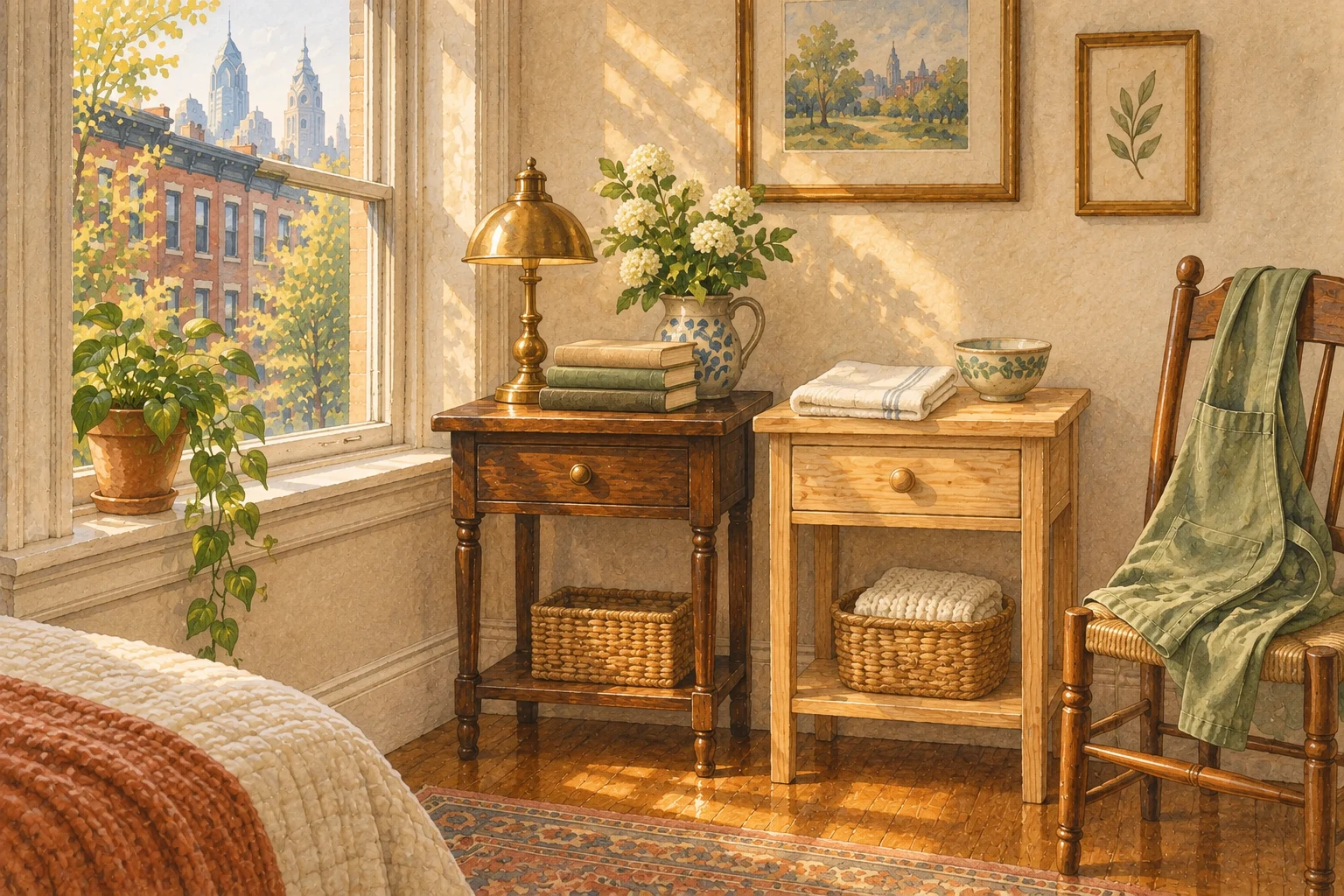
The booking says “Dust & Clean Countertop / Bedside Table”. You are in a bedroom you have never seen, in front of a wooden table with a lamp on it. The line names two surfaces and two verbs, and it names no wood, finish, cloth, water or polish.
Below is a one-page card for that decision, with two fictional visits. It is a suggested personal record for independent cleaners, not a Hometress requirement, training standard or app feature, and it does not tell you which cloth to put on a table. The pages come from four furniture makers, Ethan Allen, Stickley, Bassett and IKEA, five documents in all, and were read November 2, 2026. That is four makers, not every table in every bedroom, and this guide does not claim otherwise. The task lines come from our published cleaning checklist.
The short answer
- Three of the five documents use a damp cloth on wood: Ethan Allen, Stickley’s blog and Bassett. Stickley’s guide mists water onto the furniture and wipes it dry, and IKEA says dry for pine and damp, then dry, for oak and beech.
- The dry cloth is where two pages collide. Stickley’s blog says “Never use a completely dry cloth as this can actually scratch the finish.” IKEA says “Most wooden furniture can simply be cleaned with a dry cloth or duster”.
- None of the five prints polish as a dusting step, and Ethan Allen and Bassett each caution against some polishes.
- This comparison does not cover veneer, laminate or a painted top.
- Ours, not theirs: the card records which top, which page, what touched it and what you left. It sets no method.
What the sheet says and what it leaves open
Hometress’s published Standard list has one Bedroom line, “Dust & Clean Countertop / Bedside Table”, and Deep, Move and Dream Home inherit it. It sits next to “Dust & Clean Upholstered Furniture”, a different material, so this card covers hard tops only. Kitchen has its own “Dust & Clean Countertop” line, which this card does not cover. The verbs are dust and clean.
The sheet does not say wood, finish, cloth, water or polish, and it does not say which surface counts as a bedside table or a bedroom countertop. Our picture-frames-and-glass card takes the “Dust Room Decorations & Picture Frames (up to 9ft)” line, our blinds-and-mirrors card takes the spray-or-cloth choice on other bedroom lines, and our countertop-material card looks at countertop materials. This card does not repeat them.
Five documents, four makers
Ethan Allen’s “Use & Care” PDF says “All information is current as of February 1, 2025”. Stickley has two pages: a blog post, “Caring for Craftsman Furniture: A Short Guide” (January 23, 2024), and a “Furniture Care Guide” page with no date in the text I read. Bassett’s “How to Care for Wood Furniture” blog post is marked “Updated 9/23/22”. IKEA’s “How to clean natural wood furniture” page is an English page on its Spanish site, with no date in the text I read.
Each page is about the maker’s own furniture. Stickley’s blog is about “traditional Craftsman furniture”, and IKEA’s page names pine, oak, beech and bamboo. Ethan Allen’s PDF says “we cannot guarantee the success of your results.” The table keeps each page in its own row.
| Document | Cloth | Water and soap | Polish, sprays and oils | Grain and other tops |
|---|---|---|---|---|
| Ethan Allen, Use & Care PDF (current as of February 1, 2025) | “Dust using a soft, clean, slightly damp white cloth such as a white cotton T-shirt or cotton diaper.” “Use a dry (preferably cotton) cloth, if necessary, to remove any moisture from the surface.” | To clean: a cloth “dampened with a solution of mild soap and water”, then one “dampened only with water to remove all soap residue”, then “a soft, dry cotton cloth to completely remove all moisture.” On scored tops: “carefully remove all moisture from the grooves”. | “we do not recommend the use of polishes that may change or damage the appearance of any item’s finish.” | Standard care names no grain direction. Glass top: “Clean with a damp cloth or glass cleaner”, and “do not allow glass cleaner overspray to come in contact with wood surfaces.” Metal top: “Dust with a clean cloth that has been moistened with water”; commercial metal cleaners are not recommended. |
| Stickley, “Caring for Craftsman Furniture” blog post (January 23, 2024) | “Use a slightly damp cloth (microfiber is great) to wipe down the surface.” “Never use a completely dry cloth as this can actually scratch the finish.” | “Distilled water is optimal for cleaning as it dries completely and will leave no scale or residue.” For general cleaning, “a tiny bit of dish soap and some warm water”, then wash away the soap residue and dry. | Never near the furniture: alcohol, acetone, bleach, ammonia, oil-based soaps and silicone. “All abrasive agents should also be avoided.” Lemon and orange oil: “Our advice is not to use them, or to be extremely sparing.” | No grain direction on the page. Written about “traditional Craftsman furniture”. |
| Stickley, Furniture Care Guide page (no date in the text read) | “Frequent dusting should be accomplished by means of water and a cloth to dry.” “Mist the water directly onto the furniture and wipe it dry with a cloth (never a sponge).” | “Water will not harm wood finishes when used like this.” “Never use oil soaps for frequent cleaning.” Its paragraph on Stickley’s own furniture dressing says “(never use soap or a sponge)”. | “Furniture polishes, oils, or waxes should not be used for dusting.” The page also offers Stickley’s own furniture dressing, “a paste wax” in its words, for its finishes. | “Always wipe in the direction of the wood grain not in a circular motion.” |
| Bassett, “How to Care for Wood Furniture” blog post (“Updated 9/23/22”) | “wipe down your furniture with a dampened cloth.” “Then wipe away any remaining moisture with a dry cloth.” “Use cotton, as synthetic fibers can cause surface scratches.” | For its Custom Dining and BenchMade collections, which carry a performance finish: a “100% cotton cloth slightly dampened with water and a mild dish detergent”, then wipe away the residue and follow with a dry cloth. | “avoiding wax-based polishes and polishes containing silicone.” | No grain direction on the page. |
| IKEA, “How to clean natural wood furniture” page (no date in the text read) | Pine: “use a dry cloth, as any moisture may mark or damage the wood, especially if it is untreated.” Oak and beech: “use a damp cloth and dry immediately with a dry cloth.” “Most wooden furniture can simply be cleaned with a dry cloth or duster; nothing else is required.” | No soap step on the page. | Ammonia is barred: “It damages the wood and removes its shine.” The page also offers IKEA’s own wood-treatment oil for a shinier finish on pine, oak and beech. | “always clean in the direction of the grain, using a soft cloth without rubbing or scratching.” |
Where a cell says something is not on a page, that is a statement about the pages I read, not about the makers’ other documents.
Where the pages do not line up
On the cloth, five documents give five instructions. Ethan Allen asks for a slightly damp white cloth and a dry one “if necessary”. Stickley’s blog asks for a slightly damp cloth and bars a completely dry one, and its guide has you mist water on and wipe it off. Bassett wipes damp, then dry. IKEA’s page has pine dusted dry and oak and beech damp, then dry. These are makers writing about their own finishes, and the pages do not give one answer for a table of unknown make.
The sharpest gap is the dry cloth. I do not claim either side is wrong: Stickley is writing about its own Craftsman pieces and IKEA about its own solid wood, and neither page covers the other’s. So whichever cloth a cleaner picks for a table of unknown make, one of these pages says otherwise for its own furniture.
On soap, Stickley’s blog allows “a tiny bit of dish soap” for general cleaning, while its guide’s dressing paragraph says “(never use soap or a sponge)” for dusting and cleanup. They may be about different jobs, so I do not call it a contradiction. Ethan Allen’s clean step uses mild soap and then a water-only wipe, Bassett’s mild detergent is for two named collections, and IKEA prints no soap step.
On polish, the pages are closer. Ethan Allen does not recommend polishes that may change a finish, Stickley’s guide keeps polish out of dusting, Bassett avoids wax-based and silicone polishes, and Stickley’s blog bars silicone and advises against lemon and orange oil, or sparing use. Stickley’s guide and IKEA’s page each also offer the maker’s own product for the finish, a dressing and an oil, and the card follows neither.
Where a page has a damp step on wood, Ethan Allen, Bassett, Stickley’s guide and IKEA’s oak and beech paragraph each print a dry-off (Ethan Allen’s is “if necessary”), and Stickley’s blog ties drying to its soap step. That is narrower than a method, so I do not offer one.
Tops that are not wood
Ethan Allen’s page has lines for two other tops on its own furniture: glass, cleaned with a damp cloth or glass cleaner, keeping overspray off any wood; and metal, dusted with a cloth moistened with water. This comparison covers no veneer, laminate or painted top, so for those the card has a row for “outside this comparison”. A bedside table is not a countertop, so the countertop-material card is a related read, not an answer.
The card
Copy this into a note, one card per table. Work down the rows in order; the right-hand column is what to write when you cannot fill a row in.
| Field | What to write | If you cannot fill it in |
|---|---|---|
| 1. Line and surface | The sheet line (“Dust & Clean Countertop / Bedside Table”) and which surface you dusted: a bedside table, a dresser top, another surface. | The sheet does not say which surface counts. Write what you did. |
| 2. Top as identified | Wood, glass, metal or another top, and how you know: a maker’s label, the client’s note, or only what you can see. | Write “finish unknown”. For veneer, laminate or a painted top, write “outside this comparison”. |
| 3. Page followed | Ethan Allen, Stickley (blog or guide), Bassett, IKEA or none, and that the page is about the maker’s own furniture. | Write “none”. No page above covers a table of unknown make. |
| 4. Top before | Dust, a white ring, a sticky film, a polish residue, scratches, and what stood on the top and went back. | Write what you saw. |
| 5. What touched it | The cloth (dry, slightly damp, water misted on) and whether any soap, spray or polish was used, and what dried it. | Write “dry cloth only” if that is what it was. |
| 6. Grain and moisture | Whether you wiped along the grain (Stickley’s guide and IKEA name it) and whether any moisture was left on a grooved top (Ethan Allen names grooves). | Write “not checked” and why. |
| 7. What was left | A mark, ring or sticky patch you did not chase, or a top you did not touch, and why. | Write “none left”. |
| 8. Ask the client | A top you cannot identify, a white ring or sticky film, or a request to polish or to use a product the client supplies. | Tell the client and write what you left. |
What to send when the finish is unknown
Two lines, ours, not from any page. First: “The top of the bedside table is a finish I cannot identify, and the care pages I have read disagree on cloth and water.” Second: “Is there a maker, a care label or a way you want it done? Until I hear, I will leave the top untouched and write that down.”
What the sheet does not define
It does not define a countertop, a bedside table, a finish, a method, a product or a time. The card is the habit that fills the gap: write what you saw, which page you followed and what you left. The same habit is in our final walkthrough scope check and our surface-by-surface check.
Two fictional visits
These visits are fictional. The bedrooms belong to no real client, and none of the makers has endorsed the card. The circumstances are invented; what a page says and what is our suggestion are marked separately.
A Standard visit, a table with a maker’s name
Line: Standard, “Dust & Clean Countertop / Bedside Table”. Surface: a bedside table; the client’s note says it is a Stickley piece, and the maker’s label is inside the drawer. Page followed: Stickley’s Furniture Care Guide, which is written for Stickley’s own furniture. What touched it: a cloth with water misted onto the top as the page prints, wiped dry with a second cloth along the grain, with no soap and no polish. I wrote the page, the cloth and the grain in rows 3, 5 and 6. The blog says “slightly damp cloth” and the guide says mist and wipe dry; I followed one page and recorded that it was the guide. Unresolved: nothing.
A Deep visit, a dark top with no label
Line: Deep, which inherits the Standard Bedroom line. Surface: a bedside table with a dark, glossy top, no label and no note from the client. A faint white ring sits near the lamp. Page followed: none, so “finish unknown” is in row 2 and “none” in row 3. What touched it: nothing. I left the top untouched and sent the two-line note above (ours). I did not chase the ring: I wrote it in rows 4 and 7 and asked about it in row 8. The card records what I did, not that it was right. Unresolved: the finish, and the ring.
What this guide leaves out
It recommends no brand, product or price: IKEA’s own wood-treatment oil and Stickley’s own furniture dressing appear only as the pages’ offers, and the card adopts neither. It covers no upholstered furniture, which has its own sheet line, and no veneer, laminate or painted top. It covers no maker other than the four, because no other maker’s page was read. It gives no repair or stain-removal steps, so the remedies for rings on some of these pages stay out. It gives no advice of its own on who is responsible if a finish is already damaged. It does not cover pay.
Where a platform fits
Hometress is a cleaning marketplace in Philadelphia. It is free to join, and cleaners carry their own insurance. If writing down which page you followed is how you already work, the application takes about five minutes. This guide does not cover pay.